Texas Revocation of Directive to Physicians and Family or Surrogates
What is this form?
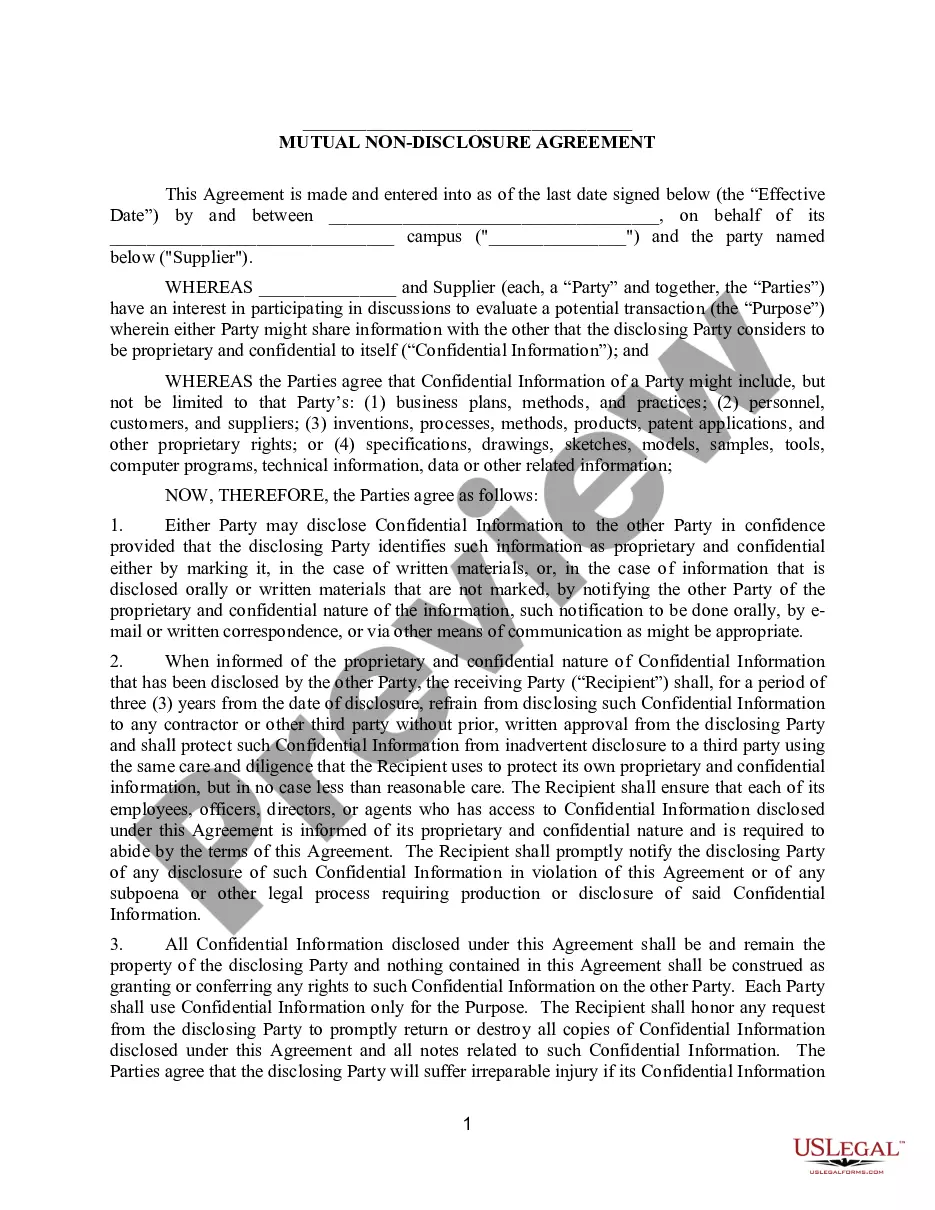
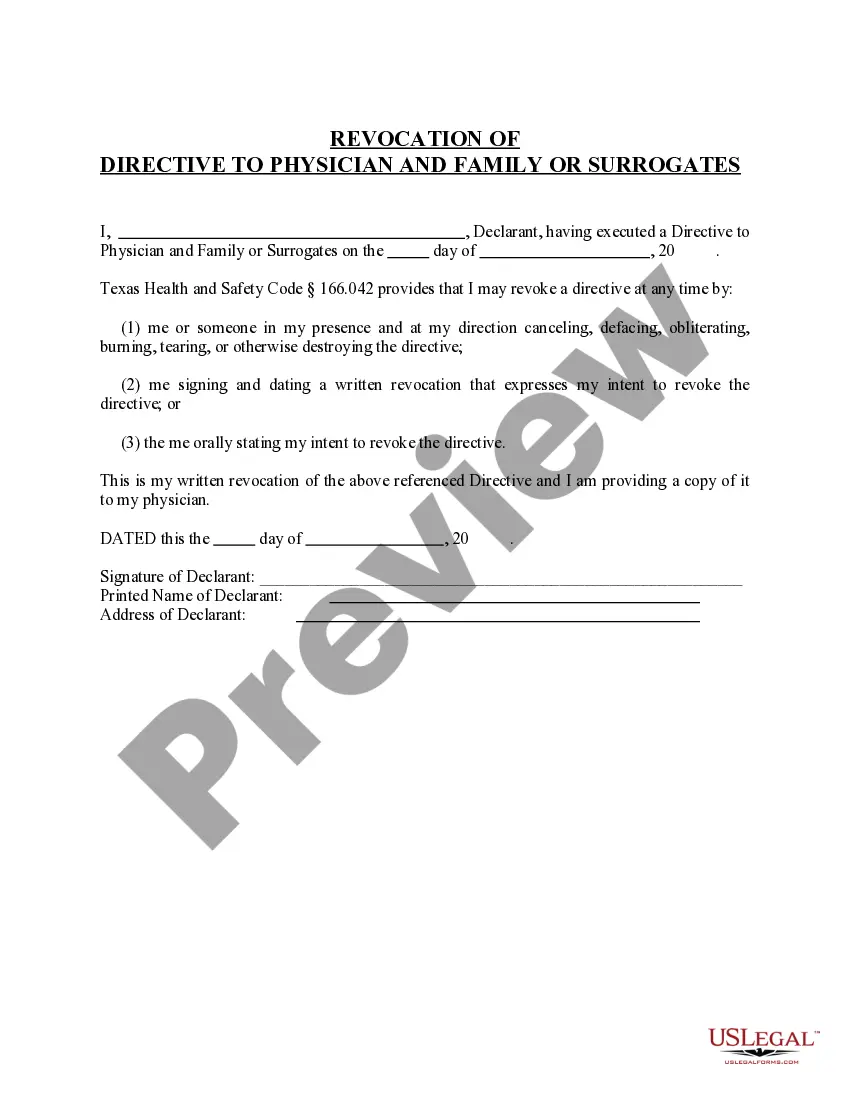
The Revocation of Directive to Physicians and Family or Surrogates is a legal form that allows individuals to communicate their intent to revoke a previous medical directive. This directive is important for those who have previously made decisions about their medical treatment in case they are unable to express their wishes in the future. By using this form, you are clearly stating that you no longer wish for the previous directive to be followed, which differs from merely altering or updating it.
Form components explained
- Statement of revocation expressing intent to revoke the previous directive.
- Information about the previous directive being revoked.
- Signature and date to confirm the revocation.
- Provision of a copy to the physician for proper documentation.
When this form is needed
This form should be used when you have made a prior medical directive and decide that you no longer wish for it to be in effect. Situations that may prompt this revocation include changes in your medical preferences, a change in your health condition, or a reassessment of your values and beliefs regarding medical treatment.
Who this form is for
This form is appropriate for anyone who has previously completed a medical directive and wishes to cancel it. Specifically, it is designed for:
- Individuals who have a medical directive they want to revoke.
- Patients anticipating changes in their health care preferences.
- Persons who want to ensure their current wishes regarding medical treatment are clearly communicated.
Completing this form step by step
- Identify the previous directive you are revoking.
- Sign and date the form to confirm your intention to revoke the directive.
- Provide a copy of the signed revocation form to your physician.
- Consider discussing with your physician to ensure they understand your current wishes.
Notarization guidance
Notarization is generally not required for this form. However, certain states or situations might demand it. You can complete notarization online through US Legal Forms, powered by Notarize, using a verified video call available anytime.
Get your form ready online
Our built-in tools help you complete, sign, share, and store your documents in one place.
Make edits, fill in missing information, and update formatting in US Legal Forms—just like you would in MS Word.
Download a copy, print it, send it by email, or mail it via USPS—whatever works best for your next step.
Sign and collect signatures with our SignNow integration. Send to multiple recipients, set reminders, and more. Go Premium to unlock E-Sign.
If this form requires notarization, complete it online through a secure video call—no need to meet a notary in person or wait for an appointment.
We protect your documents and personal data by following strict security and privacy standards.

Make edits, fill in missing information, and update formatting in US Legal Forms—just like you would in MS Word.

Download a copy, print it, send it by email, or mail it via USPS—whatever works best for your next step.

Sign and collect signatures with our SignNow integration. Send to multiple recipients, set reminders, and more. Go Premium to unlock E-Sign.

If this form requires notarization, complete it online through a secure video call—no need to meet a notary in person or wait for an appointment.

We protect your documents and personal data by following strict security and privacy standards.
Typical mistakes to avoid
- Not dating the form, which is essential to indicate when the revocation takes effect.
- Failing to provide a copy to the physician, which may lead to confusion regarding your current wishes.
- Not clearly identifying the previous directive that is being revoked.
Benefits of completing this form online
- Convenient access to a professionally drafted legal document.
- Edit and customize the form to fit your specific situation.
- Fast download options, allowing you to act quickly when needed.
Legal use & context
- Revoking a medical directive must be done in accordance with state laws to be enforceable.
- This form provides a clear and legal method to revoke your previous healthcare decisions.
Key takeaways
- This form allows you to revoke a previous medical directive legally.
- Signing and dating the form is essential for its validity.
- Providing a copy to your physician is crucial for effective communication of your wishes.
Looking for another form?
Form popularity
FAQ
Advance care directives are legally enforceable in NSW. Although NSW does not have specific legislation on advance care directives, the Supreme Court has said that valid advance care directives must be respected (as an extension to a person's right to determine their own medical treatment).
Advance Directives have an expiration date.Advance Directives do not expire, but can be invalidated if you create new Advance Directives. It is wise to review your Advance Directives periodically to be sure they still reflect your wishes.
In most cases, your health care documents will be honored in other states.Most states accept health care directives from other states as long as the documents are legally valid in the state where they were made -- but this is not always the case.
An advance directive, alone, may not be sufficient to stop all forms of life-saving treatment.You retain the right to override the decisions or your representative, change the terms of your living will or POA, or completely revoke an advance directive.
Note: Texas law now allows an option for a person's signature to be acknowledged by a notary instead of witness signatures and for digital or electronic signatures on the Directive to Physicians, Out-of-Hospital Do Not Resuscitate Order, and the Medical Power of Attorney, if certain requirements are met.
Overview: In Texas you must fill out two separate forms to have a complete Advance Directive: A Living Will called a "Directive to Physicians and Family or Surrogates" and a "Medical Power of Attorney" (a.k.a. Health Care Proxy).
Some states combine a declaration and a durable power of attorney into a single form, called an "advance health care directive."If someone disputes the validity of your health care directive, it may be challenged in court.
The law requires that you sign your advance directive, or direct another to sign it, in the presence of two adult witnesses, who must also sign the document.
A person can also revoke their Advance Directive orally, by telling their healthcare provider that they no longer want either the entire document or any parts of it enforced.