South Dakota Notice of Dispute by Corporation
About this form
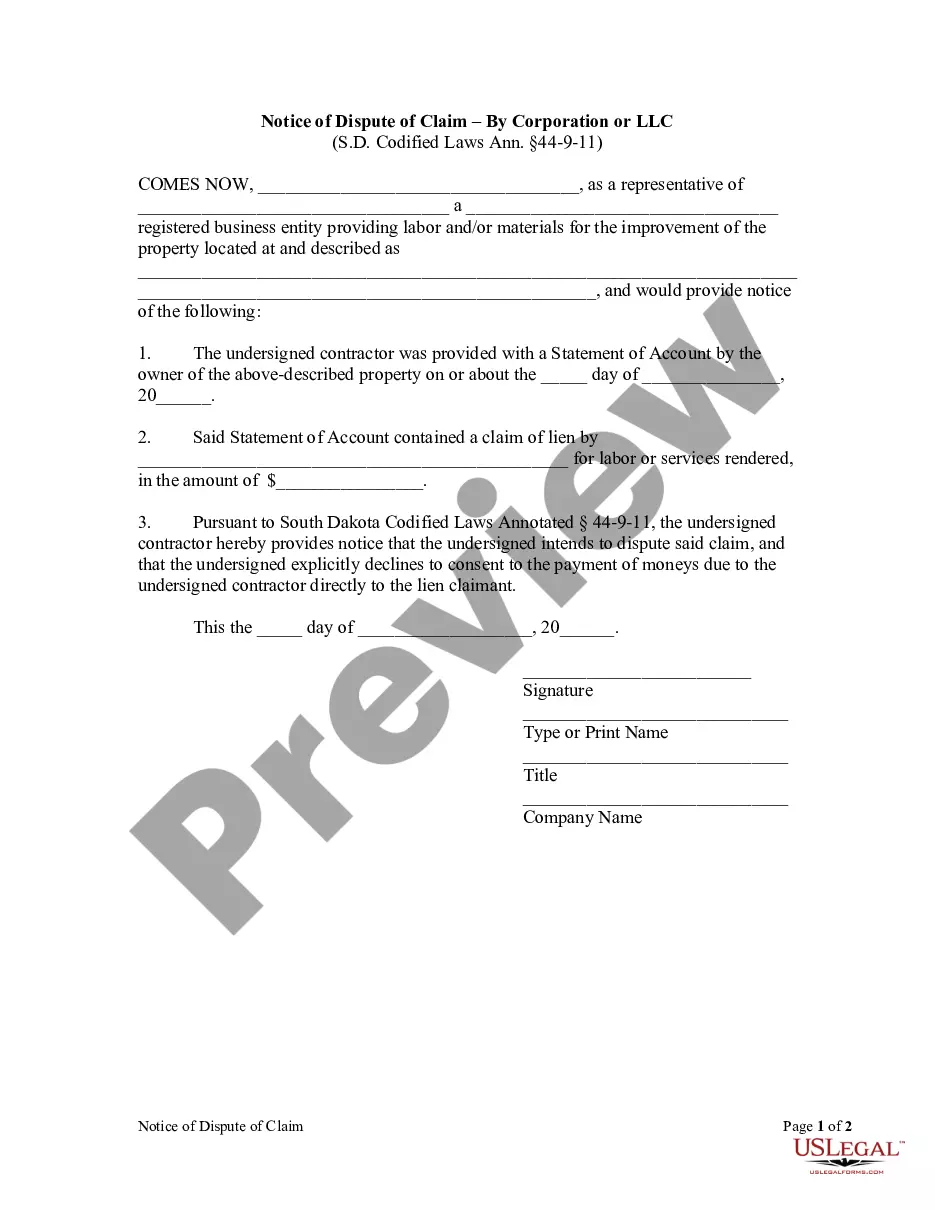
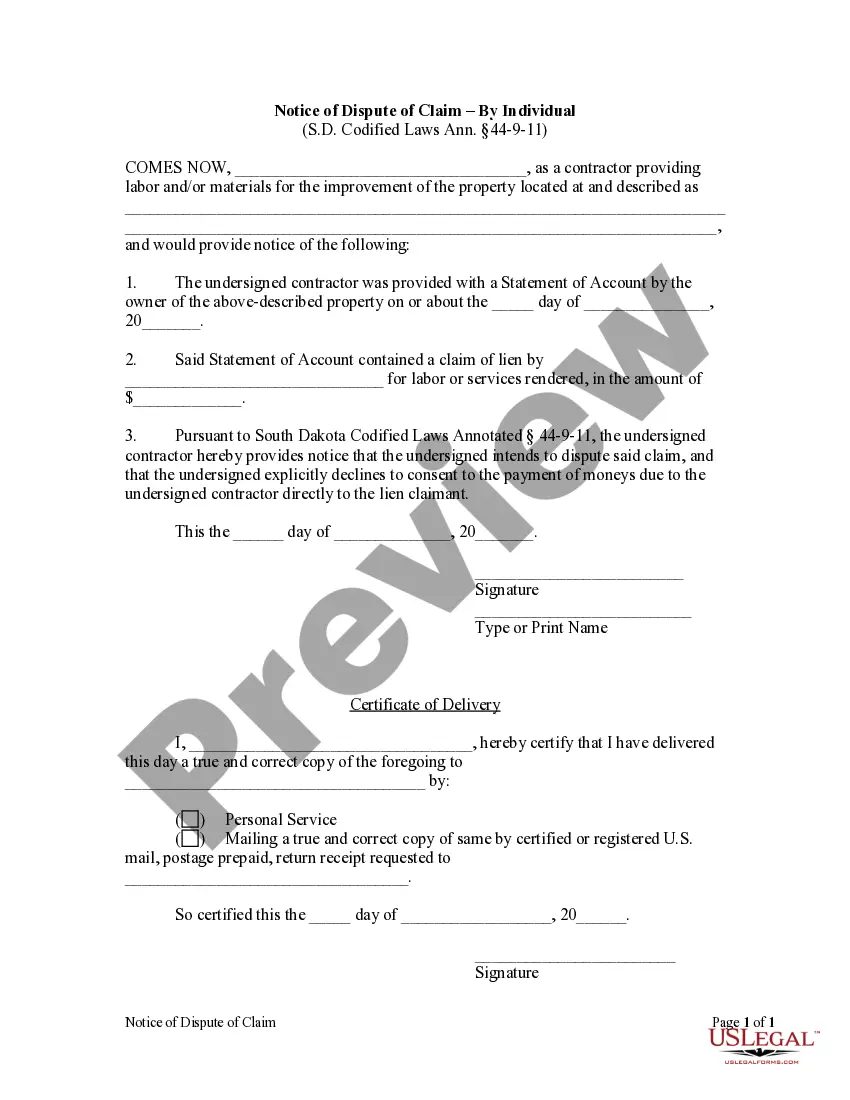
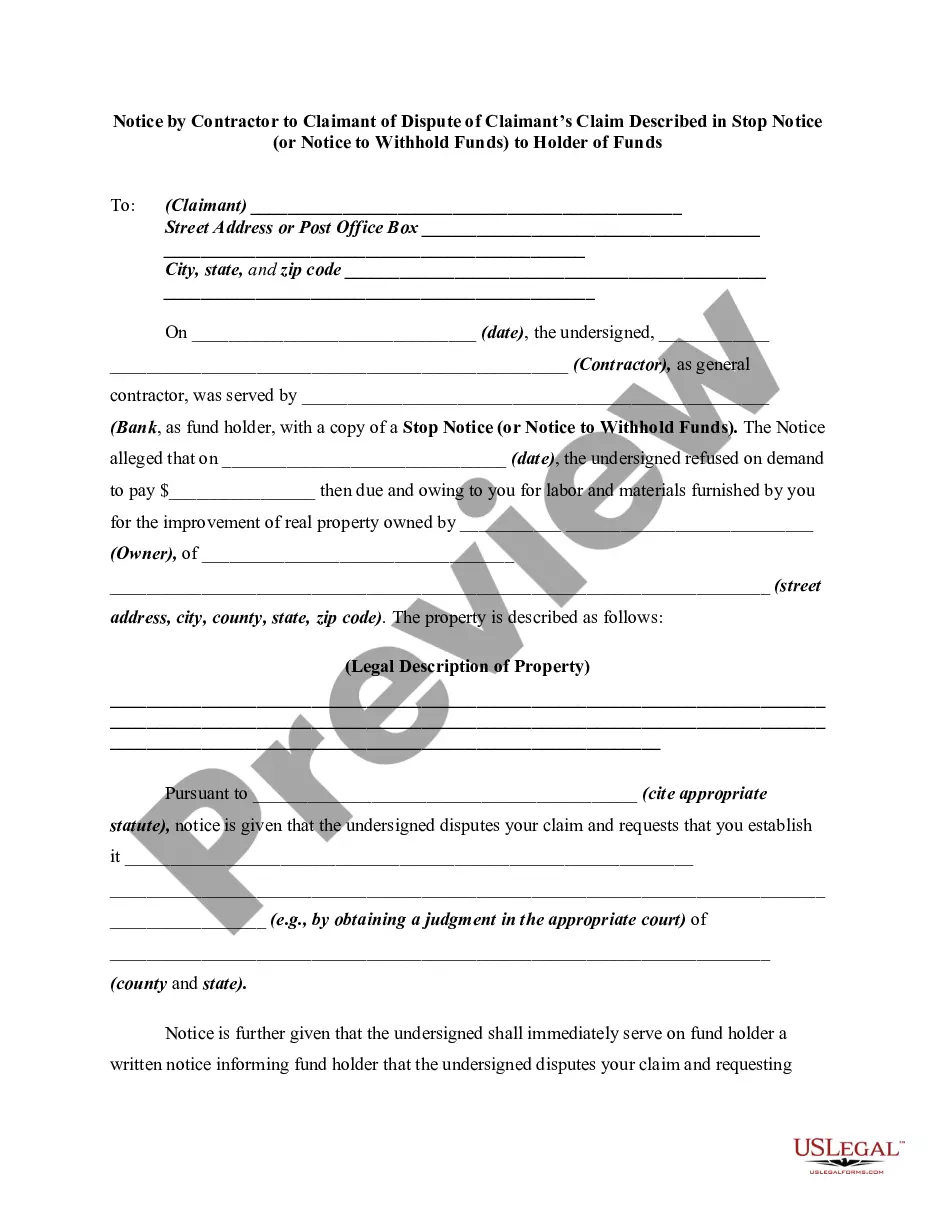
The Notice of Dispute by Corporation is a legal document that allows a contractor to formally dispute a claim made against them by a property owner or their agent. This form is essential in construction and improvement projects to protect contractors' rights when they do not agree with a claim of lien for unpaid labor or materials. Unlike other notices, this form specifically acknowledges the intention to dispute the stated claims, ensuring that the contractor does not inadvertently consent to payments directly to the lien claimant.
Key components of this form
- Identification of the corporation and its representative.
- Details of the property related to the dispute.
- Reference to the Statement of Account received from the owner.
- Explicit intention to dispute a lien claim.
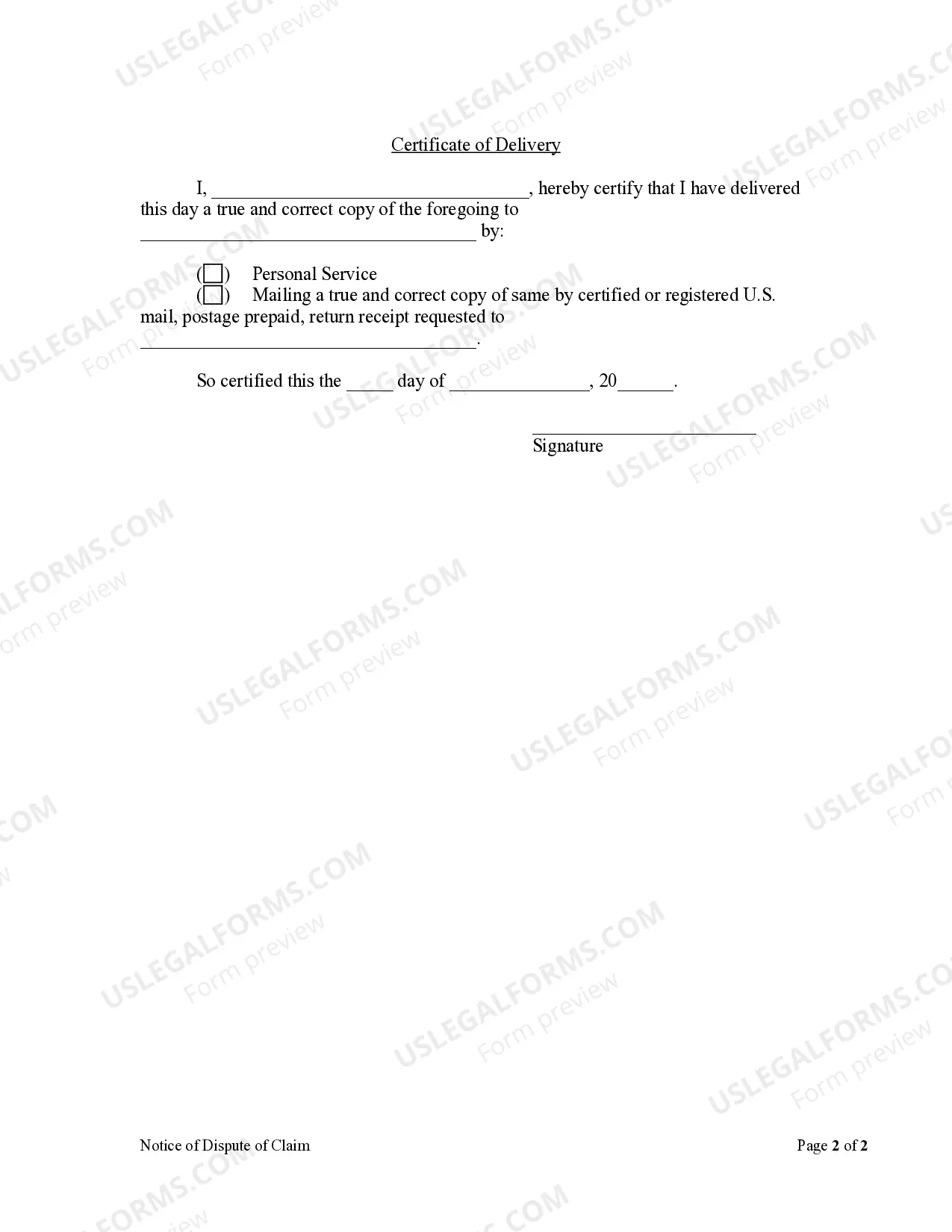
- Certification of delivery of the notice to the relevant parties.
When to use this document
This form should be used when a contractor receives a Statement of Account that includes a claim of lien from a property owner or agent. If the contractor intends to dispute this claim, they must file this notice within fifteen days of receiving the Statement of Account to assert their rights and avoid being deemed to have accepted the claim.
Who needs this form
- Contractors providing labor or materials for property improvements.
- Corporate representatives acting on behalf of a company in legal disputes.
- Any contractor who receives a claim of lien and wishes to contest it.
How to complete this form
- Enter the name of the representative and the corporation in the designated fields.
- Provide a complete description of the property relevant to the dispute.
- Fill in the date you received the Statement of Account.
- Specify the name of the claimant and the amount claimed.
- Sign and date the notice to complete it.
- Certify the delivery method of the notice to the other party.
Is notarization required?
This form usually doesn’t need to be notarized. However, local laws or specific transactions may require it. Our online notarization service, powered by Notarize, lets you complete it remotely through a secure video session, available 24/7.
Get your form ready online
Our built-in tools help you complete, sign, share, and store your documents in one place.
Make edits, fill in missing information, and update formatting in US Legal Forms—just like you would in MS Word.
Download a copy, print it, send it by email, or mail it via USPS—whatever works best for your next step.
Sign and collect signatures with our SignNow integration. Send to multiple recipients, set reminders, and more. Go Premium to unlock E-Sign.
If this form requires notarization, complete it online through a secure video call—no need to meet a notary in person or wait for an appointment.
We protect your documents and personal data by following strict security and privacy standards.

Make edits, fill in missing information, and update formatting in US Legal Forms—just like you would in MS Word.

Download a copy, print it, send it by email, or mail it via USPS—whatever works best for your next step.

Sign and collect signatures with our SignNow integration. Send to multiple recipients, set reminders, and more. Go Premium to unlock E-Sign.

If this form requires notarization, complete it online through a secure video call—no need to meet a notary in person or wait for an appointment.

We protect your documents and personal data by following strict security and privacy standards.
Common mistakes
- Failing to submit the notice within the fifteen-day deadline.
- Not providing complete or accurate details about the property.
- Incorrectly delivering the notice to the wrong party.
- Neglecting to sign and date the form.
Benefits of using this form online
- Convenient access to legal forms anytime and anywhere.
- Editable templates allow for easy customization to fit specific situations.
- Reliability of forms drafted by licensed attorneys to ensure legal compliance.
Looking for another form?
Form popularity
FAQ
The first efforts to form LLCs were thwarted by IRS rulings that the business form was too much like a corporation to escape corporate tax complications.Thus it is extremely important that the LLC promoters avoid the corporate characteristics of continuity of life and free transferability of interests.
By default, LLCs with more than one member are treated as partnerships and taxed under Subchapter K of the Internal Revenue Code. However, an LLC can elect to be treated as an association taxable as a corporation by filing Form 8832, Entity Classification Election.
As a side note, if you forget to renew the LLC, the company will generally be listed as inactive or administratively dissolved on the public record. If this is the case, don't panic; it just means the State hasplaced the LLC on the inactive list because of non-payment of fees.
The main advantage of having an LLC taxed as a corporation is the benefit to the owner of not having to take all of the business income on your personal tax return. You also don't have to pay self-employment tax on your income as an owner from the corporation. The main disadvantage is double taxation.
LLCs are not corporations and do not use articles of incorporation. Instead, LLCs form by filing articles of organization.
LLC owners must pay self-employment taxes for all income. S-corp owners may pay less on this tax, provided they pay themselves a "reasonable salary." LLCs can have an unlimited number of members, while S-corps are limited to 100 shareholders.
For example, in California an LLC expires when the members unanimously consent to file a certificate of cancellation. After the certificate is filed, registration of the LLC will be canceled and all of its powers, rights and privileges will cease.
By dissolving an LLC properly, it means that the LLC is no longer a legal business entity so you won't be expected to pay any fees or taxes, or file any more documents. Despite no longer operating, it is possible for members to create a new LLC and run it in the same way as the dissolved company.
The main difference between an LLC and a corporation is that an llc is owned by one or more individuals, and a corporation is owned by its shareholders. No matter which entity you choose, both entities offer big benefits to your business. Incorporating a business allows you to establish credibility and professionalism.