Rhode Island Last Will and Testament for Divorced person not Remarried with Minor Children
Overview of this form
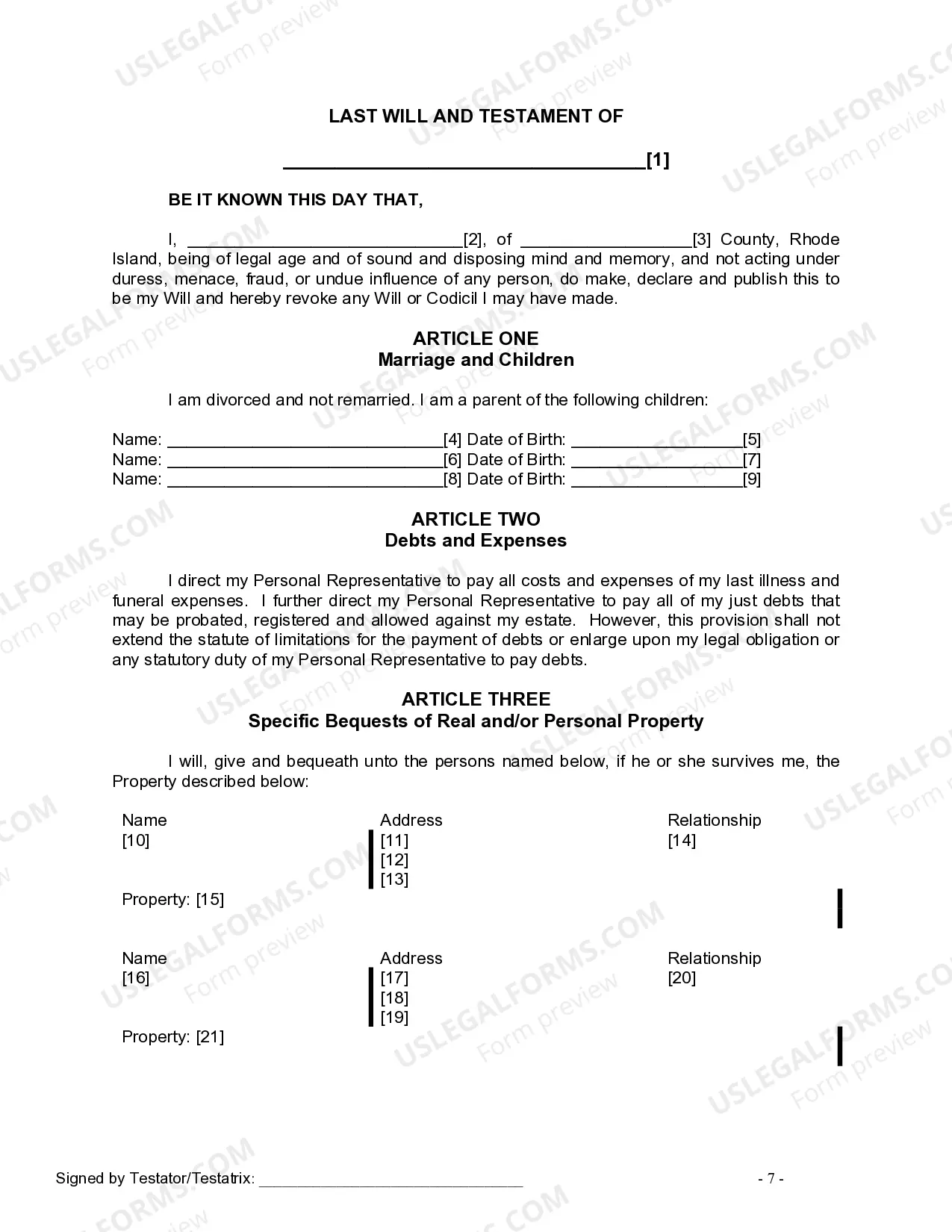
This Last Will and Testament is specifically designed for divorced individuals who have not remarried and have minor children. It outlines how your property and assets will be distributed upon your death, appoints a personal representative, and includes provisions for minor children, ensuring their care and financial support. Unlike standard wills, this form includes considerations unique to your circumstances, allowing you to establish guardianship for your minors and create trusts to manage their inheritance until they reach adulthood.
Form components explained
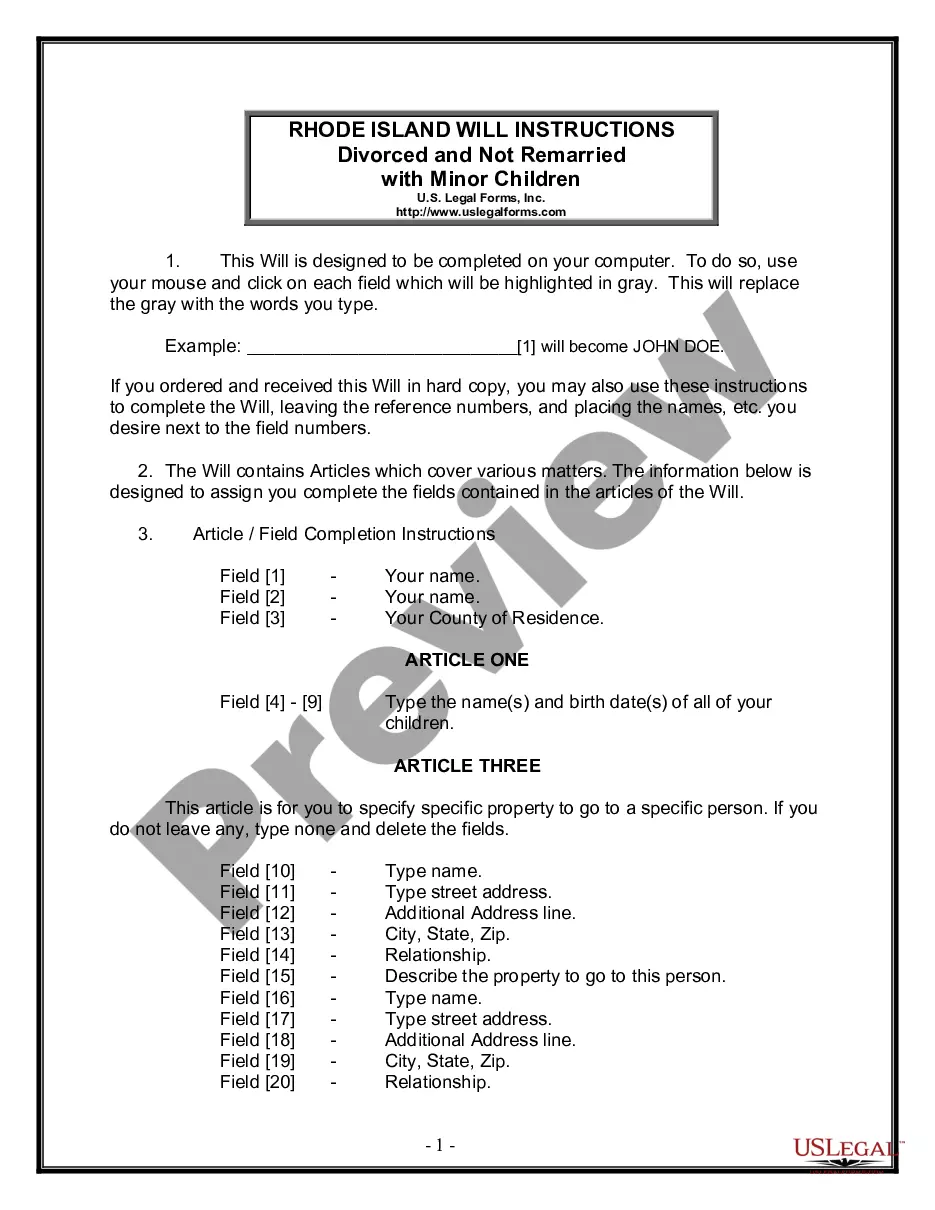
Article One: Identifies the testator's marital status and children, including their names and birth dates.
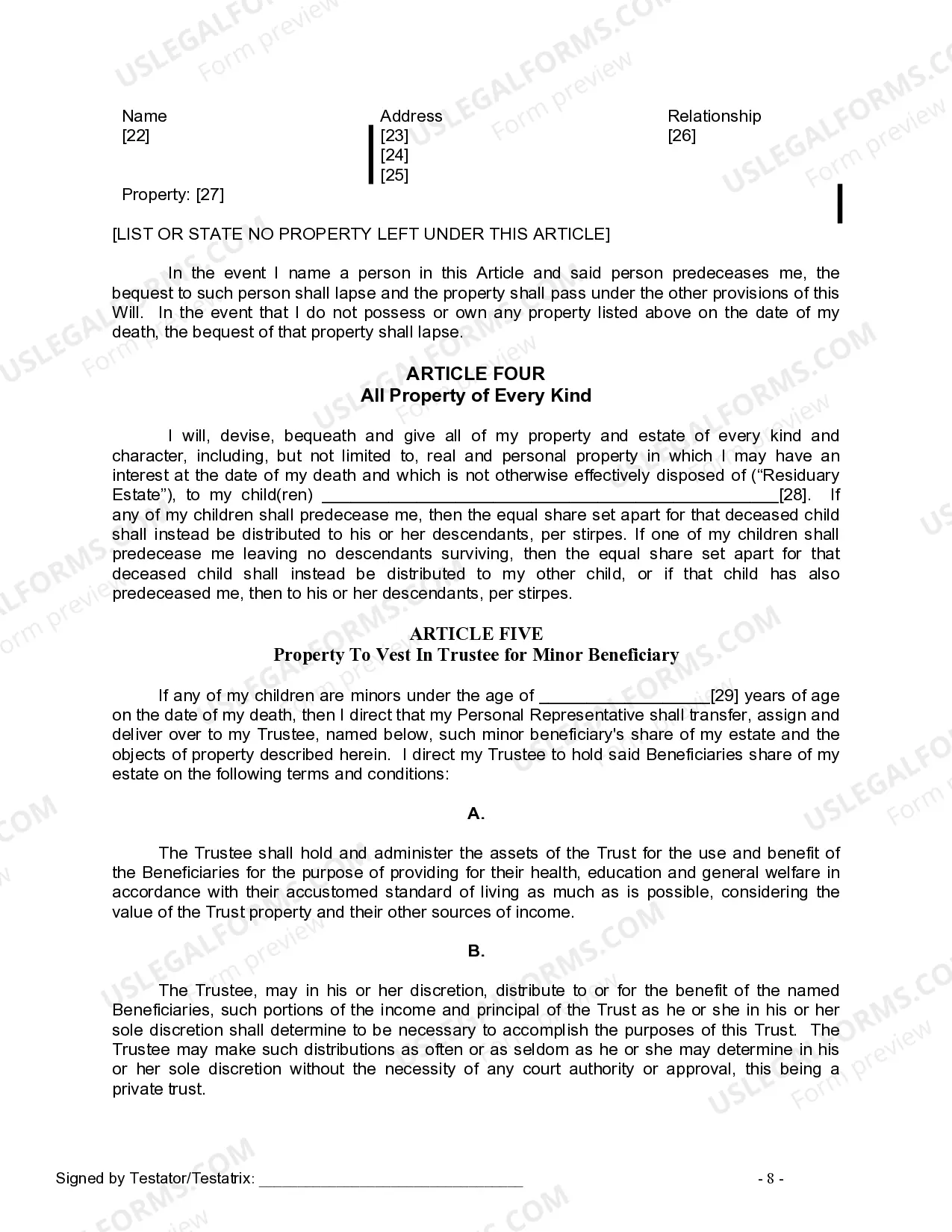
Article Three: Allows for specific bequests of personal property to named individuals.
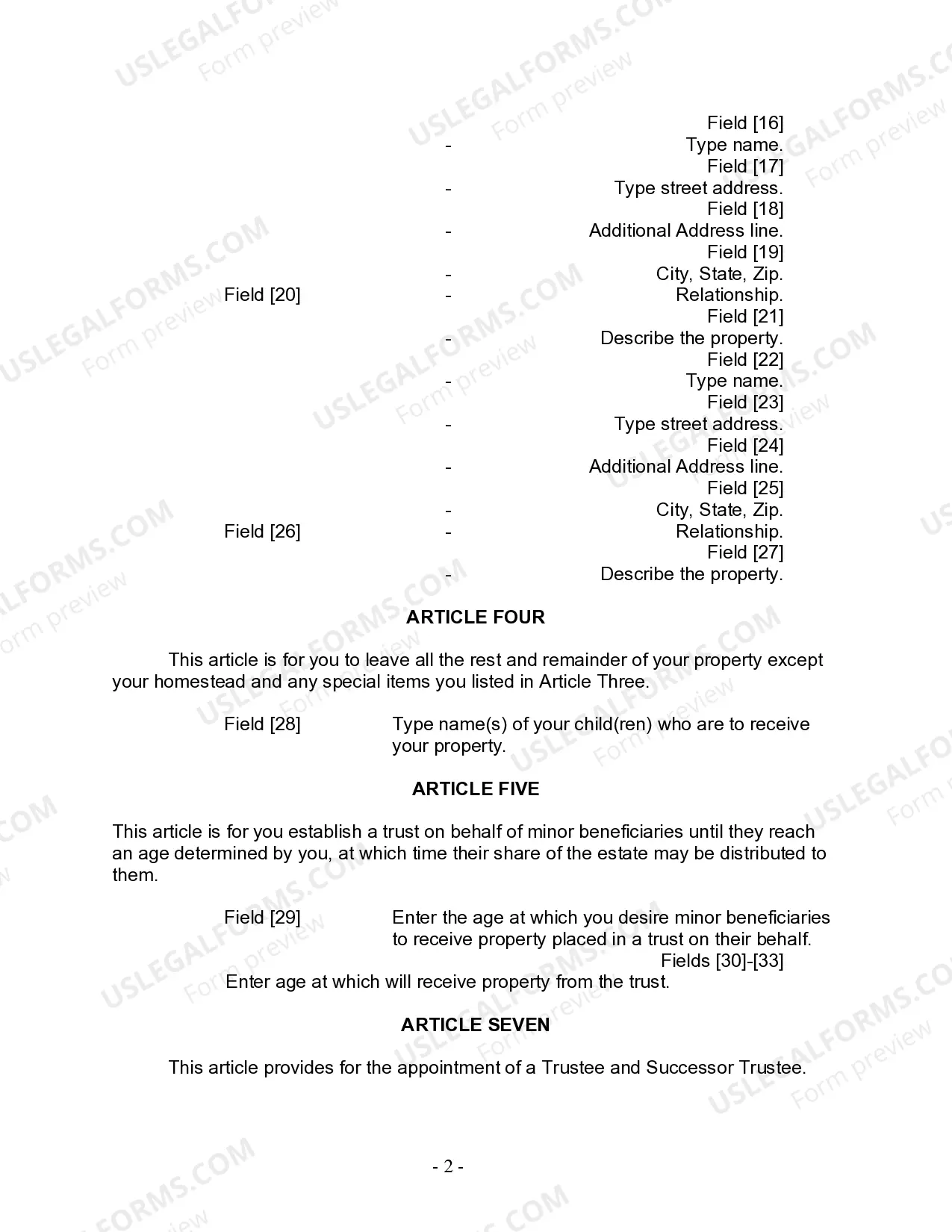
Article Four: Distributes the residual estate, excluding homestead, among your children.
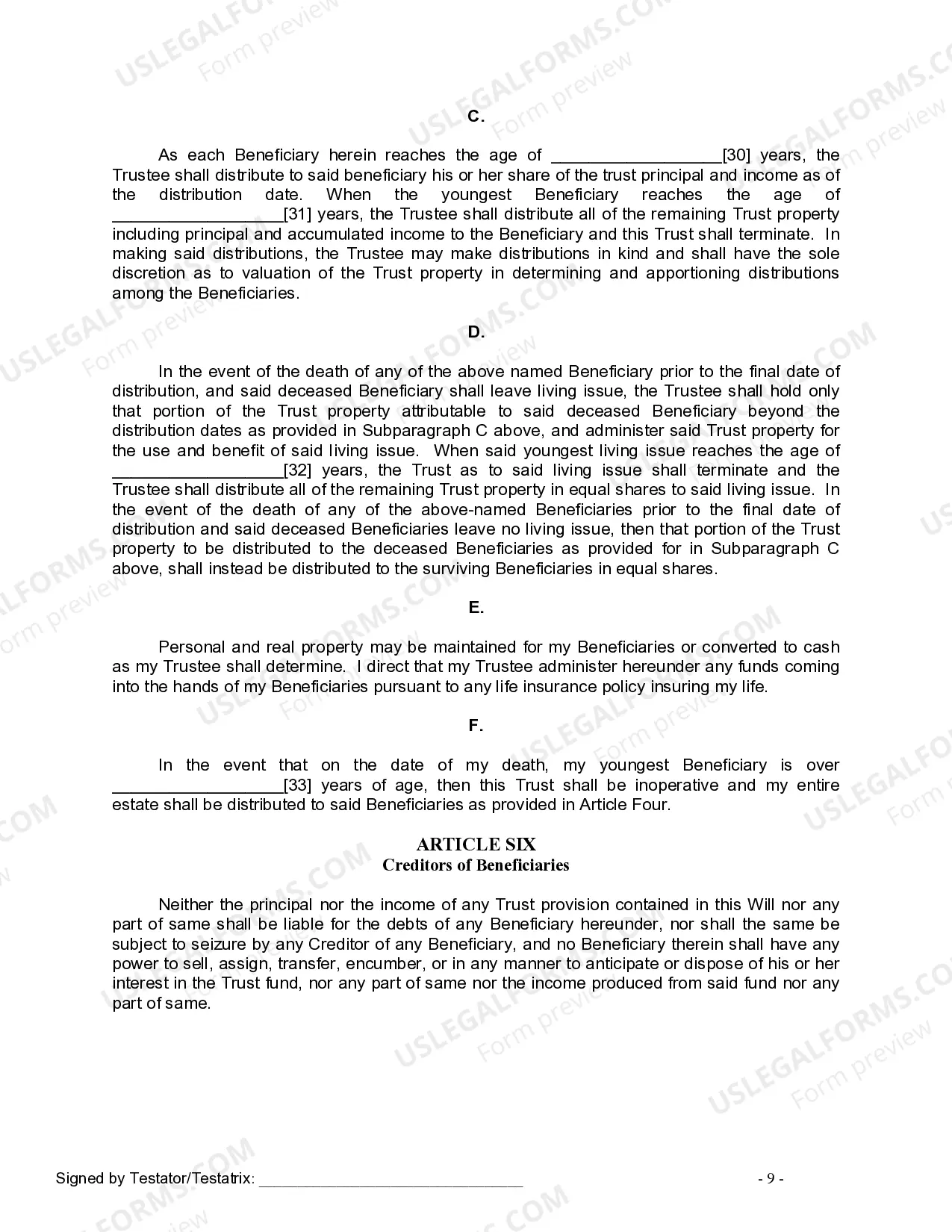
Article Five: Establishes a trust for minor children until they reach a specified age.
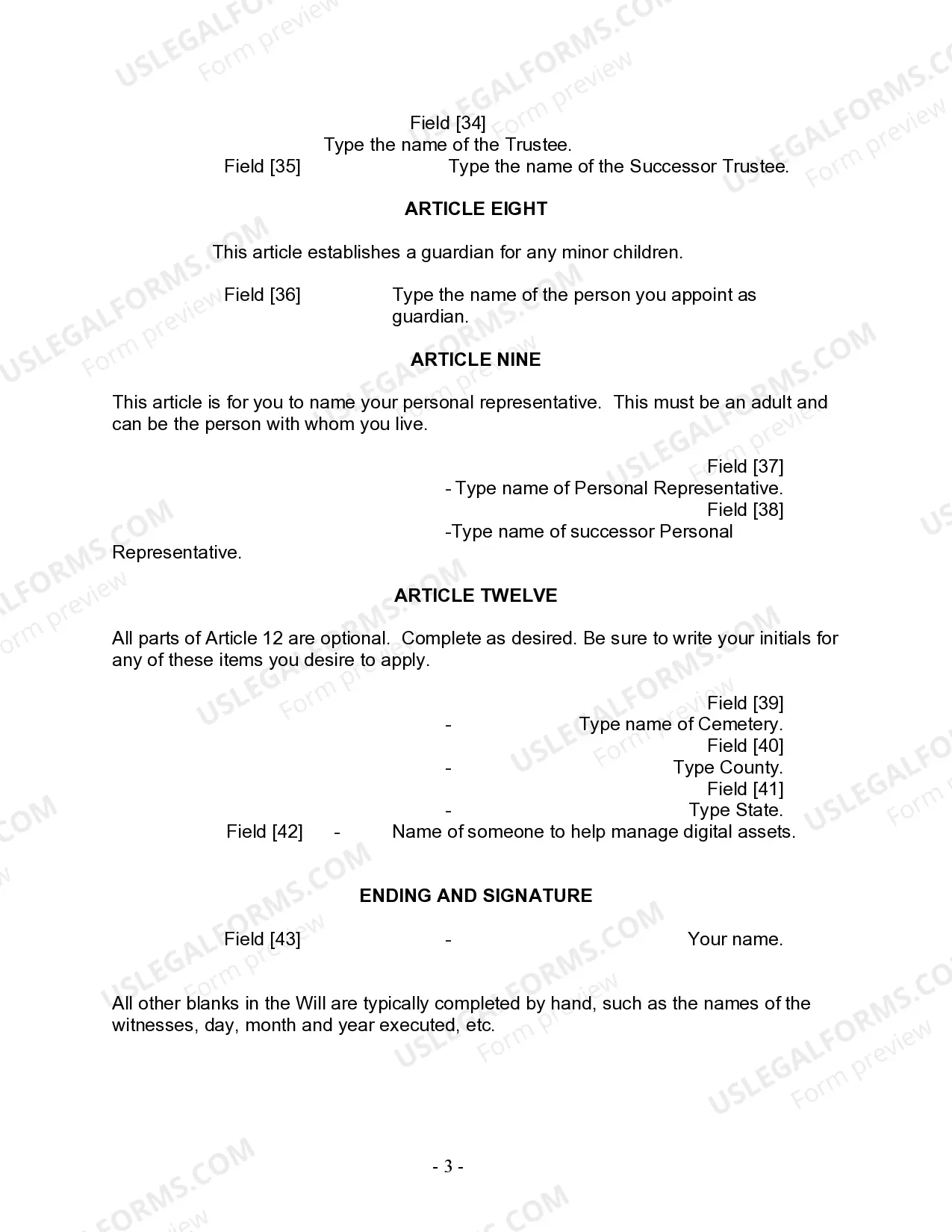
Article Eight: Appoints a guardian for any minor children in the case of the testator's death.
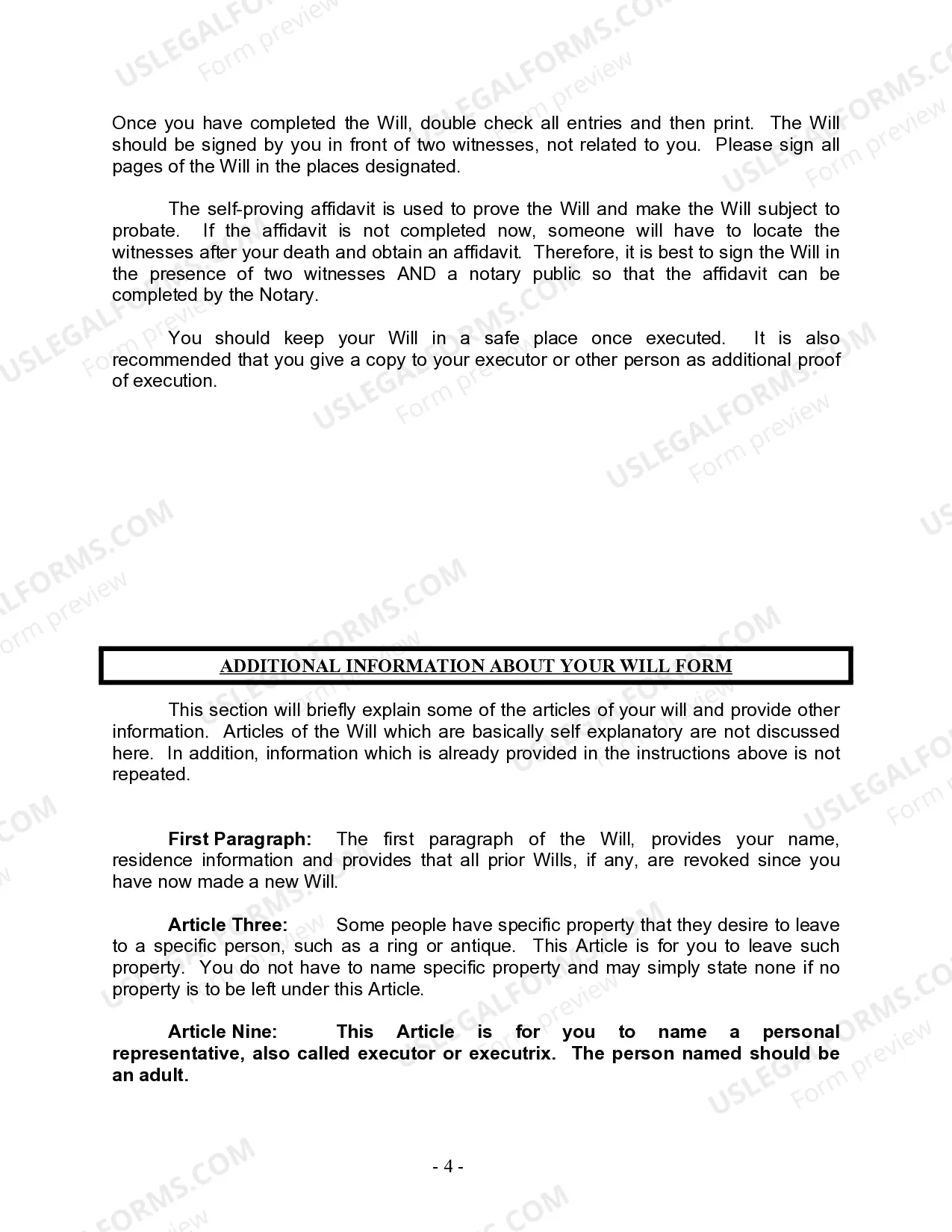
Article Nine: Names a personal representative to oversee the estate.




When this form is needed
This form is appropriate for individuals who are divorced, without remarriage, and have minor children. It is crucial to use this will to ensure that your children are cared for according to your wishes in the event of your death. Additionally, this document is essential if you wish to specify guardianship and establish a financial plan for your children.
Who can use this document
This Last Will and Testament is intended for:
- Divorced individuals with minor children.
- Parents seeking to designate guardians for their children.
- Those wanting to specify how their estate is managed for the benefit of their children.
Instructions for completing this form
- Enter your name and county of residence at the beginning of the document.
- List the names and birth dates of your minor children in Article One.
- Specify any specific bequests of personal property in Article Three.
- Designate a guardian for your minor children in Article Eight.
- Ensure the document is signed in front of two witnesses and a notary if using the self-proving affidavit.
Does this form need to be notarized?
Notarization is required for this form to take effect. Our online notarization service, powered by Notarize, lets you verify and sign documents remotely through an encrypted video session, available 24/7.
Get your form ready online
Our built-in tools help you complete, sign, share, and store your documents in one place.
Make edits, fill in missing information, and update formatting in US Legal Forms—just like you would in MS Word.
Download a copy, print it, send it by email, or mail it via USPS—whatever works best for your next step.
Sign and collect signatures with our SignNow integration. Send to multiple recipients, set reminders, and more. Go Premium to unlock E-Sign.
If this form requires notarization, complete it online through a secure video call—no need to meet a notary in person or wait for an appointment.
We protect your documents and personal data by following strict security and privacy standards.

Make edits, fill in missing information, and update formatting in US Legal Forms—just like you would in MS Word.

Download a copy, print it, send it by email, or mail it via USPS—whatever works best for your next step.

Sign and collect signatures with our SignNow integration. Send to multiple recipients, set reminders, and more. Go Premium to unlock E-Sign.

If this form requires notarization, complete it online through a secure video call—no need to meet a notary in person or wait for an appointment.

We protect your documents and personal data by following strict security and privacy standards.
Avoid these common issues
- Failing to have the will signed by two appropriate witnesses.
- Not specifying a guardian for minor children, leaving their care uncertain.
- Omitting to review and update the will after significant life changes, such as additional children or changes in guardianship.
Why use this form online
- You can easily edit the form to customize it for your specific needs.
- Downloadable and printable for quick execution.
- Provides peace of mind knowing your estate is planned according to your wishes.
Looking for another form?
Form popularity
FAQ
Fraud or Undue Influence A nonfamily caregiver forcing the testator to leave them an inheritance. A family member getting the testator to sign a will by pretending it is just a general legal document that needs a signature.
Contrary to popular belief, you do not need to have an attorney draft a will for you. Anyone can write this document on their own, and as long as it meets all of the legal requirements of the state, courts will recognize one you wrote yourself.
The claimant must prove that the facts are inconsistent with any other hypothesis; undue influence means influence exercised either by fraud or coercion.
Include personal identifying information. Include a statement about your age and mental status. Designate an executor. Decide who will take care of your children. Choose your beneficiaries. List your funeral details. Sign and date your Last Will and Testament.
A will can also be declared invalid if someone proves in court that it was procured by undue influence. This usually involves some evil-doer who occupies a position of trust -- for example, a caregiver or adult child -- manipulating a vulnerable person to leave all, or most, of his property to the manipulator instead
Age: The testator must be at least 18 years old. Capacity: The testator must be of sane mind. Signature: The will must be signed by the testator or by someone else in the testator's name in his presence, by his express direction.
Contrary to popular belief, you do not need to have an attorney draft a will for you. Anyone can write this document on their own, and as long as it meets all of the legal requirements of the state, courts will recognize one you wrote yourself.
In most situations, a will template is an easy and inexpensive way to make sure your wishes are known and carried out. Most people can get everything they need by using a will template, with little cost or hassle.
The Free Last Will and Testament Template for Word is compatible with Word 2003 or later versions.