Pennsylvania Quitclaim Deed from Individual to Two Individuals in Joint Tenancy
What this document covers
The Quitclaim Deed from Individual to Two Individuals in Joint Tenancy is a legal document that allows a property owner (the Grantor) to transfer their interest in real estate to two individuals (the Grantees) who will hold the property as joint tenants. This means that if one owner dies, the surviving tenant automatically inherits the property. Unlike warranties or other types of deeds, a quitclaim deed does not guarantee that the Grantor has clear title to the property being transferred. This form is particularly useful for couples or partners wishing to jointly own property while establishing rights of survivorship.
What’s included in this form
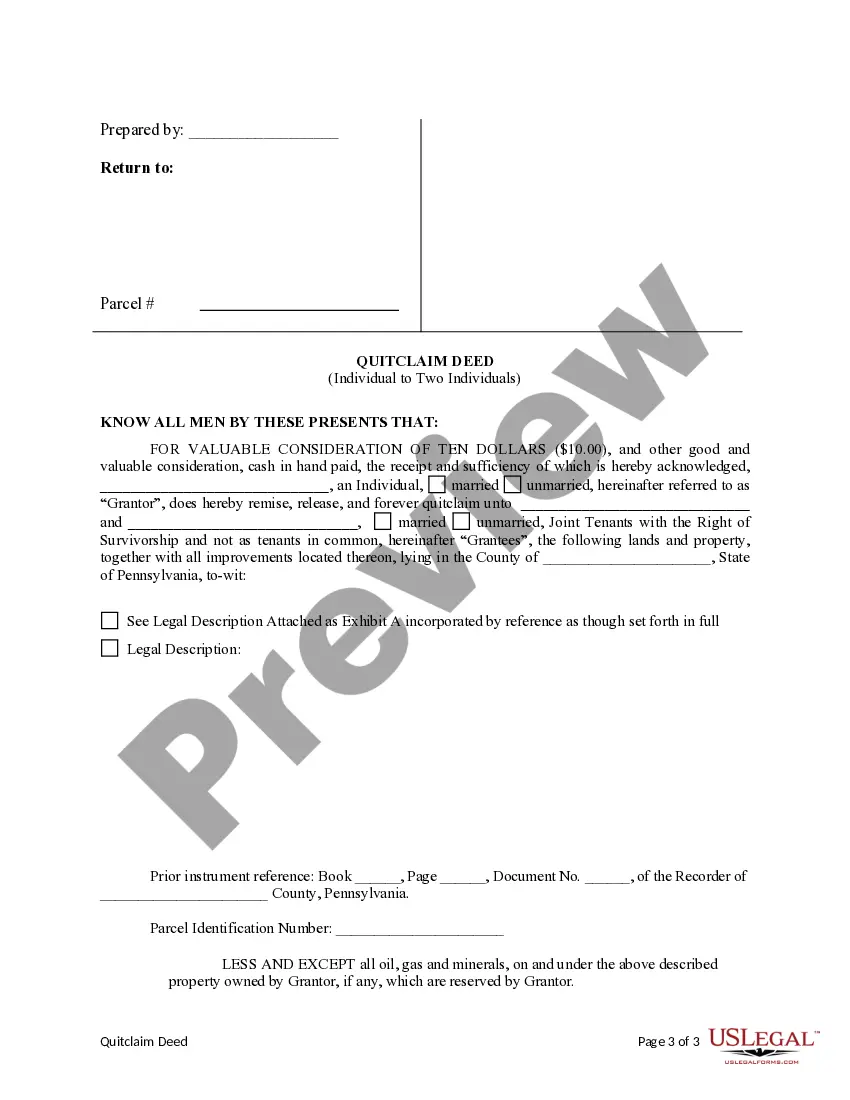
- Grantor and Grantees: Clearly identifies the individual transferring the property and the two individuals receiving it.
- Property Description: Contains a detailed description of the property being transferred, including geographic location and improvements.
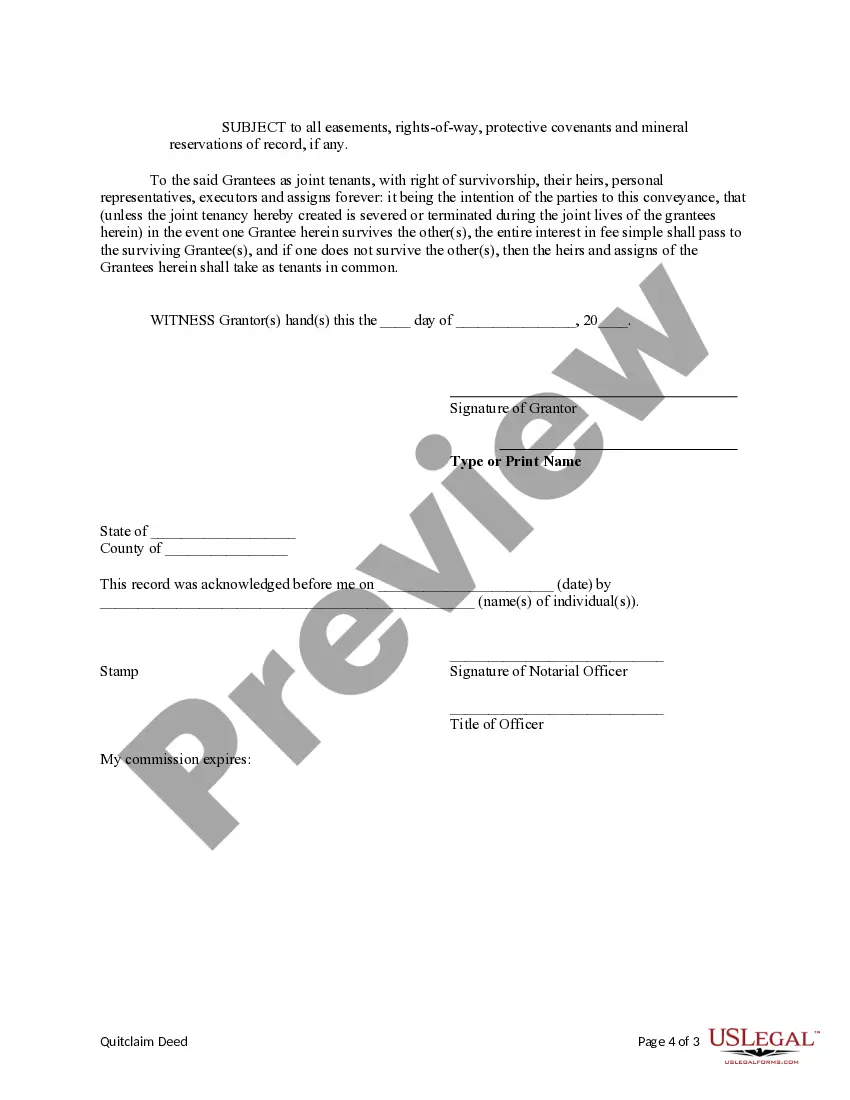
- Joint Tenancy Clause: Establishes that the Grantees hold the property in joint tenancy with the right of survivorship.
- Reservation of Minerals: Specifies that the Grantor reserves any oil, gas, and mineral rights on the property.
- Date and Signature Lines: Includes spaces for the Grantor's signature and the date of execution.





Situations where this form applies
This form should be used when an individual wishes to transfer their property interest to two people who will share ownership. Common scenarios include transferring property to family members, partners, or friends as a joint ownership arrangement. It is also applicable in cases where the Grantor wants to ensure property passes automatically to the surviving tenant upon their death, thereby avoiding probate.
Who can use this document
- Individuals looking to transfer real estate to two other individuals.
- Couples who want to ensure that the property owned jointly will automatically pass to the surviving partner.
- Family members transferring property as inheritance without the need for a formal probate process.
- Anyone seeking to establish joint ownership with survivorship rights.
How to complete this form
- Identify all parties involved: Specify the Grantor and both Grantees by name.
- Provide a detailed description of the property being transferred, ensuring accuracy in location and boundaries.
- Indicate the marital status of the Grantor and Grantees if applicable.
- Fill in the effective date and sign the document in the designated signature area.
- Ensure the form is witnessed if required, and consider notarization for added validity.
Is notarization required?
This form must be notarized to be legally valid. US Legal Forms provides secure online notarization powered by Notarize, allowing you to complete the process through a verified video call.
Get your form ready online
Our built-in tools help you complete, sign, share, and store your documents in one place.
Make edits, fill in missing information, and update formatting in US Legal Forms—just like you would in MS Word.
Download a copy, print it, send it by email, or mail it via USPS—whatever works best for your next step.
Sign and collect signatures with our SignNow integration. Send to multiple recipients, set reminders, and more. Go Premium to unlock E-Sign.
If this form requires notarization, complete it online through a secure video call—no need to meet a notary in person or wait for an appointment.
We protect your documents and personal data by following strict security and privacy standards.

Make edits, fill in missing information, and update formatting in US Legal Forms—just like you would in MS Word.

Download a copy, print it, send it by email, or mail it via USPS—whatever works best for your next step.

Sign and collect signatures with our SignNow integration. Send to multiple recipients, set reminders, and more. Go Premium to unlock E-Sign.

If this form requires notarization, complete it online through a secure video call—no need to meet a notary in person or wait for an appointment.

We protect your documents and personal data by following strict security and privacy standards.
Mistakes to watch out for
- Failing to accurately describe the property, leading to potential disputes.
- Not including the required reservation clause for minerals, if applicable.
- Neglecting to ensure all parties sign the document.
- Assuming notarization is not needed; always check local laws.
- Forgetting to date the document upon signing.
Advantages of online completion
- Convenience of completing the form at any time from your device.
- Editability allows for adjustments before finalizing the document.
- Access to a legal form that complies with state laws ensures reliability.
- Instant download provides immediate availability for use.
Looking for another form?


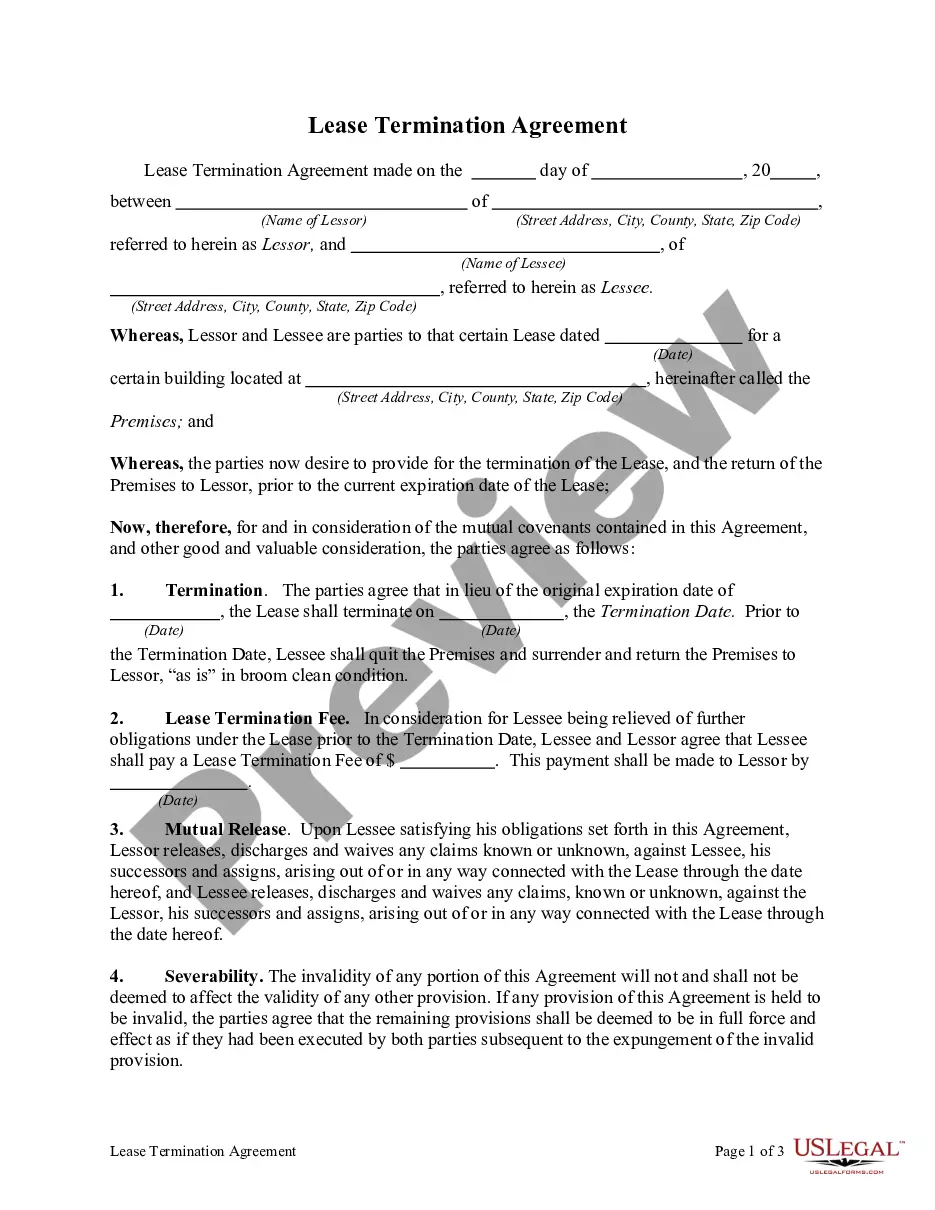


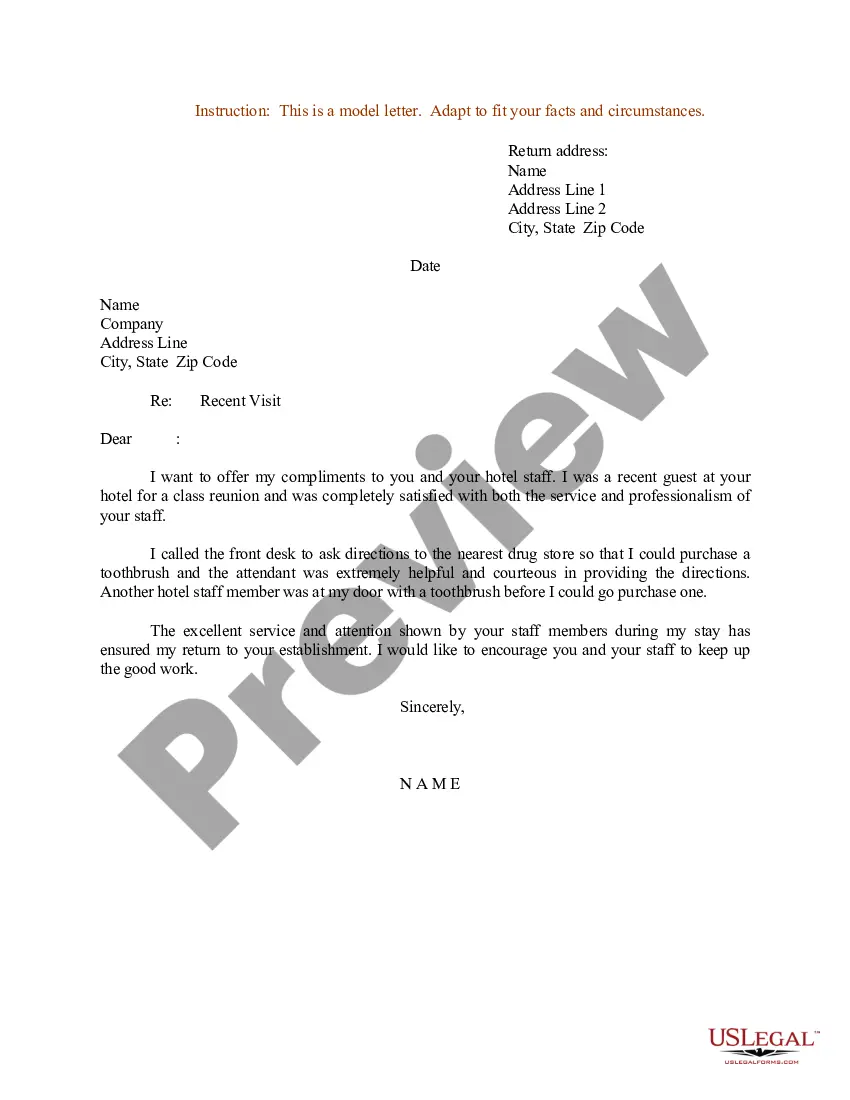



Form popularity
FAQ
It's usually a very straightforward transaction, but it's possible for a quitclaim deed to be challenged. If a quitclaim deed is challenged in court, the issue becomes whether the property was legally transferred and if the grantor had the legal right to transfer the property.
It is also crucial that a spouse know about the loan, even if he or she is not on the mortgage. In general, the spouse must sign a deed of trust, the Truth in Lending and Right to Cancel documents. By signing these documents, they are simply acknowledging the existence of the mortgage.
But you might be wondering if an owner can transfer a deed to another person without a real estate lawyer. The answer is yes. Parties to a transaction are always free to prepare their own deeds.A quitclaim deed, for example, is far simpler than a warranty deed.
In order to transfer ownership of the marital home pursuant to a divorce, one spouse is going to need to sign a quitclaim deed, interspousal transfer deed, or a grant deed, in order to convey the title to the property.
Fill in the deed form. Print it out. Have the grantor(s) and grantee(s) sign and get the signature(s) notarized. Fill out a Statement of Value form, if necessary. Get the Uniform Parcel Number (UPI) on the deed certified, if required by your county.
A person who signs a quitclaim deed to transfer property they do not own results in no title at all being transferred since there is no actual ownership interest. The quitclaim deed only transfers the type of title you own.
You'll need to pay a fee, which varies from county to county. For example, in Montgomery County, near Philadelphia, the fee for recording a deed is $86.75 for up to four pages and up to four names, and $1 per additional name and $4 per additional page.
To use a Quitclaim Deed to add someone to a property deed or title, you would need to create a Quitclaim Deed and list all of the current owners in the grantor section. In the grantee section, you would list all of the current owners as well as the person you would like to add.