Oregon Co-Petitioners' (with no or adult children) Affidavit in Support of Motion for Waiver of 90 Day Waiting Period
What is this form?
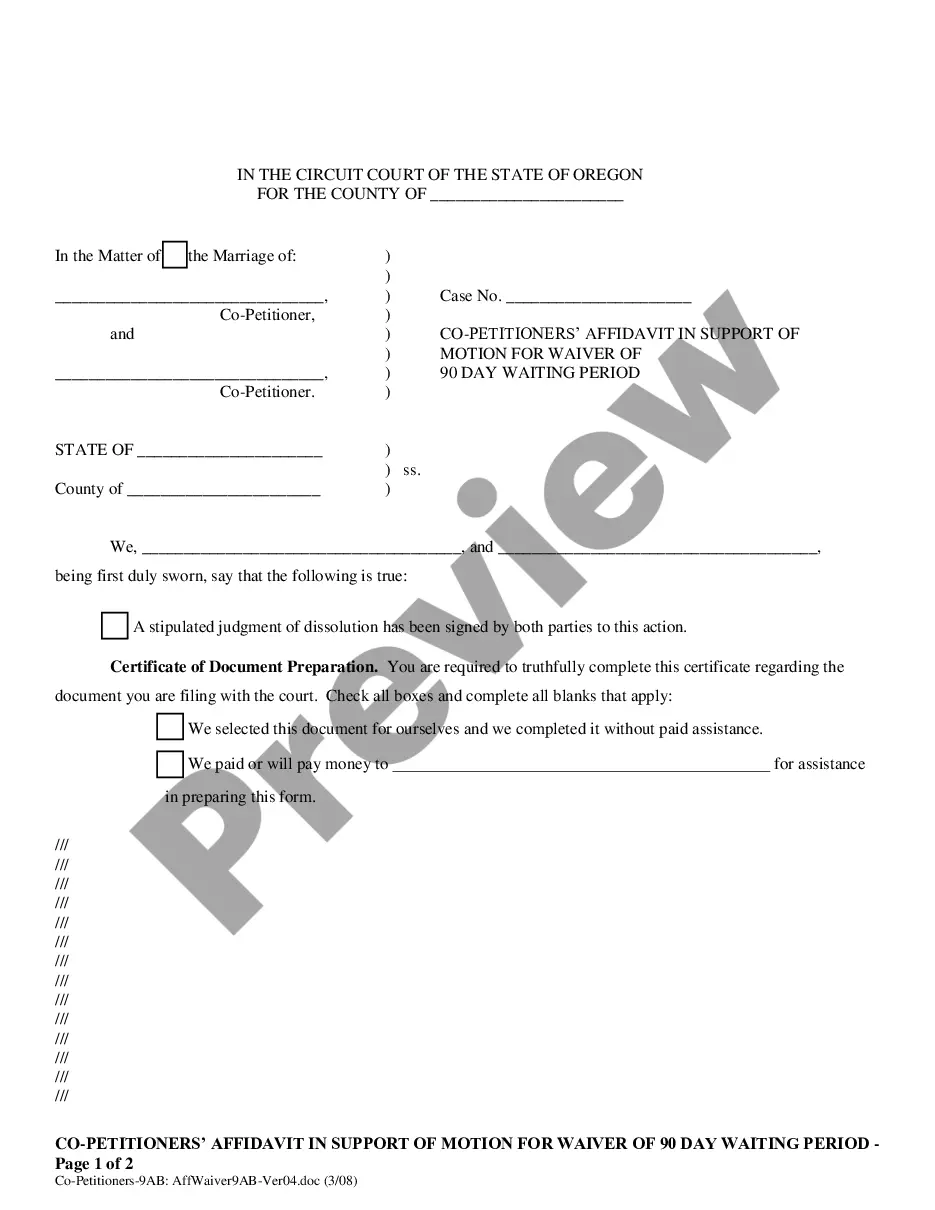
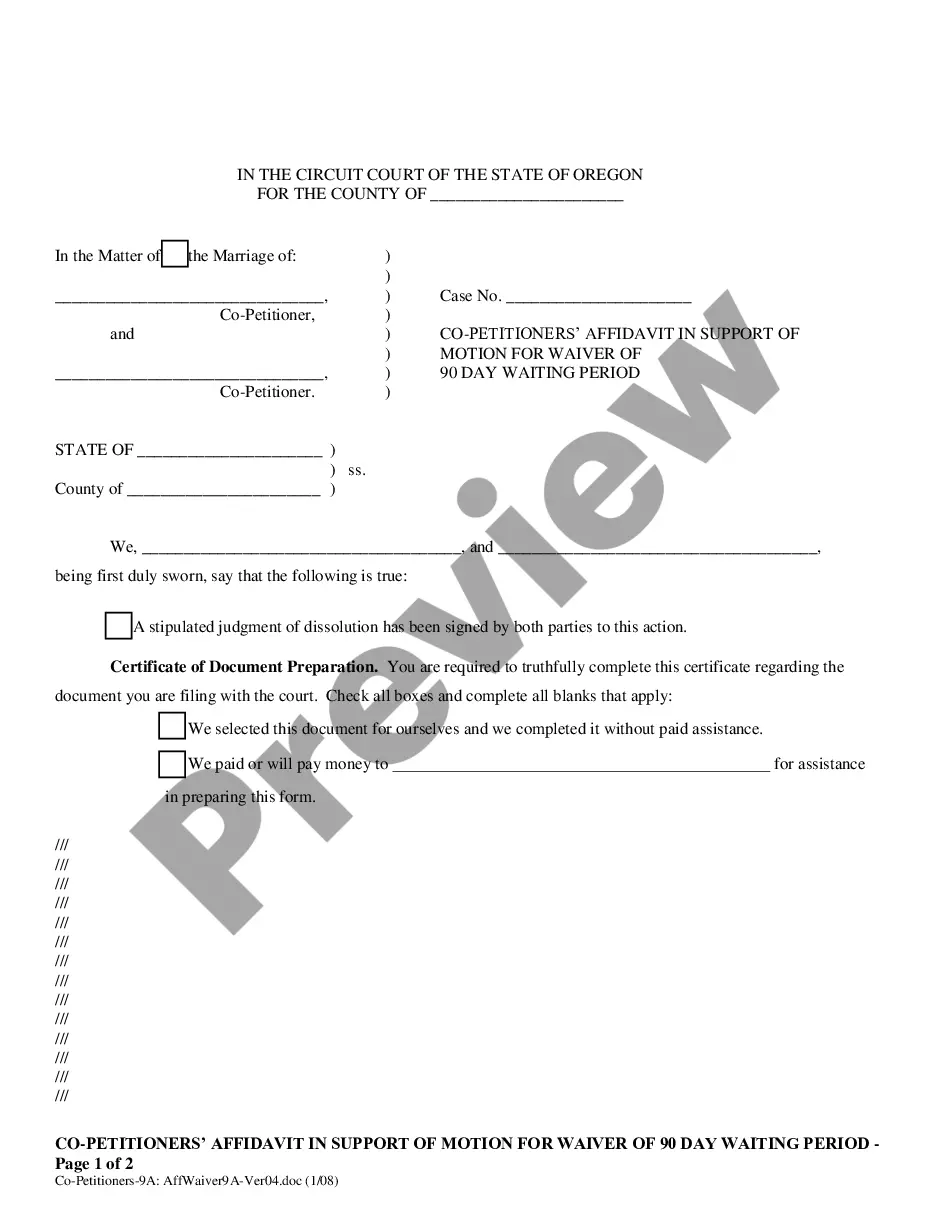
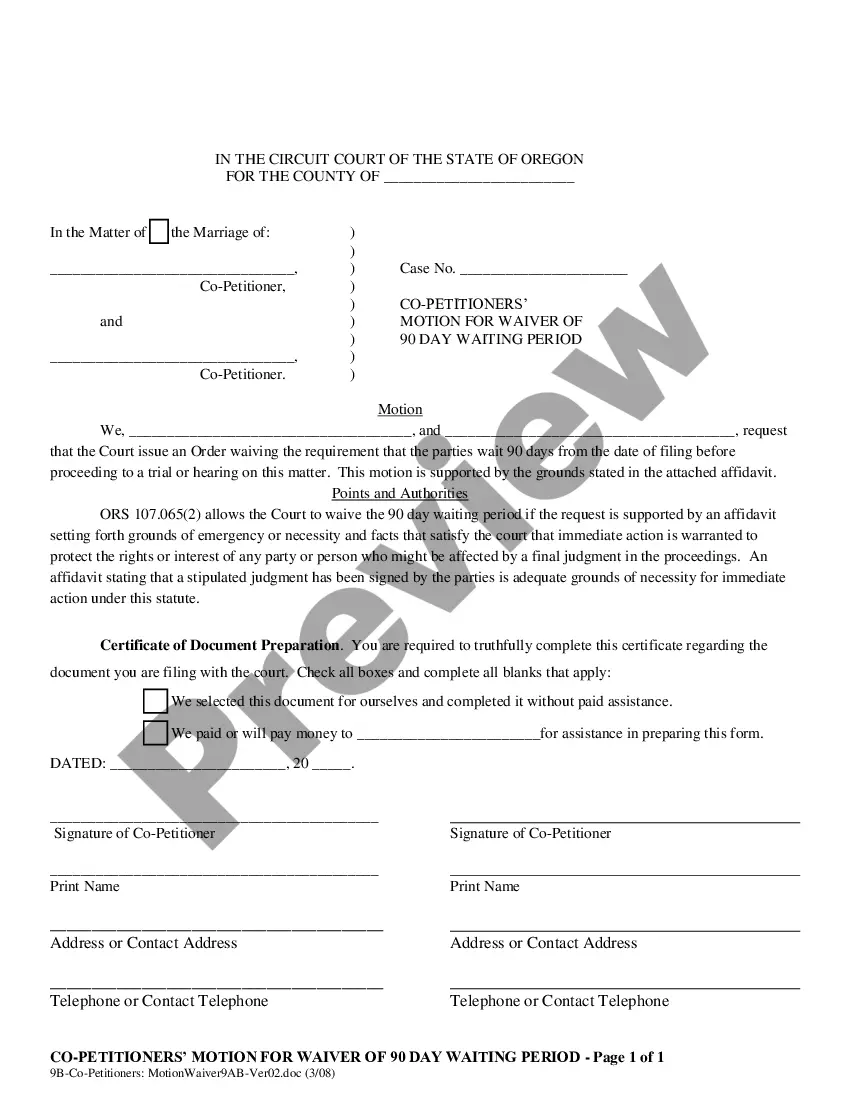
The Co-Petitioners' Affidavit in Support of Motion for Waiver of 90 Day Waiting Period is a legal document that provides the necessary details to the court, establishing that immediate action is required to protect the rights of the involved parties during divorce proceedings. This form assists couples without minor children to expedite the process by requesting a waiver of the standard 90-day waiting period before a final judgment can be entered, setting it apart from similar affidavits that may involve child custody concerns.
What’s included in this form
- Identification of co-petitioners and their marital status.
- A statement affirming that a stipulated judgment of dissolution has been signed.
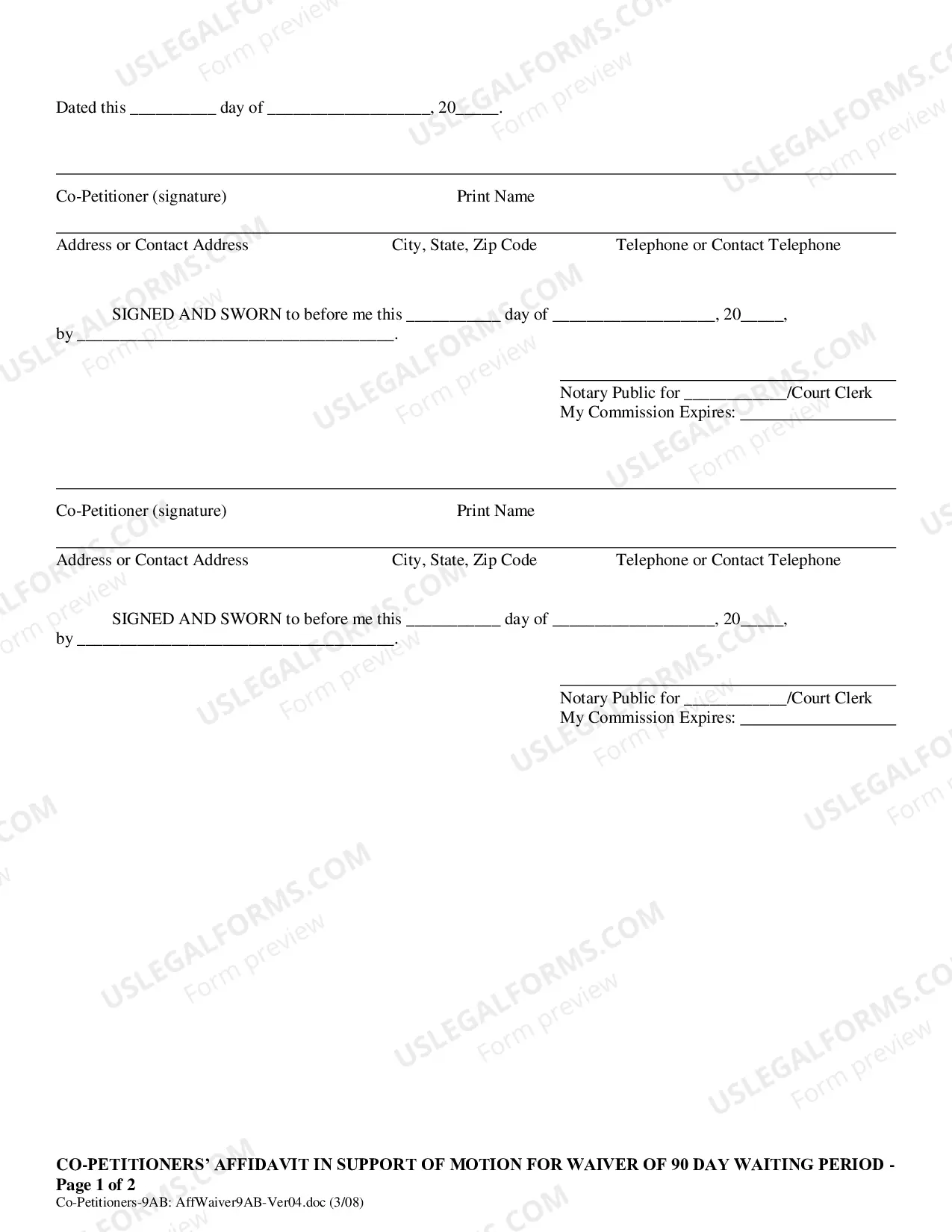
- Certificate of Document Preparation confirming how the form was completed.
- Signature lines for both co-petitioners and notarization details.
When this form is needed
This form should be used when both parties in a divorce agree to proceed without waiting the standard 90 days. It is particularly applicable for couples who have no minor children and who wish to finalize their divorce proceedings as swiftly as possible. When both parties are in agreement on the terms of their divorce, this affidavit facilitates an expedited legal process.
Who can use this document
- Couples currently undergoing divorce proceedings without minor children.
- Co-petitioners who have reached an agreement on the terms of dissolution.
- Individuals filing for divorce in jurisdictions that allow for the waiver of the 90-day waiting period.
How to complete this form
- Identify the full names of both co-petitioners at the top of the document.
- Enter the case number as assigned by the court.
- Check the box confirming that a stipulated judgment of dissolution has been signed.
- Complete the Certificate of Document Preparation section, indicating how the form was prepared.
- Both co-petitioners must sign the affidavit in the designated areas.
- Submit the completed form to the court as part of the divorce proceedings.
Does this document require notarization?
Yes, this form must be notarized to be legally valid. Both co-petitioners are required to sign the affidavit in front of a notary public, ensuring that the signatures are genuine and that the document meets legal standards. US Legal Forms provides integrated online notarization options, including secure video calls, available 24/7, for your convenience.
Get your form ready online
Our built-in tools help you complete, sign, share, and store your documents in one place.
Make edits, fill in missing information, and update formatting in US Legal Forms—just like you would in MS Word.
Download a copy, print it, send it by email, or mail it via USPS—whatever works best for your next step.
Sign and collect signatures with our SignNow integration. Send to multiple recipients, set reminders, and more. Go Premium to unlock E-Sign.
If this form requires notarization, complete it online through a secure video call—no need to meet a notary in person or wait for an appointment.
We protect your documents and personal data by following strict security and privacy standards.

Make edits, fill in missing information, and update formatting in US Legal Forms—just like you would in MS Word.

Download a copy, print it, send it by email, or mail it via USPS—whatever works best for your next step.

Sign and collect signatures with our SignNow integration. Send to multiple recipients, set reminders, and more. Go Premium to unlock E-Sign.

If this form requires notarization, complete it online through a secure video call—no need to meet a notary in person or wait for an appointment.

We protect your documents and personal data by following strict security and privacy standards.
Mistakes to watch out for
- Failing to correctly identify both co-petitioners' names and case number.
- Not checking the acknowledgment of the stipulated judgment, leading to delays.
- Neglecting to sign the affidavit before a notary public.
- Incompletely filling out the Certificate of Document Preparation section.
Why use this form online
- Easy access to downloadable templates prepared by licensed attorneys.
- Immediate availability, allowing you to fill out and submit forms at your convenience.
- Editable documents that can be customized to fit your specific situation.
- Confidence in legal accuracy, as forms are drafted in compliance with state laws.
Looking for another form?




Form popularity
FAQ
In Oregon, the court will presume that the spouses contributed equally to the acquisition of most property during marriage, regardless of what title says. Property acquired equally will be split equally. The only assets left out of this presumption are gifts to one spouse that are always kept separate.
Will it take me long to get a divorce? An uncontested divorce (where you and your spouse agree about the terms of the divorce) can be final about three months after the divorce petition is filed and delivered to your spouse. You may be able to reduce this time if the judge thinks you have a very good reason.
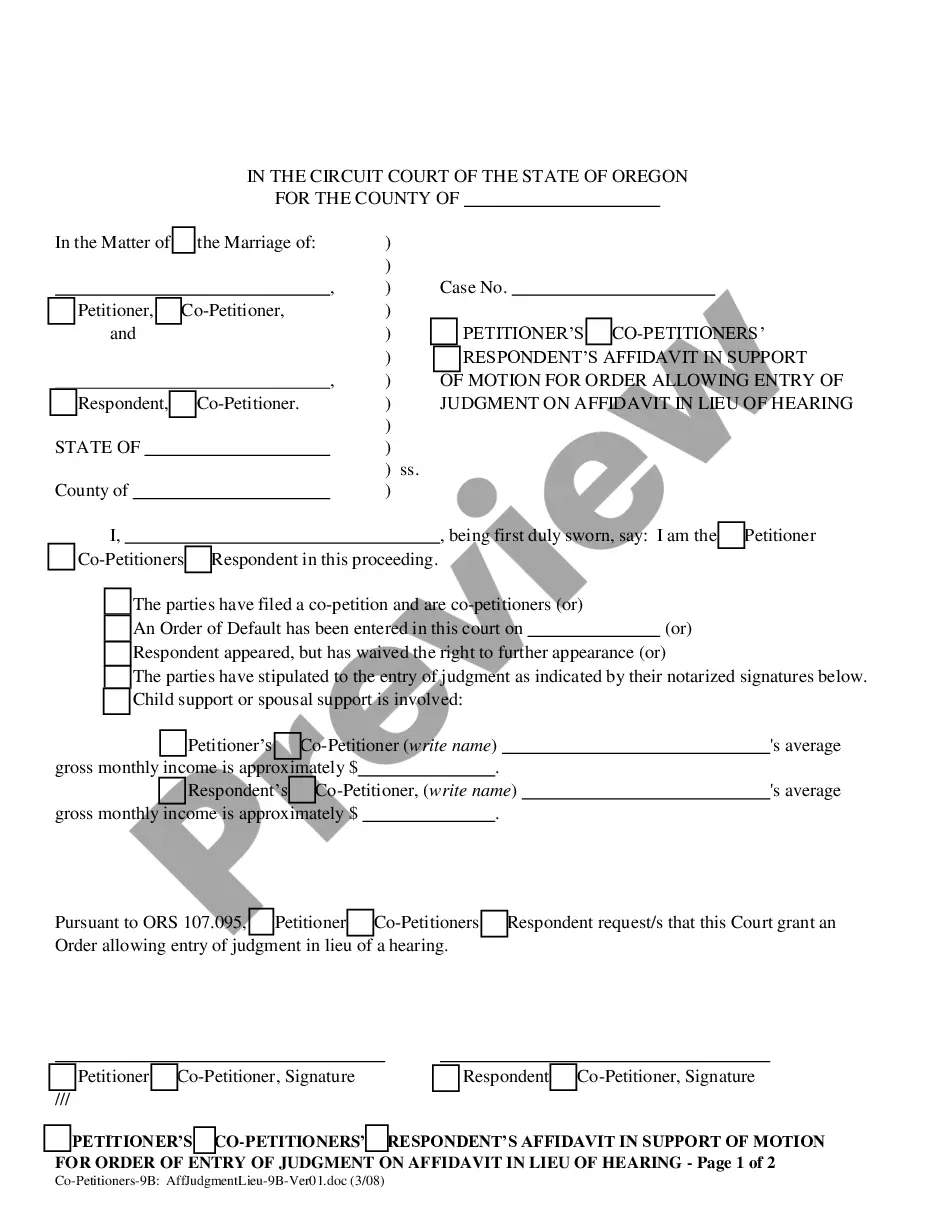
ORCP 69 requires the court or clerk to enter an order of default on a showing by affidavit or declaration that a party against whom a judgment is sought has been served with Summons or is otherwise subject to the jurisdiction of the Court and has failed to plead or otherwise defend within the time set by law.
While Oregon used to have a 90-day waiting period in place, the state no longer imposes this requirement. Even though there is no time frame imposed to divorce once the papers are filed and served, it is important to note that the respondent spouse has 30 days to answer the divorce petition.
In a standard Oregon divorce, the non-filing spouse, also known as the Respondent, signs an Acceptance of Service in front of a Notary Public, which eliminates the need for formal service. Petitioner simply mails or hand-delivers the divorce documents to the Respondent.
Finally, something to be aware of is that filing first will not give you any significant advantage over the court's final decision. A judge is required to consider both spouses' testimony and evidence equally, then determine custody, support, and property division.
A summary dissolution is an uncontested divorce which allows couples to end their marriage without ever appearing in court. Summary dissolution is a streamlined option, but is available only to couples who satisfy the following requirements: one or both spouses have lived in Oregon for the past six months.
?It does not generally matter who is the first to file dissolution papers. The court does not give any preference to the first person to file (the petitioner), or any disadvantage to the person who is the respondent. The filing fees are the same for both the petitioner and the respondent.