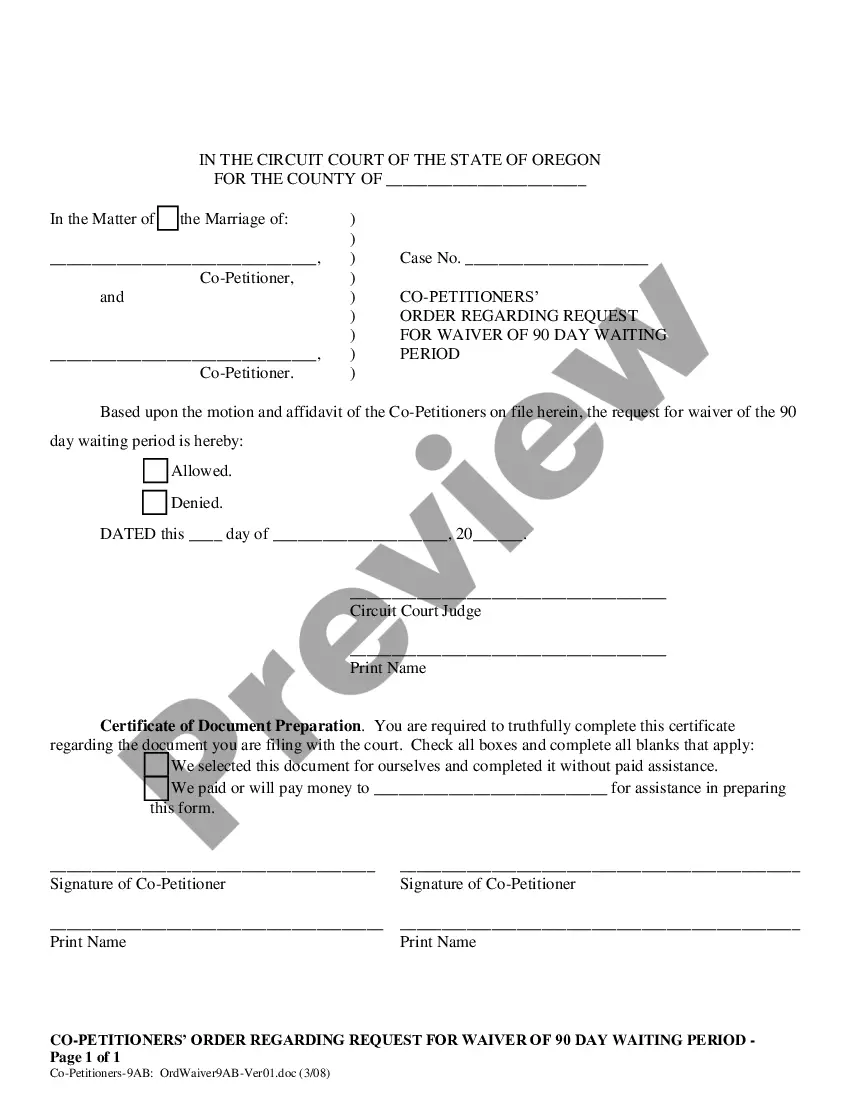
Oregon Co-Petitioners' Order Regarding Request for Waiver of 90 Day Waiting Period
Understanding this form
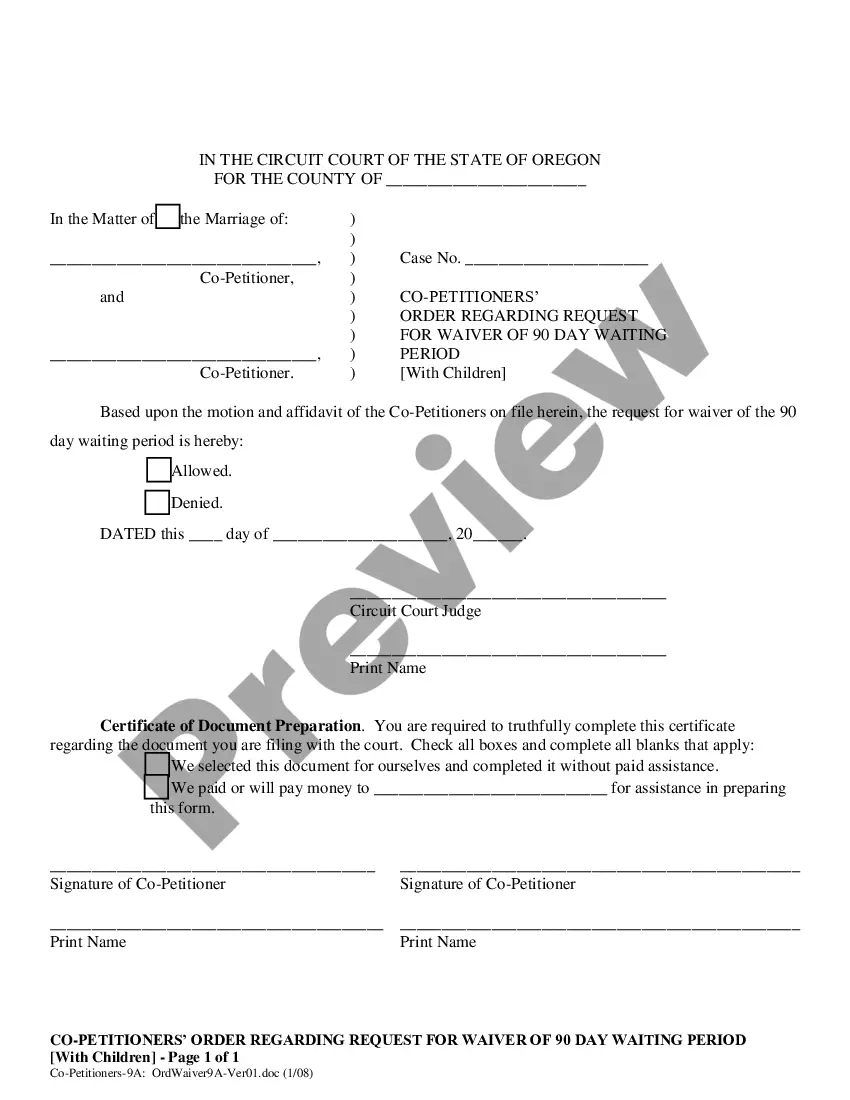
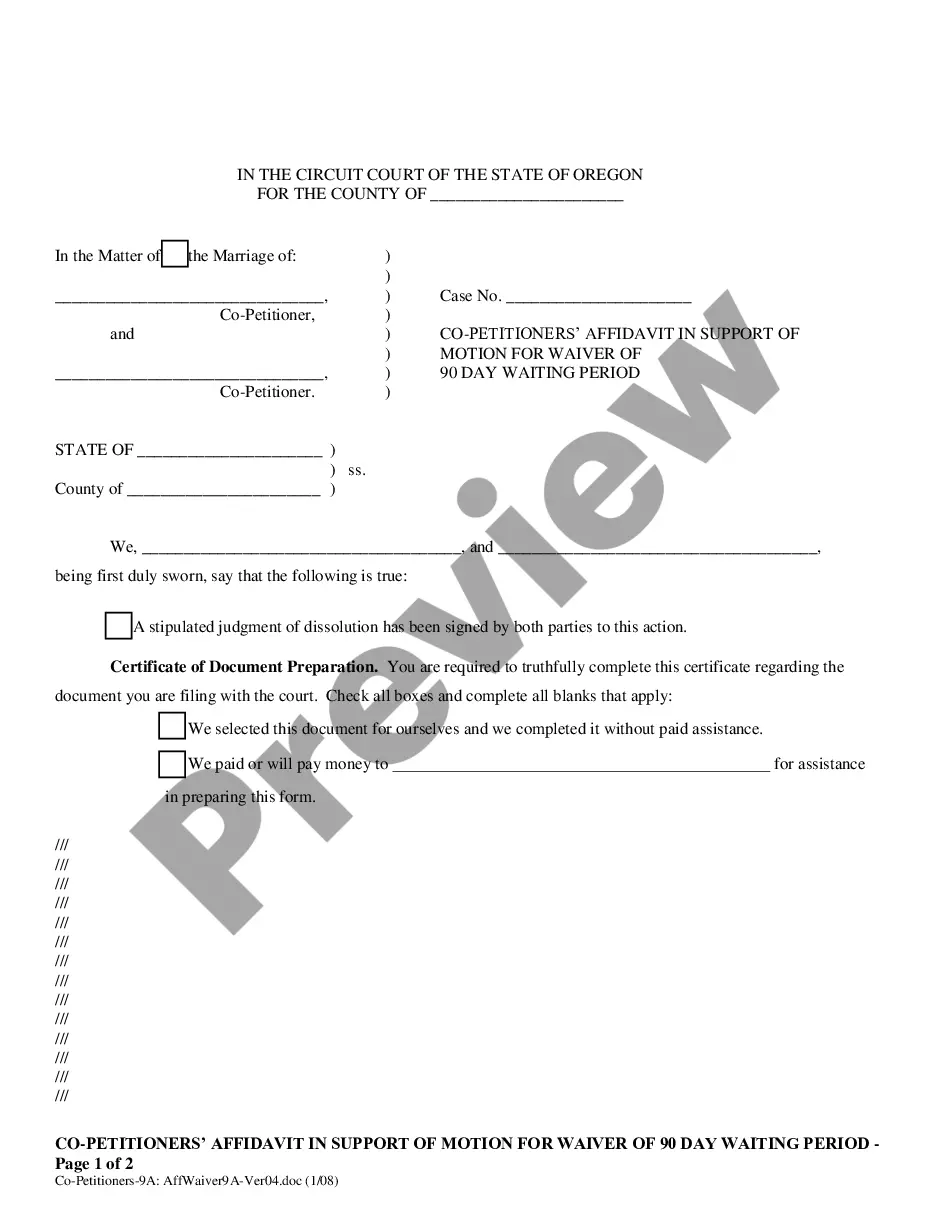
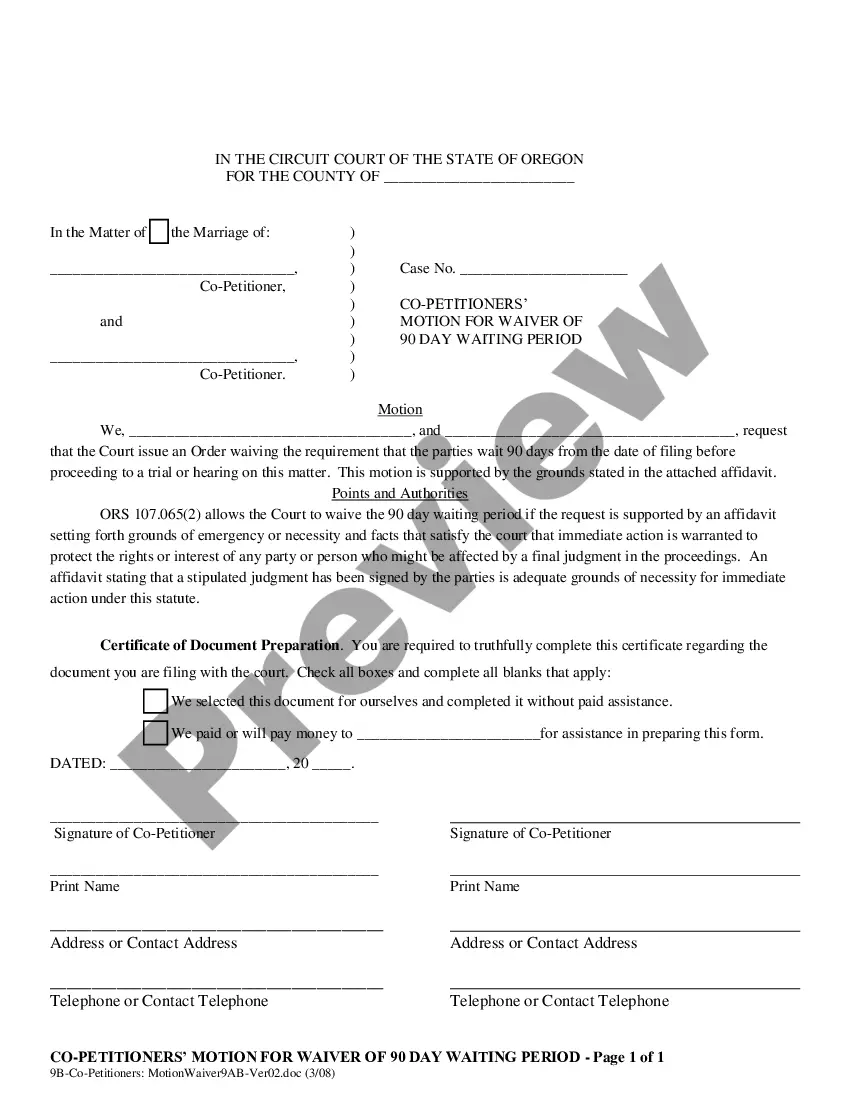
The Co-Petitioners' Order Regarding Request for Waiver of 90 Day Waiting Period is a legal document used in court to allow or deny co-petitioners' request for a waiver of the standard 90-day waiting period for a divorce. This form serves as an official court order resulting from the motion and affidavit submitted by both co-petitioners, distinguishing it from other divorce-related forms focused on different aspects of the dissolution process.
What’s included in this form
- Identification of the court and the parties involved in the matter
- A section to indicate whether the request for waiver is allowed or denied
- Signature lines for both co-petitioners
- Certification of document preparation, specifying assistance in preparing the form
- Date line for formalizing the order by the Circuit Court Judge
Situations where this form applies
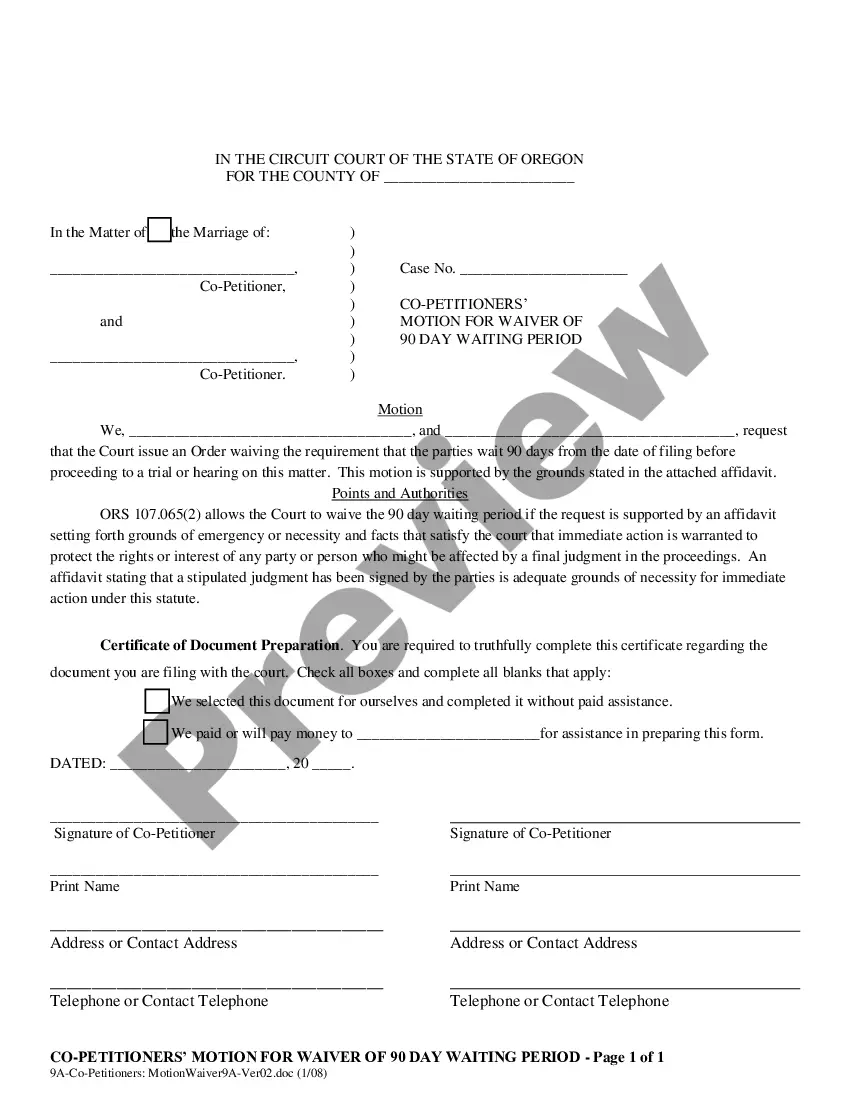
This form is typically used when co-petitioners have filed for divorce and wish to request a waiver of the mandatory 90-day waiting period. This situation may arise if both parties mutually agree to expedite the divorce process due to specific circumstances, such as significant life changes or personal situations that necessitate a faster resolution.
Who can use this document
- Couples seeking a divorce who have filed a joint petition
- Individuals who want to request a waiver of the waiting period after filing for divorce
- Anyone who has legal standing in the marriage dissolution process and agrees to the motion
Instructions for completing this form
- Identify the court and the county where the divorce case is filed.
- Enter the names of both co-petitioners as they appear on official documents.
- Mark the appropriate box to indicate whether the request for waiver is allowed or denied.
- Provide the date of signature and signature of both co-petitioners.
- Complete the certificate of document preparation regarding assistance in filling out the form.
Notarization guidance
This form does not typically require notarization unless specified by local law. However, it is important to ensure all signatures are completed as required to maintain the document's validity.
Get your form ready online
Our built-in tools help you complete, sign, share, and store your documents in one place.
Make edits, fill in missing information, and update formatting in US Legal Forms—just like you would in MS Word.
Download a copy, print it, send it by email, or mail it via USPS—whatever works best for your next step.
Sign and collect signatures with our SignNow integration. Send to multiple recipients, set reminders, and more. Go Premium to unlock E-Sign.
If this form requires notarization, complete it online through a secure video call—no need to meet a notary in person or wait for an appointment.
We protect your documents and personal data by following strict security and privacy standards.

Make edits, fill in missing information, and update formatting in US Legal Forms—just like you would in MS Word.

Download a copy, print it, send it by email, or mail it via USPS—whatever works best for your next step.

Sign and collect signatures with our SignNow integration. Send to multiple recipients, set reminders, and more. Go Premium to unlock E-Sign.

If this form requires notarization, complete it online through a secure video call—no need to meet a notary in person or wait for an appointment.

We protect your documents and personal data by following strict security and privacy standards.
Common mistakes to avoid
- Failing to accurately fill out the court and county information.
- Leaving the allowed or denied box unchecked.
- Not providing signatures or the date of signing.
- Incorrectly completing the certification of document preparation section.
Why use this form online
- Convenient access to a legally crafted document without the need for in-person consultations.
- Easy editing to ensure that all details are accurate before submission.
- Secure storage and download options available for your legal records.
Looking for another form?
Form popularity
FAQ
Depending on your state's laws, you might be able to file a "joint" petition for divorce (some states call this an uncontested or collaborative divorce), which means that both spouses agree not only to the divorce but to all divorce-related issues that follow.
"Petitioner" refers to the party who petitioned the Supreme Court to review the case. This party is variously known as the petitioner or the appellant. "Respondent" refers to the party being sued or tried and is also known as the appellee.
You have 30 days from the date you were served with the Petition to file a written Response with the court clerk and pay the filing fee. If you don't file a Response within 30 days of being served, the Petitioner can ask the court to enter an Order of Default and then enter a judgment based on the Petition.
?It does not generally matter who is the first to file dissolution papers. The court does not give any preference to the first person to file (the petitioner), or any disadvantage to the person who is the respondent. The filing fees are the same for both the petitioner and the respondent.
In a contested divorce the petitioner (plaintiff) petitions the court for a divorce and respondent (defendant) has to respond. When the petition is jointly filed, the spouses are called Co-Petitioners. The husband and wife petition the court together with paperwork that is signed by both parties.
Your spouse does NOT need to sign the Petition if you are filing on your own. STEP 3- File your forms with the court. Take your completed forms to the clerk at the counter in the courthouse. Give the forms to the clerk to file your case.
In English law, a co-respondent is, in general, a respondent to a petition, or other legal proceeding, along with another or others, or a person called upon to answer in some other way.
Oregon does not have a mandatory waiting period for divorces, so it is possible to end your marriage quickly. It generally takes several days to a few weeks for the court to process dissolution paperwork.