Oregon Co-Petitioners' Acknowledgment About Dissolution
What this document covers
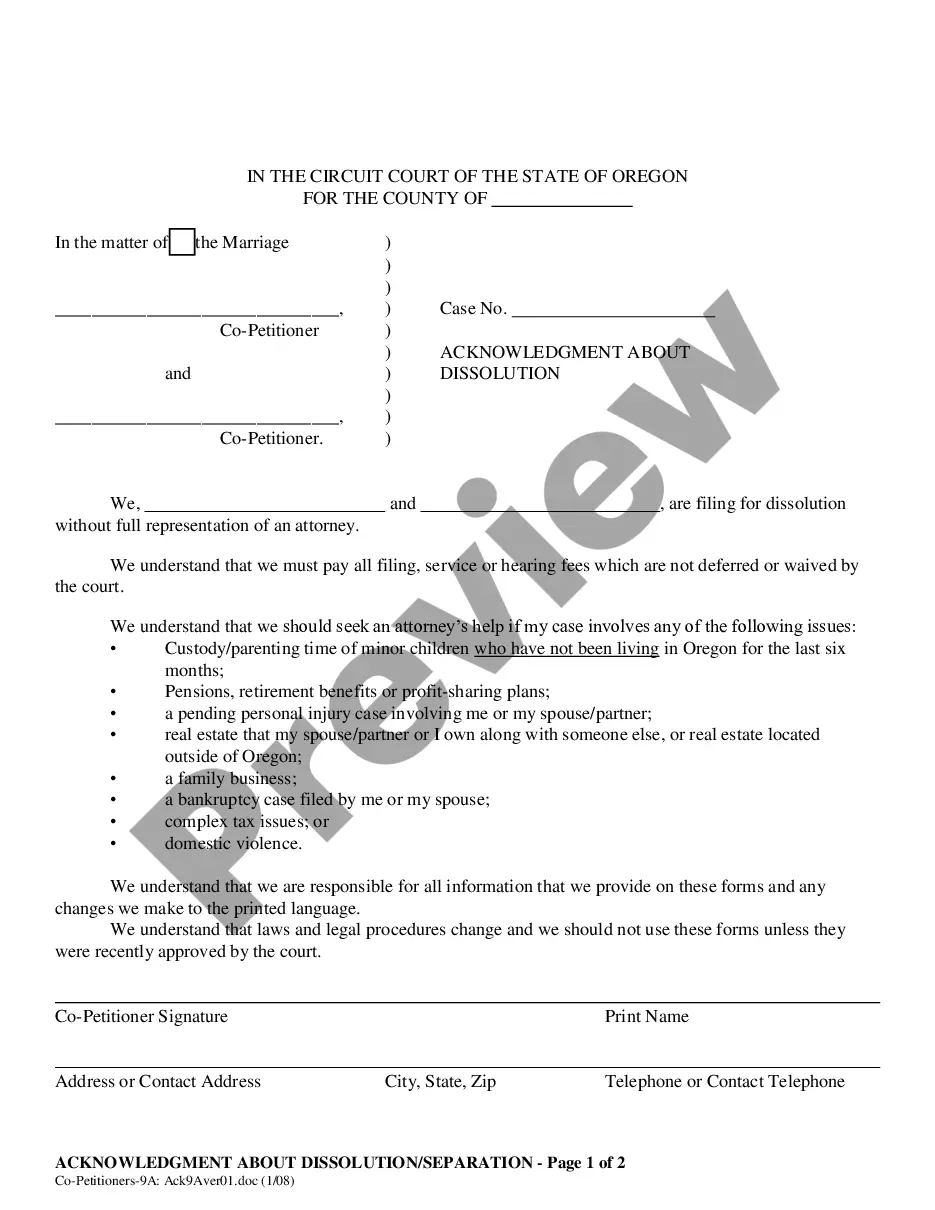
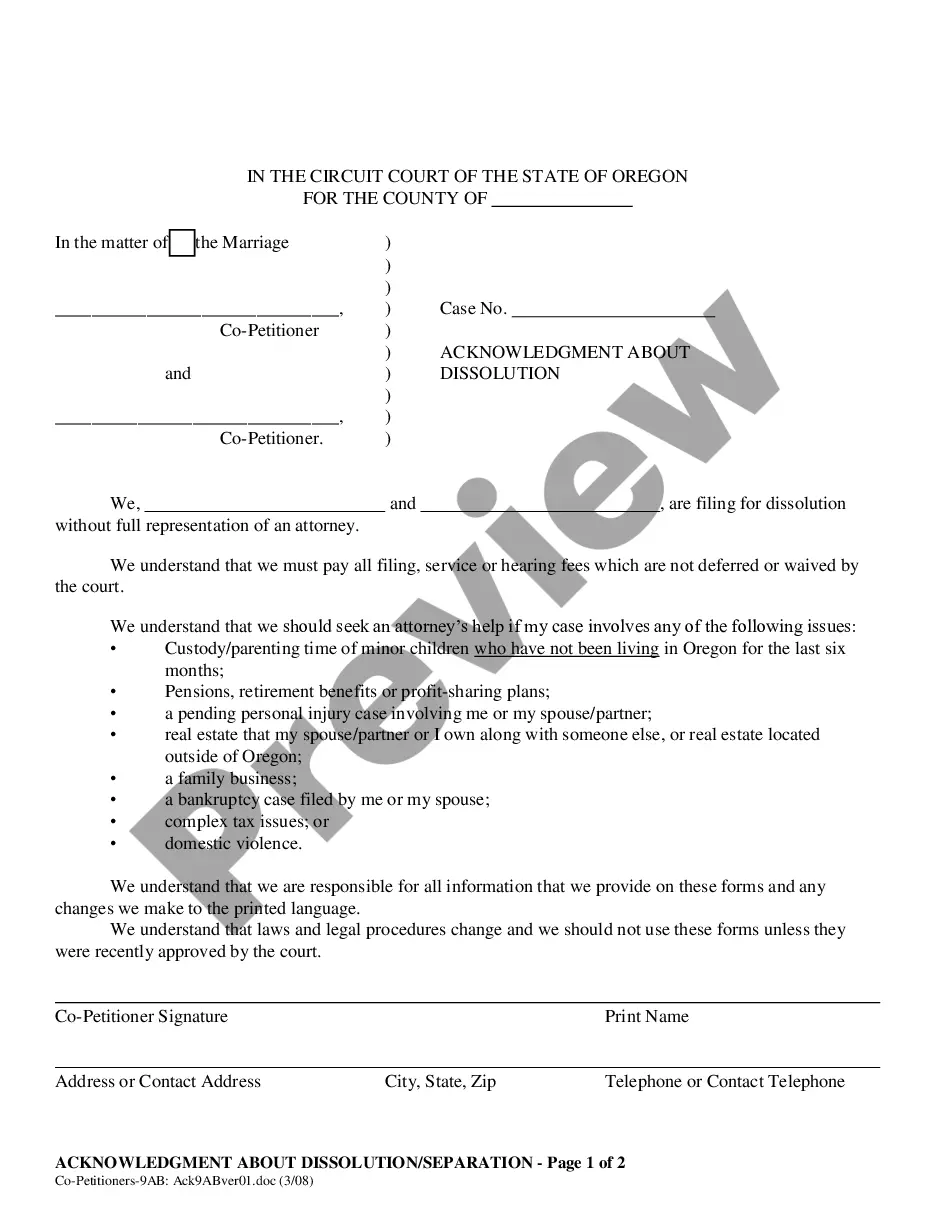
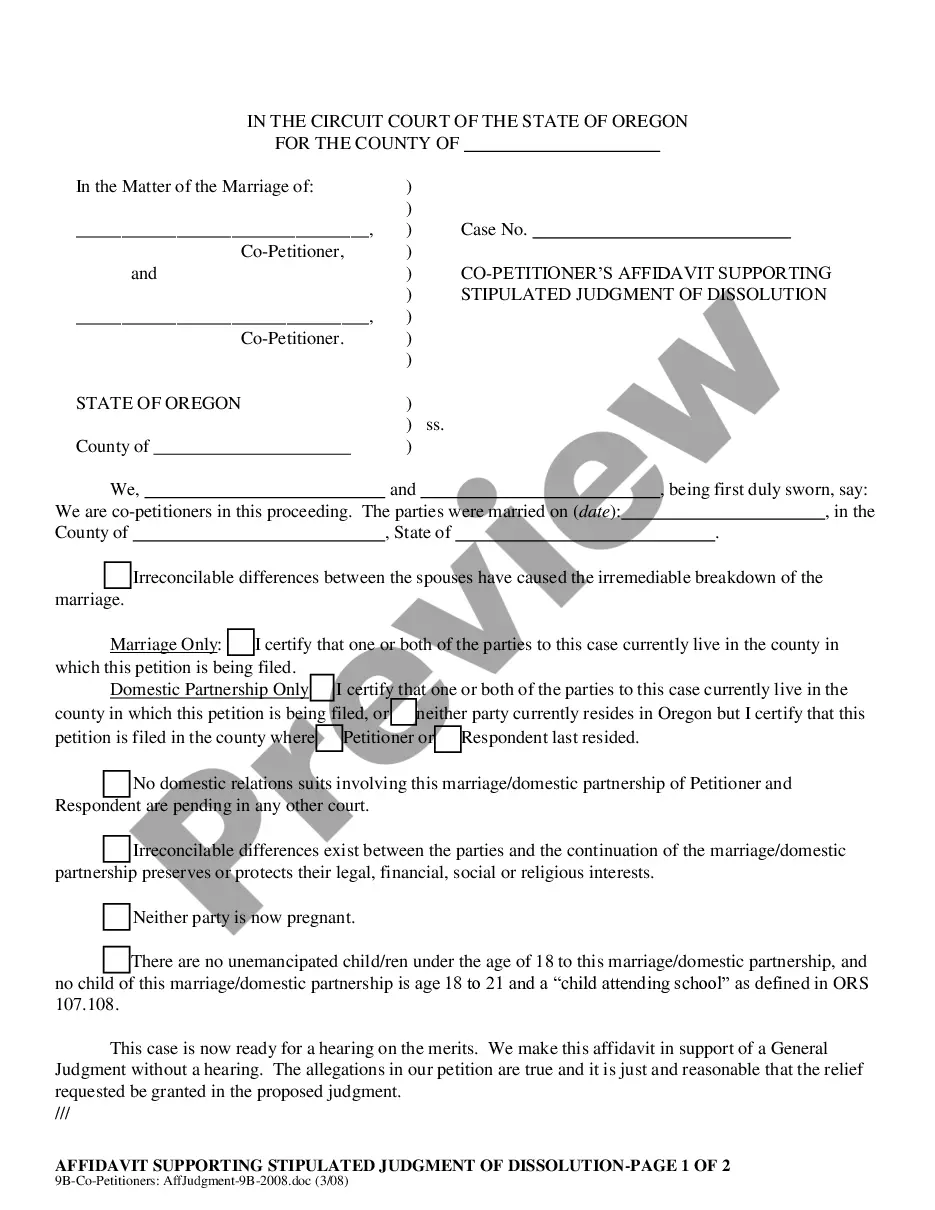
The Co-Petitioners' Acknowledgment About Dissolution is a legal form required during the divorce process. It confirms that both co-petitioners are filing for dissolution without the full representation of an attorney. This acknowledgment also outlines the responsibilities of the co-petitioners regarding court fees and the importance of seeking legal counsel in specific circumstances. Unlike other divorce forms, this form specifically emphasizes the co-petitioners' understanding and agreement to proceed without full legal representation.
Key components of this form
- Identification of the co-petitioners involved in the divorce.
- Statement acknowledging filing for dissolution of marriage without full attorney representation.
- Responsibility for all court-related fees unless waived by the court.
- List of circumstances that may require legal assistance.
- Signatures and printed names of both co-petitioners.

Common use cases
This form should be used at the time the divorce petition is filed in the circuit court. It is essential when both spouses agree to pursue a divorce without the full representation of an attorney. This form is particularly relevant in situations where the co-petitioners are managing a straightforward dissolution process without complex legal issues that would necessitate attorney involvement.
Who needs this form
- Couples who mutually decide to divorce without a lawyer.
- Individuals who understand the legal implications of their dissolution.
- Those who have no significant legal complexities in their divorce case.
- Individuals willing to take responsibility for filing fees and potential legal issues.
Instructions for completing this form
- Identify and enter the names of both co-petitioners in the designated fields.
- Clearly state that you are filing for dissolution without full representation of an attorney.
- Read the responsibilities listed regarding court fees and legal consultation for specific issues.
- Each co-petitioner must sign the form and print their name below the signature.
- Provide your address and contact telephone number in the respective fields.
Notarization requirements for this form
This form does not typically require notarization unless specified by local law. It is important to review any specific requirements from the Oregon circuit court regarding notarization or additional verification for divorce filings.
Get your form ready online
Our built-in tools help you complete, sign, share, and store your documents in one place.
Make edits, fill in missing information, and update formatting in US Legal Forms—just like you would in MS Word.
Download a copy, print it, send it by email, or mail it via USPS—whatever works best for your next step.
Sign and collect signatures with our SignNow integration. Send to multiple recipients, set reminders, and more. Go Premium to unlock E-Sign.
If this form requires notarization, complete it online through a secure video call—no need to meet a notary in person or wait for an appointment.
We protect your documents and personal data by following strict security and privacy standards.

Make edits, fill in missing information, and update formatting in US Legal Forms—just like you would in MS Word.

Download a copy, print it, send it by email, or mail it via USPS—whatever works best for your next step.

Sign and collect signatures with our SignNow integration. Send to multiple recipients, set reminders, and more. Go Premium to unlock E-Sign.

If this form requires notarization, complete it online through a secure video call—no need to meet a notary in person or wait for an appointment.

We protect your documents and personal data by following strict security and privacy standards.
Typical mistakes to avoid
- Failing to sign the form, which invalidates it.
- Not listing all required personal information accurately.
- Ignoring the need for legal advice in cases with potential complexities.
- Submitting the form without ensuring it reflects the most current legal standards.
Benefits of using this form online
- Convenient access allows you to fill out the form at your own pace.
- Editable documents let you ensure all details are correct before submission.
- Access to attorney-drafted templates ensures reliability and adherence to legal standards.
- No need for physical visits to a lawyer for basic acknowledgments.
Looking for another form?
Form popularity
FAQ
In a contested divorce the petitioner (plaintiff) petitions the court for a divorce and respondent (defendant) has to respond. When the petition is jointly filed, the spouses are called Co-Petitioners. The husband and wife petition the court together with paperwork that is signed by both parties.
Joint Petition for a Summary Dissolution. A summary dissolution is a special court process for ending a divorce quickly and efficiently. If all the requirements are met, the court will simply grant the divorce without a hearing.
The parties must file a joint petition together in court, meaning both parties sign on to the petition. The joint petition must be accompanied by a settlement agreement that completely and totally resolves all issues relating to the divorce?including alimony and the distribution of all assets and debts.
§ 107.075 (2021).) Some uncontested dissolutions where the parties have no children can be completed in under a month. Most often, though, an Oregon uncontested dissolution will take one to three months to finalize.
A summary dissolution is a simpler way to end a marriage or domestic partnership for couples who qualify and are able to work together. A summary dissolution becomes final 6 months after you file with the court. This shows the basic process. Select any step to navigate to step-by-step instructions.
A summary dissolution is an easier way to get divorced or end a domestic partnership. It's less expensive and there's not as much paperwork as the standard divorce process. Not everyone can use this process.
Dissolution of marriage judgments terminate the marital status of parties, while parties that receive a legal separation judgment are still legally married to each other. There are tax implications that may arise.
You have 30 days from the date you were served with the Petition to file a written Response with the court clerk and pay the filing fee. If you don't file a Response within 30 days of being served, the Petitioner can ask the court to enter an Order of Default and then enter a judgment based on the Petition.