Oklahoma Revocation of Health Care Directive
Overview of this form
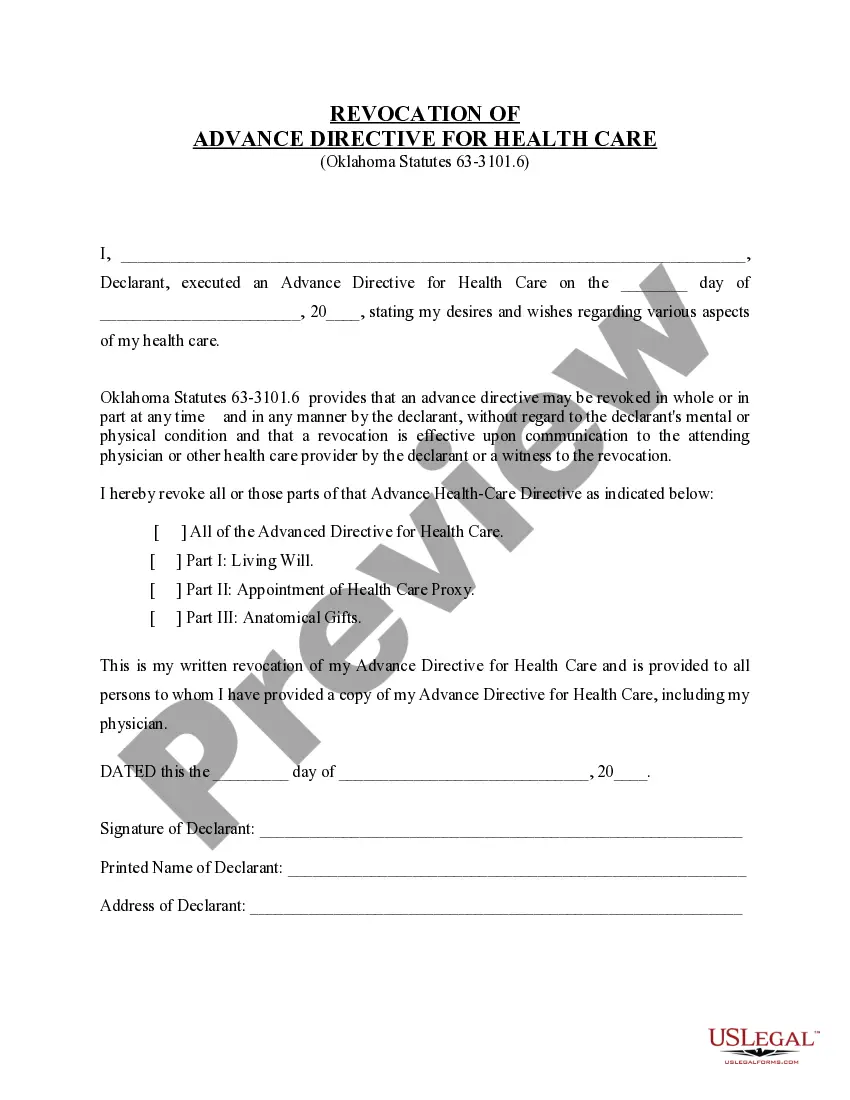
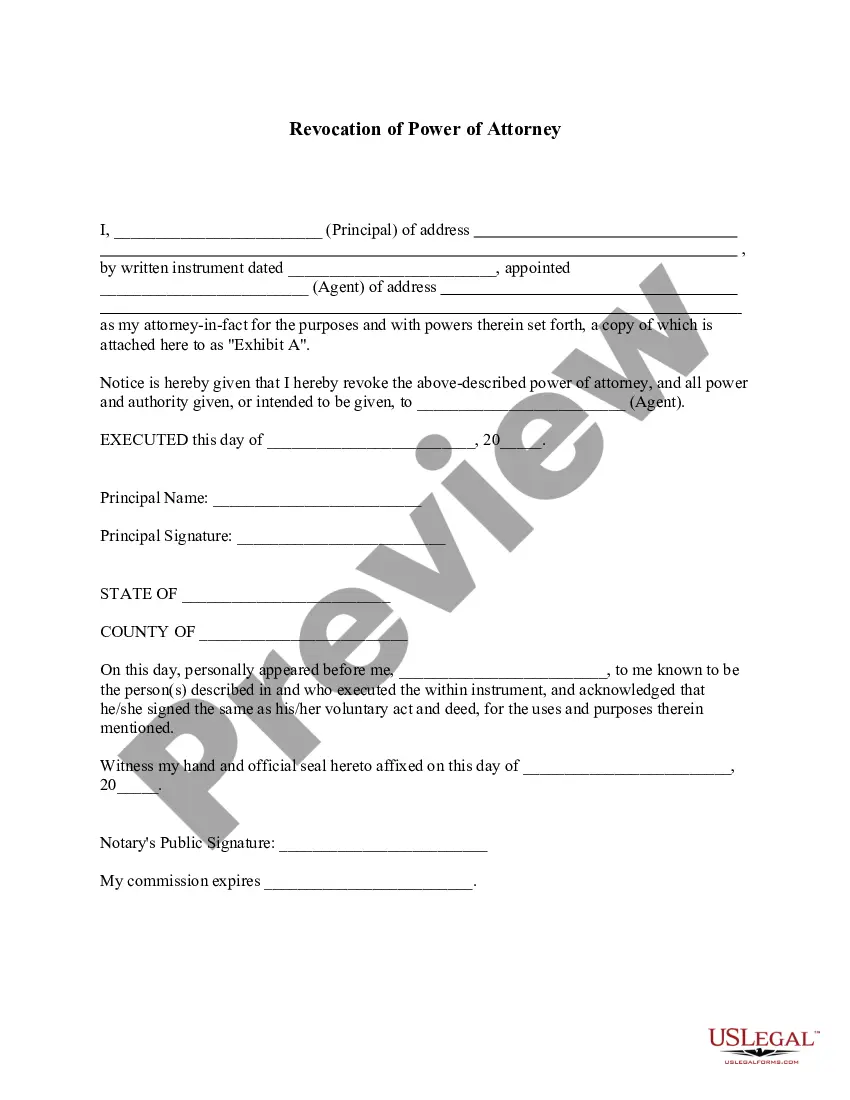
The Revocation of Health Care Directive is a legal document that allows individuals to partially or fully revoke their previously established Advance Directive for Health Care. This form is essential as it enables a declarant to update or withdraw their choices regarding medical treatment, appoint a health care proxy, and make anatomical gifts. Unlike other advance directive forms, this specific revocation form is focused solely on canceling prior health care instructions, ensuring that your current wishes are accurately reflected, regardless of your mental or physical condition.
Form components explained
- Declarant's information, including name and address.
- Date of execution of the original Advance Directive for Health Care.
- Specification of what parts of the advance directive are being revoked.
- Signature and printed name of the declarant.
- Option to notify relevant parties, such as health care providers and agents.
- Effective revocation upon communication to attending physicians.
Common use cases
This revocation form should be used when individuals wish to change their health care preferences outlined in their Advance Directive for Health Care. It is appropriate in situations where a declarant may wish to remove specific instructions or the entire directive due to changes in personal beliefs, health conditions, family dynamics, or other significant life events.
Who needs this form
- Individuals who have previously established an Advance Directive for Health Care.
- Anyone who wishes to revoke or alter their health care decisions formally.
- People looking to appoint a new health care agent or adjust existing instructions.
- Individuals experiencing changes in their health status or personal circumstances.
How to prepare this document
- Identify yourself by entering your name and address at the beginning of the form.
- Fill in the date when you initially executed the Advance Directive for Health Care.
- Specify whether you are revoking the entire directive or certain parts, such as the living will or health care proxy.
- Sign and print your name to validate the revocation.
- Consider providing copies to your health care agents and medical providers to ensure they have your current health care wishes.
Does this document require notarization?
Notarization is generally not required for this form. However, certain states or situations might demand it. You can complete notarization online through US Legal Forms, powered by Notarize, using a verified video call available anytime.
Get your form ready online
Our built-in tools help you complete, sign, share, and store your documents in one place.
Make edits, fill in missing information, and update formatting in US Legal Forms—just like you would in MS Word.
Download a copy, print it, send it by email, or mail it via USPS—whatever works best for your next step.
Sign and collect signatures with our SignNow integration. Send to multiple recipients, set reminders, and more. Go Premium to unlock E-Sign.
If this form requires notarization, complete it online through a secure video call—no need to meet a notary in person or wait for an appointment.
We protect your documents and personal data by following strict security and privacy standards.

Make edits, fill in missing information, and update formatting in US Legal Forms—just like you would in MS Word.

Download a copy, print it, send it by email, or mail it via USPS—whatever works best for your next step.

Sign and collect signatures with our SignNow integration. Send to multiple recipients, set reminders, and more. Go Premium to unlock E-Sign.

If this form requires notarization, complete it online through a secure video call—no need to meet a notary in person or wait for an appointment.

We protect your documents and personal data by following strict security and privacy standards.
Common mistakes to avoid
- Failing to clearly indicate whether the entire directive or specific sections are revoked.
- Not communicating the revocation to relevant health care providers.
- Forgetting to sign and date the form, which could render it invalid.
- Assuming that verbal revocations are sufficient without written confirmation.
Benefits of using this form online
- Immediate access to the form for convenience and efficiency.
- Editable fields allow for easy customization according to your specific needs.
- Reliable templates drafted by licensed attorneys to ensure compliance with legal standards.
- The ability to download and store copies for your records securely.
Legal use & context
- Revocation is effective upon communication to your attending physician or other healthcare providers.
- This form serves as a legal notification of your intent to revoke previously made health care decisions.
Summary of main points
- The Revocation of Health Care Directive allows you to update your health care preferences legally.
- This form is essential when your circumstances around health care wishes change.
- Always communicate revocations to your health care providers to ensure your current wishes are known.
Looking for another form?
Form popularity
FAQ
Some states combine a declaration and a durable power of attorney into a single form, called an "advance health care directive."If someone disputes the validity of your health care directive, it may be challenged in court.
A person can change an Individual Healthcare Instruction by writing a new Advance Directive with the changes in it that she wants to make.A person can also revoke their Advance Directive orally, by telling their healthcare provider that they no longer want either the entire document or any parts of it enforced.
An advance directive, alone, may not be sufficient to stop all forms of life-saving treatment.You retain the right to override the decisions or your representative, change the terms of your living will or POA, or completely revoke an advance directive.
False. Naming a health care agent proxy does not take away any of your authority. You always have the right, while you are still competent, to override the decision of your proxy or revoke the directive.
An advance directive, alone, may not be sufficient to stop all forms of life-saving treatment.You retain the right to override the decisions or your representative, change the terms of your living will or POA, or completely revoke an advance directive.
The living will. Durable power of attorney for health care/Medical power of attorney. POLST (Physician Orders for Life-Sustaining Treatment) Do not resuscitate (DNR) orders. Organ and tissue donation.
Advance care directives are legally enforceable in NSW. Although NSW does not have specific legislation on advance care directives, the Supreme Court has said that valid advance care directives must be respected (as an extension to a person's right to determine their own medical treatment).
A person can also revoke their Advance Directive orally, by telling their healthcare provider that they no longer want either the entire document or any parts of it enforced.