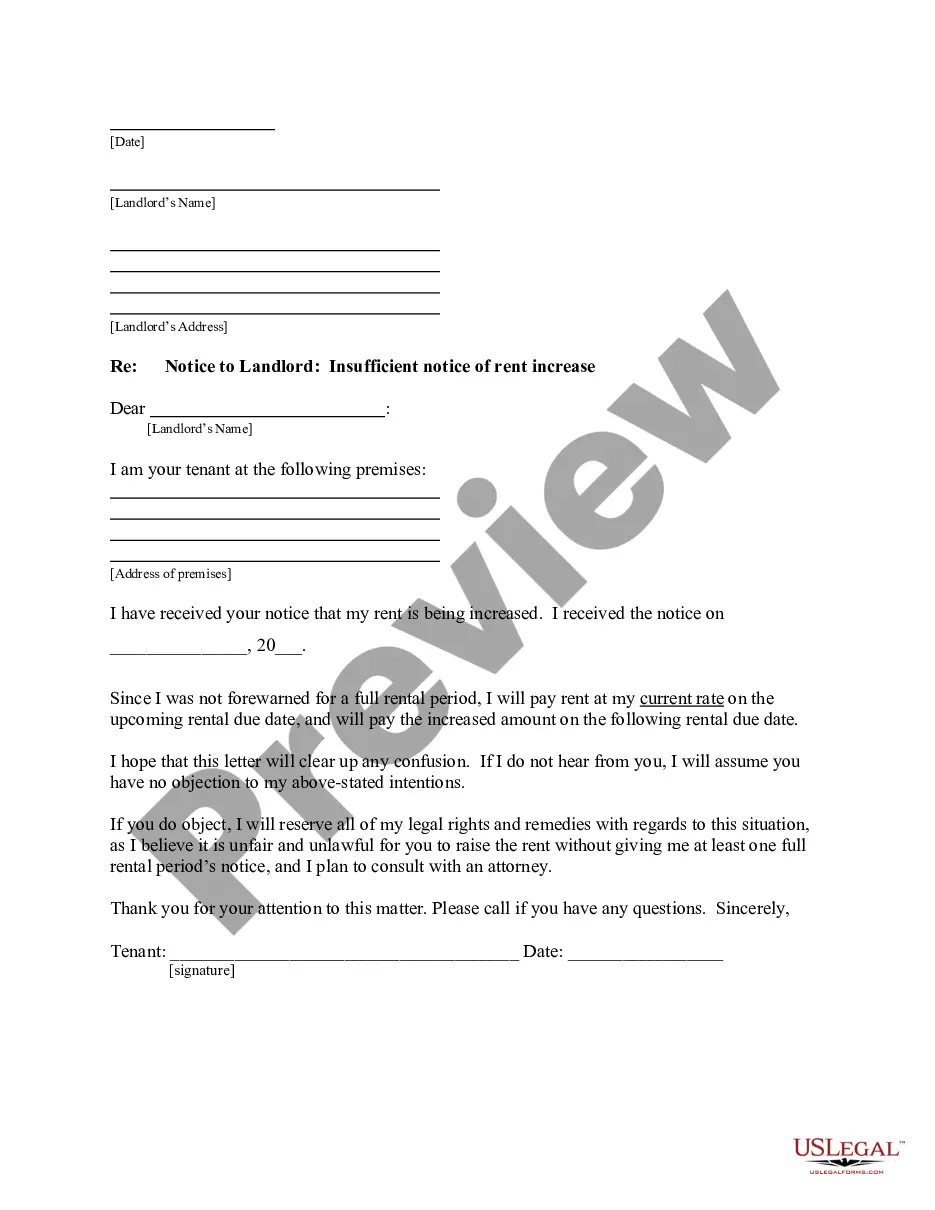
Oklahoma Letter from Tenant to Landlord about Insufficient notice of rent increase
What is this form?
This form is a Letter from Tenant to Landlord about insufficient notice of rent increase. It serves to formally notify the landlord that the tenant has not received adequate advance notice of a rent increase for a month-to-month lease. The letter clarifies that the tenant will continue to pay the current rent amount until proper notice is given, ensuring legal compliance and clear communication between both parties.
Key parts of this document
- Identification of the tenant and landlord.
- Statement addressing the insufficient notice of rent increase.
- Intention to continue paying the current rental rate.
- Request for confirmation or objection from the landlord.
- Signature and date for formal acknowledgment.


When to use this form
This form should be used when a landlord attempts to increase rent without providing the legally required notice period. It is particularly useful in situations where the tenant wants to assert their rights and clarify their intentions regarding the rent payment until proper notice is received.
Intended users of this form
Eligible users of this form include:
- Tenants receiving a rent increase notice that does not comply with legal requirements.
- Individuals leasing a property under a month-to-month rental agreement.
- Anyone seeking to maintain clear communication with their landlord regarding rental terms.
How to prepare this document
Follow these steps to complete the form:
- Identify the parties involved, including the tenant's name and the landlord's name or address.
- Clearly state the notice of insufficient rent increase.
- Specify that the tenant will pay the current rent amount until proper notice is provided.
- Request a response from the landlord regarding their objection or agreement.
- Sign and date the letter to formalize the communication.
Does this form need to be notarized?
This form does not typically require notarization unless specified by local law.
Get your form ready online
Our built-in tools help you complete, sign, share, and store your documents in one place.
Make edits, fill in missing information, and update formatting in US Legal Forms—just like you would in MS Word.
Download a copy, print it, send it by email, or mail it via USPS—whatever works best for your next step.
Sign and collect signatures with our SignNow integration. Send to multiple recipients, set reminders, and more. Go Premium to unlock E-Sign.
If this form requires notarization, complete it online through a secure video call—no need to meet a notary in person or wait for an appointment.
We protect your documents and personal data by following strict security and privacy standards.

Make edits, fill in missing information, and update formatting in US Legal Forms—just like you would in MS Word.

Download a copy, print it, send it by email, or mail it via USPS—whatever works best for your next step.

Sign and collect signatures with our SignNow integration. Send to multiple recipients, set reminders, and more. Go Premium to unlock E-Sign.

If this form requires notarization, complete it online through a secure video call—no need to meet a notary in person or wait for an appointment.

We protect your documents and personal data by following strict security and privacy standards.
Mistakes to watch out for
- Failing to provide accurate information about the rental property or parties involved.
- Not specifying the date by which the landlord should respond.
- Ignoring local laws regarding the required notice period for rent increases.
Why complete this form online
- Convenience of downloading the form instantly for immediate use.
- Editability allows customization to match individual circumstances.
- Reliability, as forms are drafted by licensed attorneys ensuring legal compliance.
- The letter serves as a formal record for both tenant and landlord regarding the rent increase notice.
- It protects the tenant's rights by documenting their intent to continue paying the initial rent amount.
- The enforceability of this letter may depend on local landlord-tenant laws regarding notice periods.
What to keep in mind
- Use this letter to formally address insufficient rent increase notices.
- Documenting your intentions can prevent misunderstandings with your landlord.
- Always review state-specific requirements for compliance.
Looking for another form?
Form popularity
FAQ
Research the Rental Market. Rental markets rise and fall and with it rent prices go up and down. Consider the Season. Calculate If It's Financially Worth It to Negotiate Rent. Consider How Close You Are to a Vacancy. Offer Incentives Instead. Next Steps.
I am writing to make you a request to reduce my rental obligation each month until the economy improves. Honestly, it would be very difficult for me to continue doing business with the current rent and would be highly grateful if you could consider my request.
Tenant's name. Property address. Landlord name and contact information. Date the letter is written. Date the rent increase will take effect. Amount of rent increase. Current cost of rent.
Ask the landlord if rent price is open to discussion. Highlight your strengths as a tenant. Inquire about extending the lease. Offer to end the lease in the summer. Research the property's value. Be open to compromise. Negotiate directly, follow up in writing.
Remember you're a business. Do your research. Raise the rent all at once or incrementally. Don't negotiate or ask tenants what they think a fair rent increase would be. Be courteous and firm. Find a template you like. Send a formal letter by certified mail. Give the tenant notice.
Dear (property manager's name), I wanted to contact you today to ask if we could discuss lowering my rent. I love living here but lately, finances have been difficult and a slight reduction in rent would go a long way in helping. It's important to me to be a good and responsible tenant.
It is now illegal for residential landlords to raise rent more than 5 percent, plus the local rate of inflation, in one year.
Step 1: Write a Cover Letter. Step 2: Provide a Summary of the Proposal. Step 3: Specify the Operations of the Tenant. Step 4: Present the Cost Summary. Step 5: List the Terms of the Contract. Step 6: Mention the Benefits.