New York Demand for Terms of Contract by Corporation
What is this form?
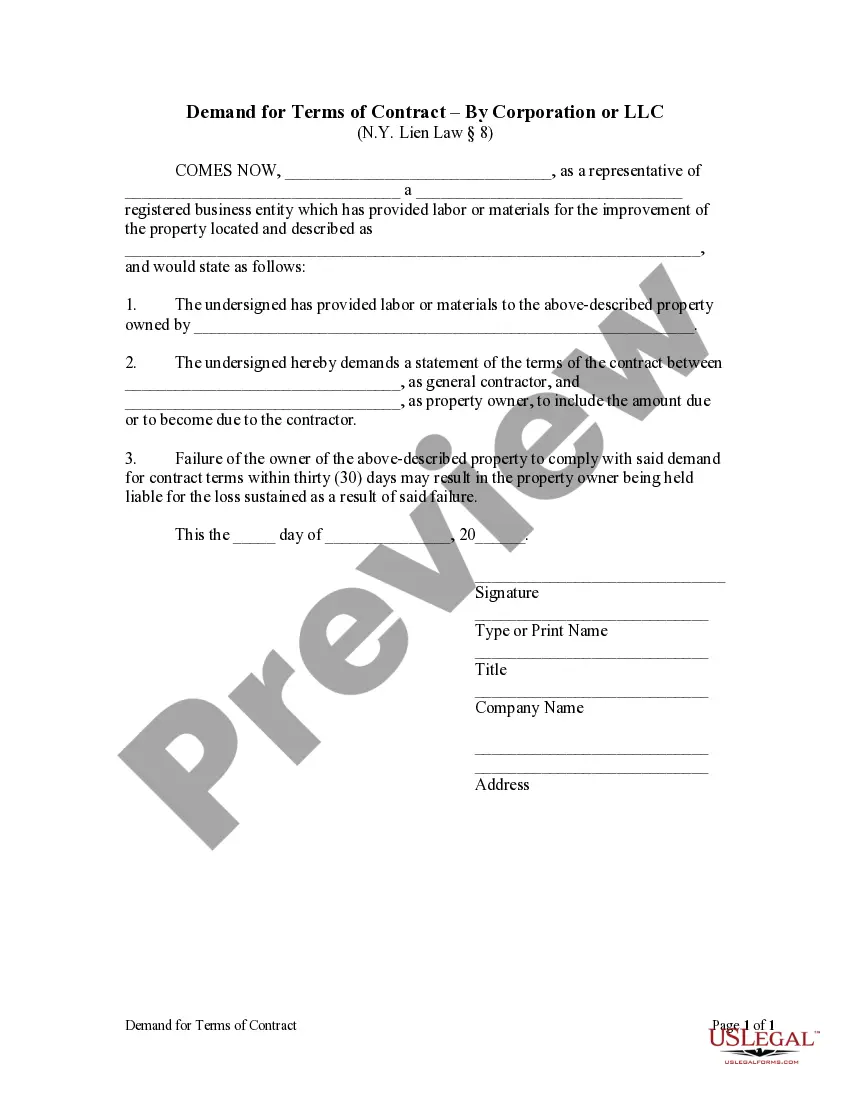
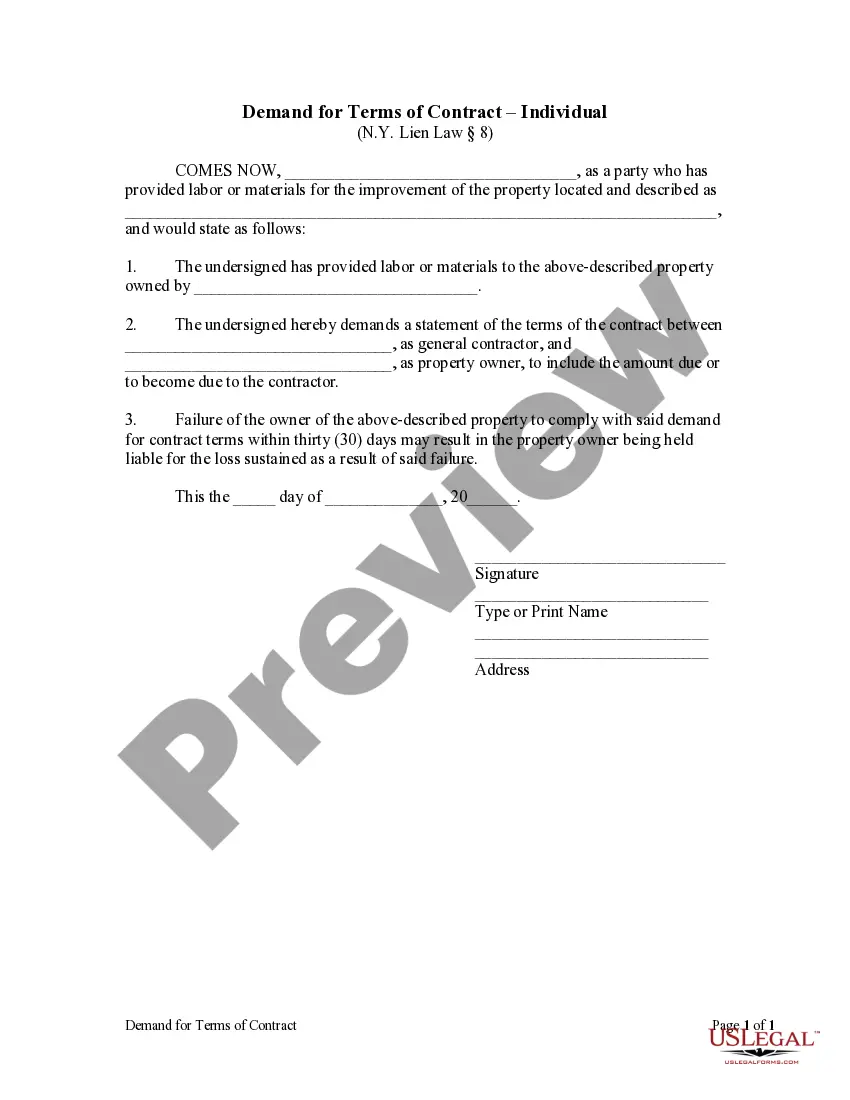
The Demand for Terms of Contract by Corporation is a legal document that allows contractors or subcontractors in New York to request the terms of contracts between the property owner and the general contractor. This form empowers those who provide labor or materials to seek clarity on payments and obligations, ensuring they have access to necessary contract details. Unlike other contract-related forms, this document specifically addresses the rights of subcontractors and suppliers to demand contractual information from property owners.
Main sections of this form
- Identification of the representative and corporation making the demand.
- Description of the property where labor or materials were provided.
- Details of the demand for the terms of the contract between the contractor and the property owner.
- Notification of the property owner's obligation to respond within thirty (30) days.
- Signature and contact information of the representative from the corporation.
When to use this document
This form should be used when a subcontractor, laborer, or materialman has provided services or materials for a property but has not received the terms of the contract between the general contractor and the property owner. It is particularly important in situations where timely payment is necessary, and clarity on contractual obligations is needed to avoid potential financial losses or disputes.
Who this form is for
Eligible users of this form include:
- Subcontractors who have performed work or supplied materials for a property.
- Laborers seeking to confirm the terms of their agreements with contractors.
- Material suppliers wanting assurance regarding payment obligations from property owners.
How to complete this form
- Identify the representative and the name of the corporation making the demand.
- Specify the property where the labor or materials were provided.
- Fill in the name of the property owner and the general contractor involved in the contract.
- Clearly indicate the demand for a statement of the contract terms.
- Sign and date the form, including the title of the representative.
Notarization requirements for this form
This form does not typically require notarization to be legally valid. However, some jurisdictions or document types may still require it. US Legal Forms provides secure online notarization powered by Notarize, available 24/7 for added convenience.
Get your form ready online
Our built-in tools help you complete, sign, share, and store your documents in one place.
Make edits, fill in missing information, and update formatting in US Legal Forms—just like you would in MS Word.
Download a copy, print it, send it by email, or mail it via USPS—whatever works best for your next step.
Sign and collect signatures with our SignNow integration. Send to multiple recipients, set reminders, and more. Go Premium to unlock E-Sign.
If this form requires notarization, complete it online through a secure video call—no need to meet a notary in person or wait for an appointment.
We protect your documents and personal data by following strict security and privacy standards.

Make edits, fill in missing information, and update formatting in US Legal Forms—just like you would in MS Word.

Download a copy, print it, send it by email, or mail it via USPS—whatever works best for your next step.

Sign and collect signatures with our SignNow integration. Send to multiple recipients, set reminders, and more. Go Premium to unlock E-Sign.

If this form requires notarization, complete it online through a secure video call—no need to meet a notary in person or wait for an appointment.

We protect your documents and personal data by following strict security and privacy standards.
Common mistakes to avoid
- Failure to accurately identify the property involved in the contract.
- Not including complete contact information for the corporation.
- Missing the signature of the representative, which may invalidate the demand.
- Neglecting to clearly state the demand for the contract terms.
Benefits of completing this form online
- Convenient access to latest legal forms from anywhere at any time.
- Editable templates that allow for personalization to fit specific circumstances.
- Reliable and legally sound documents prepared by licensed attorneys.
Main things to remember
- The Demand for Terms of Contract by Corporation is essential for subcontractors and suppliers to obtain contract details.
- The property owner must respond within thirty days to avoid liability for damages.
- This form is specific to New York law and serves to protect the rights of those providing work or materials.
Looking for another form?
Form popularity
FAQ
The first efforts to form LLCs were thwarted by IRS rulings that the business form was too much like a corporation to escape corporate tax complications.Thus it is extremely important that the LLC promoters avoid the corporate characteristics of continuity of life and free transferability of interests.
Both types of entities have the significant legal advantage of helping to protect assets from creditors and providing an extra layer of protection against legal liability. In general, the creation and management of an LLC are much easier and more flexible than that of a corporation.
In an LLC, individuals with an ownership share are called members. In a corporation, they are called shareholders. One of the advantages an LLC has over a corporation is that in many states, a creditor cannot collect a member's dividends, whereas in a corporation dividends can be collected from shareholders.
LLC owners must pay self-employment taxes for all income. S-corp owners may pay less on this tax, provided they pay themselves a "reasonable salary." LLCs can have an unlimited number of members, while S-corps are limited to 100 shareholders.
LLCs are owned by members who generally are not legally liable for company debts. LLCs have the legal authority to enter contracts relating to their business operations, but the laws of the individual states outline the parties that may legally bind an LLC to contractual agreements.
One of the main reasons to form a corporation or LLC for a small business is to avoid personal liability for the business' debts. As we mentioned earlier, corporations and LLCs have their own legal existence. It's the corporation or LLC that owns the business, its assets, debts, and liabilities.
Probably the most obvious advantage to forming an LLC is protecting your personal assets by limiting the liability to the resources of the business itself. In most cases, the LLC will protect your personal assets from claims against the business, including lawsuits.There is also the tax benefit to an LLC.
An LLC can achieve pass-through taxation status without any of those restrictions. LLCs also offer more income tax choices in how you are taxed. By default, LLCs enjoy pass-through taxation under IRS rules. However, by making an IRS election, you could have your LLC taxed as a C corporation or an S Corporation.
One of the main reasons to form a corporation or LLC for a small business is to avoid personal liability for the business' debts. As we mentioned earlier, corporations and LLCs have their own legal existence. It's the corporation or LLC that owns the business, its assets, debts, and liabilities.