Nebraska Quitclaim Deed from Husband and Wife to an Individual
What this document covers
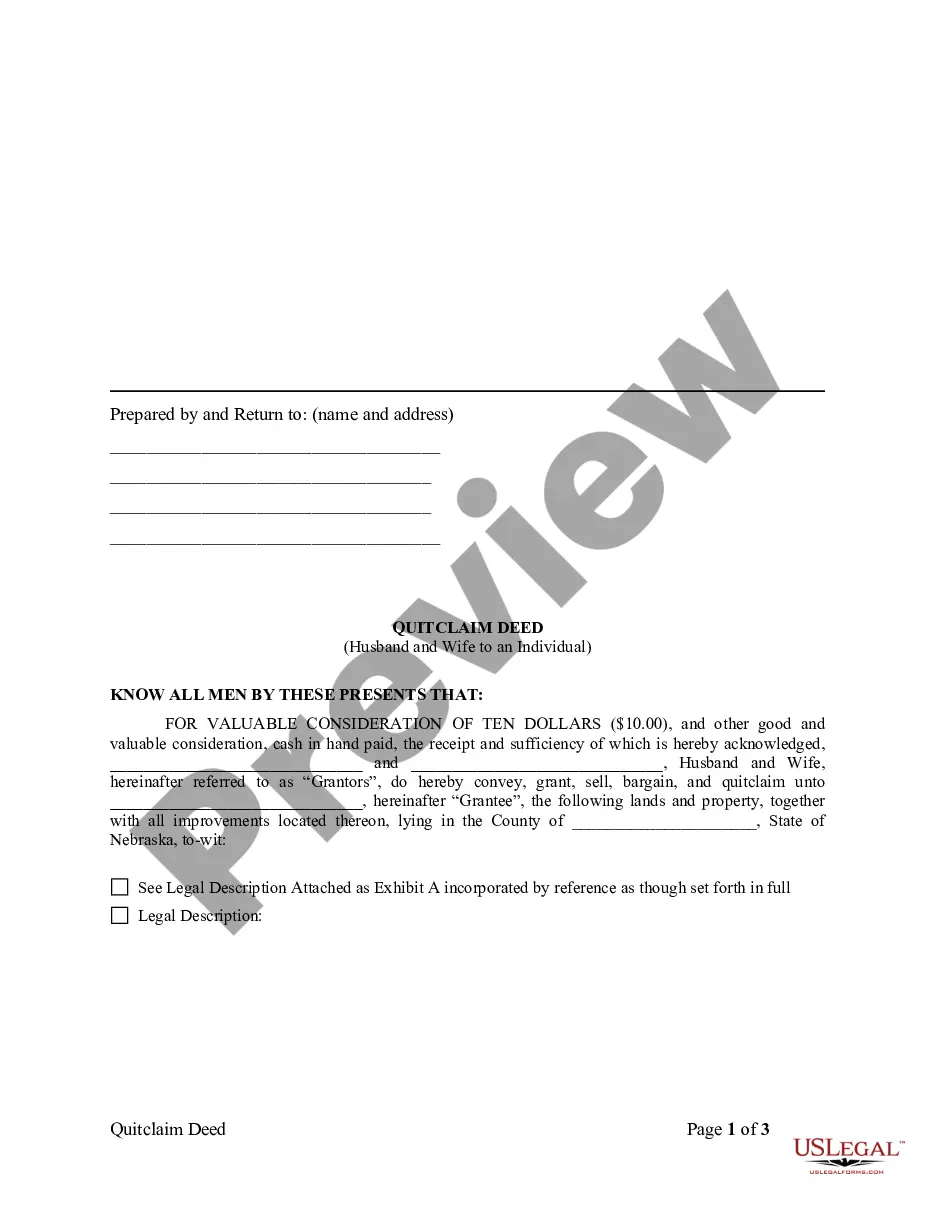
This Quitclaim Deed from Husband and Wife to an Individual is a legal document that allows a married couple (grantors) to transfer their interest in a property to an individual (grantee). Unlike other types of deeds, a quitclaim deed does not guarantee that the grantors own the property free and clear of other claims, making it a simple choice for transferring property rights without extensive warranties. This form is often used in familial situations, such as property transfers between spouses or family members.
Key components of this form
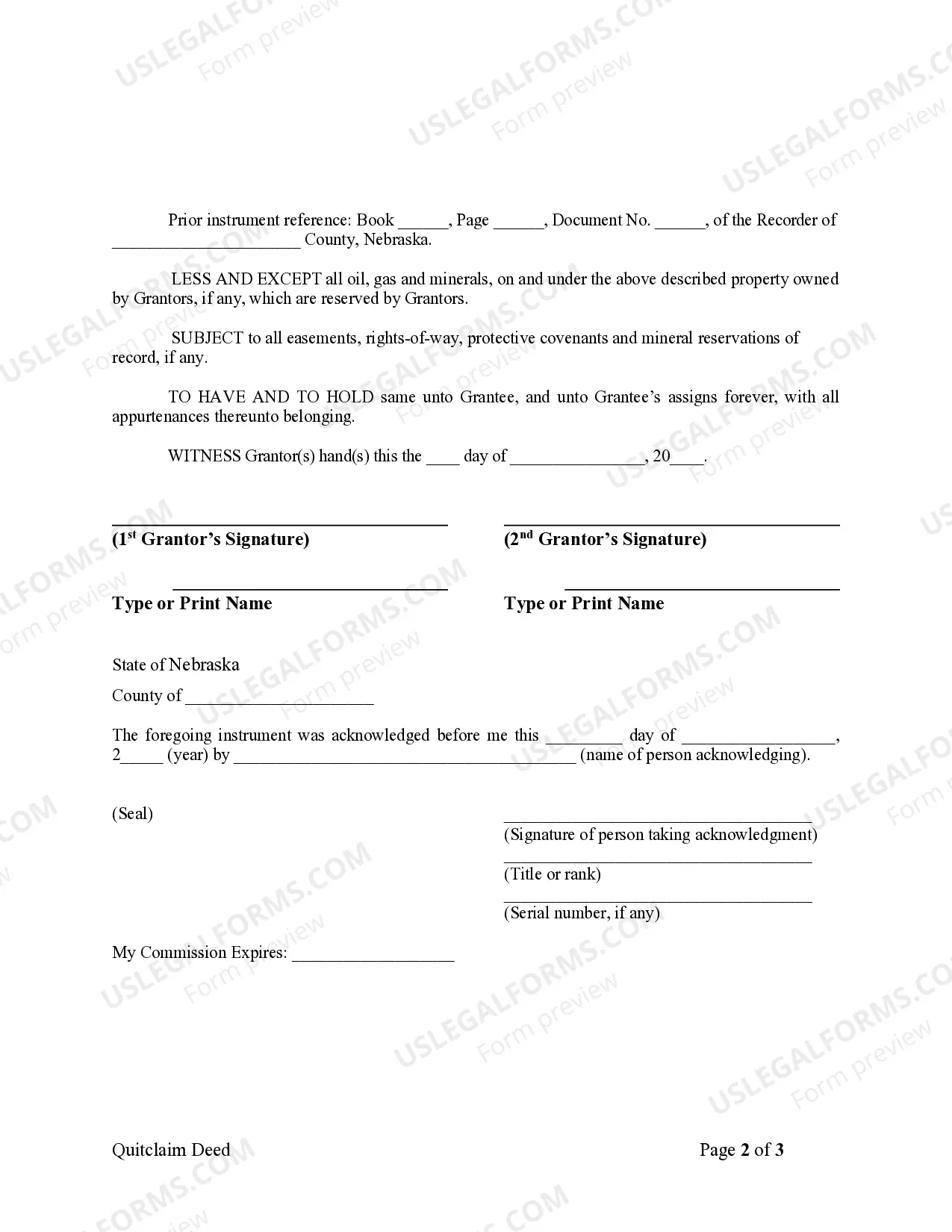
- Prepared by and Return to section: Contains the names and addresses for recording the deed.
- Grantors: Identifies the husband and wife transferring the property.
- Grantee: Specifies the individual receiving the property.
- Property Description: Details the exact location and boundaries of the property being transferred.
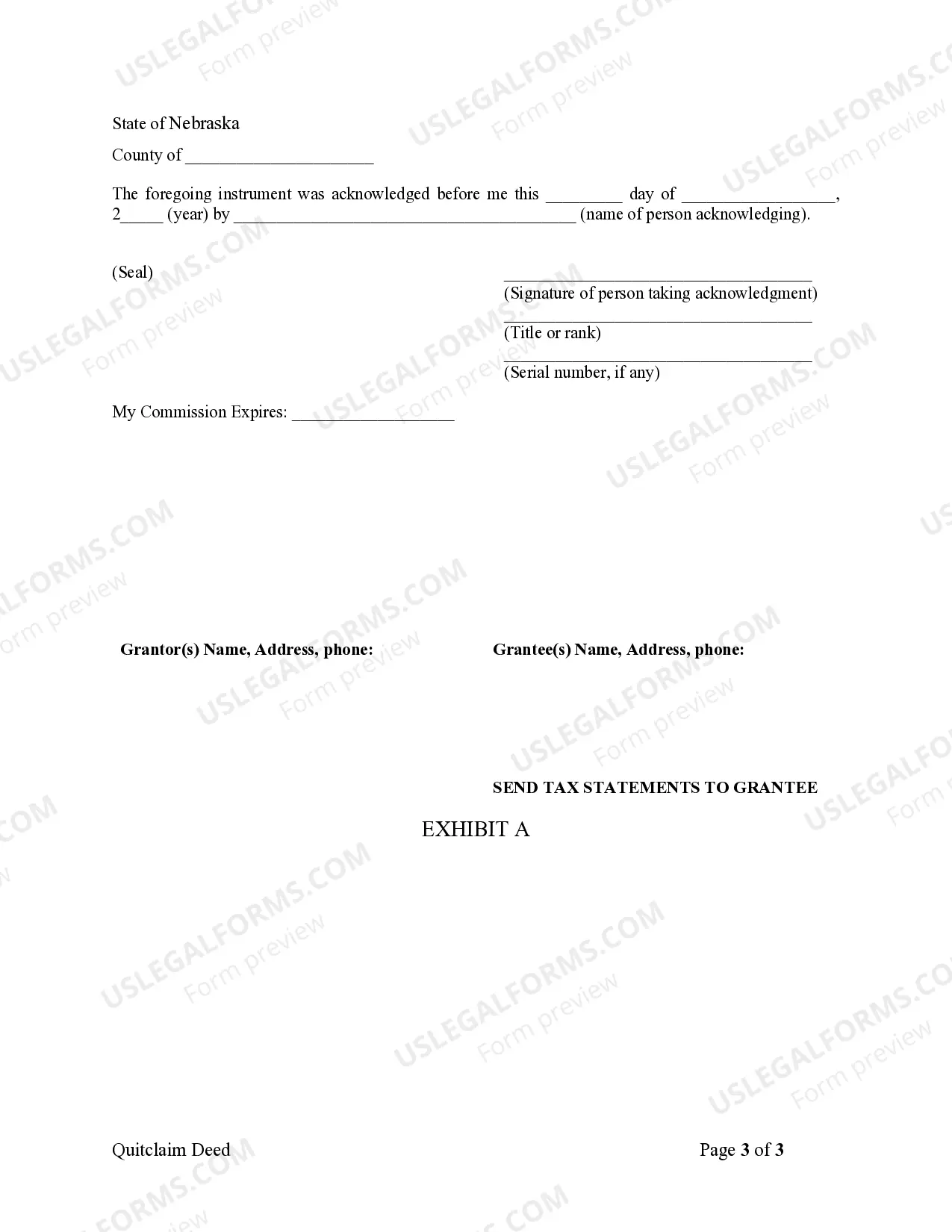
- Reservation of Rights: States that oil, gas, and minerals, if any, are reserved by the grantors.
- Notary Acknowledgment: A section for the notary public to verify the identities of the parties involved.






Situations where this form applies
This form is particularly useful when a married couple wants to transfer property ownership to an individual, such as in a divorce settlement, gift to a family member, or sale of shared property. It is also applicable when the couple wishes to clarify ownership or simplify property transfers within their family.
Intended users of this form
- Married couples transferring property to a single individual.
- Couples wishing to clarify their ownership rights to a property.
- Individuals receiving property as a gift from a spouse or family member.
- Parties involved in a divorce settlement where property division is necessary.
Steps to complete this form
- Identify the parties: Clearly specify the names of the husband and wife as grantors and the individual as the grantee.
- Fill in the property description: Include the legal description of the property being transferred.
- Determine the consideration: Typically, this is a nominal amount such as ten dollars (10.00).
- Complete the notary section: Have the document signed in front of a notary public to validate the transfer.
- File the deed: Submit the completed quitclaim deed to the appropriate county office for recording.
Does this form need to be notarized?
Yes, this form must be notarized to be legally valid. The notary public will verify the identities of the grantors and ensure that the document is executed appropriately. US Legal Forms offers integrated online notarization services, providing secure video calls with notaries available 24/7, ensuring convenience and legal equivalence without the need for travel.
Get your form ready online
Our built-in tools help you complete, sign, share, and store your documents in one place.
Make edits, fill in missing information, and update formatting in US Legal Forms—just like you would in MS Word.
Download a copy, print it, send it by email, or mail it via USPS—whatever works best for your next step.
Sign and collect signatures with our SignNow integration. Send to multiple recipients, set reminders, and more. Go Premium to unlock E-Sign.
If this form requires notarization, complete it online through a secure video call—no need to meet a notary in person or wait for an appointment.
We protect your documents and personal data by following strict security and privacy standards.

Make edits, fill in missing information, and update formatting in US Legal Forms—just like you would in MS Word.

Download a copy, print it, send it by email, or mail it via USPS—whatever works best for your next step.

Sign and collect signatures with our SignNow integration. Send to multiple recipients, set reminders, and more. Go Premium to unlock E-Sign.

If this form requires notarization, complete it online through a secure video call—no need to meet a notary in person or wait for an appointment.

We protect your documents and personal data by following strict security and privacy standards.
Typical mistakes to avoid
- Failing to provide a complete property description could lead to confusion and issues with ownership.
- Not properly acknowledging the deed before a notary, which may invalidate the document.
- Using incorrect names or misspellings of the parties involved, complicating legal recognition.
- Neglecting to consider state-specific recording fees, which can lead to complications during the filing process.
Why complete this form online
- Convenient access to professionally drafted legal forms from licensed attorneys.
- Edit and customize the document to fit your specific needs and circumstances.
- Save time by downloading the form immediately, avoiding delays associated with traditional legal services.
Legal use & context
- This form serves to facilitate the transfer of property rights without providing any assurance about the title's validity.
- Commonly used in informal transactions, it does not typically hold up as strong legal evidence of ownership.
- Ensure mutual consent between parties is confirmed before completing the deed.
Quick recap
- A quitclaim deed transfers property rights without ownership guarantees.
- Best suited for informal property transfers among known parties.
- Complete all necessary sections accurately to avoid legal issues.
- Notarization is required for the deed to be legally recognized.
Looking for another form?
Form popularity
FAQ
A quitclaim deed transfers title but makes no promises at all about the owner's title.A person who signs a quitclaim deed to transfer property they do not own results in no title at all being transferred since there is no actual ownership interest. The quitclaim deed only transfers the type of title you own.
A quitclaim deed affects ownership and the name on the deed, not the mortgage. Because quitclaim deeds expose the grantee to certain risks, they are most often used between family members and where there is no exchange of money.Quitclaim deeds transfer title but do not affect mortgages.
A quitclaim deed is quick and easy because it transfers all of one person's interest in the property to another.The deed transfers all claims the seller has to the property, if any. If the seller has no interest in the real estate, no interest is transferred.
It's often easier to qualify for a joint mortgage, because both spouses can contribute income and assets to the application. However, if one spouse can qualify for a mortgage based on his own income and credit, the mortgage does not need to be in both spouses' names unless you live in a community property state.
One of the simplest ways to add your wife to the home title is by using an interspousal deed. You can transfer the property from your sole and separate property to mutual tenancy, such as joint tenants with right of survivorship, with your wife.
In California, all property bought during the marriage with income that was earned during the marriage is deemed "community property." The law implies that both spouses own this property equally, regardless of which name is on the title deed.
The drawback, quite simply, is that quitclaim deeds offer the grantee/recipient no protection or guarantees whatsoever about the property or their ownership of it. Maybe the grantor did not own the property at all, or maybe they only had partial ownership.
A quitclaim deed is a deed (proof of ownership) that is passed from a grantor (the existing property owner) to a grantee (the new property owner) that does not have a warranty.A quitclaim deed has no guarantees for the grantor or grantee.
Misconceptions and Realities. It is a misconception that someone can be removed from the deed. Nor can a co-owner simply take away another party's interest in a property by executing a new deed without that other party. In short, no one can be passively removed from a title.