North Carolina Quitclaim Deed from Individual to Individual
About this form
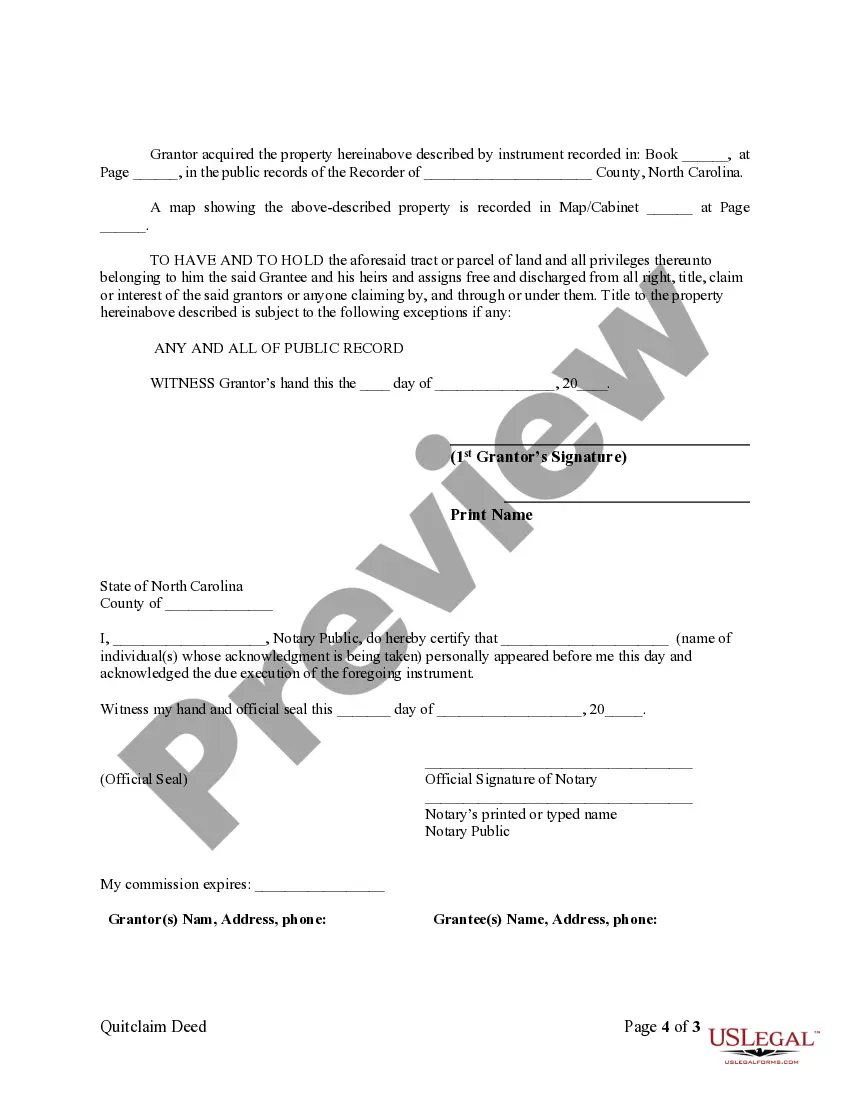
The Quitclaim Deed from Individual to Individual is a legal document that allows one individual, known as the Grantor, to transfer their interest in a property to another individual, known as the Grantee. Unlike warranty deeds, a quitclaim deed does not guarantee that the Grantor has a valid title to the property; it only conveys whatever interest the Grantor has at the time of the transfer. This form is ideal for situations where the parties involved trust each other, such as in familial or informal transfers, and it complies with state statutory laws to ensure its legal validity.
Key parts of this document
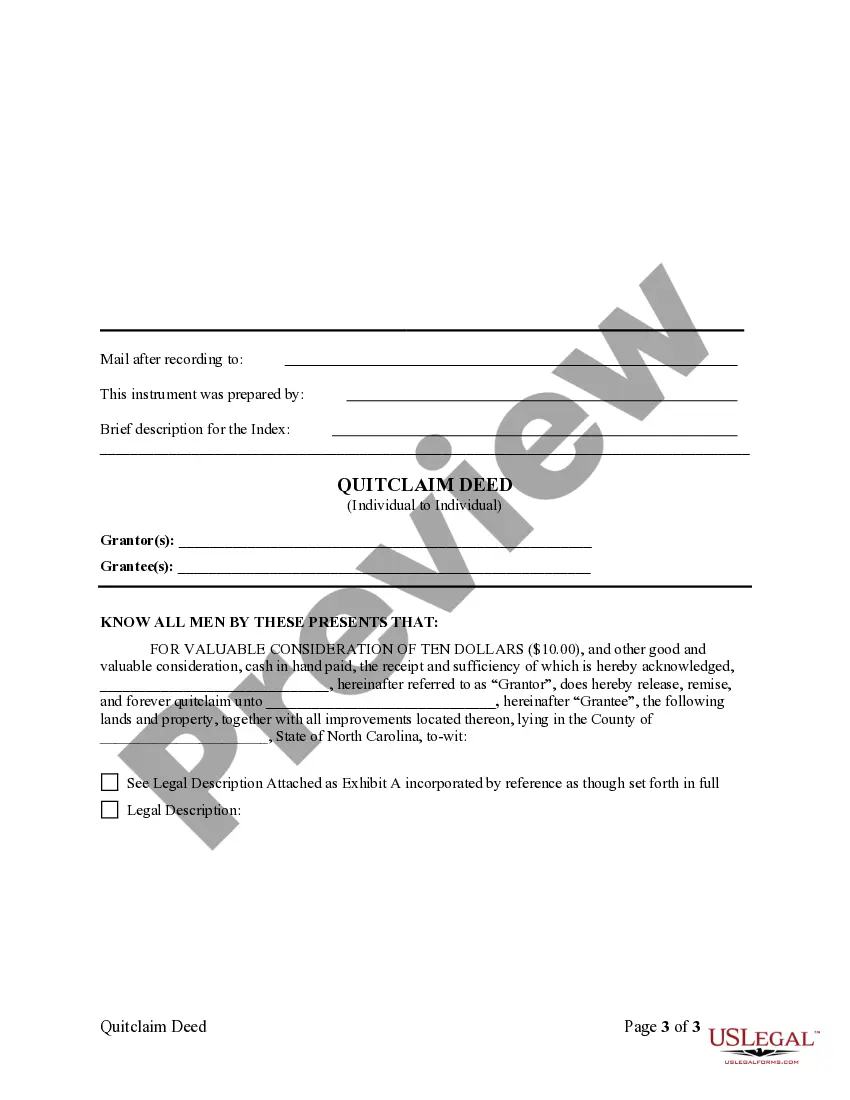
- Grantor and Grantee Information: Includes the names and addresses of both the person transferring the property and the person receiving it.
- Property Description: A detailed description of the property being transferred, often including a legal description or attached exhibit.
- Consideration Clause: States the amount of consideration provided for the transfer, which is generally nominal.
- Exceptions and Reservations: Specifies any exceptions, such as reserved rights to minerals or other resources beneath the property.
- Signatures: Requires the signatures of both the Grantor and Grantee for the deed to be executed properly.






Common use cases
This form is often used in various scenarios, including but not limited to family transactions, transferring property between friends, or resolving estate matters. It is particularly useful when the transfer is informal, and the parties are familiar with one another. Additionally, it can be beneficial in situations where the Grantor may not wish to be held liable for any existing claims against the property.
Who this form is for
This form is intended for:
- Individuals looking to transfer property ownership to another person without a warranty.
- Family members engaged in property transfers where trust is established.
- Friends or acquaintances facilitating transactions that do not require extensive legal formalities.
- Parties involved in settling an estate or property-related disputes informally.
How to complete this form
- Identify the parties involved: Enter the full names and addresses of both the Grantor and the Grantee.
- Specify the property: Provide a legal description of the property being transferred, including any relevant attachments.
- Enter consideration: Include the amount of consideration (often nominal) for the property transfer.
- Add exceptions: Note any exceptions or reservations relevant to the property, like oil and mineral rights.
- Obtain signatures: Ensure both the Grantor and Grantee sign the deed for it to be valid.
Notarization requirements for this form
This form must be notarized to be legally valid. US Legal Forms provides secure online notarization powered by Notarize, allowing you to complete the process through a verified video call.
Get your form ready online
Our built-in tools help you complete, sign, share, and store your documents in one place.
Make edits, fill in missing information, and update formatting in US Legal Forms—just like you would in MS Word.
Download a copy, print it, send it by email, or mail it via USPS—whatever works best for your next step.
Sign and collect signatures with our SignNow integration. Send to multiple recipients, set reminders, and more. Go Premium to unlock E-Sign.
If this form requires notarization, complete it online through a secure video call—no need to meet a notary in person or wait for an appointment.
We protect your documents and personal data by following strict security and privacy standards.

Make edits, fill in missing information, and update formatting in US Legal Forms—just like you would in MS Word.

Download a copy, print it, send it by email, or mail it via USPS—whatever works best for your next step.

Sign and collect signatures with our SignNow integration. Send to multiple recipients, set reminders, and more. Go Premium to unlock E-Sign.

If this form requires notarization, complete it online through a secure video call—no need to meet a notary in person or wait for an appointment.

We protect your documents and personal data by following strict security and privacy standards.
Mistakes to watch out for
- Failing to provide a complete and accurate legal description of the property.
- Not having both parties sign the document, which can invalidate the transfer.
- Ignoring local or state-specific requirements which could affect enforceability.
- Assuming verbal agreements suffice without proper documentation.
Why use this form online
- Convenient access to a legally compliant template that can be completed from anywhere.
- Editability allows for quick updates and modifications as necessary.
- Reliable templates drafted by licensed attorneys ensure legal standards are met.
Looking for another form?
Form popularity
FAQ
Filing the Quitclaim Deed In Wake County, North Carolina, as of 2019, the fee is $64 for the first 35 pages of the quitclaim deed and $4 for each additional page. Since most quitclaim deeds are much less than 35 pages, the fee in Wake County typically will be $64.
If you own your own home, you are free to gift or sell an interest in the real property to someone else.You'll need to transfer an interest by writing up another deed with the person's name on it. In California, you can use either a grant deed, a quitclaim deed or an interspousal deed, depending on your circumstances.
A Quitclaim Deed must be notarized by a notary public or attorney in order to be valid.Consideration in a Quitclaim Deed is what the Grantee will pay to the Grantor for the interest in the property.
They are commonly used to add/remove someone to/from real estate title or deed (divorce, name changes, family and trust transfers). The quitclaim deed is a legal document (deed) used to transfer interest in real estate from one person or entity (grantor) to another (grantee).
Yes, you can use a Quitclaim Deed to transfer a gift of property to someone. You must still include consideration when filing your Quitclaim Deed with the County Recorder's Office to show that title has been transferred, so you would use $10.00 as the consideration for the property.
A quitclaim deed transfers the owner's entire interest in the property to the person receiving the property but it only transfers what he actually owns, so if two people jointly own the property and one of them quitclaims his interest to his brother, he can only transfer his half of the ownership.
Laws § 47B-8. Recording This form must be submitted, after completion and signature, to the Register of Deeds in the county where the real estate is located. Signing (A§ 47-38) All quit claim deeds are required to be signed with the Grantor(s) being witnessed by a Notary Public.
But you might be wondering if an owner can transfer a deed to another person without a real estate lawyer. The answer is yes. Parties to a transaction are always free to prepare their own deeds.A quitclaim deed, for example, is far simpler than a warranty deed.