North Carolina Quitclaim Deed from Husband and Wife to Husband and Wife
Understanding this form
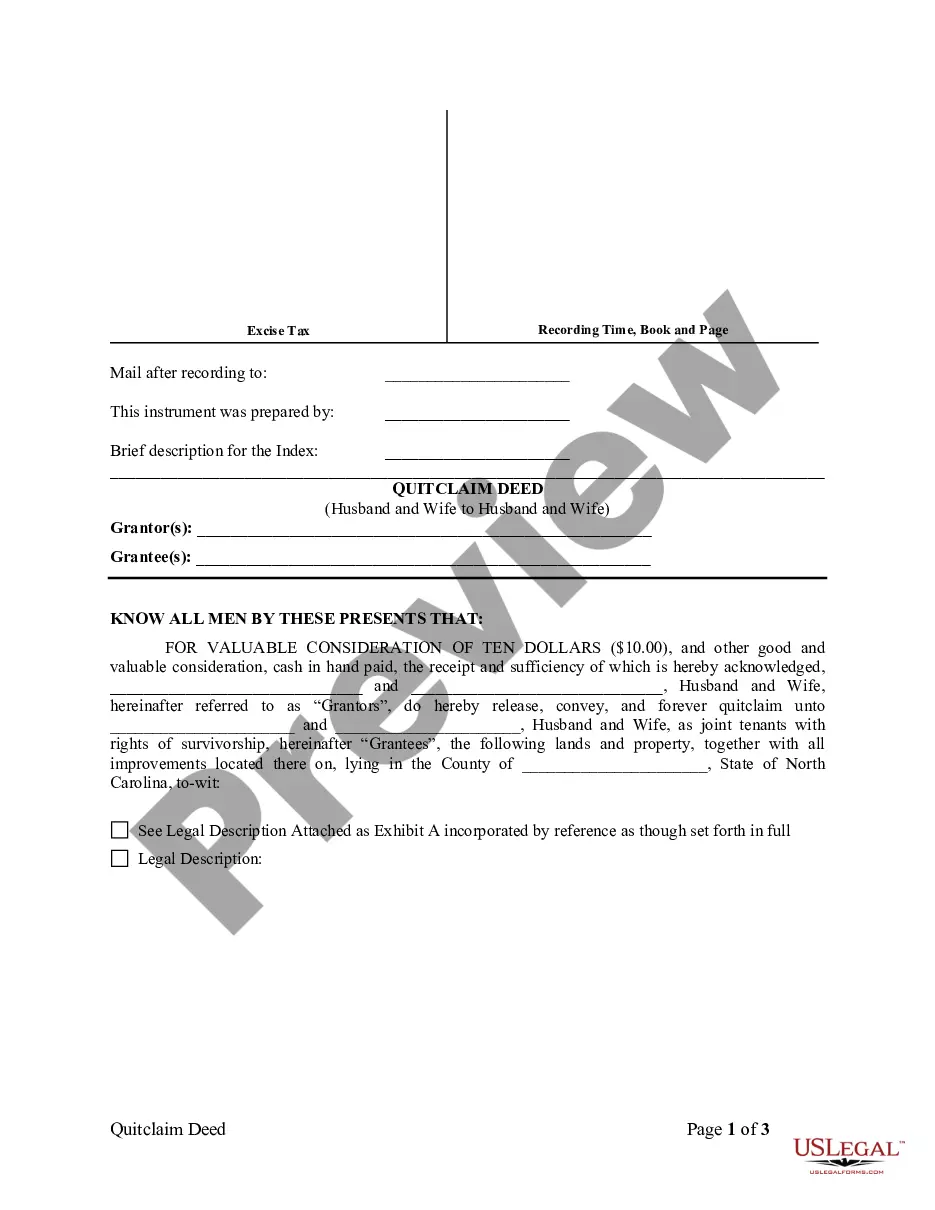
The Quitclaim Deed from Husband and Wife to Husband and Wife is a legal document used to transfer property ownership between spouses. Unlike a warranty deed, which guarantees that the title is clear, a quitclaim deed simply relinquishes any interest the grantors have in the property without making any warranties about the title. This form is particularly useful in situations where spouses want to simplify property transfer between themselves, such as during estate planning or in divorce settlements.
Form components explained
- Names of grantors (the spouses transferring property) and grantees (the spouses receiving property).
- Statement regarding the consideration paid for the property transfer.
- Description of the property being conveyed.
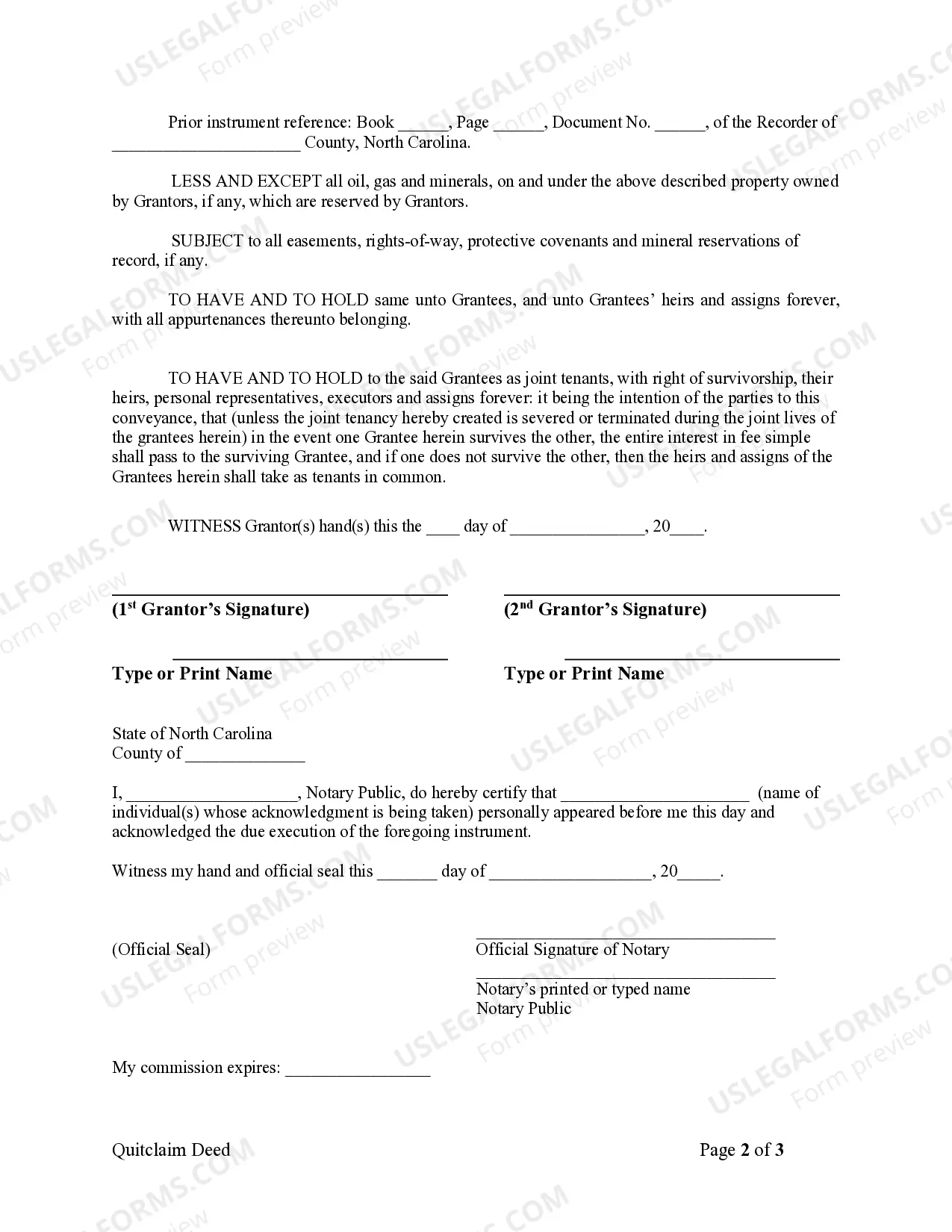
- Declaration of joint tenancy with rights of survivorship for the grantees.
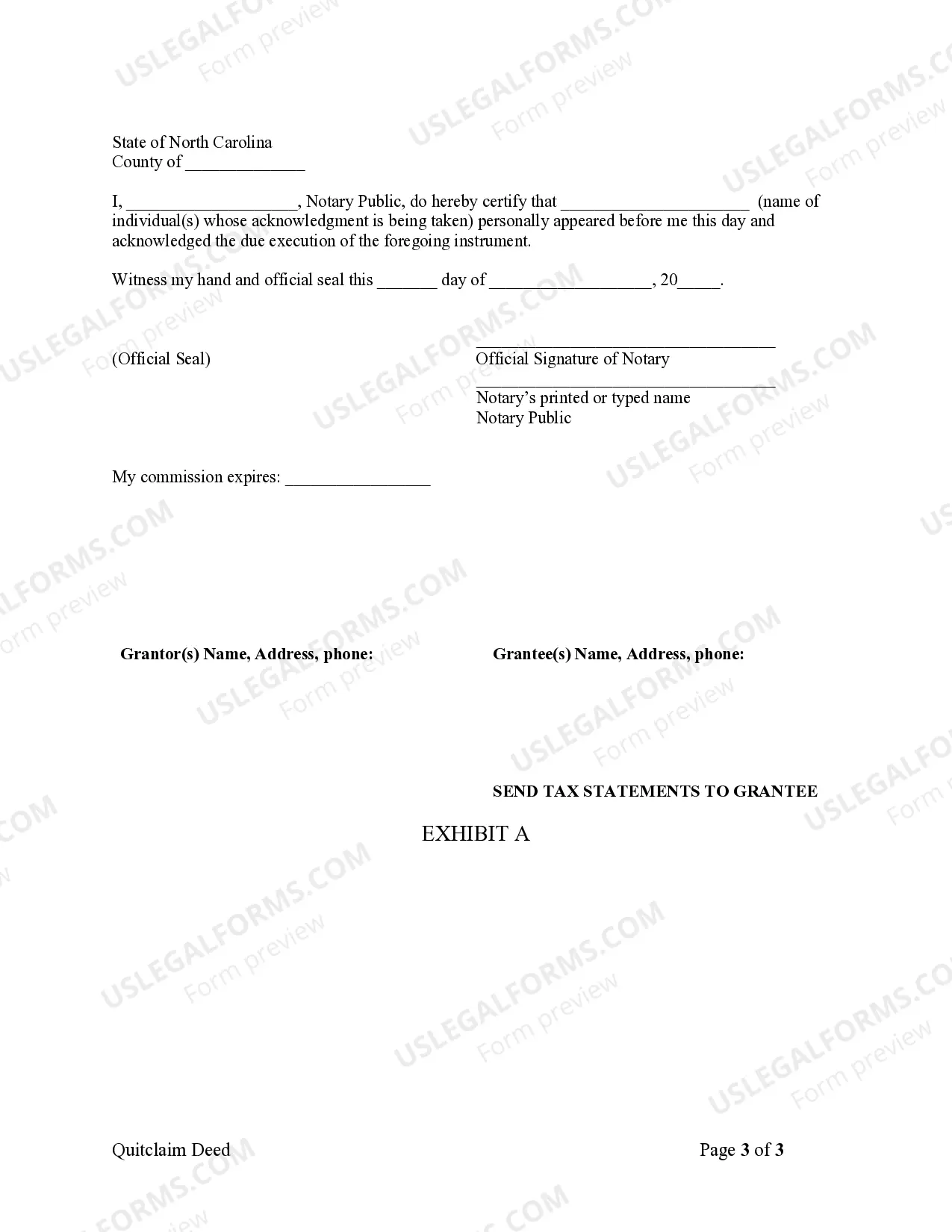
- Notary public acknowledgment section for legal verification.






When to use this document
This deed should be used when married couples wish to transfer property between themselves without a sale. Common scenarios include:
- Transferring property ownership for estate planning purposes.
- Changing the way property is held between spouses, such as converting to joint tenancy.
- Clarifying ownership terms during or after a divorce.
Intended users of this form
This form is intended for:
- Married couples who wish to transfer property ownership between themselves.
- Couples looking to simplify their property titles.
- Homeowners who want to adjust ownership terms for estate planning.
How to prepare this document
- Identify the grantors and grantees by writing the full names of both spouses.
- Specify the legal description of the property to be transferred.
- Indicate the consideration amount, typically a nominal sum like ten dollars.
- Ensure that both spouses sign the document in the appropriate areas.
- Have the document notarized by a qualified notary public to ensure legal validity.
Does this form need to be notarized?
This form needs to be notarized to ensure legal validity. US Legal Forms provides secure online notarization powered by Notarize, allowing you to complete the process through a verified video call, available anytime.
Get your form ready online
Our built-in tools help you complete, sign, share, and store your documents in one place.
Make edits, fill in missing information, and update formatting in US Legal Forms—just like you would in MS Word.
Download a copy, print it, send it by email, or mail it via USPS—whatever works best for your next step.
Sign and collect signatures with our SignNow integration. Send to multiple recipients, set reminders, and more. Go Premium to unlock E-Sign.
If this form requires notarization, complete it online through a secure video call—no need to meet a notary in person or wait for an appointment.
We protect your documents and personal data by following strict security and privacy standards.

Make edits, fill in missing information, and update formatting in US Legal Forms—just like you would in MS Word.

Download a copy, print it, send it by email, or mail it via USPS—whatever works best for your next step.

Sign and collect signatures with our SignNow integration. Send to multiple recipients, set reminders, and more. Go Premium to unlock E-Sign.

If this form requires notarization, complete it online through a secure video call—no need to meet a notary in person or wait for an appointment.

We protect your documents and personal data by following strict security and privacy standards.
Mistakes to watch out for
- Failing to provide a clear legal description of the property.
- Not having the document notarized, which may make it invalid.
- Leaving out the names of the grantors or grantees.
- Not specifying how the property is held (joint tenants) can lead to misunderstandings.
Benefits of using this form online
- Convenience of downloading and filling out the form from home.
- Editability allows users to customize the document as needed.
- Access to reliably drafted legal forms created by licensed attorneys.
- Saves time compared to drafting a new deed from scratch.
Main things to remember
- A quitclaim deed is ideal for spouses transferring property between themselves.
- It is essential to accurately fill out the form to avoid issues with property rights.
- Notarization is typically required for the deed to be enforceable.
Looking for another form?

Form popularity
FAQ
California married couples generally have three options to take title to their community (vs separate) property real estate: community property, joint tenancy or Community Property with Right of Survivorship. The latter coming into play in California July of 2001.
In California, all property bought during the marriage with income that was earned during the marriage is deemed "community property." The law implies that both spouses own this property equally, regardless of which name is on the title deed.
It's often easier to qualify for a joint mortgage, because both spouses can contribute income and assets to the application. However, if one spouse can qualify for a mortgage based on his own income and credit, the mortgage does not need to be in both spouses' names unless you live in a community property state.
In order to transfer ownership of the marital home pursuant to a divorce, one spouse is going to need to sign a quitclaim deed, interspousal transfer deed, or a grant deed, in order to convey the title to the property.
In divorces, states have two options for dividing property: community property division (where marital property belongs to both spouses equally, regardless of who bought it) or equitable division (where the court divides marital property equitably (justly.) North Carolina is not a community property state.
A married person buying property individually The owner needs to sign, but their spouse may not be required to sign documents at closing. North Carolina has a specific statute allowing a married buyer of real estate to sign their purchase-money Deed of Trust without requiring the signature of the buyer's spouse.
It is also crucial that a spouse know about the loan, even if he or she is not on the mortgage. In general, the spouse must sign a deed of trust, the Truth in Lending and Right to Cancel documents. By signing these documents, they are simply acknowledging the existence of the mortgage.
The names on the mortgage show who's responsible for paying back the loan, while the title shows who owns the property. You can put your spouse on the title without putting them on the mortgage; this would mean that they share ownership of the home but aren't legally responsible for making mortgage payments.
In cases where a couple shares a home but only one spouse's name is on it, the home will not automatically pass to the surviving pass, if his or her name is not on the title.