Minnesota Warranty Deed from Corporation to Two Individuals
What is this form?
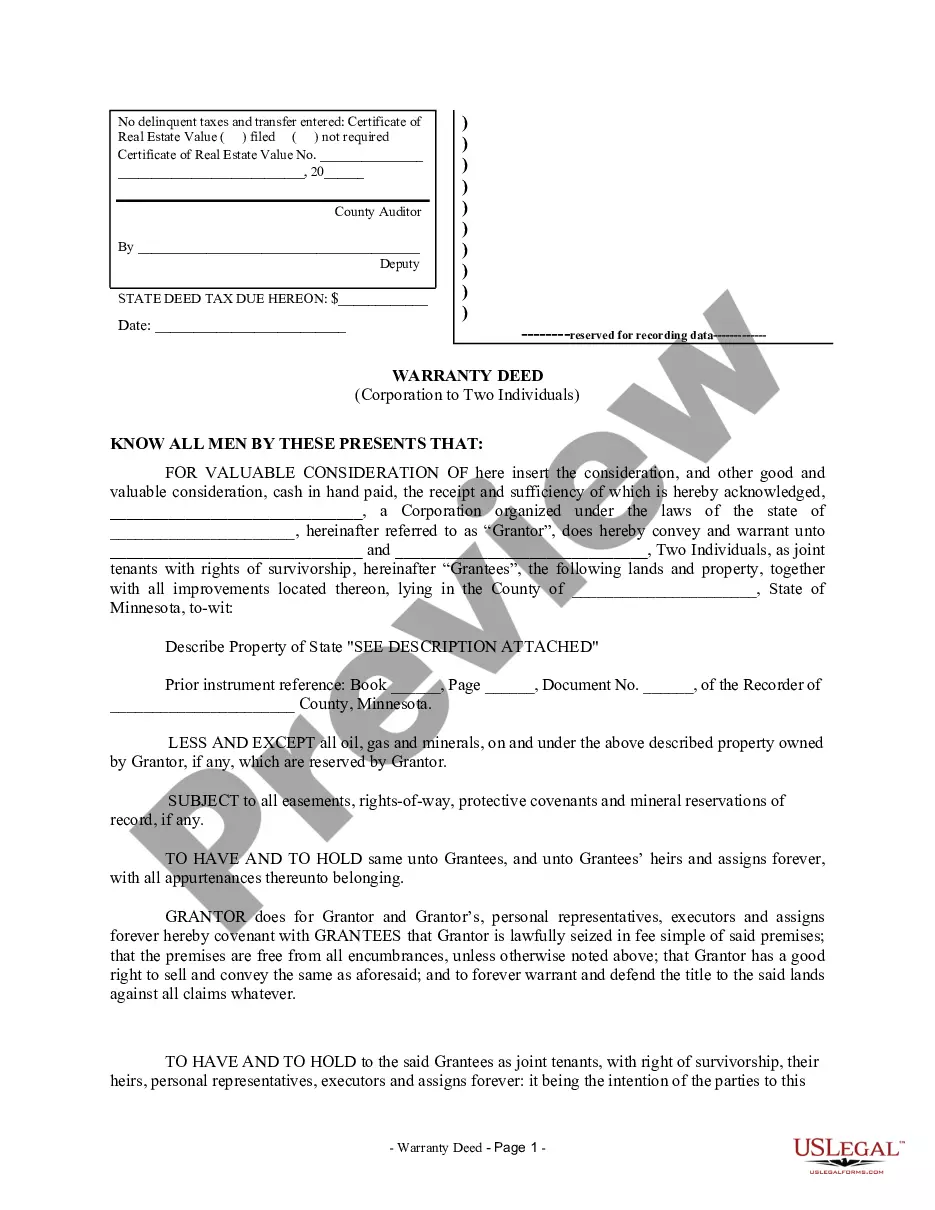
The Warranty Deed from Corporation to Two Individuals is a legal document that facilitates the transfer of property ownership from a corporation (the Grantor) to two individuals (the Grantees). This form ensures that the Grantor conveys and warrants the property while reserving certain rights, such as oil, gas, and mineral interests. Unlike other types of deeds, this warranty deed provides greater protection to the Grantees, guaranteeing that they receive clear title to the property free of encumbrances, except as noted within the deed.
Main sections of this form
- Identification of the Grantor and Grantees, including their roles and relationships.
- A description of the property being transferred, including any specific details or attached descriptions.
- Clear terms regarding the reservation of oil, gas, and mineral rights by the Grantor.
- Clauses detailing the warranties provided by the Grantor, ensuring ownership is free from encumbrances.
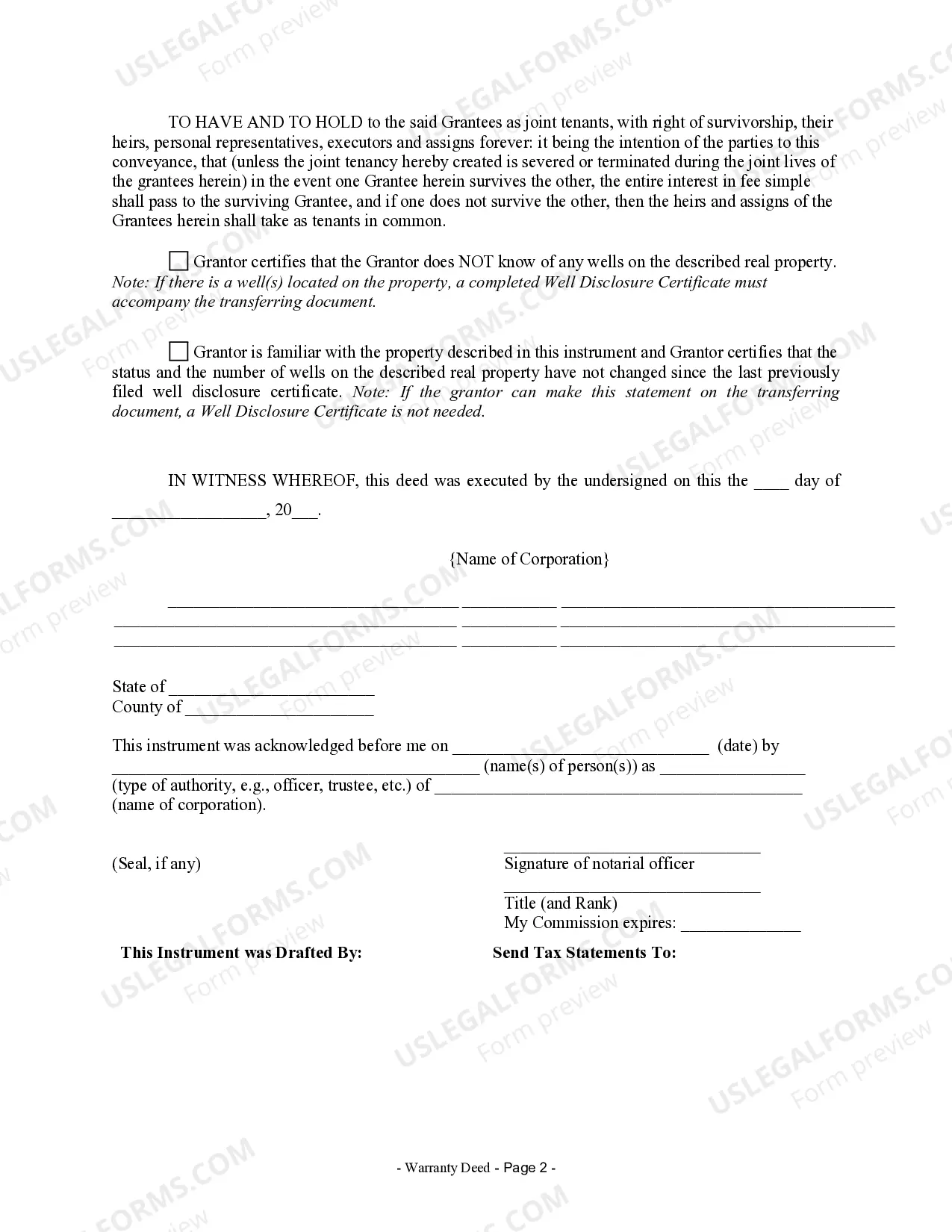
- Provisions for joint tenancy of the Grantees, including rights of survivorship.
- Signature lines for the authorized representative of the corporation and the acknowledgment by a notary public.




When to use this document
This form is commonly used when a corporation intends to convey real estate property to two individuals, particularly when both wish to hold the property jointly. Situations may include family property transfers, business property transfers involving personal parties, or situations where one or both individuals want to establish rights of survivorship in the property in question.
Who this form is for
This warranty deed is suitable for:
- Corporations transferring property to individual members.
- Individuals who are accepting property from corporate entities.
- Real estate attorneys or professionals handling property transitions.
- Any party involved in a transaction requiring the transfer of real estate ownership under a corporate entity.
Steps to complete this form
- Identify the parties involved: the corporation as the Grantor and the two individuals as Grantees.
- Enter the property description accurately to avoid any future disputes.
- State the consideration (the value exchanged) for the transfer.
- Include any reservations such as oil, gas, and mineral rights by the Grantor, as needed.
- Have the authorized representative of the corporation sign the deed and ensure it is dated.
- Final steps include obtaining a notary acknowledgment, if required, to legitimize the document.
Notarization guidance
To make this form legally binding, it must be notarized. Our online notarization service, powered by Notarize, lets you verify and sign documents remotely through an encrypted video session.
Get your form ready online
Our built-in tools help you complete, sign, share, and store your documents in one place.
Make edits, fill in missing information, and update formatting in US Legal Forms—just like you would in MS Word.
Download a copy, print it, send it by email, or mail it via USPS—whatever works best for your next step.
Sign and collect signatures with our SignNow integration. Send to multiple recipients, set reminders, and more. Go Premium to unlock E-Sign.
If this form requires notarization, complete it online through a secure video call—no need to meet a notary in person or wait for an appointment.
We protect your documents and personal data by following strict security and privacy standards.

Make edits, fill in missing information, and update formatting in US Legal Forms—just like you would in MS Word.

Download a copy, print it, send it by email, or mail it via USPS—whatever works best for your next step.

Sign and collect signatures with our SignNow integration. Send to multiple recipients, set reminders, and more. Go Premium to unlock E-Sign.

If this form requires notarization, complete it online through a secure video call—no need to meet a notary in person or wait for an appointment.

We protect your documents and personal data by following strict security and privacy standards.
Common mistakes to avoid
- Failing to provide a complete and accurate property description.
- Not specifying reservations of rights clearly, leading to confusion or disputes.
- Omitting signatures from the appropriate parties, making the deed invalid.
- Neglecting to obtain notarization, where necessary, thereby compromising the legal effect of the deed.
Why use this form online
- Easy download and editing of the form to suit specific needs.
- Access to templates drafted by licensed attorneys ensures legal compliance.
- Convenience of preparing legal documents from anywhere, avoiding the need for in-person trips.
- Quick and accurate completion with step-by-step guidance available.
Looking for another form?
Form popularity
FAQ
To transfer a Minnesota Warranty Deed from Corporation to Two Individuals, you must first prepare the deed with accurate information about the parties involved. After that, the deed must be signed by the corporation's authorized representative and notarized. Finally, file the deed with the appropriate county office to complete the transfer, which you can facilitate using templates from US Legal Forms for a smoother experience.
While you are not required to hire a lawyer for a Minnesota Warranty Deed from Corporation to Two Individuals, consulting one can be beneficial. An attorney can help you navigate complex legal language and ensure that the deed is properly executed. Alternatively, US Legal Forms offers user-friendly resources that guide you through the process, making it easier to create the deed without legal representation.
Yes, you can prepare your own Minnesota Warranty Deed from Corporation to Two Individuals. However, it's essential to ensure that you follow the specific legal requirements and regulations in Minnesota. Using a reliable resource like US Legal Forms can simplify this process by providing templates that are compliant with state laws, ensuring that you include all necessary information.
Yes, a warranty deed can be transferred, allowing ownership to change hands. When transferring a Minnesota Warranty Deed from Corporation to Two Individuals, ensure that the deed is properly executed and recorded. This transfer may involve specific legal requirements, such as obtaining signatures and notary acknowledgment. Utilizing US Legal Forms can help you navigate the transfer process effectively, ensuring all legal standards are met.
To add a person to a deed in Minnesota, you typically need to execute a new Minnesota Warranty Deed from Corporation to Two Individuals. This process involves drafting the deed with the correct legal description of the property and the names of the individuals being added. It’s important to have the deed signed in front of a notary public and then recorded with the county. Using a platform like US Legal Forms can simplify this process, providing you with the necessary templates and guidance.
A warranty deed is valid when it meets specific legal requirements, such as being in writing, signed by the grantor, and properly notarized. For a Minnesota Warranty Deed from Corporation to Two Individuals, clear identification of both parties, a legal description of the property, and the inclusion of any necessary covenants are also important. Meeting these criteria helps ensure the deed is enforceable and protects the rights of the grantee.
Yes, a warranty deed must be signed by the grantor, which is the party transferring the property. However, it is not necessary for the grantee, or the receiving party, to sign the Minnesota Warranty Deed from Corporation to Two Individuals. Ensuring that the signature is notarized can further validate the deed and help prevent future challenges.
A warranty deed can be invalid for several reasons, including lack of capacity of the grantor, improper wording, or failure to comply with state requirements. In the case of a Minnesota Warranty Deed from Corporation to Two Individuals, ensuring that all parties are legally able to transfer property is essential. Addressing these issues upfront can save you from future disputes.
Yes, a warranty deed can be challenged in court. Individuals may dispute the validity of a Minnesota Warranty Deed from Corporation to Two Individuals based on claims of fraud, coercion, or errors in the deed itself. If you find yourself in this situation, consulting an attorney can provide you with the necessary guidance to navigate the legal process.
Several factors can render a deed invalid, including improper execution, lack of necessary signatures, or failure to meet state requirements. For a Minnesota Warranty Deed from Corporation to Two Individuals, issues such as not having the deed notarized or not clearly identifying the parties involved can cause problems. It’s crucial to ensure all elements are properly addressed to avoid complications.