Michigan Warranty Deed from Individual to a Trust
What this document covers
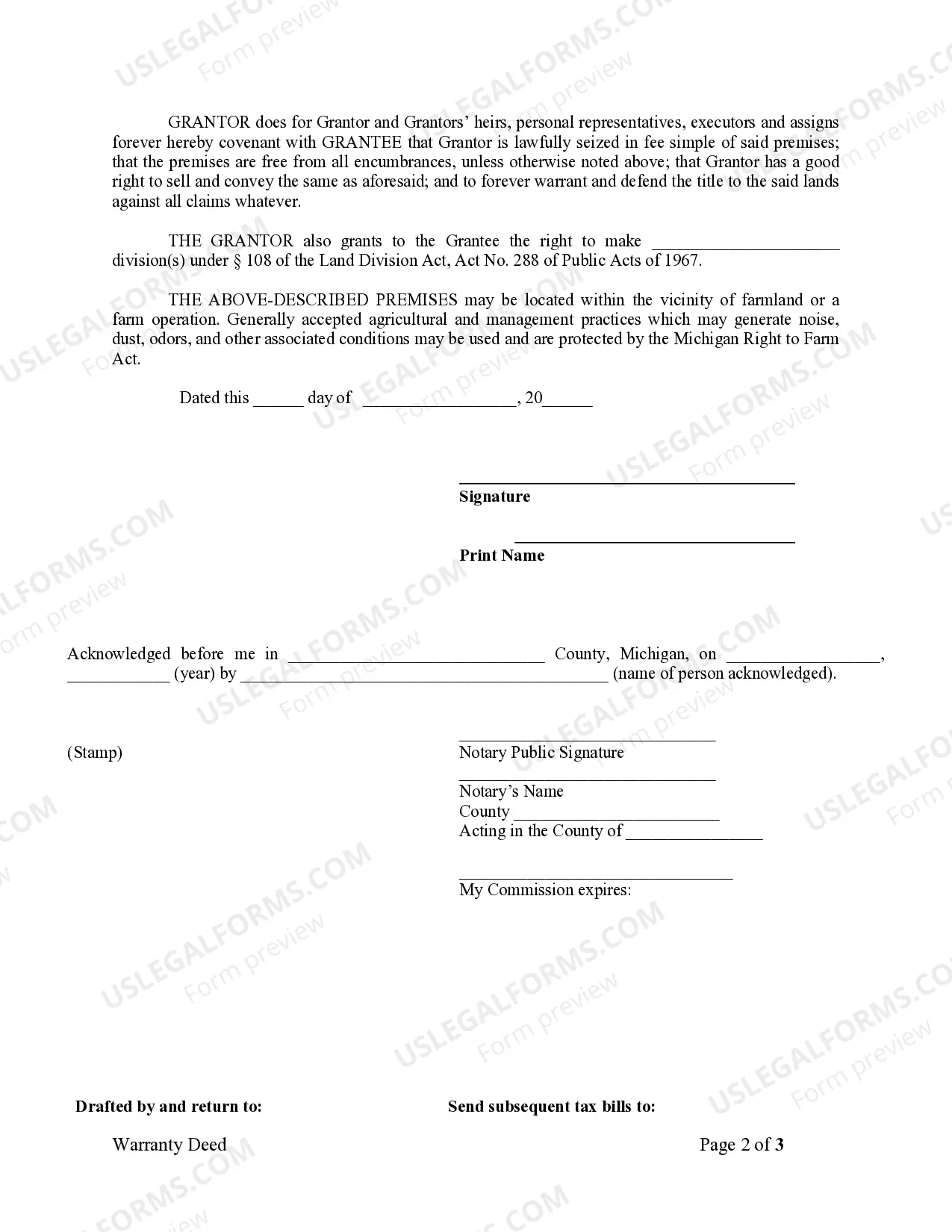
A Warranty Deed from Individual to a Trust is a legal document used to transfer property ownership from an individual (grantor) to a trust (grantee). This form guarantees that the grantor has a clear title to the property and is legally entitled to transfer it. Unlike a regular deed, this warranty deed provides additional assurances to the trust about the title, hence offering more protection to the grantee against potential disputes.
Form components explained
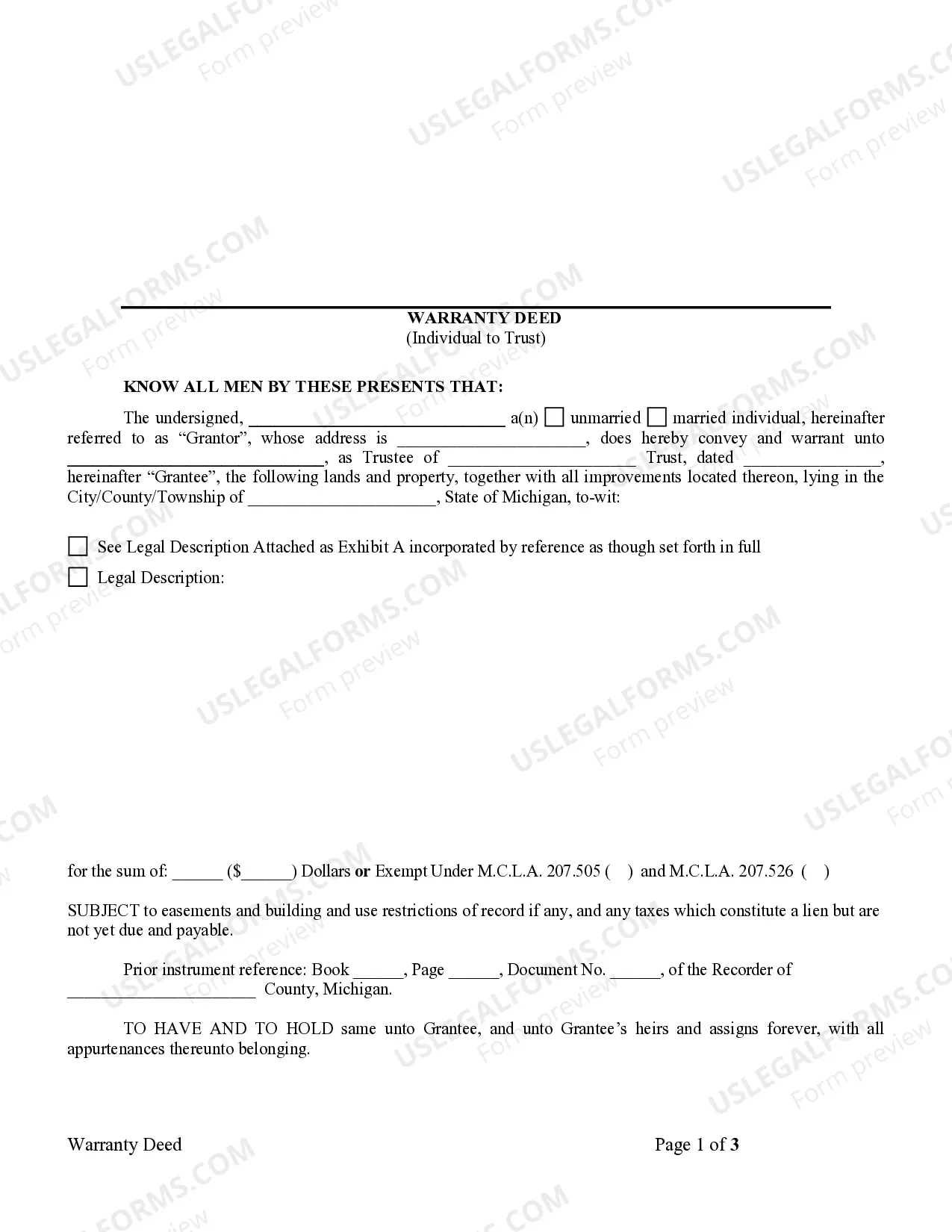
- Identification of the grantor and grantee, including their names and status (e.g., married or unmarried).
- Detailed description of the property being transferred, including a legal description attached as an exhibit.
- Covenants by the grantor that ensure the property is free from encumbrances.
- Provision for the grantor to legally defend the title against claims.
- Details of rights granted to the grantee for property division under the Land Division Act.
- Signatures of the grantor and notarization for legal validation.






When to use this form
This form should be used when an individual wants to transfer real estate property into a trust for estate planning purposes. It is applicable in various scenarios, such as transferring gifts to family members through a trust, protecting assets from unnecessary taxation, or ensuring a smooth transition of property after the grantor's death. If you need to ensure that the trust holds the property securely and that the property's title is guaranteed, this deed is appropriate.
Who should use this form
- Individuals wishing to transfer property to a trust for estate management.
- Trustees wanting to receive property on behalf of a trust.
- Persons involved in estate planning who want to protect their assets.
- Estate executors managing property transfers according to a will.
How to complete this form
- Identify the parties involved: Complete the names and statuses of the grantor and grantee.
- Specify the property: Include a detailed legal description of the property being conveyed.
- Enter any applicable prior instrument details for title verification.
- Complete the necessary covenants ensuring the grantor's rights to the property.
- Obtain signatures from both parties and ensure the form is notarized.
Notarization guidance
Yes, this form must be notarized to be legally valid. Notarization verifies the identities of the parties involved and the authenticity of their signatures. US Legal Forms offers integrated online notarization services to help you easily complete this step from the comfort of your home.
Get your form ready online
Our built-in tools help you complete, sign, share, and store your documents in one place.
Make edits, fill in missing information, and update formatting in US Legal Forms—just like you would in MS Word.
Download a copy, print it, send it by email, or mail it via USPS—whatever works best for your next step.
Sign and collect signatures with our SignNow integration. Send to multiple recipients, set reminders, and more. Go Premium to unlock E-Sign.
If this form requires notarization, complete it online through a secure video call—no need to meet a notary in person or wait for an appointment.
We protect your documents and personal data by following strict security and privacy standards.

Make edits, fill in missing information, and update formatting in US Legal Forms—just like you would in MS Word.

Download a copy, print it, send it by email, or mail it via USPS—whatever works best for your next step.

Sign and collect signatures with our SignNow integration. Send to multiple recipients, set reminders, and more. Go Premium to unlock E-Sign.

If this form requires notarization, complete it online through a secure video call—no need to meet a notary in person or wait for an appointment.

We protect your documents and personal data by following strict security and privacy standards.
Common mistakes
- Failing to include a complete legal description of the property.
- Not updating prior instrument references correctly.
- Neglecting to get the form notarized, if required.
- Inaccurate identification of the parties involved (e.g., not indicating marital status).
Why complete this form online
- Convenience of downloading and filling out the form from home.
- Editability to accommodate specific details of the property and parties.
- Access to professionally drafted templates ensuring legal compliance.
Key takeaways
- The Warranty Deed is essential for transferring property to a trust.
- Ensure all sections are completed accurately to avoid legal issues.
- Notarization is required for the deed's validity in Michigan.
Looking for another form?
Form popularity
FAQ
No. And unless the deed identifies the trust as an owner, then father is the owner of an interest. It is a common mistake to set up a trust and then fail to deed property into the trust. However, you cannot force him to make the changes you are...
In order to make the Warranty Deed legally binding, the Seller needs to sign it front of a notary public. Then signed and notarized deed must be filed at the city or county office for recording property documents. Before filing with this office all previously billed property taxes must be paid in full.
Retrieve your original deed. Get the appropriate deed form. Draft the deed. Sign the deed before a notary. Record the deed with the county recorder. Obtain the new original deed.
How To Establish A Trust. You will need to retain an estate attorney to draft and execute your trust document. For a simple revocable or irrevocable trust, it may cost anywhere from $2,000 $5,000.
A warranty deed protects property owners from future claims that someone else actually owns a portion (or all) of their property, while trustee deeds protect lenders when borrowers default on their mortgage loans.
A trustee deed offers no such warranties about the title.
Obtain a California grant deed from a local office supply store or your county recorder's office. Complete the top line of the deed. Indicate the grantee on the second line. Enter the trustees' names and addresses.
The act of transferring a property that is owned by an individual into a trust, will see the trust liable to pay stamp duty on acquisition of the asset. Additionally, the individual who is transferring ownership to the trust, will be liable to pay capital gains tax on the disposal of the asset.
Locate your current deed. Use the proper deed. Check with your title insurance company and lender. Prepare a new deed. Sign in the presence of a notary. Record the deed in the county clerk's office. Locate the deed that's in trust. Use the proper deed.