Maryland Quitclaim Deed from Corporation to Corporation
Understanding this form
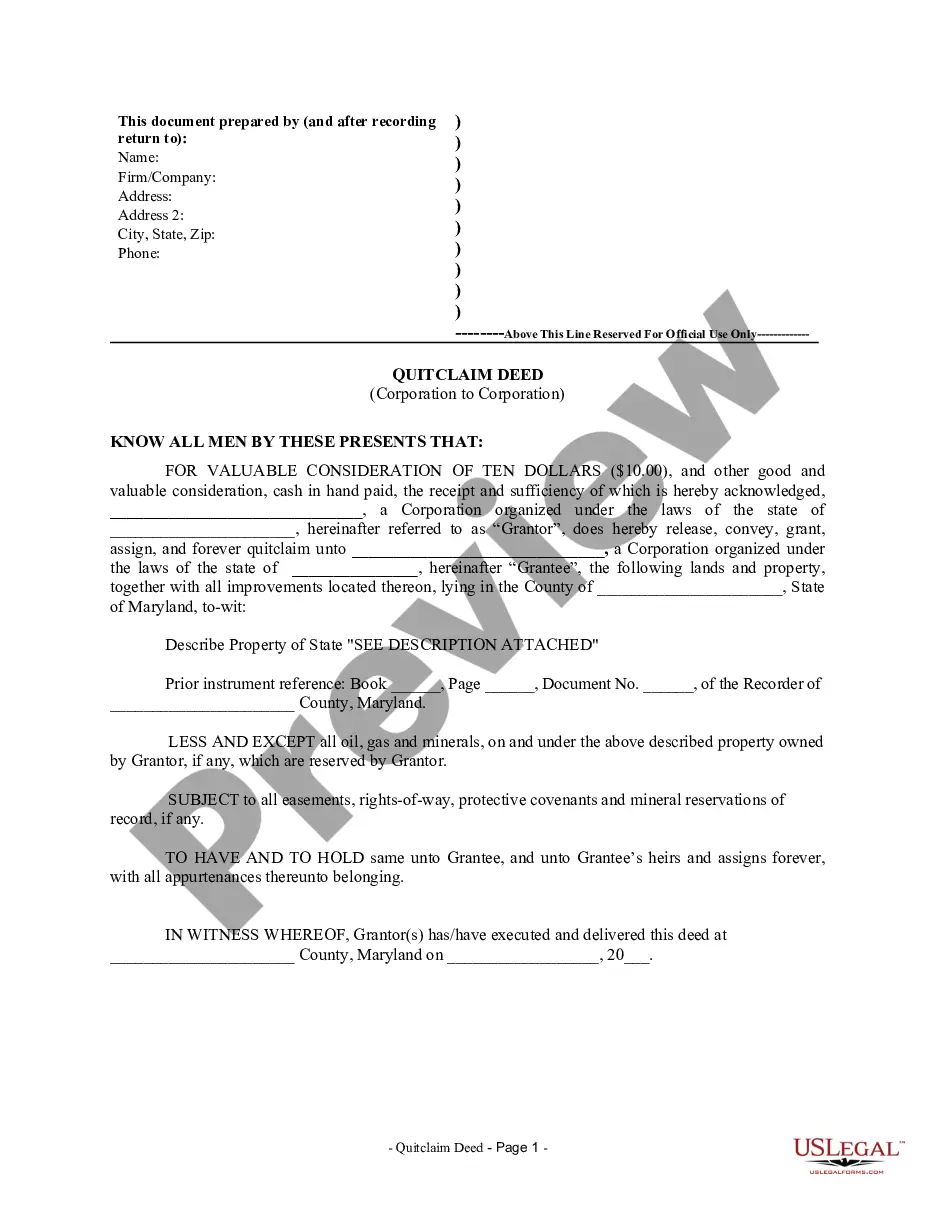
The Quitclaim Deed from Corporation to Corporation is a legal document that allows a corporation, known as the Grantor, to transfer its interest in a property to another corporation, referred to as the Grantee. This type of deed is different from warranty deeds because it conveys no warranties about the property's titleâonly that the Grantor is relinquishing its interest in the property. It is commonly used in corporate transactions and property transfers between corporations.
What’s included in this form
- Identification of both Grantor and Grantee corporations.
- Description of the property being transferred.
- Reservation of any oil, gas, and minerals by the Grantor.
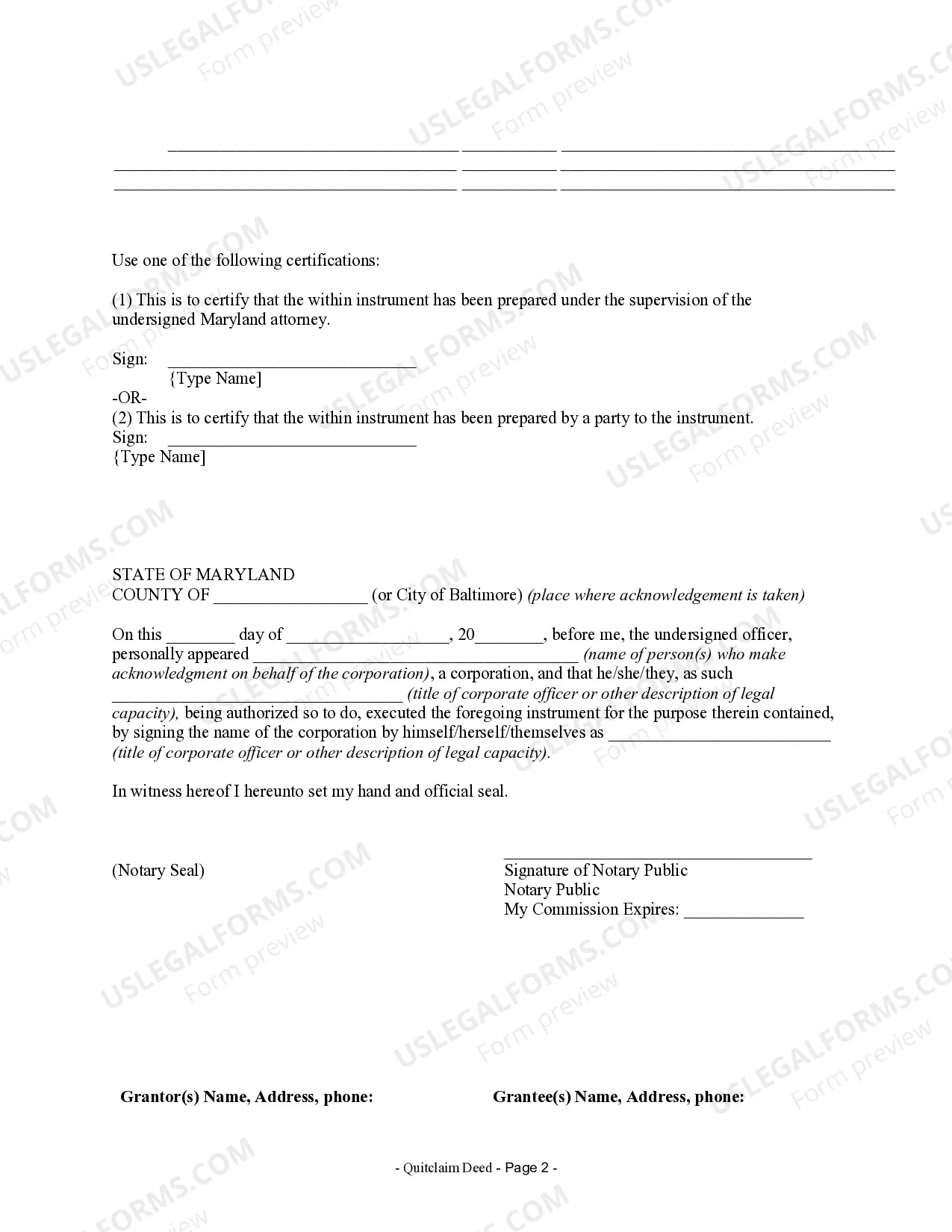
- Certifications confirming the preparation of the deed under legal supervision.
- Notary acknowledgment for the execution of the deed.



Situations where this form applies
This form should be used when a corporation intends to convey real estate to another corporation without making any guarantees about the title. Scenarios that typically require a quitclaim deed include mergers, property transfers between subsidiaries, or settling corporate asset ownership disputes.
Who can use this document
- Corporate entities looking to transfer property ownership to another corporation.
- Corporate legal teams or representatives involved in real estate transactions.
- Business owners seeking to formalize property agreements between corporations.
Instructions for completing this form
- Identify the Grantor and Grantee by entering their corporation names.
- Provide a detailed description of the property being conveyed.
- Include any prior instrument reference details, such as book and page number.
- Specify any reserved rights, such as oil and mineral interests.
- Have the appropriate corporate officer sign the form and add their title.
- Ensure the deed is notarized by a registered notary public.
Does this document require notarization?
Yes, this form must be notarized to be legally valid. It is important to ensure that a notary public oversees the signing of the document to confirm the identities of the signing representatives and to authenticate the execution of the deed.
Get your form ready online
Our built-in tools help you complete, sign, share, and store your documents in one place.
Make edits, fill in missing information, and update formatting in US Legal Forms—just like you would in MS Word.
Download a copy, print it, send it by email, or mail it via USPS—whatever works best for your next step.
Sign and collect signatures with our SignNow integration. Send to multiple recipients, set reminders, and more. Go Premium to unlock E-Sign.
If this form requires notarization, complete it online through a secure video call—no need to meet a notary in person or wait for an appointment.
We protect your documents and personal data by following strict security and privacy standards.

Make edits, fill in missing information, and update formatting in US Legal Forms—just like you would in MS Word.

Download a copy, print it, send it by email, or mail it via USPS—whatever works best for your next step.

Sign and collect signatures with our SignNow integration. Send to multiple recipients, set reminders, and more. Go Premium to unlock E-Sign.

If this form requires notarization, complete it online through a secure video call—no need to meet a notary in person or wait for an appointment.

We protect your documents and personal data by following strict security and privacy standards.
Mistakes to watch out for
- Failing to accurately describe the property being transferred.
- Not having the document properly notarized, which can lead to invalidation.
- Omitting required certifications and signatures by corporate officers.
- Forgetting to reserve rights related to oil, gas, and minerals.
Advantages of online completion
- Convenience of completing the form from any location.
- Editability allows you to customize the document to meet specific needs.
- Access to professionally drafted templates increases reliability.
- Immediate download options save time compared to traditional methods.
Key takeaways
- The Quitclaim Deed from Corporation to Corporation is essential for corporate property transfers.
- Ensure all details are accurate to prevent legal complications.
- Notarization is required for the deed to be legally binding.
Looking for another form?


Form popularity
FAQ
Correct, when executing a Maryland Quitclaim Deed from Corporation to Corporation, it is essential for authorized representatives of the corporation to sign the deed. The signature confirms the transfer of ownership and acknowledges the transaction's validity. Furthermore, ensuring that the deed is properly executed and notarized can prevent future disputes and complications. If you require detailed instructions, US Legal Forms can help in understanding the legal requirements.
Retrieve your original deed. Get the appropriate deed form. Draft the deed. Sign the deed before a notary. Record the deed with the county recorder. Obtain the new original deed.
Typically, the only cost is between $25 and $55 to record the new deed and obtain a certificate from the city/county to show that all taxes are current. The deed should be notarized and must be prepared by one of the parties or under the supervision of a Maryland attorney.
A consenting individual may be removed from a deed by filing a quitclaim deed. Under Maryland law each county has a separate procedure and requirements for filing a quitclaim deed.
How to Quitclaim Deed to LLC. A quitclaim deed to LLC is actually a very simple process. You will need a deed form and a copy of the existing deed to make sure you identify titles properly and get the legal description of the property.
To change the names on a real estate deed, you will need to file a new deed with the Division of Land Records in the Circuit Court for the county where the property is located. The clerk will record the new deed.
Documents: To submit the quitclaim deed to the Clerk of the Circuit Court, you must have a Land Intake Sheet with the deed. Filing: Quitclaim deeds in Maryland are filed with the Clerk of the Circuit Court in the county where the property is located. Each county has its own filing fee.
Presently, Maryland law permits individuals to transfer personal property to a named beneficiary outside of probate.The owner may sell the property, transfer it to someone other than the beneficiary named in the transfer-on-death deed, or place a mortgage on the property.
But you might be wondering if an owner can transfer a deed to another person without a real estate lawyer. The answer is yes. Parties to a transaction are always free to prepare their own deeds.A quitclaim deed, for example, is far simpler than a warranty deed.