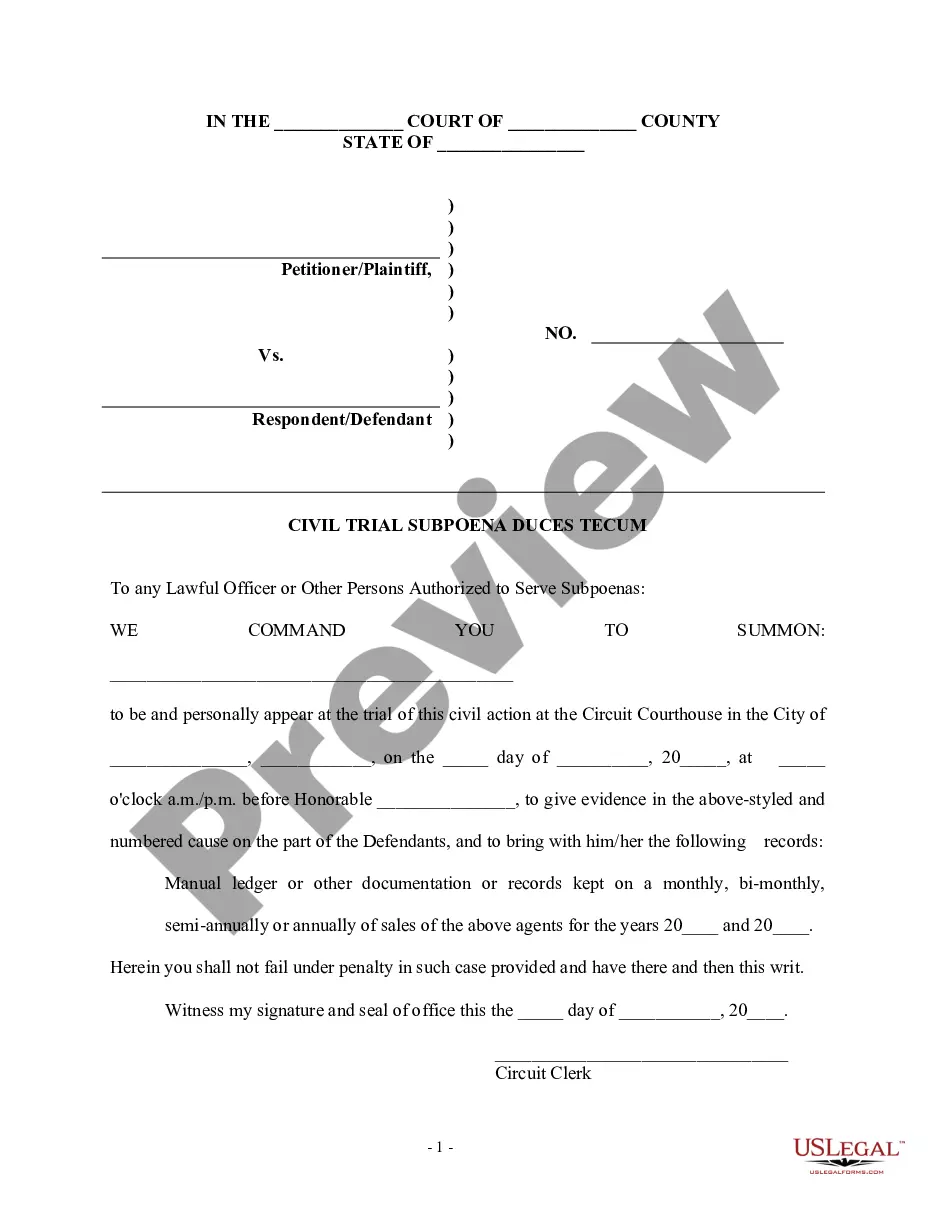
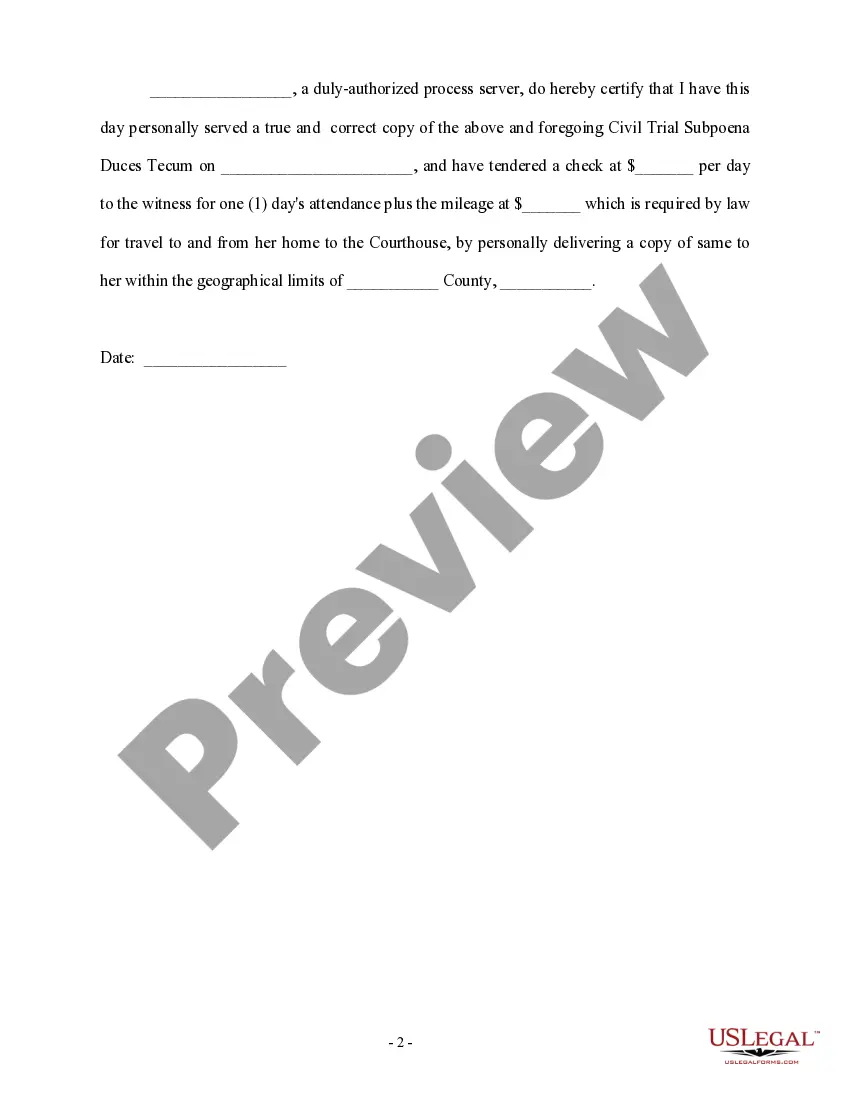
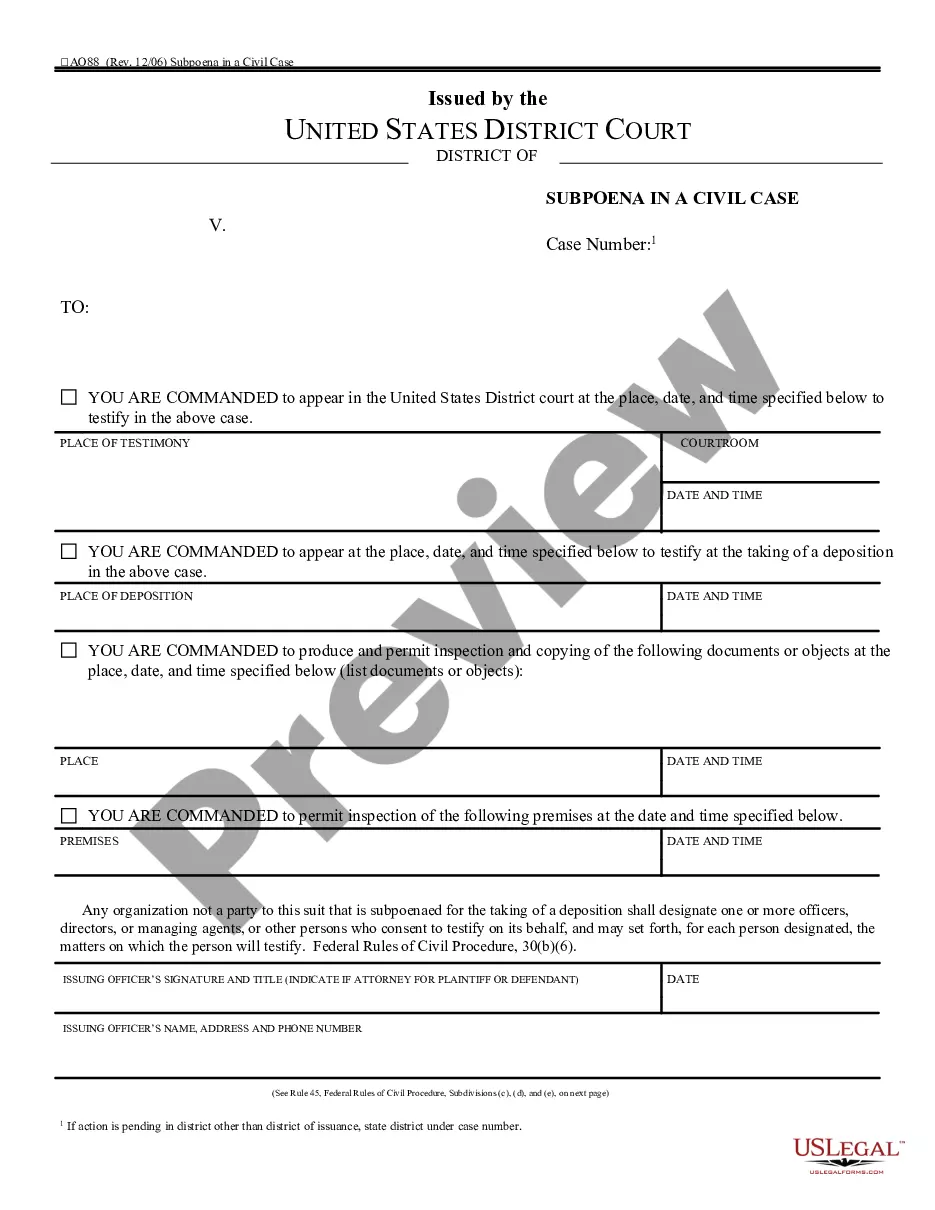
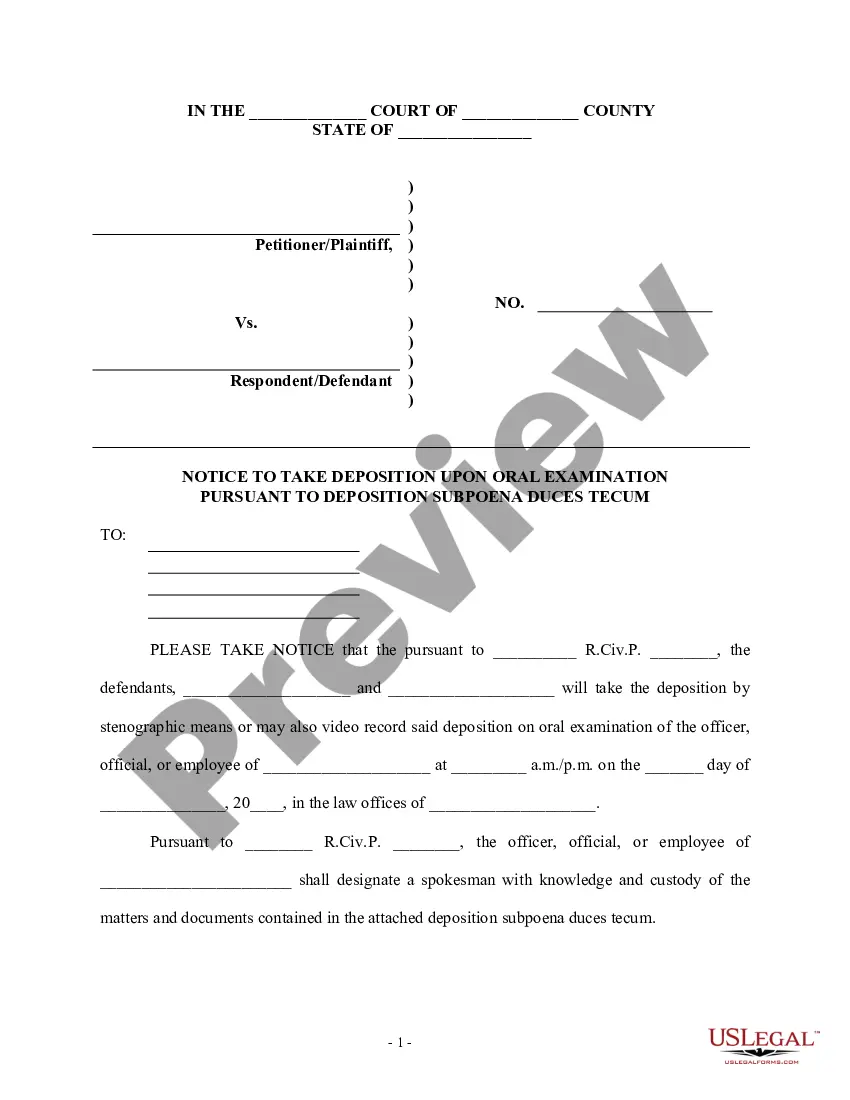
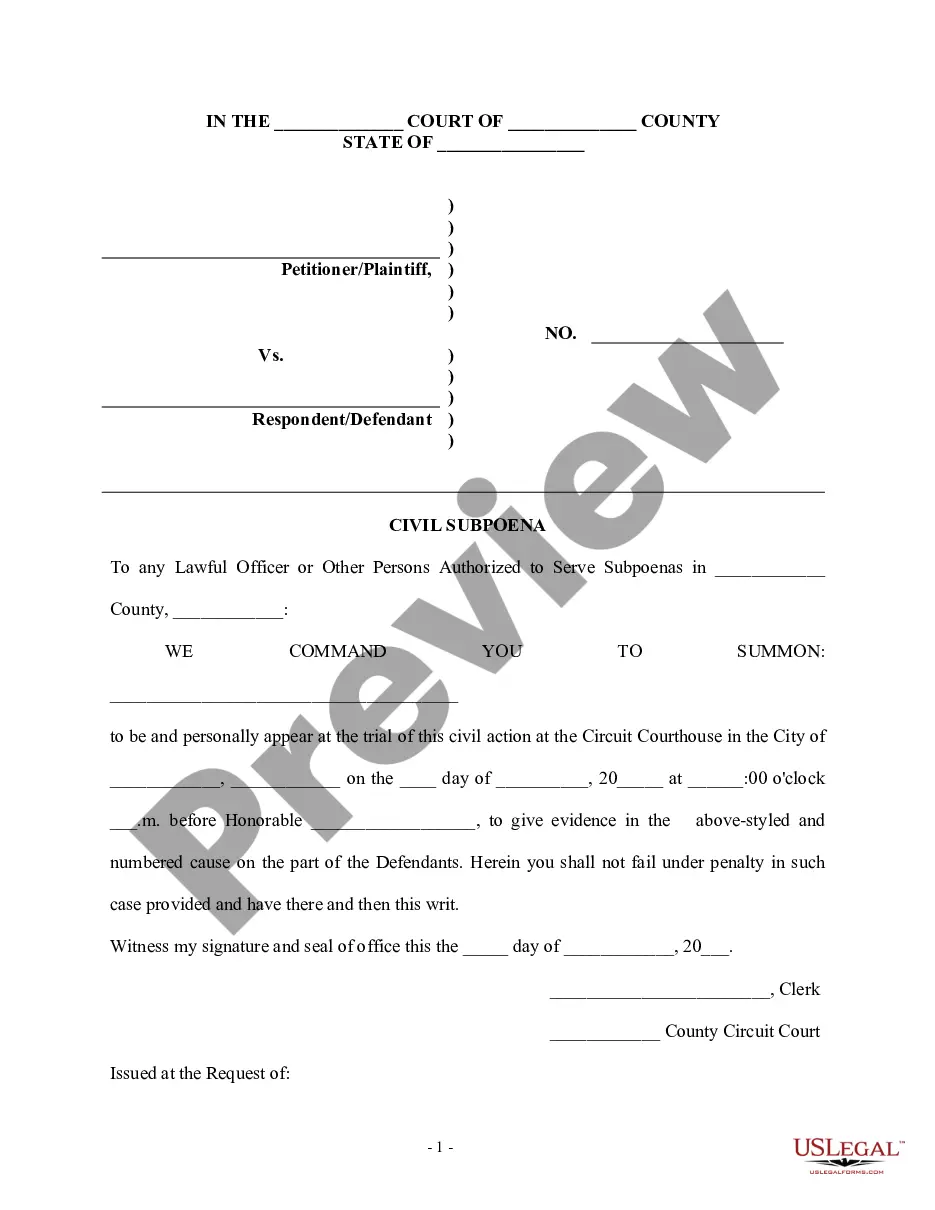
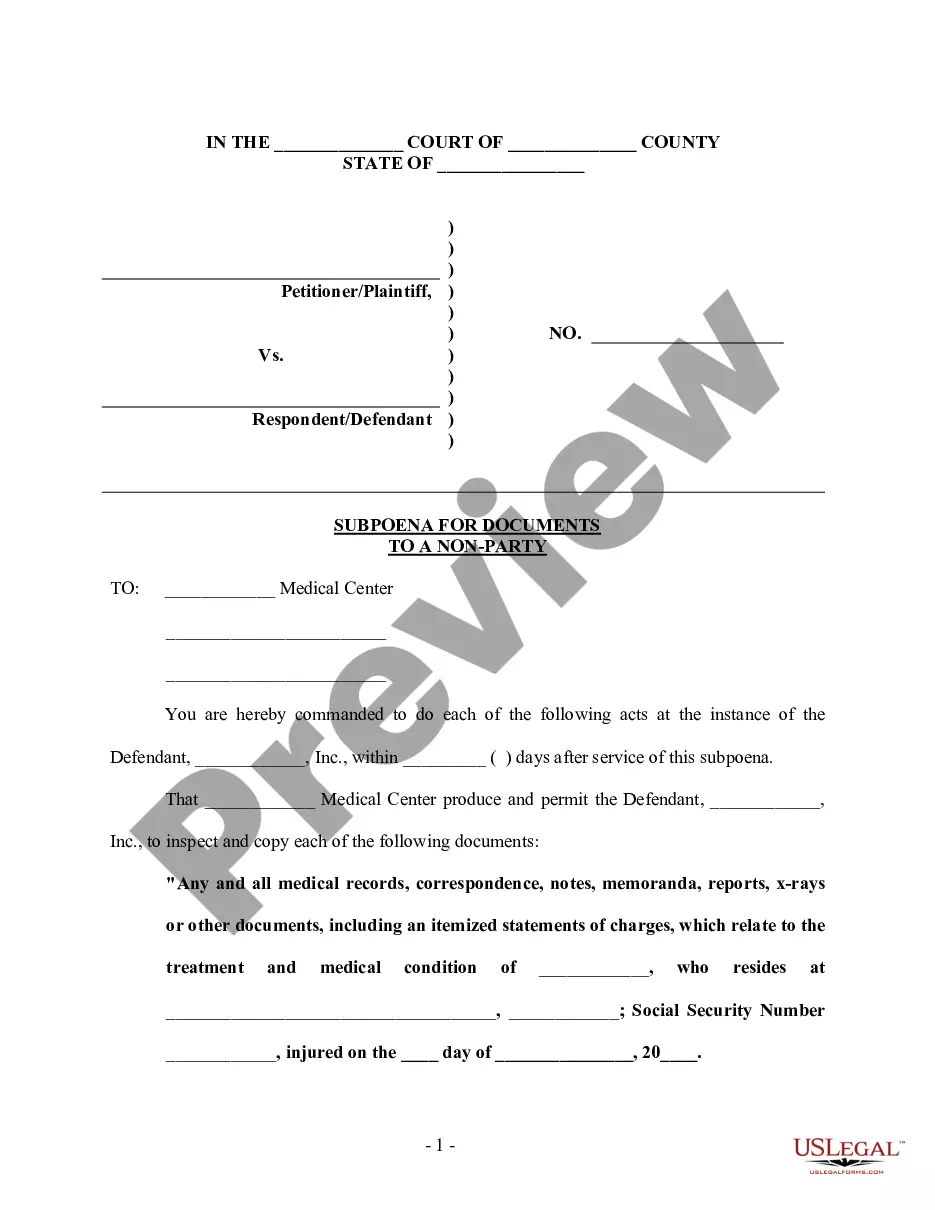
This form is a sample subpoena duces tecum for use in a personal injury case.
Queens New York Civil Trial Subpoena Duces Tecum
State:
Multi-State
County:
Queens
Control #:
US-PI-0046
Format:
Word;
Rich Text
353 downloads
Description
Free preview
Get your form ready online
Our built-in tools help you complete, sign, share, and store your documents in one place.
Built-in online Word editor
Make edits, fill in missing information, and update formatting in US Legal Forms—just like you would in MS Word.
Export easily
Download a copy, print it, send it by email, or mail it via USPS—whatever works best for your next step.
E-sign your document
Sign and collect signatures with our SignNow integration. Send to multiple recipients, set reminders, and more. Go Premium to unlock E-Sign.
Notarize online 24/7
If this form requires notarization, complete it online through a secure video call—no need to meet a notary in person or wait for an appointment.
Store your document securely
We protect your documents and personal data by following strict security and privacy standards.

Make edits, fill in missing information, and update formatting in US Legal Forms—just like you would in MS Word.

Download a copy, print it, send it by email, or mail it via USPS—whatever works best for your next step.

Sign and collect signatures with our SignNow integration. Send to multiple recipients, set reminders, and more. Go Premium to unlock E-Sign.

If this form requires notarization, complete it online through a secure video call—no need to meet a notary in person or wait for an appointment.

We protect your documents and personal data by following strict security and privacy standards.
Looking for another form?
How to fill out Civil Trial Subpoena Duces Tecum?
Are you aiming to swiftly generate a legally-enforceable Queens Civil Trial Subpoena Duces Tecum or perhaps any other document to handle your personal or business affairs.
You have two choices: consult a legal professional to draft a legitimate document for you or compose it entirely by yourself. Fortunately, there's another option - US Legal Forms.
First, ensure that the Queens Civil Trial Subpoena Duces Tecum complies with your state's or county's regulations.
If the document carries a description, confirm its intended usage. Begin the search anew if the form isn't what you need by utilizing the search bar in the header.
- It will assist you in obtaining expertly crafted legal documents without incurring exorbitant costs for legal assistance.
- US Legal Forms offers a vast collection of over 85,000 specific state form templates, inclusive of Queens Civil Trial Subpoena Duces Tecum and comprehensive form packages.
- We provide templates for a wide range of life situations: from divorce forms to real estate documentation.
- With more than 25 years in the industry, we maintain an impeccable reputation among our clients.
- Here's how you can join them and acquire the required document without unnecessary complications.
Form popularity
FAQ
The main difference lies in what each document requires. A regular subpoena demands a person to appear in court, while a subpoena duces tecum, relevant to Queens New York Civil Trial Subpoena Duces Tecum, specifically requests the submission of documents or materials. Understanding this distinction helps individuals navigate legal processes more effectively.
There are two types of Subpoenas: A Subpoena requiring a witness to attend court is called a Witness Subpoena.A Subpoena requiring someone to bring documents only to Court (no testimony from that person is needed, only the documents are needed) is called a Subpoena for the Production of Documents.
A subpoena is an Order that is issued to require the attendance of a witness to testify at a particular time and place. A subpoena duces tecum is an Order that requires a witness to bring documents, books or other items under his, her or their control, that he she or they is bound by law to produce into evidence.
In this jurisdiction, there are two (2) kinds of subpoena, to wit: subpoena ad testificandum and subpoena duces tecum. The first is used to compel a person to testify, while the second is used to compel the production of books, records, things or documents therein specified.
If you require an individual to produce a record or document necessary for your case, you may apply to the Clerk of the Court for a Subpoena Duces Tecum. This document, once signed by the Court, will direct someone to produce a bill, receipt or other document in his/her possession or under his/her control.
Subpoenas may be issued without a court order by the clerk of the court, a judge where there is no clerk, the attorney general, an attorney of record for a party to an action, an administrative proceeding or an arbitration, an arbitrator, a referee, or any member of a board, commission or committee authorized by law to
Slightly different from a standard subpoena, the Duces Tecum subpoena doesn't require any oral testimony or deposition at trial. Instead, it requires the named party to produce the necessary evidence or documents to an attorney or the courthouse before proceedings begin.
(d) Subpoenas by attorneys. An attorney appearing for a party may issue subpoenas or subpoenas duces tecum returnable at a hearing before an administrative law judge.
A subpoena duces tecum is used to produce a document or piece of evidence. It summons the recipient to either 1) deliver the requested documents or evidence to be used in an upcoming hearing or trial, or 2) appear in person at the courthouse to present such evidence.
For a subpoena duces tecum in a criminal action, the response must be provided five (5) days after receipt of the subpoena or within the time agreed upon by the party serving the subpoena and the custodian of records or witness.