Wake North Carolina Agreement Concerning Surface Equipment Between Operator and Surface Owner Concerning Construction of Ramps For Circular Irrigation Systems
Description



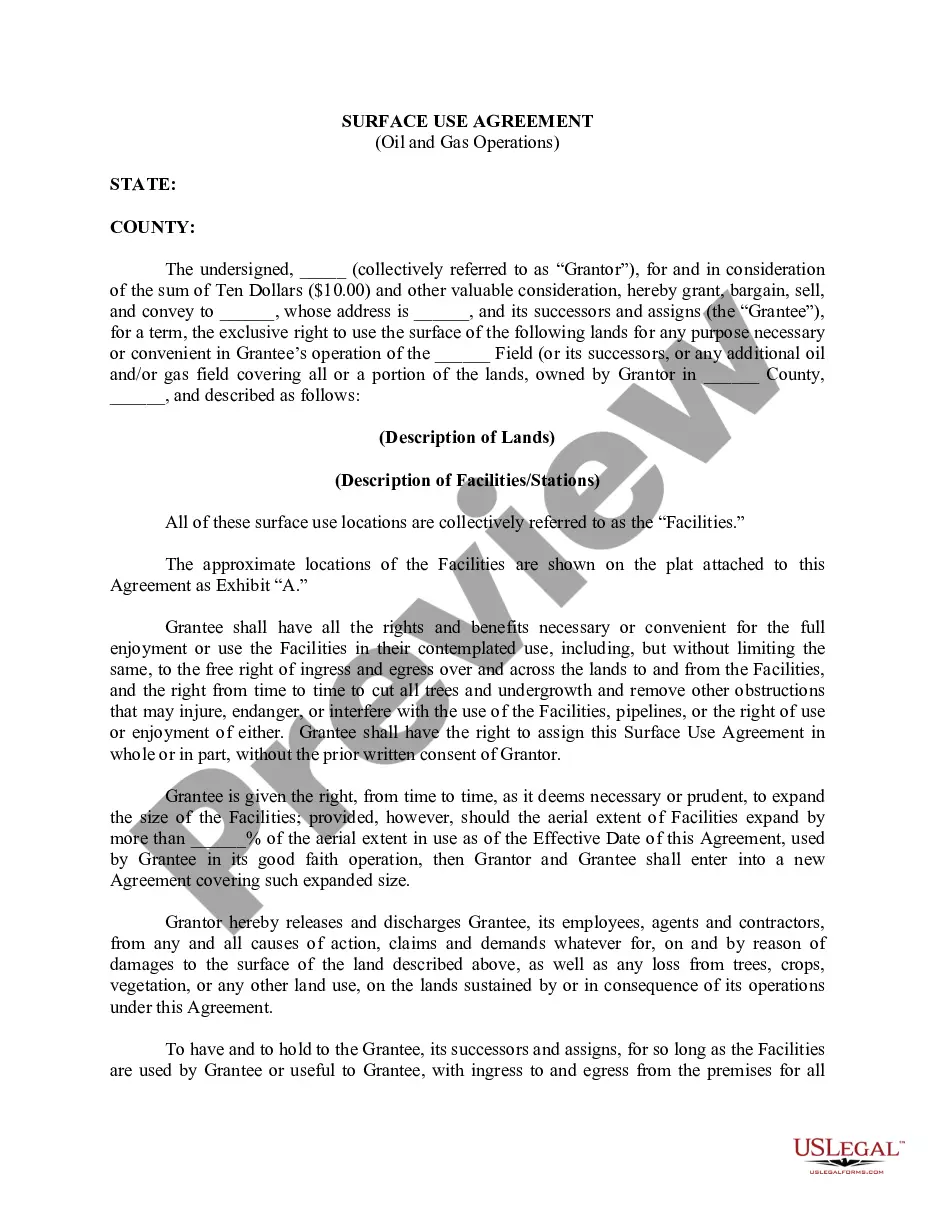




How to fill out Agreement Concerning Surface Equipment Between Operator And Surface Owner Concerning Construction Of Ramps For Circular Irrigation Systems?
Drafting legal documents is essential in the modern era. Nonetheless, it is not always necessary to enlist professional assistance to formulate certain forms from the ground up, such as the Wake Agreement Concerning Surface Equipment Between Operator and Surface Owner Regarding Construction of Ramps for Circular Irrigation Systems, using a service like US Legal Forms.
US Legal Forms offers more than 85,000 documents to select from across various categories, including living wills, real estate contracts, and divorce forms. All documents are categorized according to their respective state, streamlining the search process. Additionally, the website provides informational resources and tutorials to facilitate any tasks related to document preparation.
Below is the guide for finding and downloading the Wake Agreement Concerning Surface Equipment Between Operator and Surface Owner Regarding Construction of Ramps for Circular Irrigation Systems.
If you are already a US Legal Forms subscriber, you can locate the necessary Wake Agreement Concerning Surface Equipment Between Operator and Surface Owner Regarding Construction of Ramps for Circular Irrigation Systems, Log In to your account, and download it. Naturally, our platform cannot fully substitute for a lawyer. If you face a particularly complex issue, we recommend seeking the services of an attorney to review your document before signing and submitting it.
With over 25 years in the industry, US Legal Forms has established itself as a reliable resource for a wide range of legal forms for millions of clients. Join them today and easily acquire your state-specific documents!
- Review the document's preview and outline (if available) for an overview of what you will acquire after downloading the document.
- Verify that the template you select is tailored to your state/county/area since state regulations may influence the validity of certain documents.
- Explore related document templates or restart your search to identify the appropriate file.
- Click Buy now and create your account. If you already possess one, opt to Log In.
- Select the desired option, choose a payment method, and purchase the Wake Agreement Concerning Surface Equipment Between Operator and Surface Owner Regarding Construction of Ramps for Circular Irrigation Systems.
- Decide to save the form template in any supported format.
- Go to the My documents section to re-download the file.
Form popularity
FAQ
The most significant advantages are low initial cost, easy maintenance of the system, and compatibility with all soil types. Based on the slope, the size and shape of the field, the end conditions, and how water flows into and over the field, surface irrigation is classified into: Wild flood irrigation.
These factors include: crop. fuel cost and availability. initial cost. labor requirements. size and shape of field. water source.
Surface irrigation has evolved into an extensive array of configurations which can be broadly classified as: (1) basin irrigation; (2) border irrigation; (3) furrow irrigation; and (4) uncontrolled flooding.
Surface irrigation is where water is applied and distributed over the soil surface by gravity. It is by far the most common form of irrigation throughout the world and has been practiced in many areas virtually unchanged for thousands of years.
The different types of irrigation include- sprinkler irrigation, surface irrigation, drip irrigation, sub-irrigation and manual irrigation.
Factors affecting irrigation development are as follows: Topography and Slope of Soil: Irrigation development is done according to structure of the ground level.Structure, Depth and Permeability of Soil:Depth of Groundwater:Climate:Social Factors:Economic Factors:Resettlement:
Factors used to assess the land suitability for irrigation using groundwater. a) slope (%), b) population density, c) distance to major paved roads (km) and d) groundwater storage (million m 3 /km 2 ).
The term surface irrigation refers to systems that deliver water to crops using a gravity-fed, overland flow of water. Surface irrigation conveyance and distribution systems are among the first engineering innovations of humans, dating back to more than 6,000 years ago.
Types of Irrigation Systems Surface irrigation. Water is distributed over and across land by gravity, no mechanical pump involved. Localized irrigation.Drip irrigation.Sprinkler irrigation.Center pivot irrigation.Lateral move irrigation.Sub-irrigation.Manual irrigation.
5 Factors to Consider When Choosing an Irrigation System Soil type. The type of soil in an area can affect not only the type irrigation method used but also the irrigation run times.Land topography. In particular, hilly or sloping land can be a challenge.Local weather patterns.Type of crops grown.Water quality.