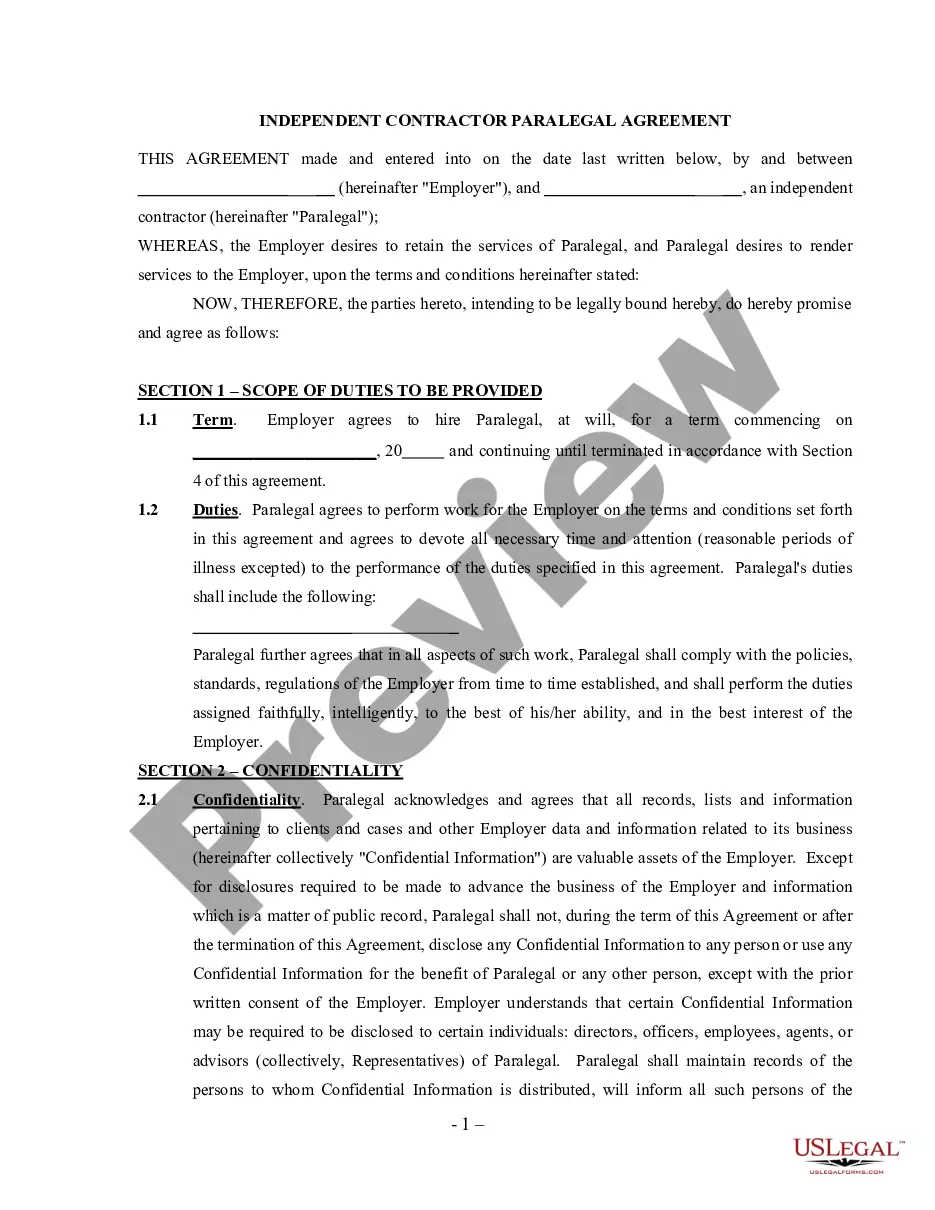
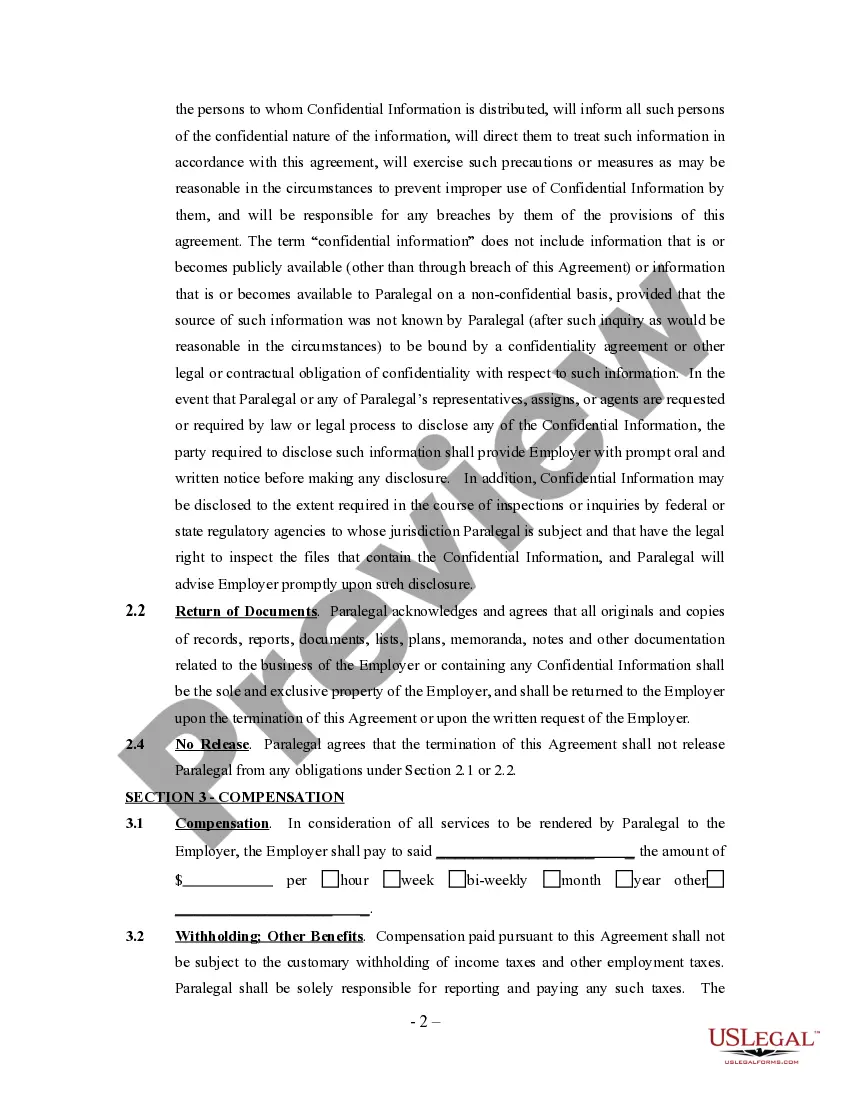
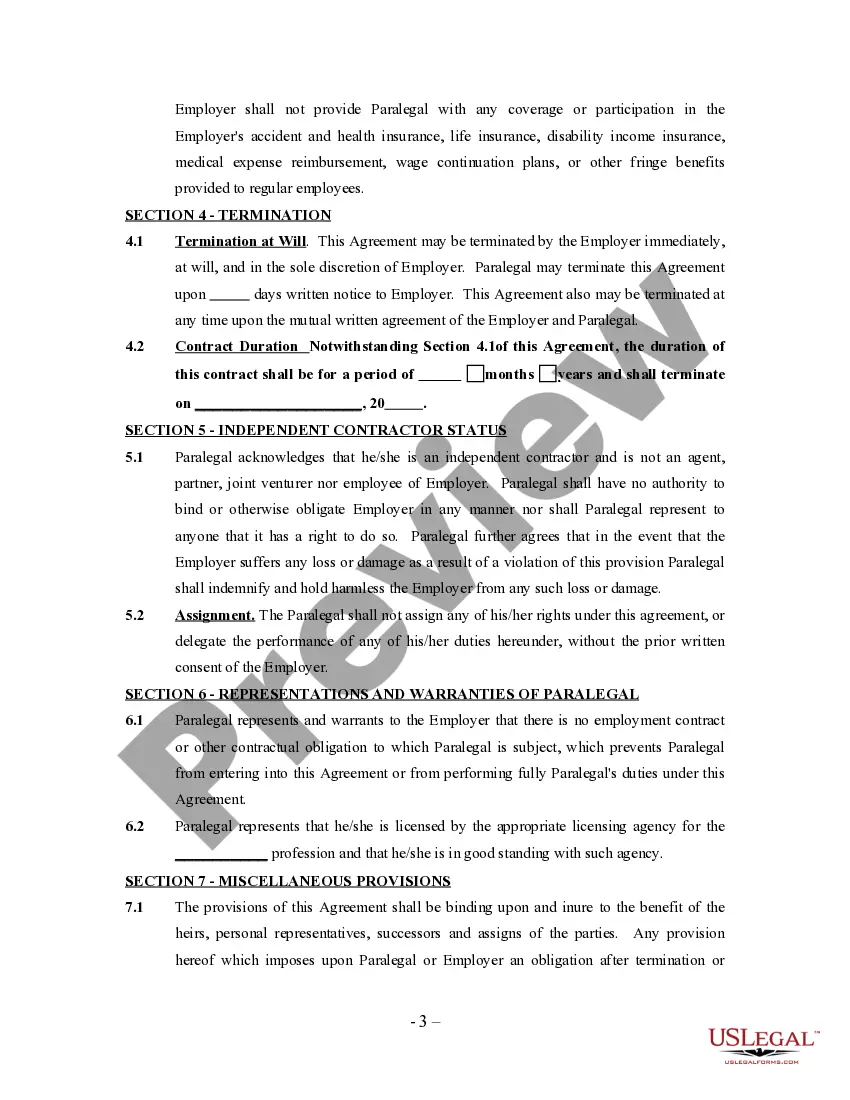
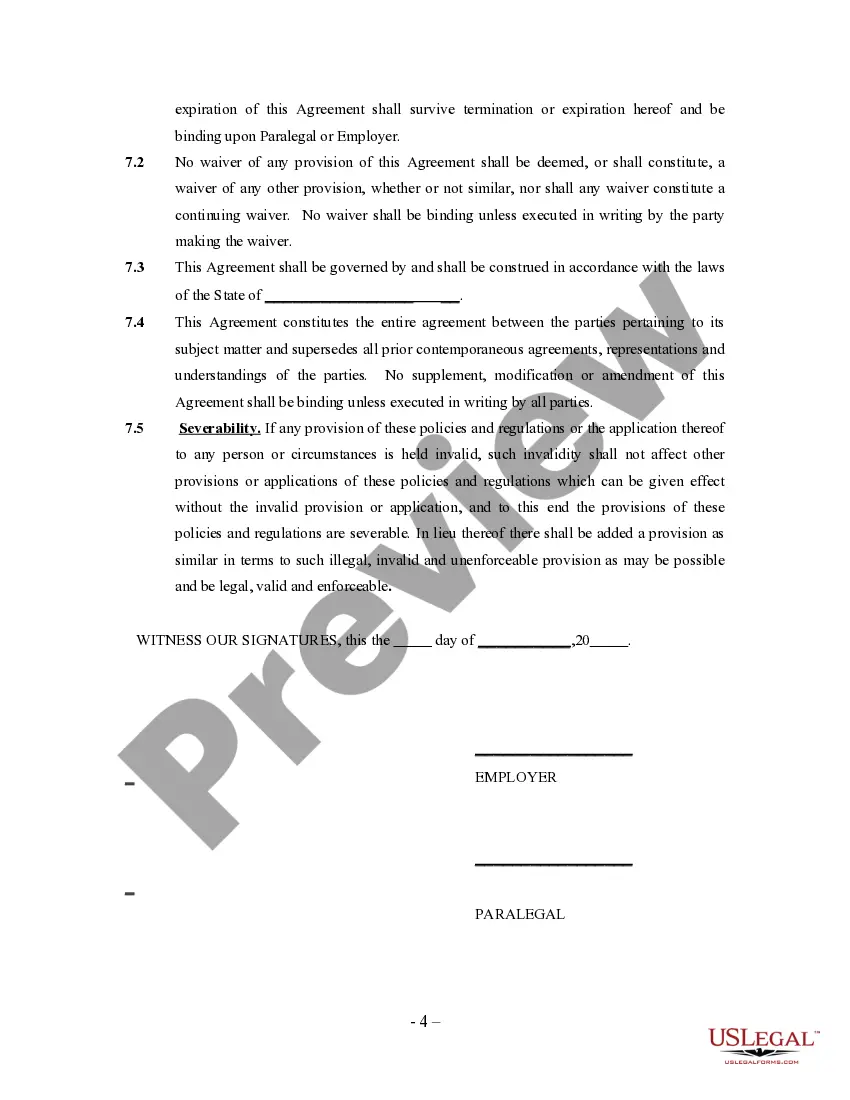
Employer contracts with a paralegal as independent contractor to provide paralegal services for employer as specified and agreed upon in the contract. Contract includes confidentiality clause.
Bronx New York Paralegal Agreement - Self-Employed Independent Contractor
State:
Multi-State
County:
Bronx
Control #:
US-INDC-131
Format:
Word;
Rich Text
288 downloads
Description
Free preview
Get your form ready online
Our built-in tools help you complete, sign, share, and store your documents in one place.
Built-in online Word editor
Make edits, fill in missing information, and update formatting in US Legal Forms—just like you would in MS Word.
Export easily
Download a copy, print it, send it by email, or mail it via USPS—whatever works best for your next step.
E-sign your document
Sign and collect signatures with our SignNow integration. Send to multiple recipients, set reminders, and more. Go Premium to unlock E-Sign.
Notarize online 24/7
If this form requires notarization, complete it online through a secure video call—no need to meet a notary in person or wait for an appointment.
Store your document securely
We protect your documents and personal data by following strict security and privacy standards.

Make edits, fill in missing information, and update formatting in US Legal Forms—just like you would in MS Word.

Download a copy, print it, send it by email, or mail it via USPS—whatever works best for your next step.

Sign and collect signatures with our SignNow integration. Send to multiple recipients, set reminders, and more. Go Premium to unlock E-Sign.

If this form requires notarization, complete it online through a secure video call—no need to meet a notary in person or wait for an appointment.

We protect your documents and personal data by following strict security and privacy standards.
Looking for another form?

How to fill out Paralegal Agreement - Self-Employed Independent Contractor?
Legislations and statutes in every domain differ from one jurisdiction to another.
If you're not a lawyer, it's simple to become confused by the various standards when it comes to creating legal documents.
To prevent costly legal aid when preparing the Bronx Paralegal Agreement - Self-Employed Independent Contractor, you require a verified template suitable for your area. That's where the US Legal Forms platform proves exceptionally advantageous.
That's the simplest and most cost-effective method to obtain current templates for any legal situations. Find them all with just a few clicks and keep your documents organized with the US Legal Forms!
- Evaluate the webpage content to confirm you have located the correct template.
- Use the Preview feature or review the form description if provided.
- Search for another document if there are discrepancies with your needs.
- Click the Buy Now button to acquire the document once you find the suitable one.
- Select one of the subscription plans and log in or set up an account.
- Choose your preferred payment method for the subscription (via credit card or PayPal).
- Select the format you wish to save the document in and hit Download.
Form popularity
FAQ
An independent contractor is a self-employed person or entity contracted to perform work foror provide services toanother entity as a nonemployee. As a result, independent contractors must pay their own Social Security and Medicare taxes.
A: Typically a worker cannot be both an employee and an independent contractor for the same company. An employer can certainly have some employees and some independent contractors for different roles, and an employee for one company can perform contract work for another company.
Becoming an independent contractor is one of the many ways to be classified as self-employed. By definition, an independent contractor provides work or services on a contractual basis, whereas, self-employment is simply the act of earning money without operating within an employee-employer relationship.
Known as poaching, having contractors contact your own clients is a risk every business takes when bringing on contractors. Poaching can happen either while the worker is on contract with you or afterward. Either way, though, you can lose the ability to do business with that client.
7 Terms you should include in an independent contractor agreement? Statement of Relationship.Project Description.Payment and Billing Terms.Responsibilities of Each Party.Project Timeline and Deadlines.Termination Conditions.Nondisclosure Terms, and Confidentiality and Non-Compete Clauses.
How do I create an Independent Contractor Agreement? State the location.Describe the type of service required.Provide the contractor's and client's details.Outline compensation details.State the agreement's terms.Include any additional clauses.State the signing details.
The general rule is that an individual is an independent contractor if the payer has the right to control or direct only the result of the work and not what will be done and how it will be done. If you are an independent contractor, then you are self-employed.
As a contract paralegal, you help lawyers prepare for cases on a freelance basis. Instead of working as an employee of the law office, you have a contract for a specified amount of time.
The contract should state who pays which expenses. The contractor is usually responsible for all expenses including mileage, vehicle maintenance, and other business travel costs; work supplies and tools; licenses, fees, and permits; phone and internet expenses; and payments to employees or subcontractors.
Independent contractors usually offer their services to the general public, not just to one person or company. Government auditors will be impressed if you market your services to the public. Here are some ways to do this: Obtain a business card and letterhead.