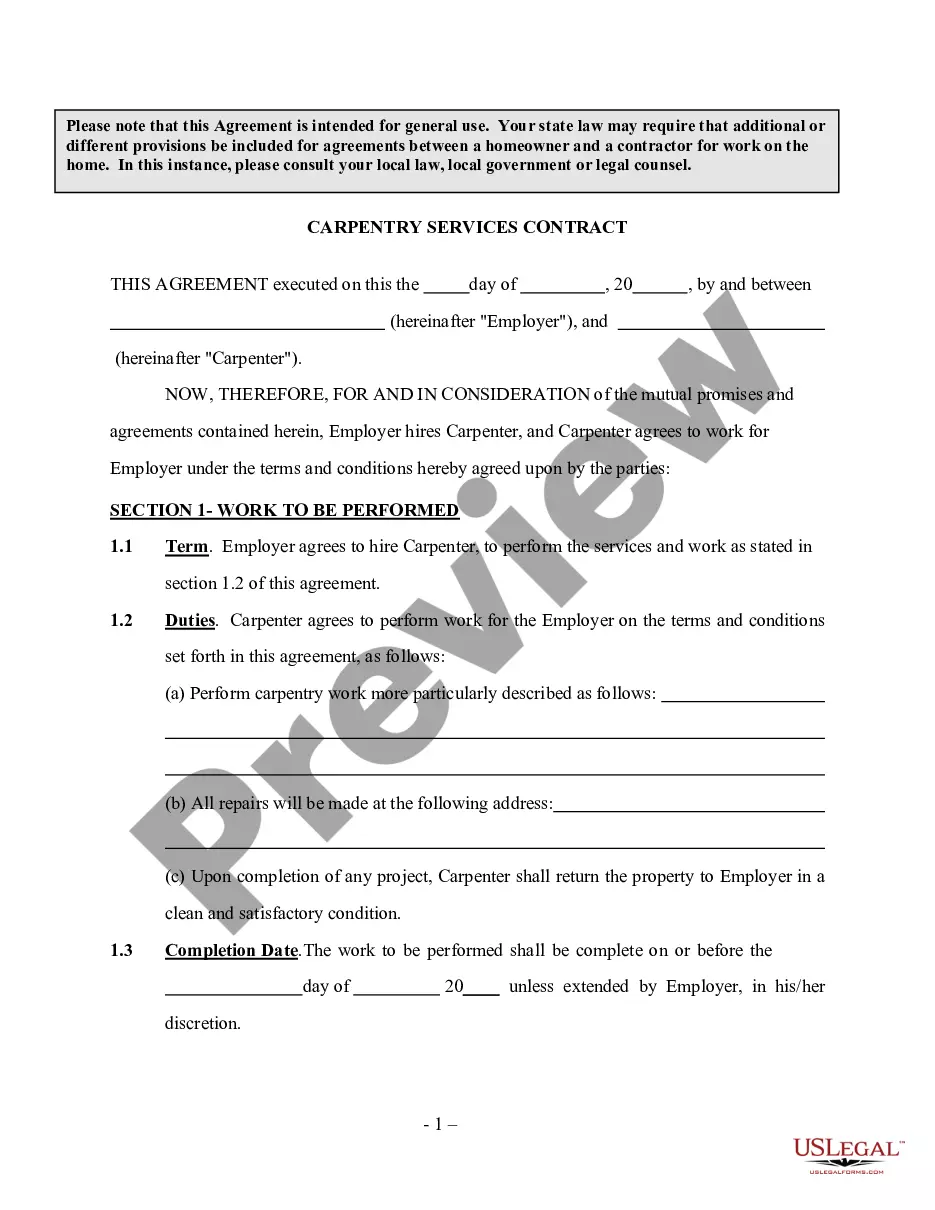
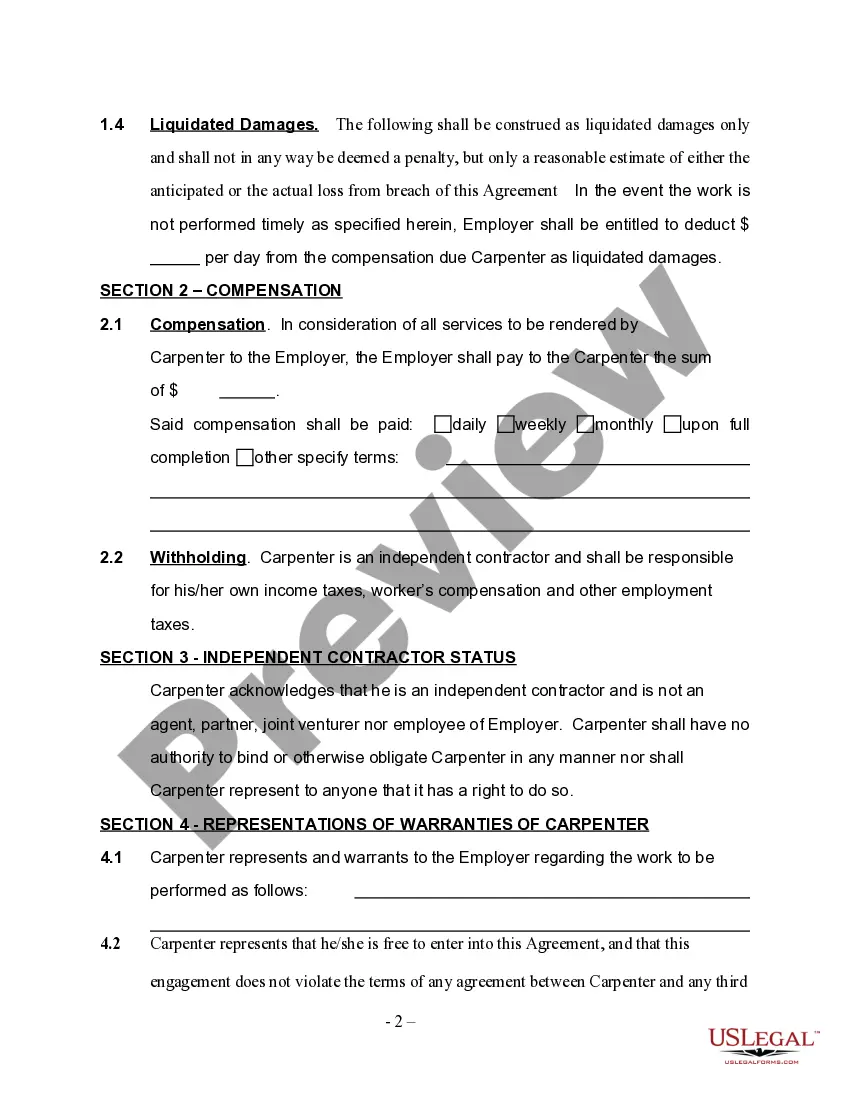
This is an agreement between either a business or an individual and a carpenter to hire the carpenter as an independent contractor. Please note that this Agreement is intended for general use. Your state law may require that additional or different provisions be included for agreements between a homeowner and a contractor for work on the home. In this instance, please consult your local law, local government or legal counsel.
Fairfax Virginia Carpentry Services Contract - Self-Employed Independent Contractor
State:
Multi-State
County:
Fairfax
Control #:
US-INDC-03
Format:
Word;
Rich Text
Instant download
Description
Free preview
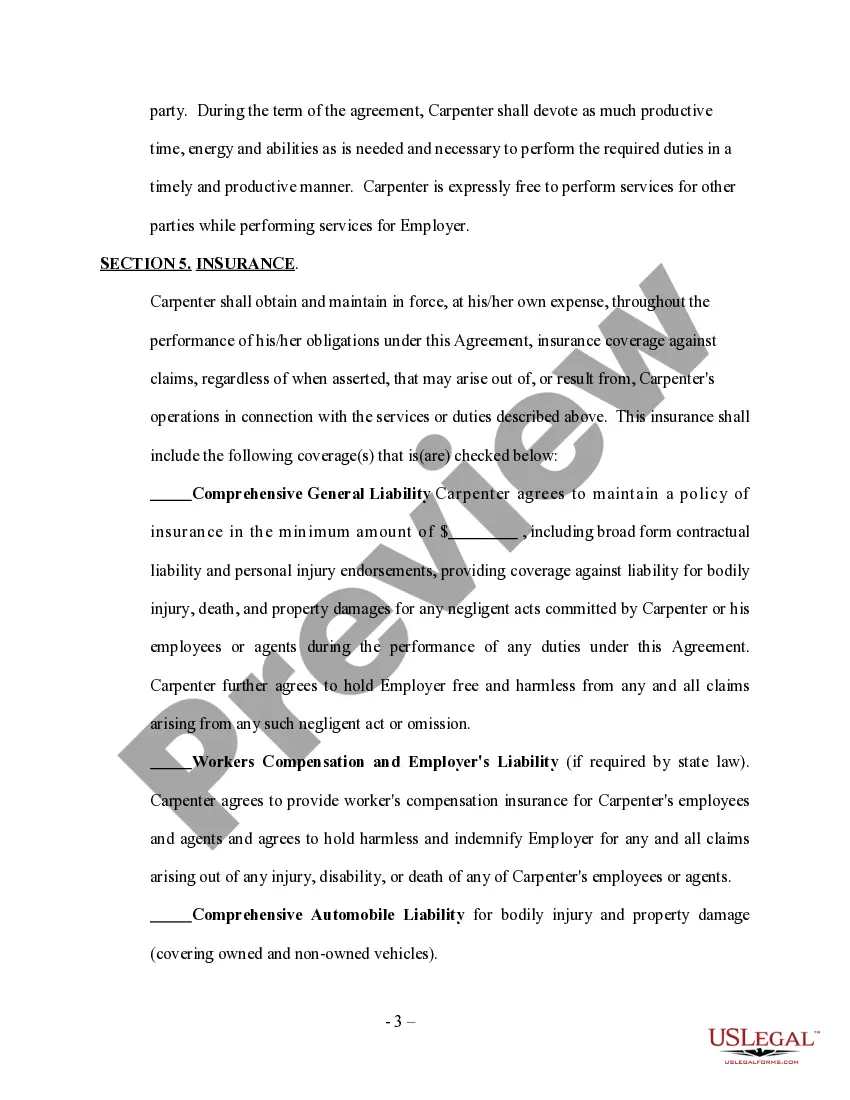
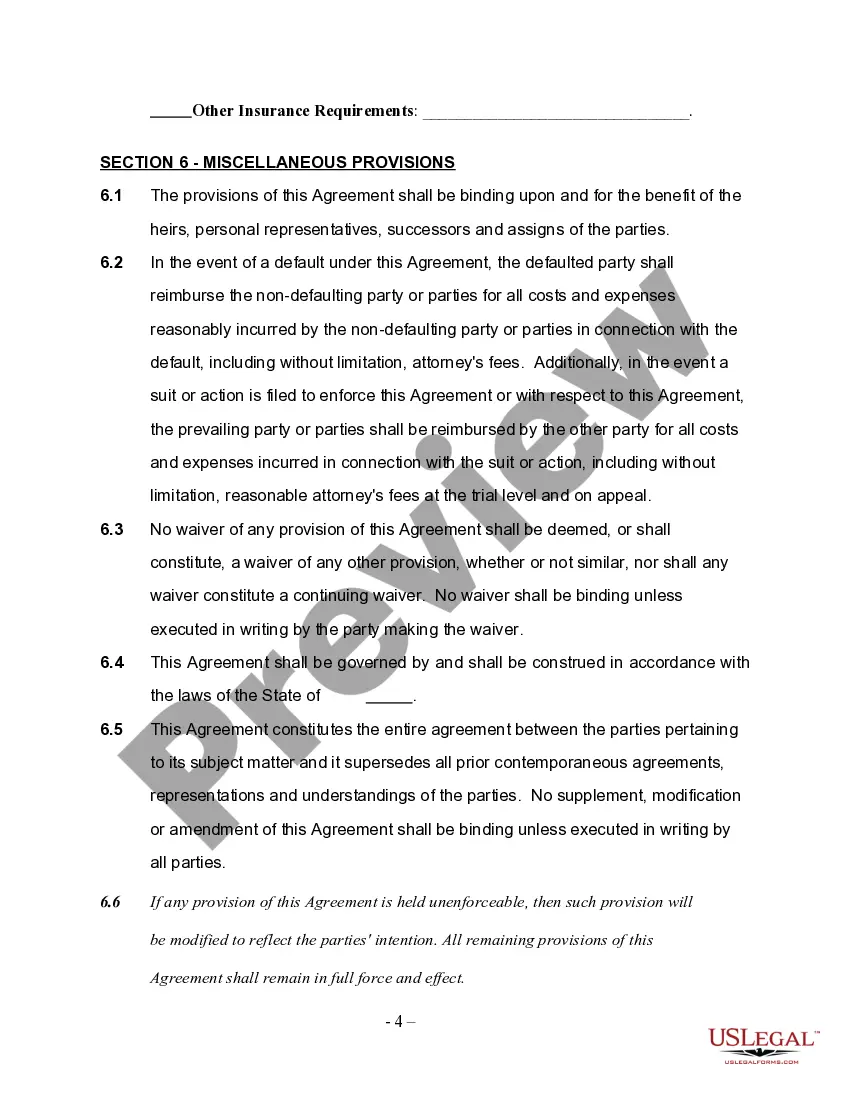
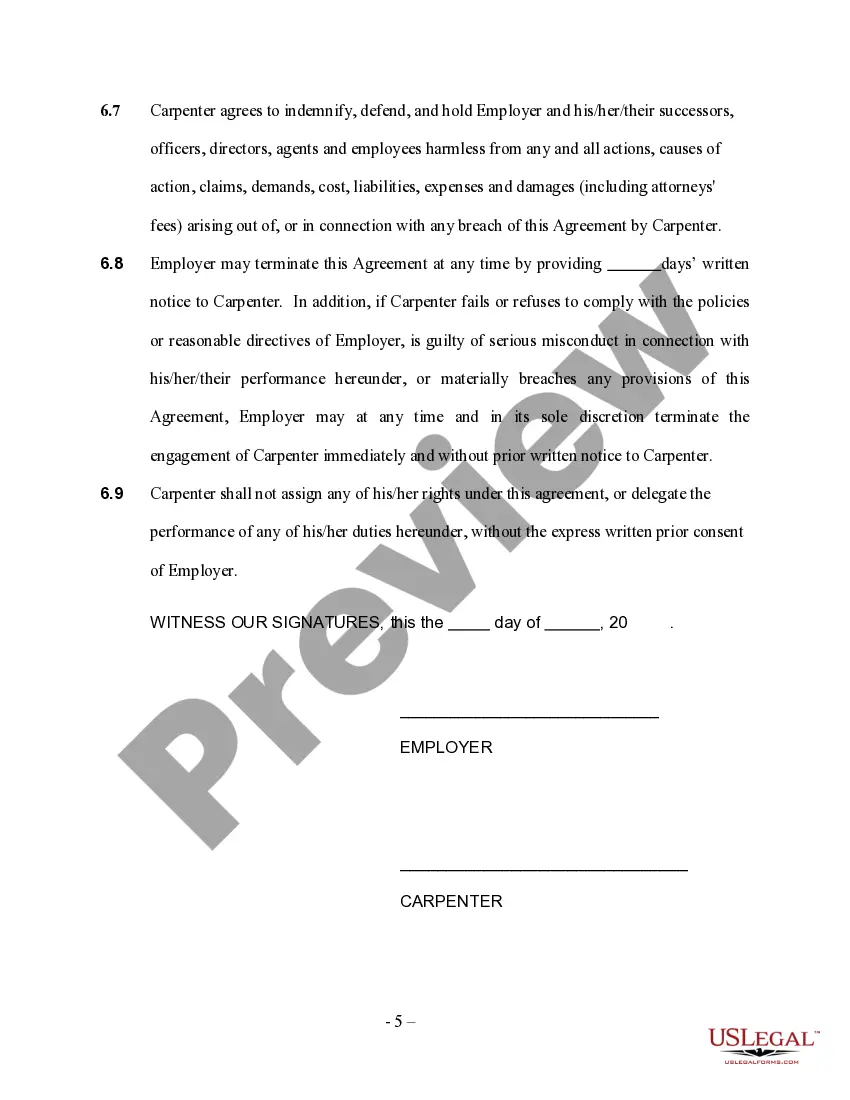
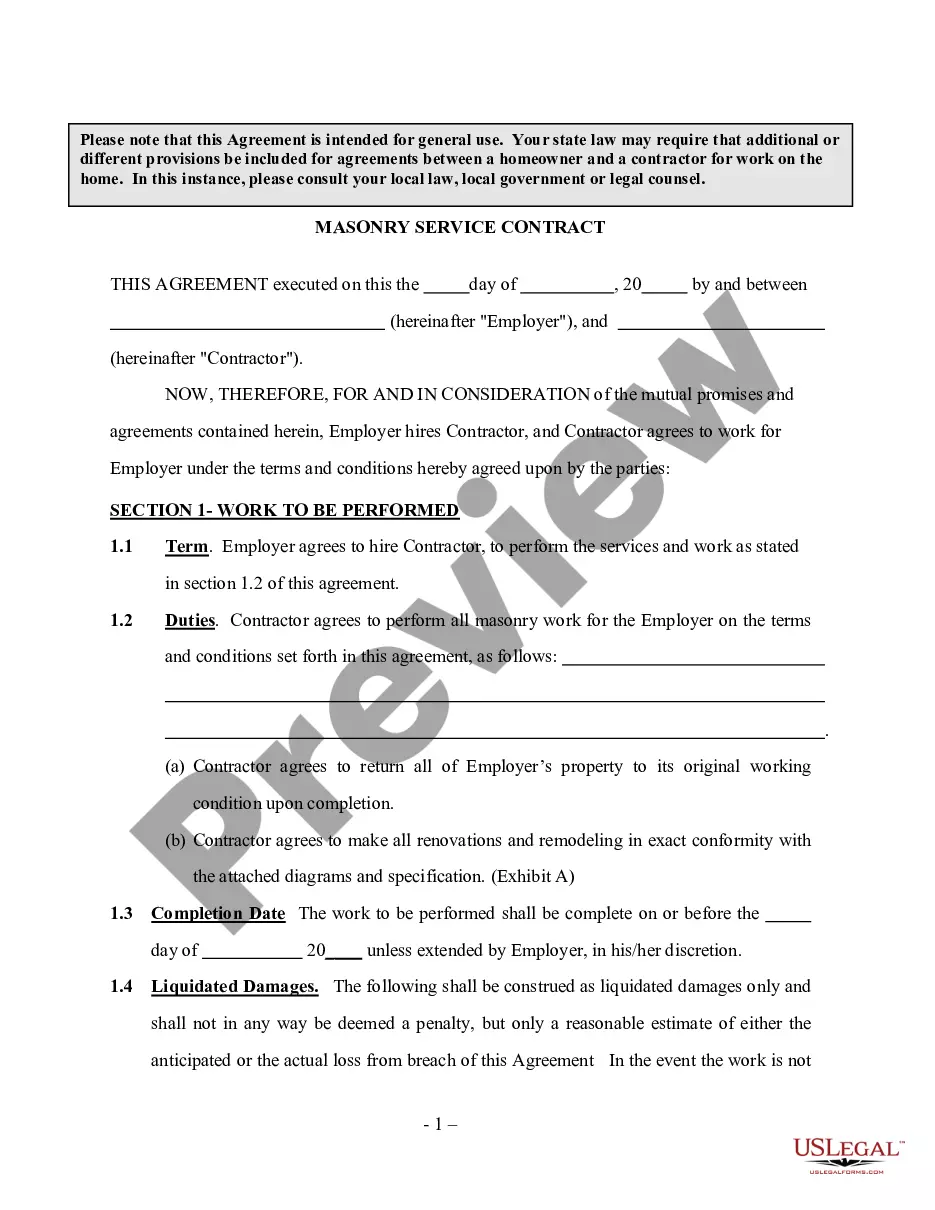
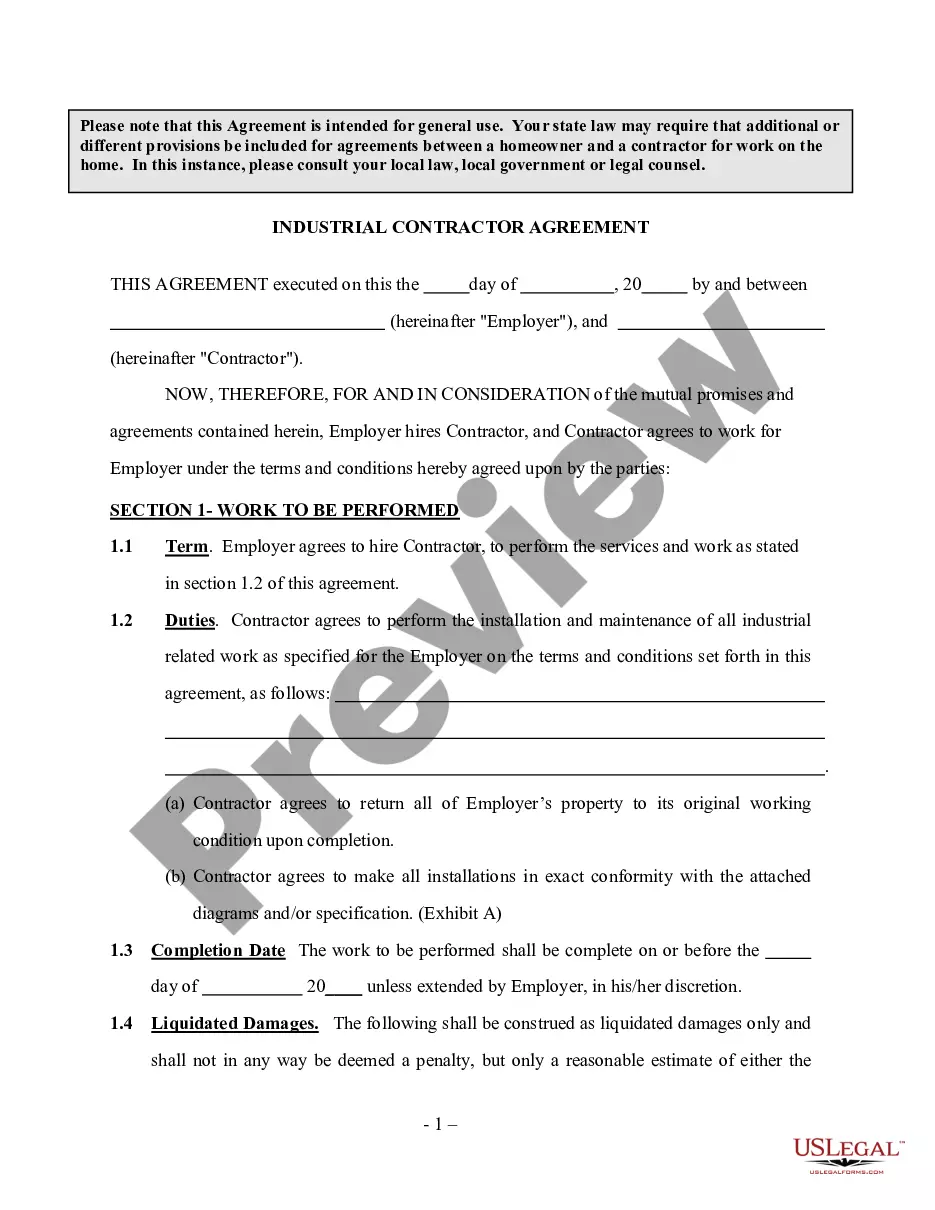
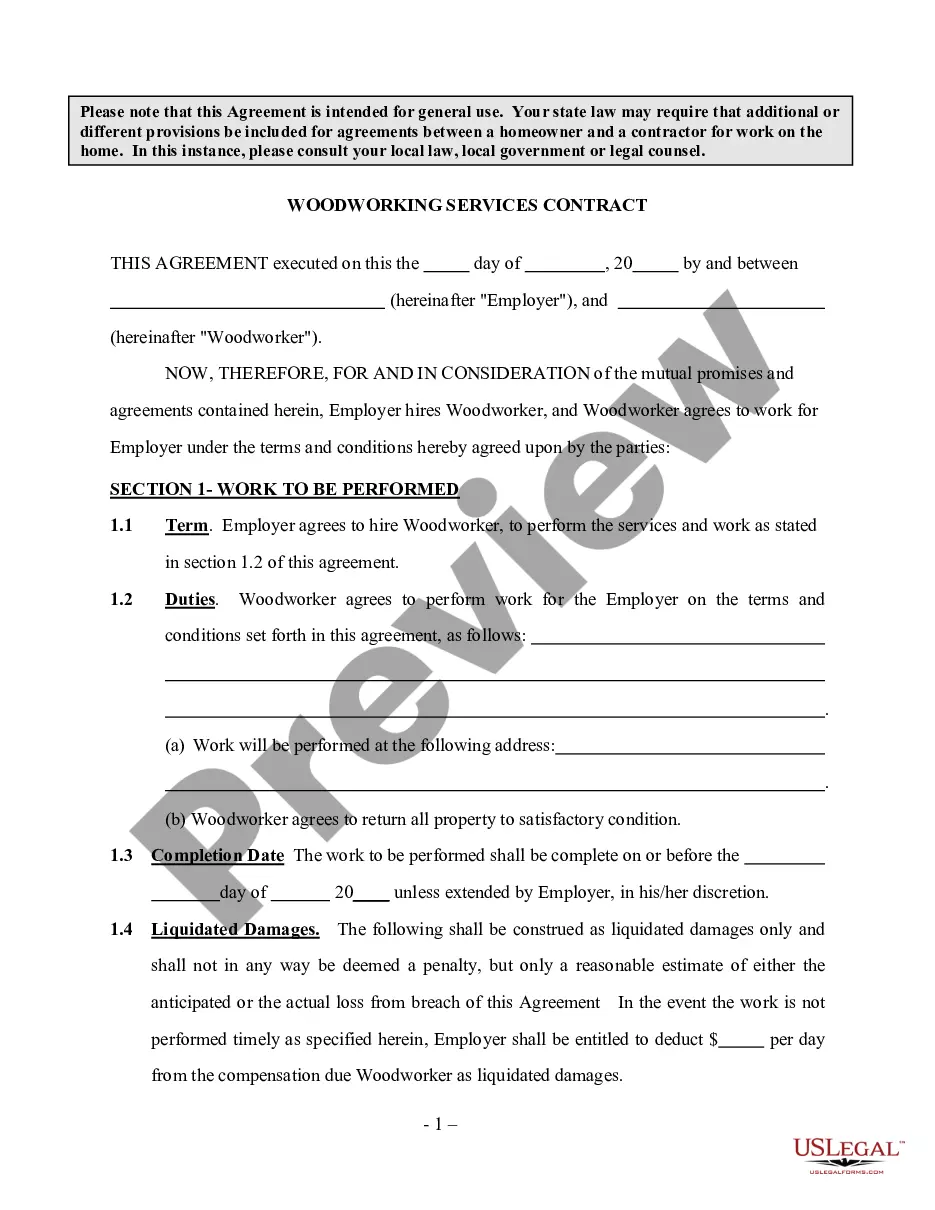
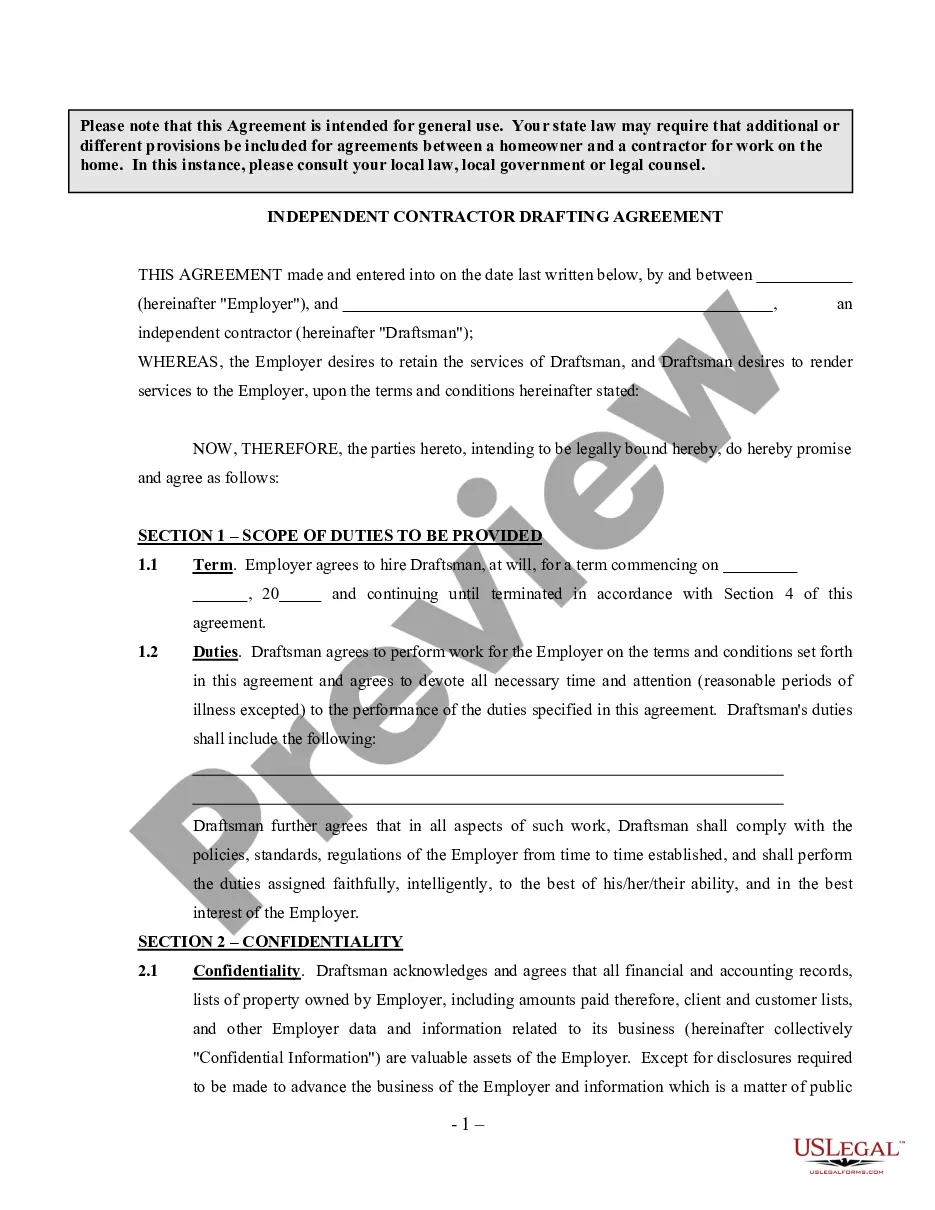





How to fill out Carpentry Services Contract - Self-Employed Independent Contractor?
A paperwork process invariably accompanies every legal action you undertake.
Establishing a business, seeking or accepting employment, transferring real estate, and numerous other life situations necessitate that you organize formal documentation that varies by jurisdiction.
This is why consolidating everything in a single location is particularly beneficial.
US Legal Forms is the largest online repository of current federal and state-specific legal documents.
Examine the description (if applicable) to confirm the template aligns with your requirements.
- Here, you can effortlessly find and download a document for any personal or professional intention relevant to your area, including the Fairfax Carpentry Services Contract - Self-Employed Independent Contractor.
- Finding templates on the site is exceedingly straightforward.
- If you already hold a subscription to our platform, Log In to your account, search for the template using the search function, and click Download to save it onto your device.
- After that, the Fairfax Carpentry Services Contract - Self-Employed Independent Contractor will be available for ongoing use in the My documents section of your account.
- If you are using US Legal Forms for the first time, adhere to this straightforward guide to acquire the Fairfax Carpentry Services Contract - Self-Employed Independent Contractor.
- Ensure you have navigated to the correct page with your local document.
- Use the Preview mode (if accessible) and examine the sample.
Form popularity
FAQ
Here's a look at the basic steps you'll need to take to create a simple and effective client contract: Include Contact Information of Both Parties.Specify Project Terms and Scope.Establish Payment Terms.Set the Schedule.Decide What Happens If a Contract Is Terminated.Determine Who Owns Final Copyrights.
Ten Tips for Making Solid Business Agreements and Contracts Get it in writing.Keep it simple.Deal with the right person.Identify each party correctly.Spell out all of the details.Specify payment obligations.Agree on circumstances that terminate the contract.Agree on a way to resolve disputes.
As of the 2020 tax year, the IRS Form 1099-NEC is the independent contractor tax form used by businesses to report payments to a contract worker in the previous tax year. This tax form for independent contractors is filed with the IRS and is also provided to the contractor for reporting income.
How do I create an Independent Contractor Agreement? State the location.Describe the type of service required.Provide the contractor's and client's details.Outline compensation details.State the agreement's terms.Include any additional clauses.State the signing details.
To set yourself up as a self-employed taxpayer with the IRS, you simply start paying estimated taxes (on Form 1040-ES, Estimated Tax for Individuals) and file Schedule C, Profit or Loss From Business, and Schedule SE, Self-Employment Tax, with your Form 1040 tax return each April.
An independent contractor is a self-employed person or entity contracted to perform work foror provide services toanother entity as a nonemployee. As a result, independent contractors must pay their own Social Security and Medicare taxes.
A basic rule of thumb that most people suggest would be to determine your hourly rate as a permanent employee, and then add 50-75%. If you were earning $65,000/year, that equates to $31.25/hr. By adding 50%, your rate would be $47/hr, and at 75%, your rate would be $55/hr.
If you are an independent contractor, then you are self-employed. The earnings of a person who is working as an independent contractor are subject to self-employment tax. To find out what your tax obligations are, visit the Self-Employed Individuals Tax Center.
An independent contractor is a self-employed person or entity contracted to perform work foror provide services toanother entity as a nonemployee. As a result, independent contractors must pay their own Social Security and Medicare taxes.
Some ways to prove self-employment income include: Annual Tax Return. This is the most credible and straightforward way to demonstrate your income over the last year since it's an official legal document recognized by the IRS.1099 Forms.Bank Statements.Profit/Loss Statements.Self-Employed Pay Stubs.