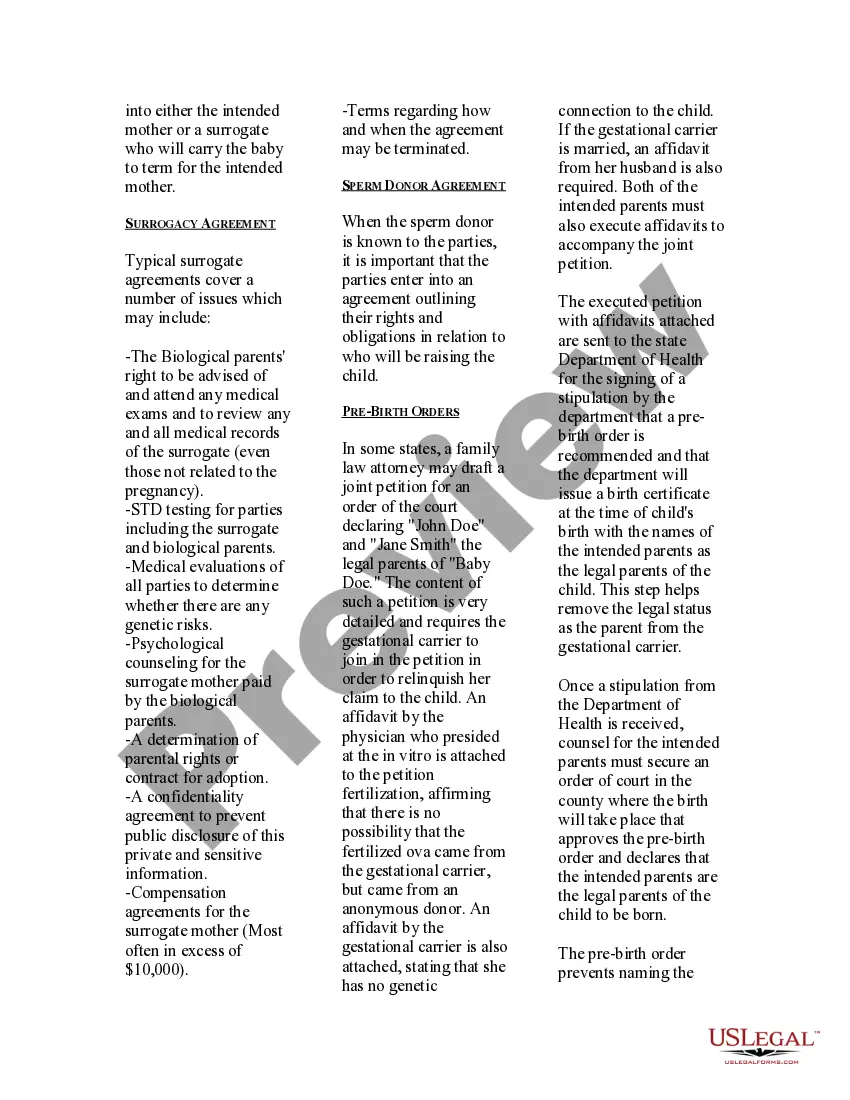
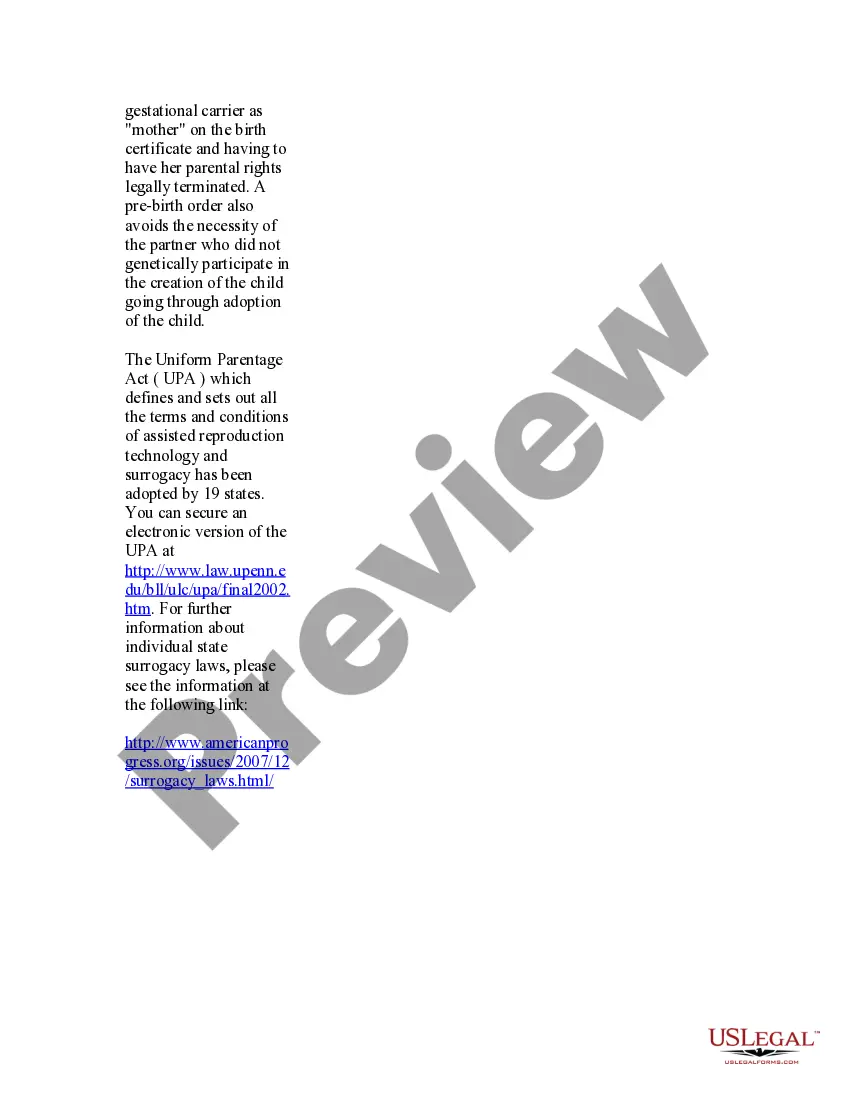
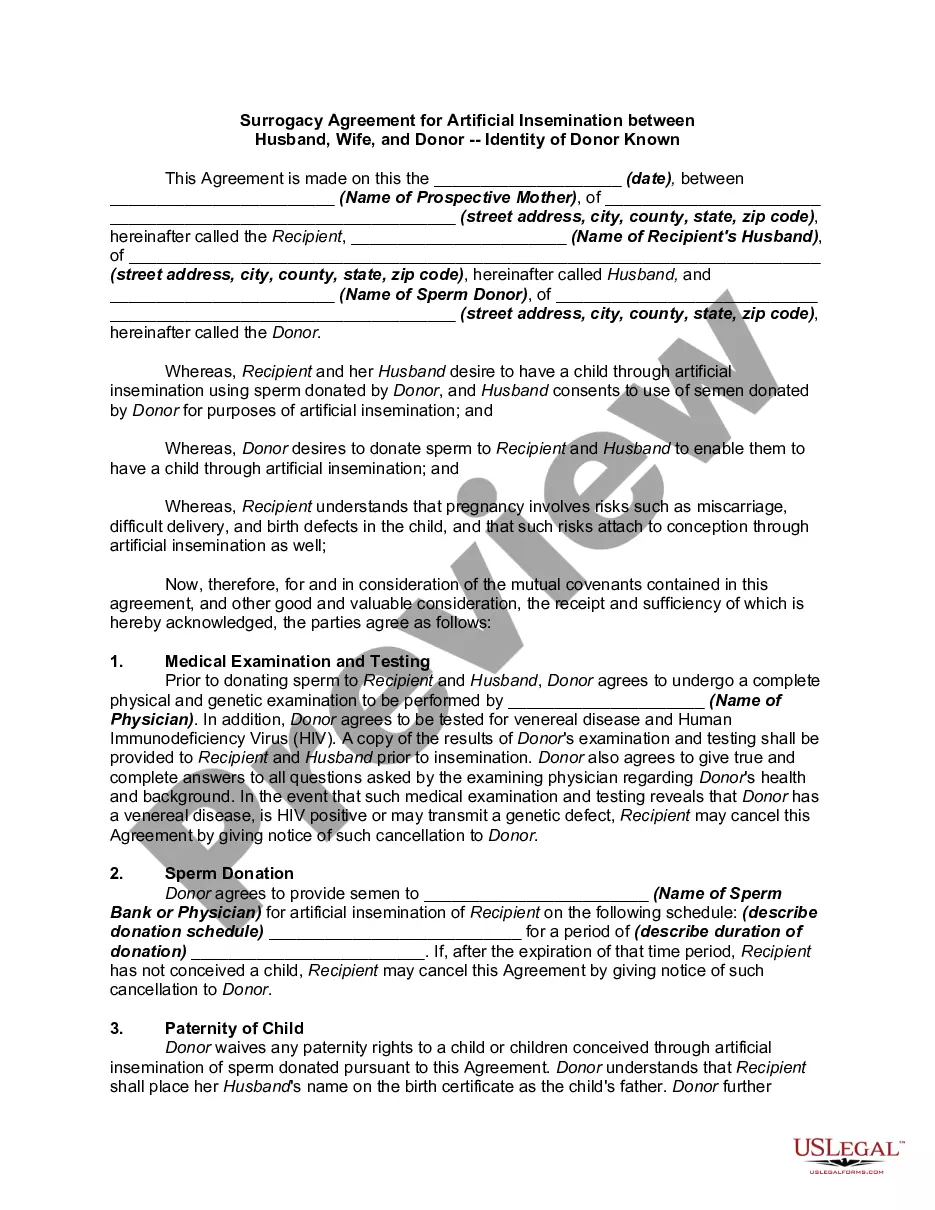
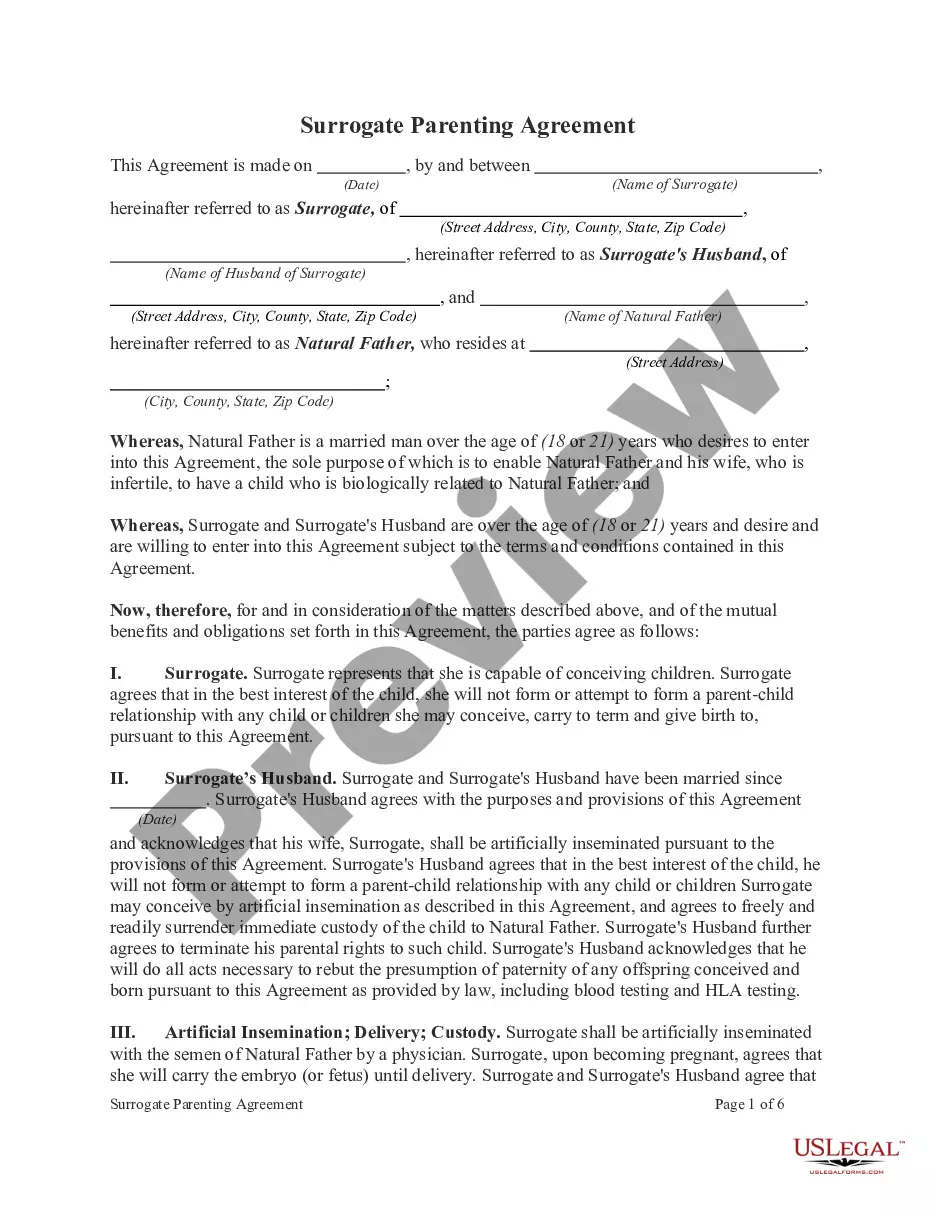
This guide provides an overview of surrogacy in the U.S. Issues discussed cover types of surrogacy and agreements included as part of the process. Links to state-specific laws are included.
Riverside California USLegal Guide to Surrogacy - Surrogate
Category:
State:
Multi-State
County:
Riverside
Control #:
US-GDE-06
Format:
Word;
Rich Text
Instant download
Description
Free preview


How to fill out USLegal Guide To Surrogacy - Surrogate?
How long does it usually take you to create a legal document.
Since every state has its own laws and regulations for various aspects of life, locating a Riverside USLegal Guide to Surrogacy - Surrogate that meets all local criteria can be daunting, and obtaining it from a qualified attorney is often costly. Numerous online platforms provide popular state-specific templates for download, but utilizing the US Legal Forms library is the most advantageous.
US Legal Forms is the most extensive online collection of templates, organized by states and areas of use. Besides the Riverside USLegal Guide to Surrogacy - Surrogate, you can find any specific document to manage your business or personal matters, adhering to your county requirements. Professionals validate all samples for their accuracy, ensuring you can prepare your documents correctly.
Print the template or utilize any preferred online editor to fill it out electronically. Regardless of how many times you need to use the purchased template, you can access all the samples you’ve ever saved in your profile by navigating to the My documents tab. Give it a try!
- Using the service is quite straightforward.
- If you already possess an account on the platform and your subscription is active, you just need to Log In, select the necessary form, and download it.
- You can keep the document in your profile anytime in the future.
- If you are a new user on the platform, there will be additional steps to take before you acquire your Riverside USLegal Guide to Surrogacy - Surrogate.
- Review the content of the page you’re on.
- Examine the description of the template or Preview it (if available).
- Look for another document using the relevant option in the header.
- Click Buy Now when you’re confident about the chosen document.
- Select the subscription plan that best matches your needs.
- Register for an account on the platform or Log In to continue to payment methods.
- Make a payment via PayPal or with your credit card.
- Change the file format if necessary.
- Click Download to save the Riverside USLegal Guide to Surrogacy - Surrogate.
Form popularity
FAQ
Can The Surrogate Mother Keep The Baby? Overall, the answer to this question is no. In pre-birth states, the surrogate mother is legally required to hand the baby over to the intended parents.
No, the baby will not look like a gestational surrogate. A baby born through surrogacy process will have a combination of physical characteristics (looks) of the egg and sperm provider since the baby's DNA only comes from the egg and sperm used to create the embryo, and not the surrogate.
The average amount of compensation, including expenses, can range from $50,000 to $80,000 depending on experience and the individual arrangements. In states like California, where surrogates are in high demand, surrogates may be paid slightly higher.
Overall, gestational carriers become surrogates to help Intended Parents, not to be attached to the baby.
A 2014 qualitative study on the experiences of eight surrogate mothers published the Iranian Journal of Reproductive Medicine, revealed surrogate moms experience significant emotional attachment to the children they carry.
Generally, many surrogacy professionals will set BMI requirements for surrogacy between 19 and 32. This range excludes most women who are medically underweight or obese both dangerous situations in which to carry a child.
A gestational surrogate is not given the option to change her mind after the baby is born. A prospective gestational surrogate is required to undergo a mental health consultation to ensure that she is comfortable with the fact that she will part with the child after his/her birth.
However, in the US, intended parents can pay a surrogate through what is known as an "inconvenience fee" in addition to expenses. This is typically valued between $20,000 (£15,380) and $35,000 (£26,915).
Yes! As a surrogate, you give up a great deal of your time and energy to help an individual or couple grow their family, and in most of the U.S. (as well as several other countries), you can be compensated for it.
Yes. Commercial surrogacy is legal in California and is regulated by CA surrogacy laws. Surrogacy compensation does not, legally or ethically, mean that intended parents are giving their gestational carrier money in exchange for their baby.