Philadelphia Pennsylvania Perpetual Nontransferable Nonexclusive Vendor-Oriented Software License Agreement
Description
Get your form ready online
Our built-in tools help you complete, sign, share, and store your documents in one place.
Make edits, fill in missing information, and update formatting in US Legal Forms—just like you would in MS Word.
Download a copy, print it, send it by email, or mail it via USPS—whatever works best for your next step.
Sign and collect signatures with our SignNow integration. Send to multiple recipients, set reminders, and more. Go Premium to unlock E-Sign.
If this form requires notarization, complete it online through a secure video call—no need to meet a notary in person or wait for an appointment.
We protect your documents and personal data by following strict security and privacy standards.

Make edits, fill in missing information, and update formatting in US Legal Forms—just like you would in MS Word.

Download a copy, print it, send it by email, or mail it via USPS—whatever works best for your next step.

Sign and collect signatures with our SignNow integration. Send to multiple recipients, set reminders, and more. Go Premium to unlock E-Sign.

If this form requires notarization, complete it online through a secure video call—no need to meet a notary in person or wait for an appointment.

We protect your documents and personal data by following strict security and privacy standards.
Looking for another form?
How to fill out Perpetual Nontransferable Nonexclusive Vendor-Oriented Software License Agreement?
Preparing documents, such as the Philadelphia Perpetual Nontransferable Nonexclusive Vendor-Oriented Software License Agreement, to handle your legal matters is a demanding and lengthy undertaking.
Numerous instances necessitate an attorney’s involvement, which also renders this task costly.
However, you can take control of your legal challenges and address them on your own.
The onboarding process for new users is equally straightforward! Here’s what you should do before obtaining the Philadelphia Perpetual Nontransferable Nonexclusive Vendor-Oriented Software License Agreement: Ensure that your template aligns with your state/county regulations, as the guidelines for crafting legal documents may vary from state to state.
- US Legal Forms is here to assist.
- Our site features over 85,000 legal templates designed for various situations and life events.
- We ensure every document complies with the laws of each state, so you don’t have to worry about possible legal complications arising from compliance.
- If you’re already familiar with our website and have a subscription with US, you know how simple it is to access the Philadelphia Perpetual Nontransferable Nonexclusive Vendor-Oriented Software License Agreement form.
- Just Log In to your account, download the form, and tailor it to suit your requirements.
- Have you misplaced your document? No worries. You can find it in the My documents section in your account - accessible on desktop or mobile.
Form popularity
FAQ
permissive license restricts users from certain activities, such as modifying or redistributing the software. Within the framework of a Philadelphia Pennsylvania Perpetual Nontransferable Nonexclusive VendorOriented Software License Agreement, these licenses protect the vendor's intellectual property by limiting how the software can be used. Understanding the implications of a nonpermissive license is crucial for users, as it establishes clear boundaries for software utilization. If you are unsure about your rights, consulting with professionals or using platforms like US Legal Forms can help clarify these complex agreements.
Exclusive license patents grant the licensee full rights to utilize the patent, blocking others from accessing it, while non-exclusive license patents allow multiple parties to use the same patent rights. In relation to the Philadelphia Pennsylvania Perpetual Nontransferable Nonexclusive Vendor-Oriented Software License Agreement, knowing these distinctions can guide your choices in licensing agreements. Understanding whether you need exclusivity can significantly impact your strategy in utilizing patented innovations.
exclusive and nontransferable license means that multiple parties can use the same rights, but you cannot transfer your rights to another party. In the context of the Philadelphia Pennsylvania Perpetual Nontransferable Nonexclusive VendorOriented Software License Agreement, this ensures that you retain access to the software without the ability to hand over your rights to someone else. This type of license provides flexibility while maintaining control over how the software is used.
Precisely identifying which intellectual property will be the subject of the license is necessary to ensure both parties are on the same page and not exceeding their rights. Scope of the Grant.Exclusivity.Territory.Term.Compensation.Termination.Conclusion.
Examples of Licensing Agreements Licensing agreements are found in many different industries. An example of a licensing agreement is a contract between the copyright holders of software and another company, allowing the latter to use the computer software for their daily business operations.
The steps for making a license agreement are as follows: Download a template for a licensing agreement. Choose your role as the licensor or licensee. Define the license(s) in the agreement. Decide whether the license is exclusive or not. Settle the matter of fees and payment schedule. Add a renewal date and rules.
Software license agreements raise important considerations for both software licensors and licensees. For software licensors, a software licensing arrangement can generate significant revenue and the licensor's ownership and control of its intellectual property (IP) rights in the software are typically paramount.
A typical software license grants the licensee, typically an end-user, permission to use one or more copies of software in ways where such a use would otherwise potentially constitute copyright infringement of the software owner's exclusive rights under copyright.
Payment clause- The provision explicitly addresses the payment of fees for the service offered by the licensor. Transfers- This clause restricts the right of licensee to sell, rent, lease, or transfer or assign any of his rights or obligation to any third party under this agreement.
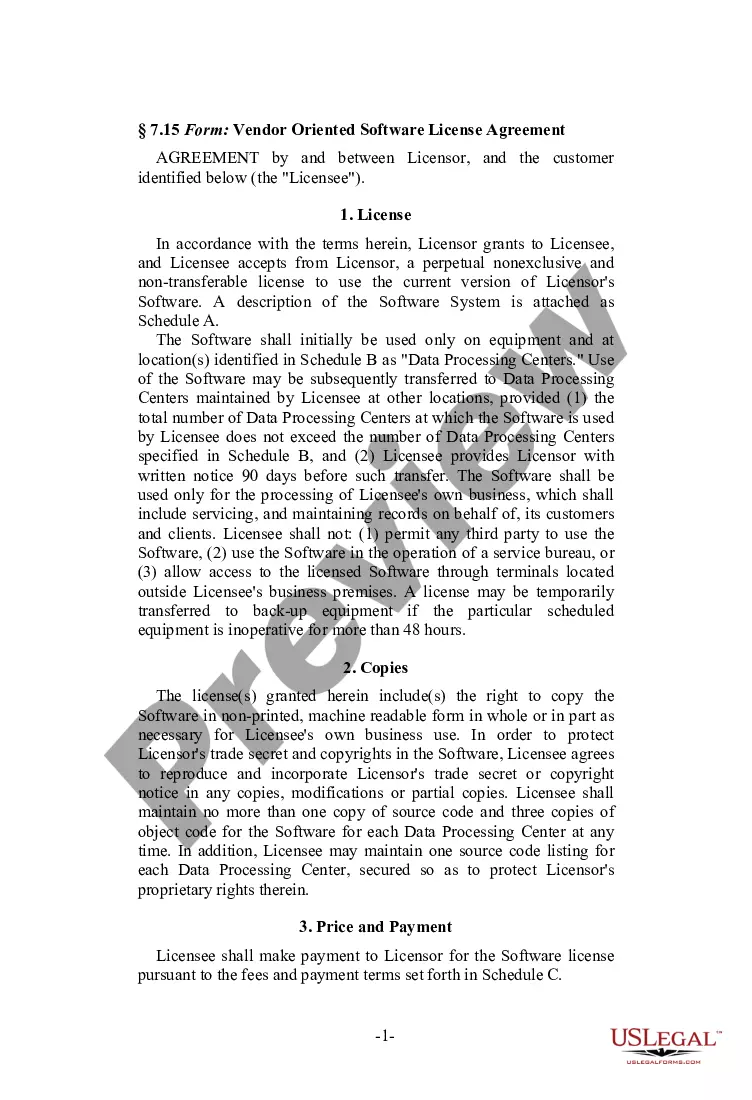
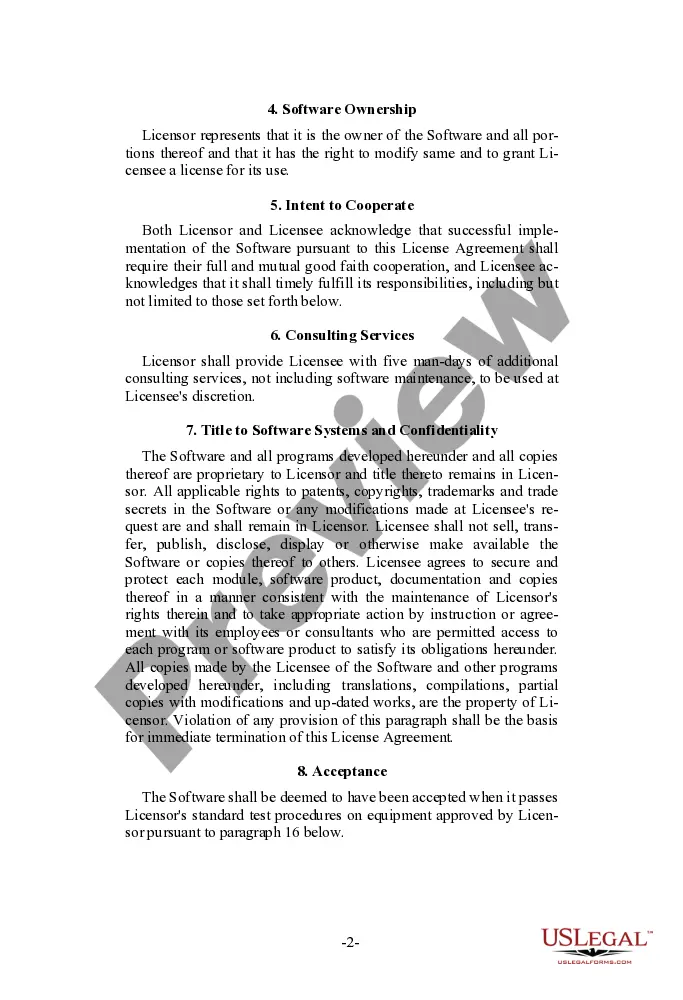
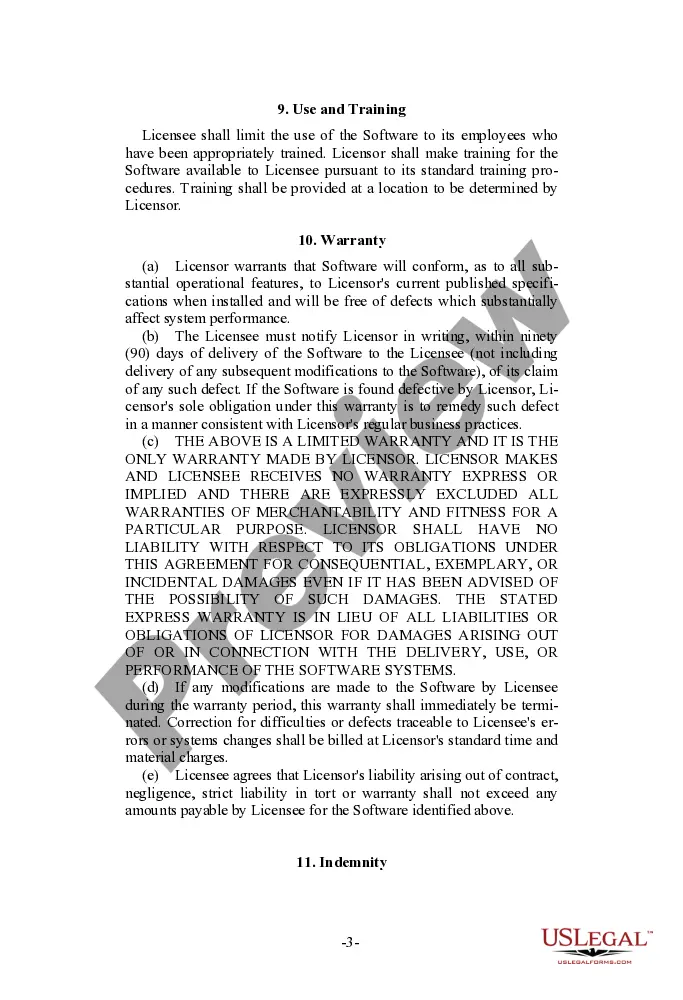
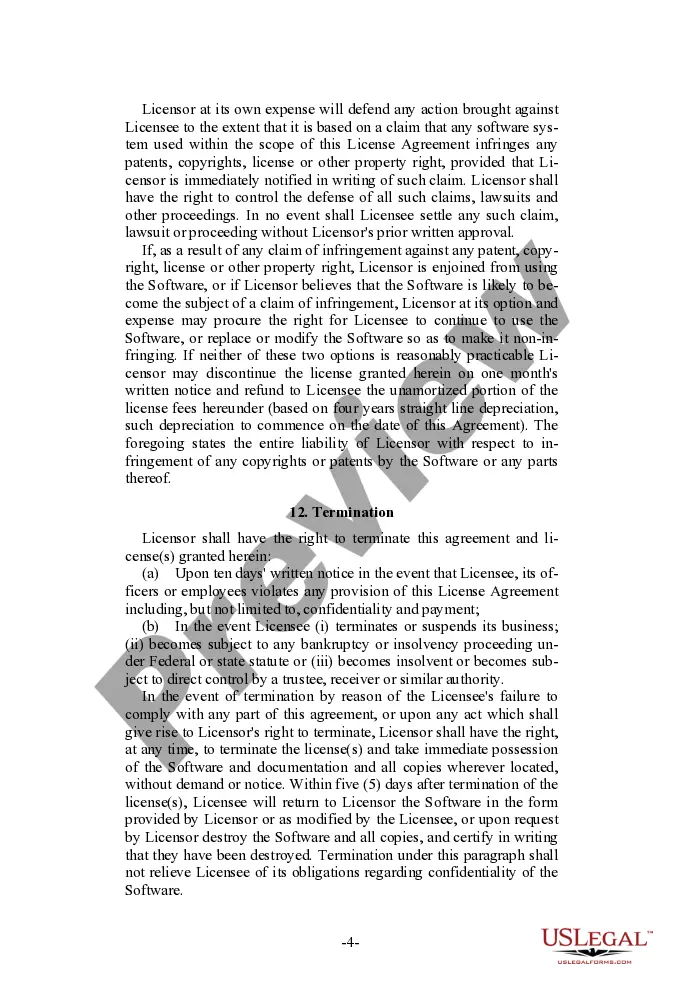
A software license agreement is the legal contract between the licensor and/or author and the purchaser of a piece of software which establishes the purchaser's rights. A software license agreement details how and when the software can be used, and provides any restrictions that are imposed on the software.