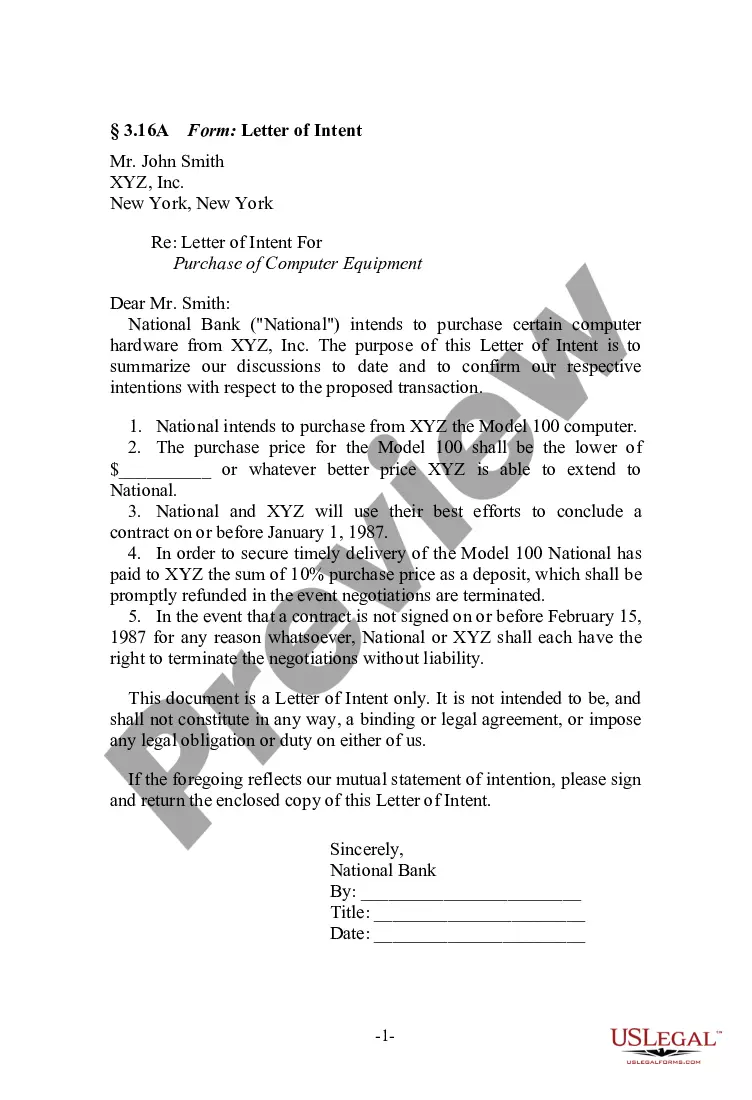
Dallas Texas Letter of Intent
Description
Get your form ready online
Our built-in tools help you complete, sign, share, and store your documents in one place.
Make edits, fill in missing information, and update formatting in US Legal Forms—just like you would in MS Word.
Download a copy, print it, send it by email, or mail it via USPS—whatever works best for your next step.
Sign and collect signatures with our SignNow integration. Send to multiple recipients, set reminders, and more. Go Premium to unlock E-Sign.
If this form requires notarization, complete it online through a secure video call—no need to meet a notary in person or wait for an appointment.
We protect your documents and personal data by following strict security and privacy standards.

Make edits, fill in missing information, and update formatting in US Legal Forms—just like you would in MS Word.

Download a copy, print it, send it by email, or mail it via USPS—whatever works best for your next step.

Sign and collect signatures with our SignNow integration. Send to multiple recipients, set reminders, and more. Go Premium to unlock E-Sign.

If this form requires notarization, complete it online through a secure video call—no need to meet a notary in person or wait for an appointment.

We protect your documents and personal data by following strict security and privacy standards.
Looking for another form?

How to fill out Letter Of Intent?
Statutes and rules in each domain vary from one jurisdiction to another.
If you're not an attorney, it's simple to become confused by the array of guidelines associated with creating legal documents.
To prevent costly legal fees while drafting the Dallas Letter of Intent, you require a validated template that is legitimate for your area.
That's the most straightforward and budget-friendly approach to obtain current templates for any legal purposes. Discover them all in just a few clicks and maintain your documentation organized with the US Legal Forms!
- Utilize the US Legal Forms platform, which is advantageous in this situation.
- US Legal Forms is relied upon by millions and features a vast collection of over 85,000 state-specific legal templates.
- It serves as an ideal option for both professionals and individuals looking for self-service templates for various life and business events.
- All forms can be reused: once you select a template, it will remain available in your account for future use.
- So, if you have an account with an active subscription, you can easily Log In and re-download the Dallas Letter of Intent from the My documents section.
- For new users, you need to follow a few additional steps to acquire the Dallas Letter of Intent.
- Review the page content to ensure you've located the right template.
- Make use of the Preview feature or examine the form description if one is provided.
Form popularity
FAQ
A letter of intent is a document outlining an agreement between two parties before the agreement is finalized. As the definition suggests, most letters of intent are not intended to bind the parties to a final agreement, but are a precursor to a final agreement.
2. Do I Need an Attorney to Prepare or Review the Letter of Intent? Typically, letters of intent are prepared by real estate agents or brokers who are assisting with the lease or purchase transaction. However, it is a good idea to hire an attorney to review it before it is finalized and signed.
Letters of Intent, sometimes referred to as "memorandums of understanding," are frequently used in media transactions and are pre-contractual documents that set forth certain basic terms upon which parties intend to enter into binding definitive agreements.
Unless the parties intended to be bound by the letter of intent, it will not be enforceable as a contract to pursue the contemplated deal, regardless of the level of detail set forth in the letter.
Intention to be legally bound is an essential element of a valid, enforceable contract. It means that all parties to a contract must accept the terms of the contract with an intention of forming a legally binding relationship.
What is a letter of intent? A letter of intent (LOI ) is a document drawn up when two parties come to a mutual agreement, but haven't worked out all the details yet. This letter is presented before the finalized legal agreement, which means that a letter of intent is not legally binding.
Specifically, most letters of intent contain exclusivity and non-disclosure provisions stipulating that the parties cannot negotiate with third parties nor disclose the existence of discussions with respect to the transaction. Parties to the letter of intent may breach these binding provisions.
It can be used for a variety of reasons: to protect confidential information, outline terms, or to evidence the parties' interest and desire to complete a transaction. Letters of intent can be binding, non-binding, or a combination of the two.
A letter of intent is a document declaring the preliminary commitment of one party to do business with another. The letter outlines the chief terms of a prospective deal and is commonly used in business transactions.
Letters of Intent, sometimes referred to as "memorandums of understanding," are frequently used in media transactions and are pre-contractual documents that set forth certain basic terms upon which parties intend to enter into binding definitive agreements.