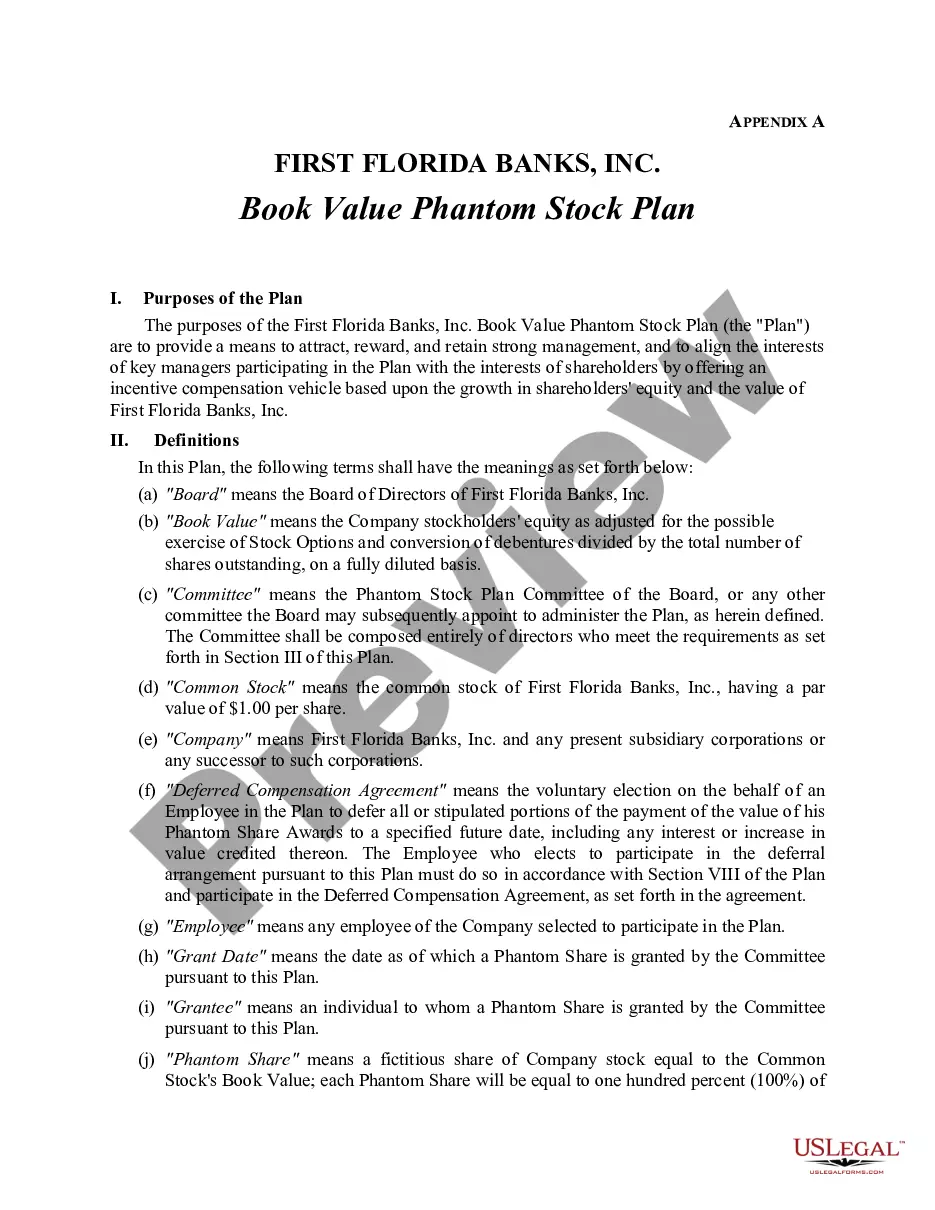
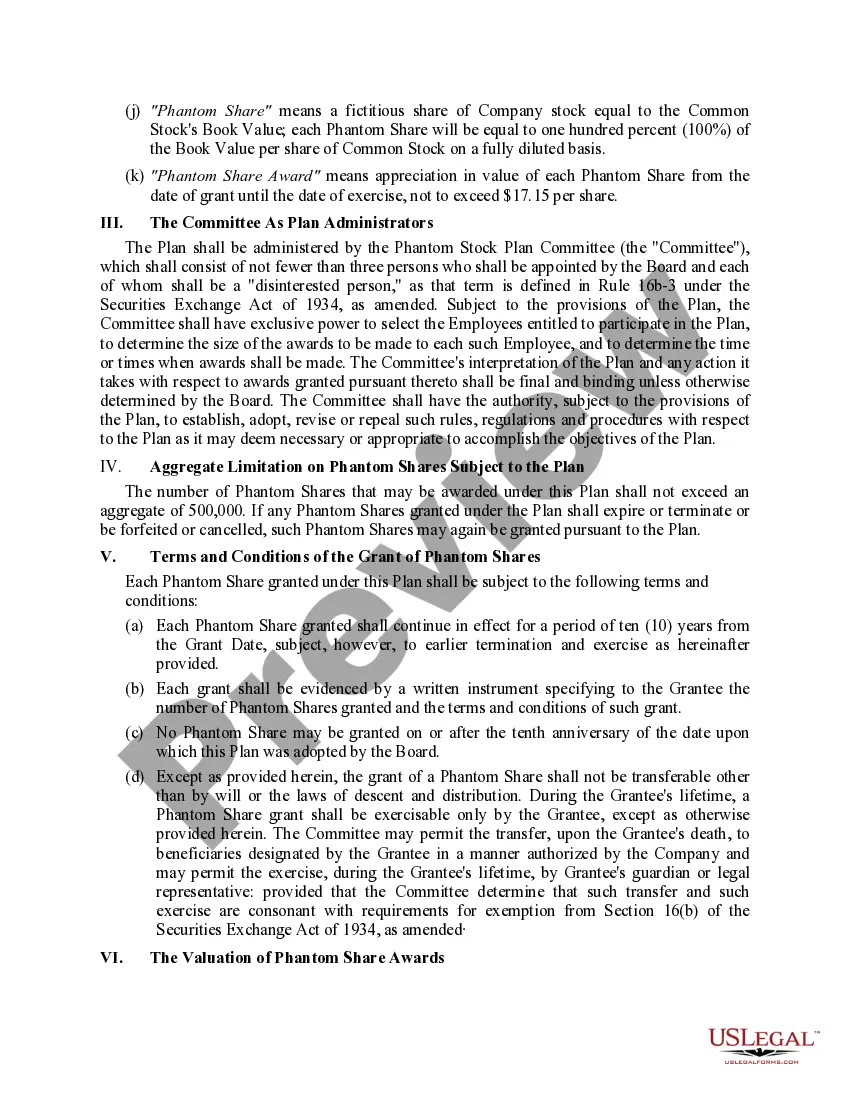
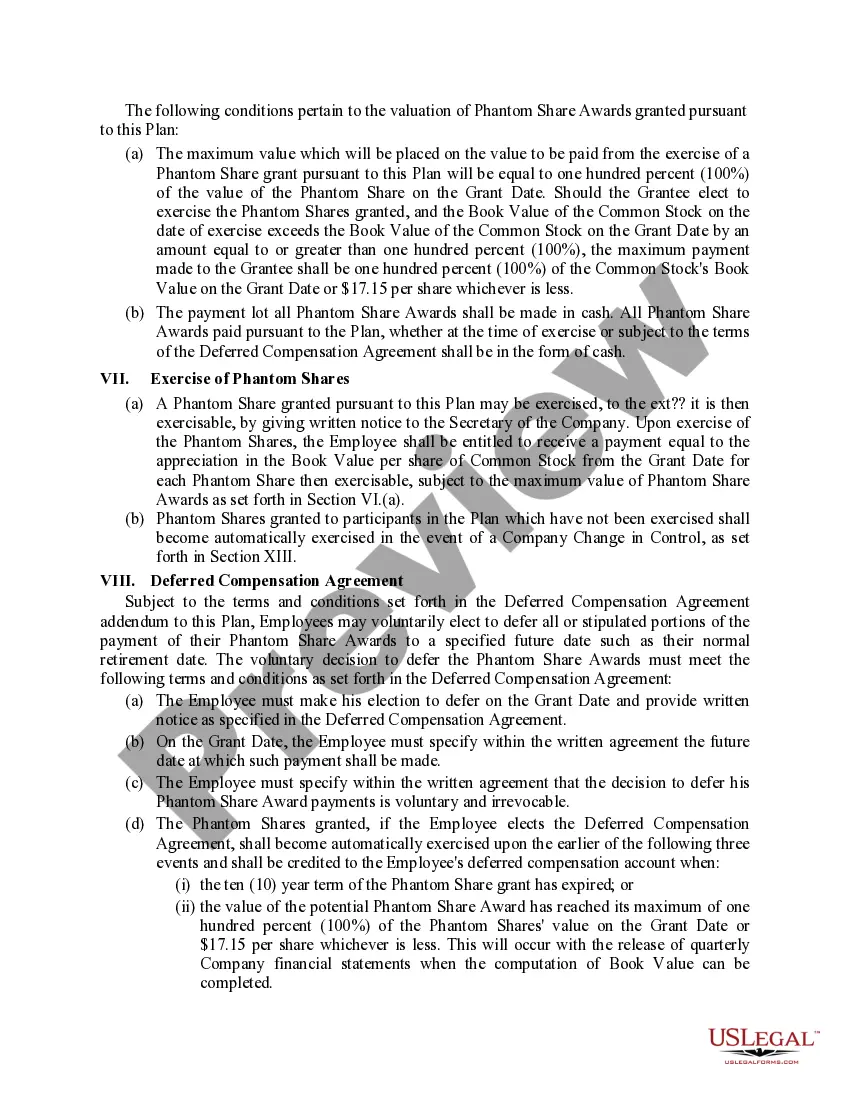
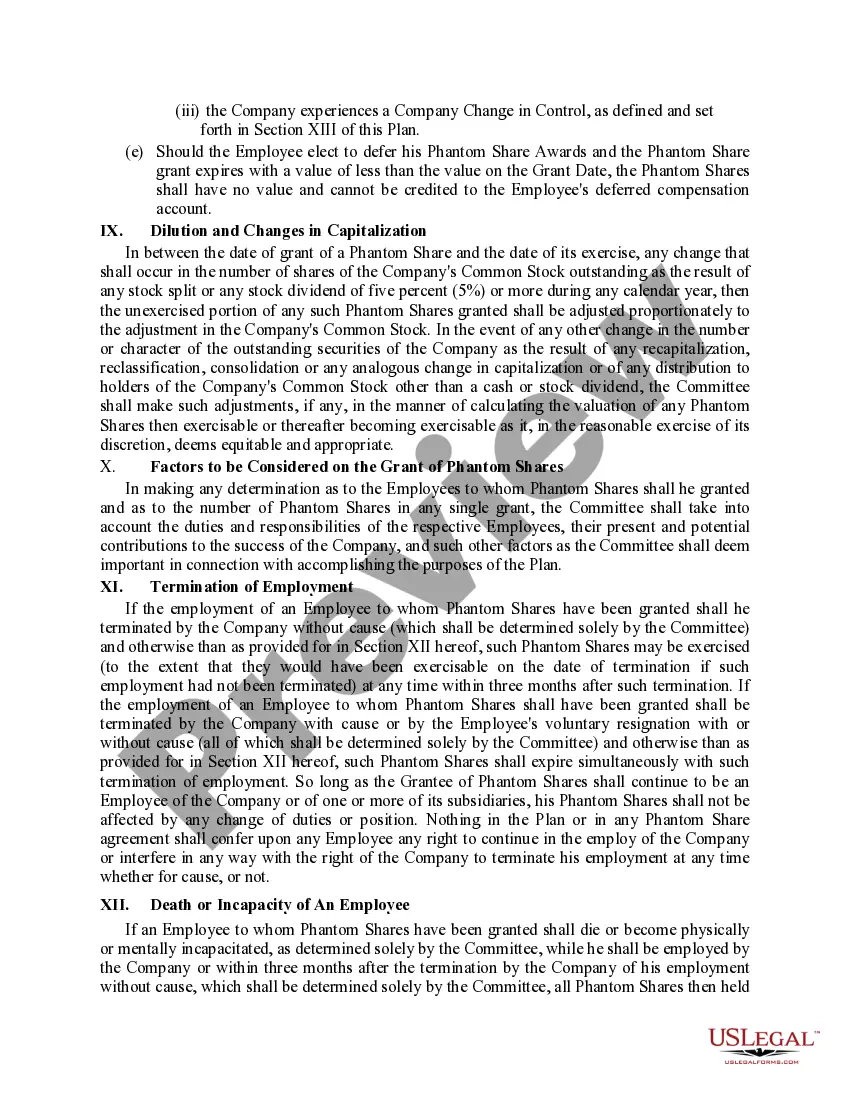
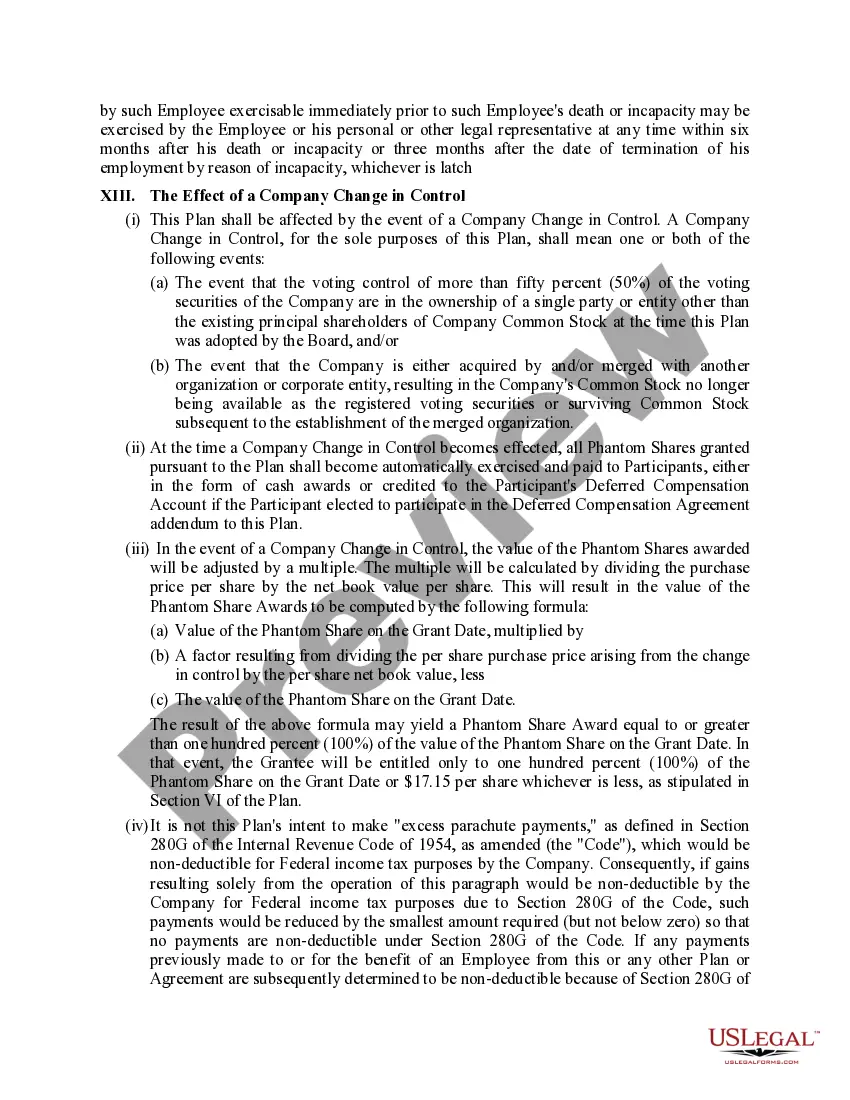
20-162A 20-162A . . . Book Value Phantom Stock Plan under which Committee of Board of Directors may, from time to time, grant quantity of phantom shares to selected employees, each share being equivalent to one share of corporation common stock. Phantom shares may be exercised at any time within ten years of date of grant (subject to certain limitations in event of termination of employment) Upon exercise, employee is paid cash equal to increase in underlying net book value per share on fully diluted basis of shares between date of grant and date of exercise
Broward Florida Book Value Phantom Stock Plan of First Florida Banks, Inc.
State:
Multi-State
County:
Broward
Control #:
US-CC-20-162A
Format:
Word;
Rich Text
72 downloads
Description
Free preview
Get your form ready online
Our built-in tools help you complete, sign, share, and store your documents in one place.
Built-in online Word editor
Make edits, fill in missing information, and update formatting in US Legal Forms—just like you would in MS Word.
Export easily
Download a copy, print it, send it by email, or mail it via USPS—whatever works best for your next step.
E-sign your document
Sign and collect signatures with our SignNow integration. Send to multiple recipients, set reminders, and more. Go Premium to unlock E-Sign.
Notarize online 24/7
If this form requires notarization, complete it online through a secure video call—no need to meet a notary in person or wait for an appointment.
Store your document securely
We protect your documents and personal data by following strict security and privacy standards.

Make edits, fill in missing information, and update formatting in US Legal Forms—just like you would in MS Word.

Download a copy, print it, send it by email, or mail it via USPS—whatever works best for your next step.

Sign and collect signatures with our SignNow integration. Send to multiple recipients, set reminders, and more. Go Premium to unlock E-Sign.

If this form requires notarization, complete it online through a secure video call—no need to meet a notary in person or wait for an appointment.

We protect your documents and personal data by following strict security and privacy standards.
Looking for another form?

How to fill out Book Value Phantom Stock Plan Of First Florida Banks, Inc.?
Handling legal documents is essential in the modern world.
However, you don't always have to seek expert assistance to create some of them from the ground up, including the Broward Book Value Phantom Stock Plan of First Florida Banks, Inc., using a service like US Legal Forms.
US Legal Forms boasts over 85,000 templates available to choose from in various categories, including living wills, real estate documents, and divorce papers. All forms are categorized by their respective state, simplifying the search process.
If you are already a US Legal Forms subscriber, you can find the required Broward Book Value Phantom Stock Plan of First Florida Banks, Inc., Log In to your account, and download it. Of course, our platform is not a complete substitute for an attorney. If you are facing a particularly complex case, we suggest consulting with an attorney to review your document prior to execution and submission.
With more than 25 years in the industry, US Legal Forms has become the preferred platform for a wide range of legal forms for millions of individuals. Join today and acquire your state-specific paperwork with ease!
- Review the document's preview and outline (if accessible) to grasp the general content you will receive after obtaining the form.
- Verify that the document you select complies with your state/county/region, as state laws can affect the legitimacy of certain records.
- Examine related document templates or restart your search to find the right document.
- Click Buy now and create your account. If you already have one, opt to Log In.
- Select the pricing plan, then a suitable payment option, and purchase the Broward Book Value Phantom Stock Plan of First Florida Banks, Inc.
- Choose to save the form template in any available format.
- Navigate to the My documents tab to re-download the document.
Form popularity
FAQ
A stock appreciation right (SAR, in short) is a lot like phantom stock. The only difference in this is that it provides the right to the monetary equivalent of the increase in the value of a specified number of shares, over a specified period of time.
To the extent that phantom stock is considered a security, private companies generally rely on the exemption from registration under Rule 701 of the Securities Act of 1933, which allows a company to offer securities to employees under a written compensatory plan if: (1) certain disclosure requirements are met and (2)
For both phantom stock and SARs, employees are taxed when the right to the benefit is exercised. At that point, the value of the award, minus any consideration paid for it (there usually is none) is taxed as ordinary income to the employee and is deductible by the employer.
Because participants in phantom stock plan are not shareholders, they are not entitled to dividends per se. However, the phantom stock plan may call for phantom dividends. Such payments might be included in a plan once a participant is vested in full value shares that have not yet been redeemed (or cashed in).
A. A phantom stock plan is a deferred compensation plan that awards the employee a unit measured by the value of a share of a company's common stock, or, in the case of a limited liability company, by the value of an LLC unit. However, unlike actual stock, the award does not confer equity ownership in the company.
The answer involves two variables: (a) the presumed value of the company, and (b) the number of shares to be used in the plan. Once these two answers are known, the phantom share price is calculated as the former (the value) divided by the latter (the number of shares).
Phantom stock is not a good idea if the company is planning on issuing them to most or all employees, especially if the shares will be paid out when the employee leaves the company or retires. In that case, phantom shares may be ruled illegal because of the Employee Retirement Income and Security Act (ERISA).
Since phantom shares are not the same as real stock, you don't have to worry about employees voting down key decisions, such as selling the company.
In conjunction with generally accepted accounting standards, a phantom stock plan is accounted for as a deferred cash compensation plan because the employee receives the increase in the value of an underlying number of shares or units over a specific period of time in the form of a cash payment on a specified date.