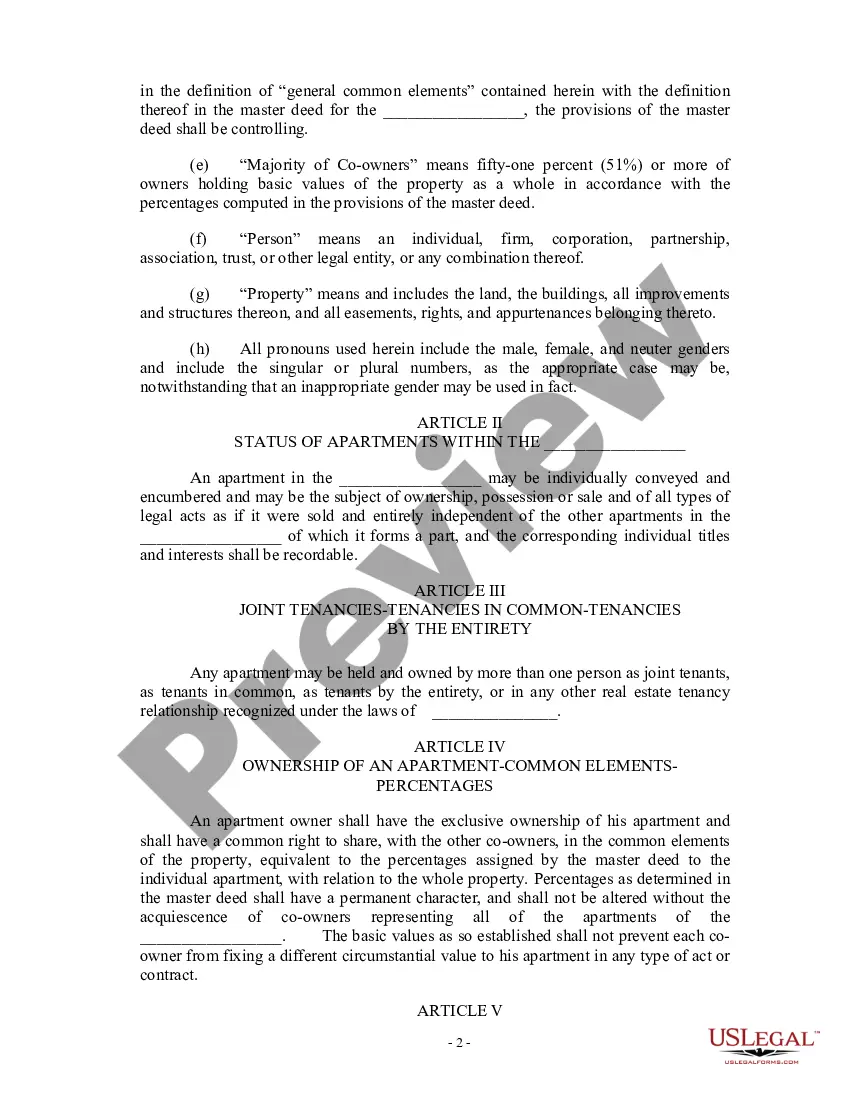
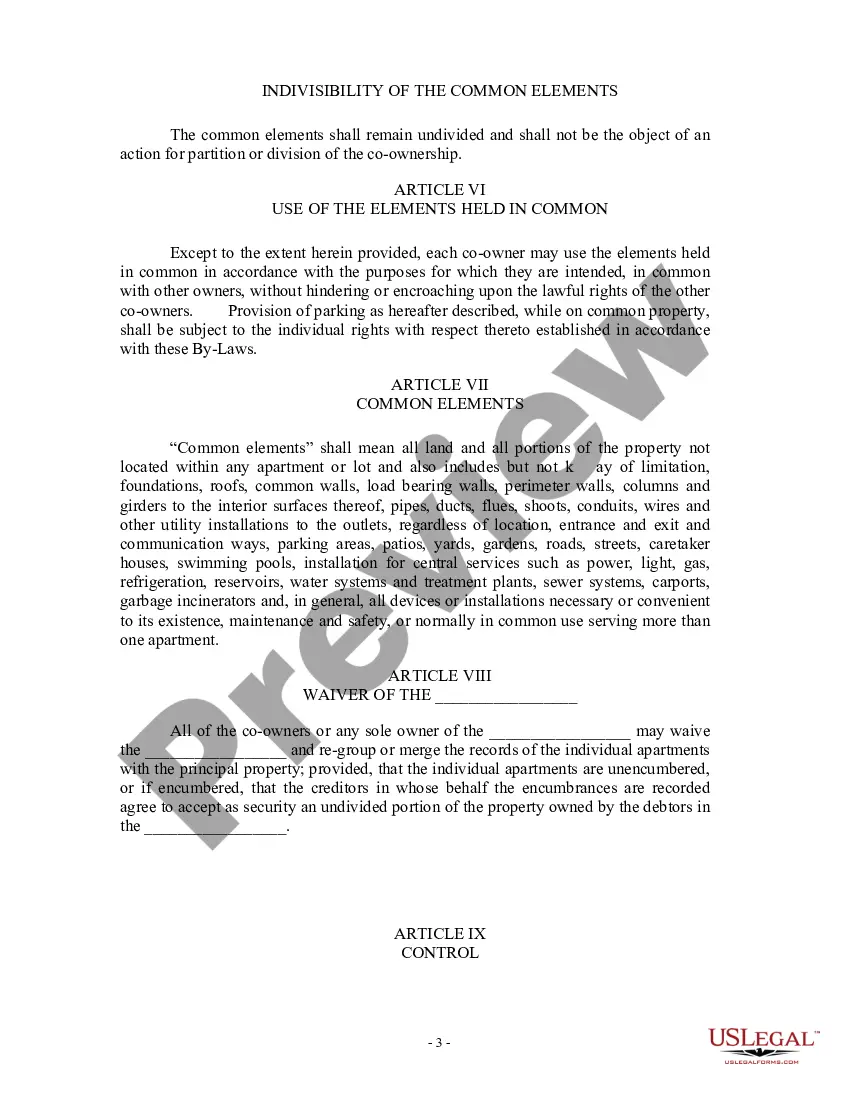
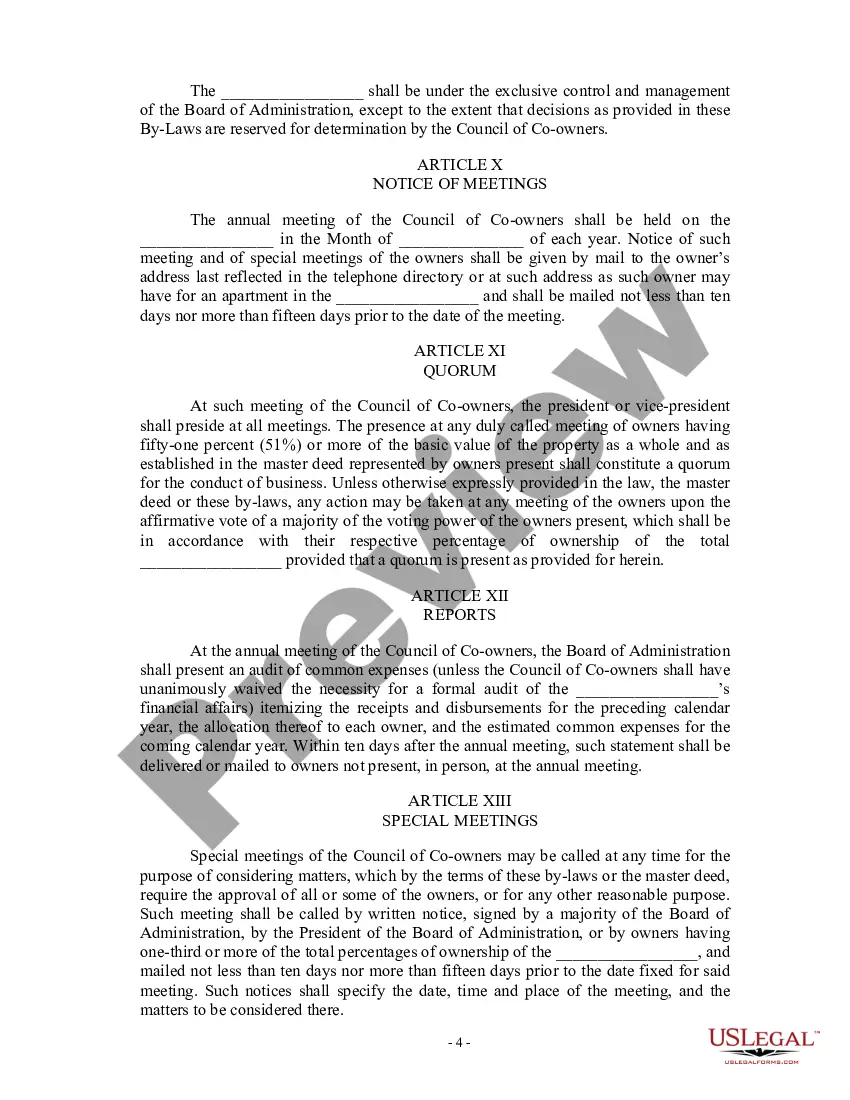
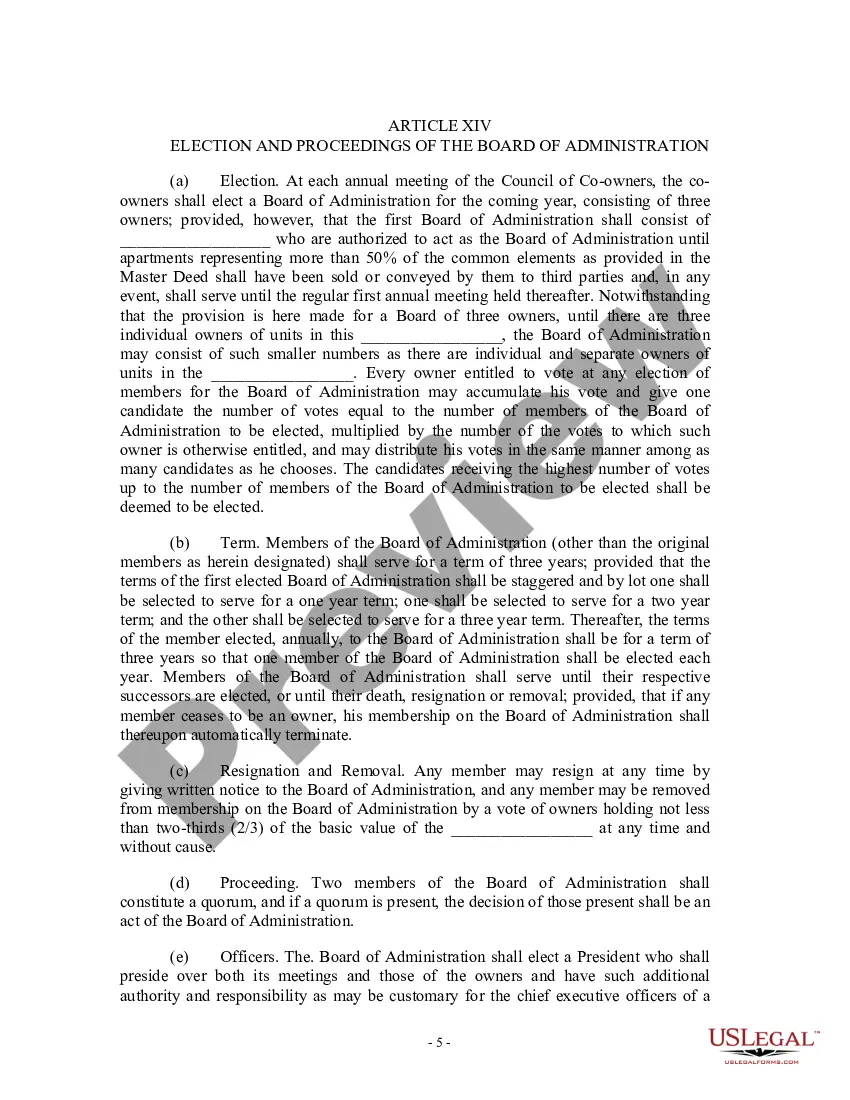
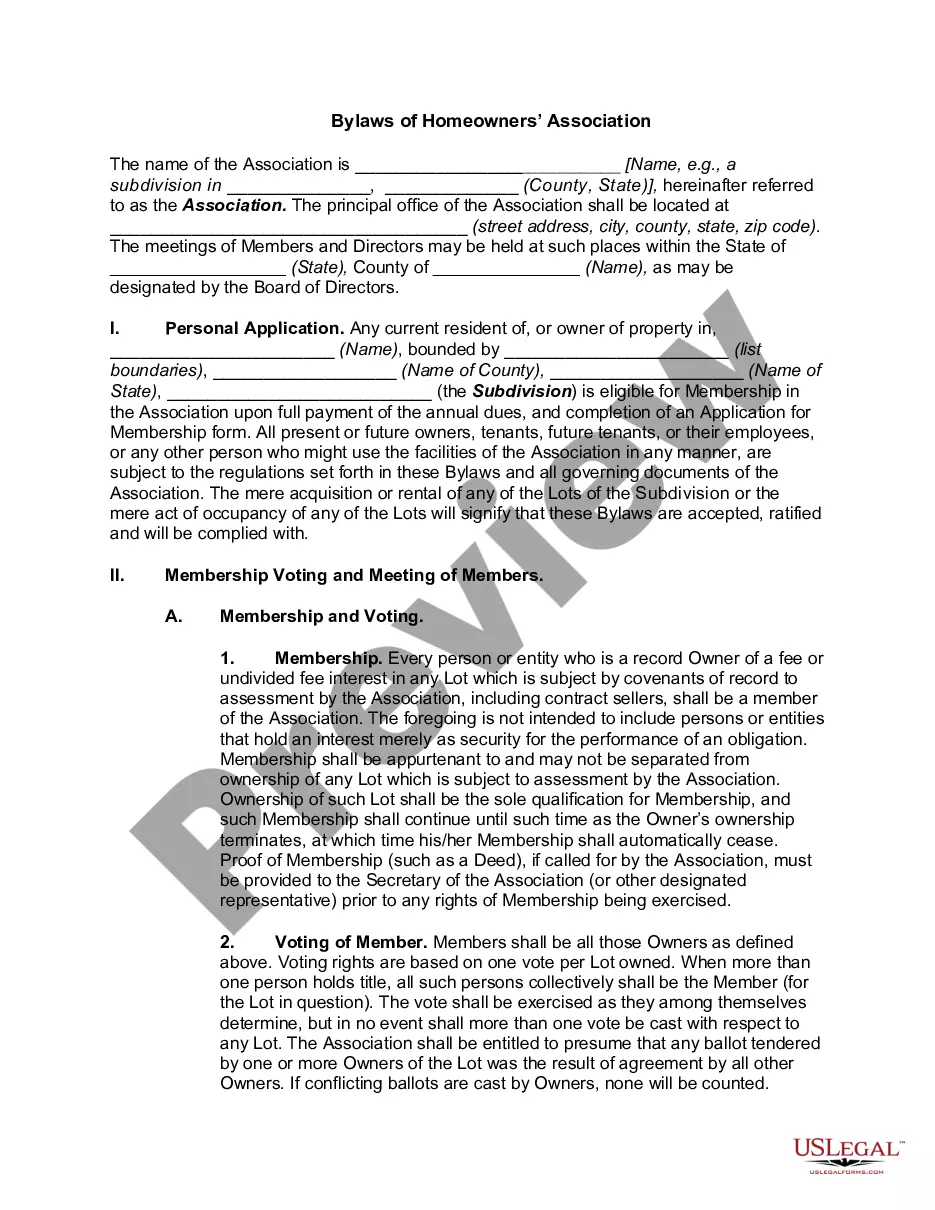
The following By-Laws have been adopted to govern the affairs of the project described in the master deed of the owners. The form also contains defintions of the words and terms used in the document.
Fairfax Virginia Bylaws of Condominium
State:
Multi-State
Category:
County:
Fairfax
Control #:
US-AR-B1039
Format:
Word;
Rich Text
170 downloads
Description
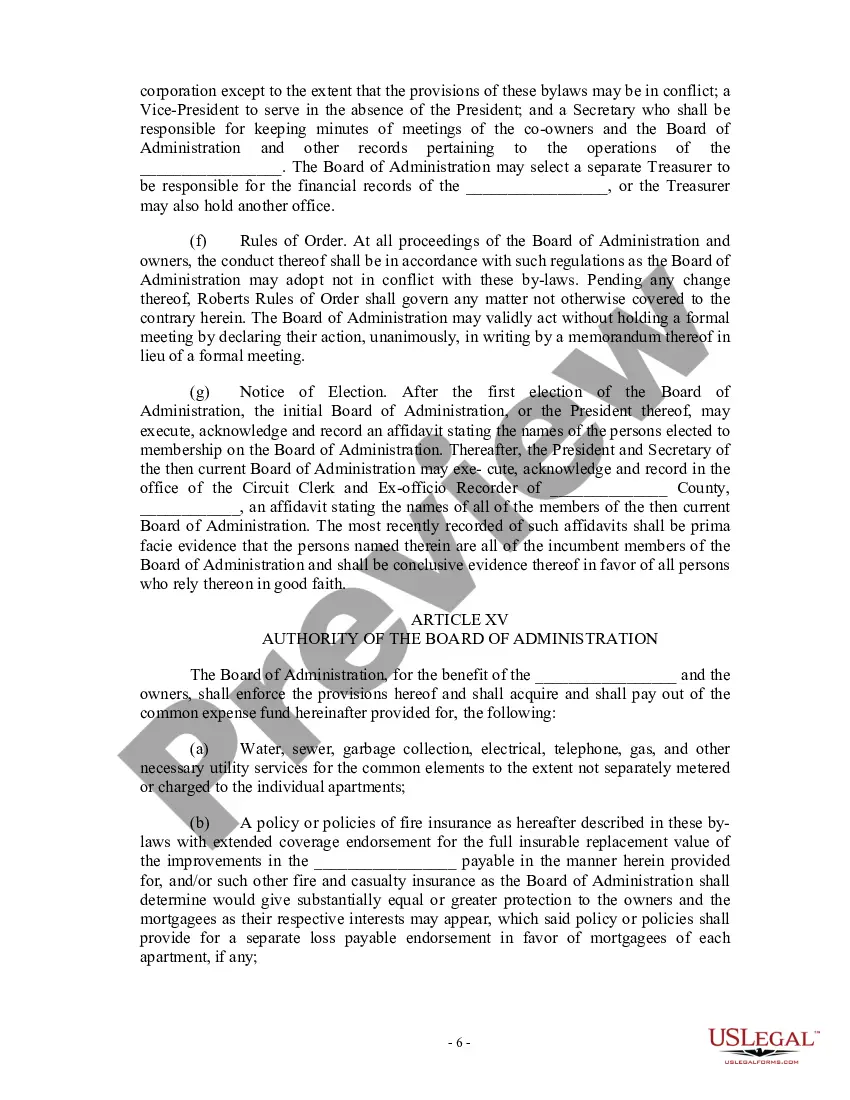
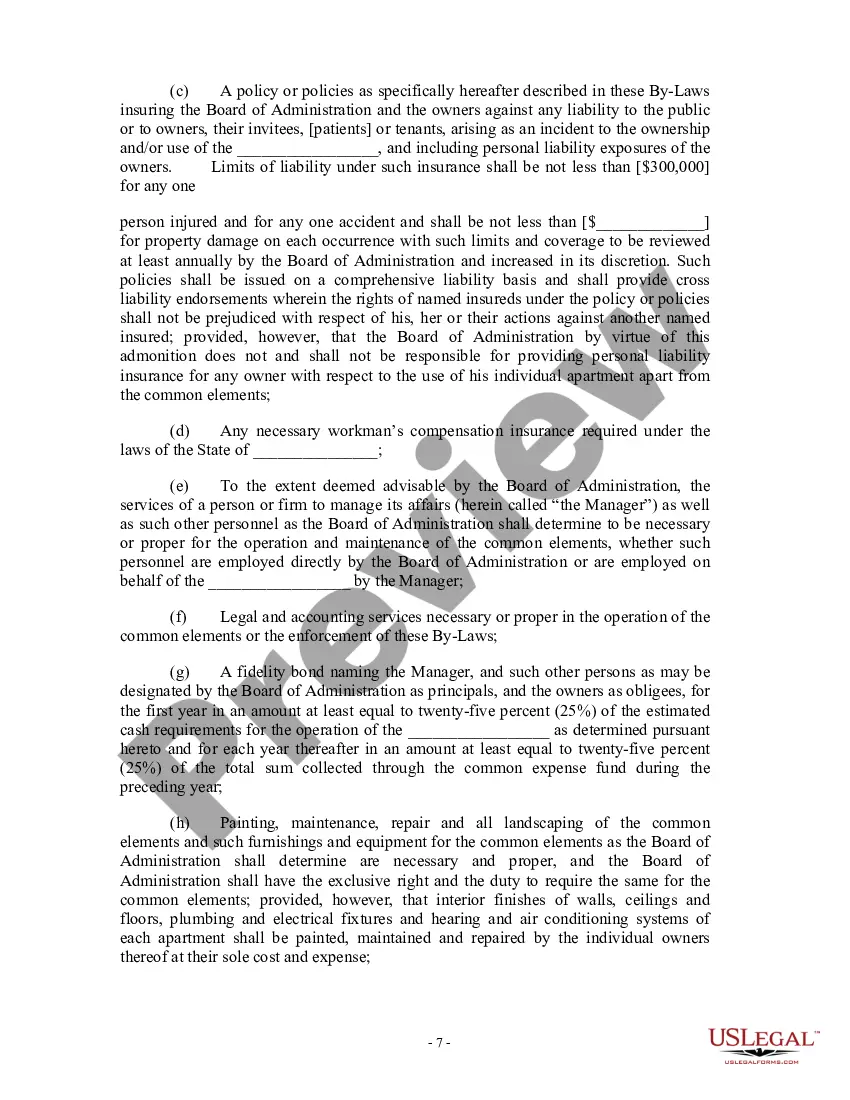
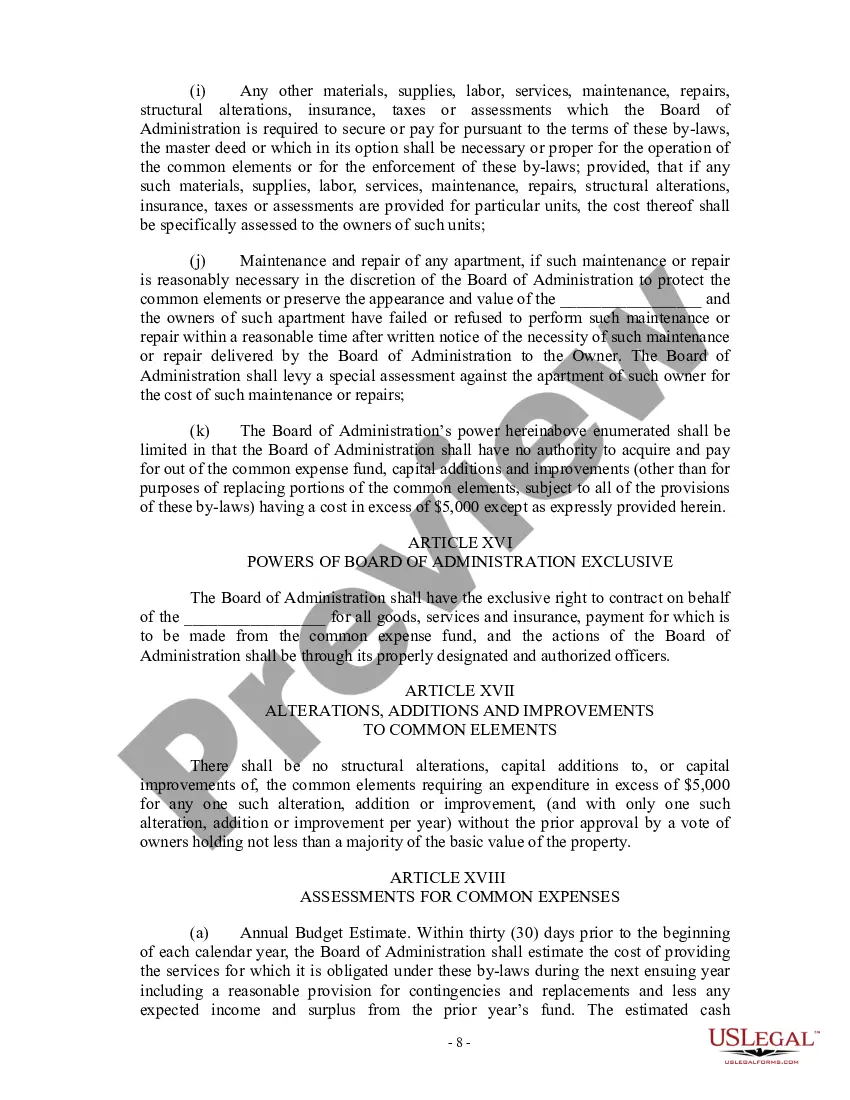
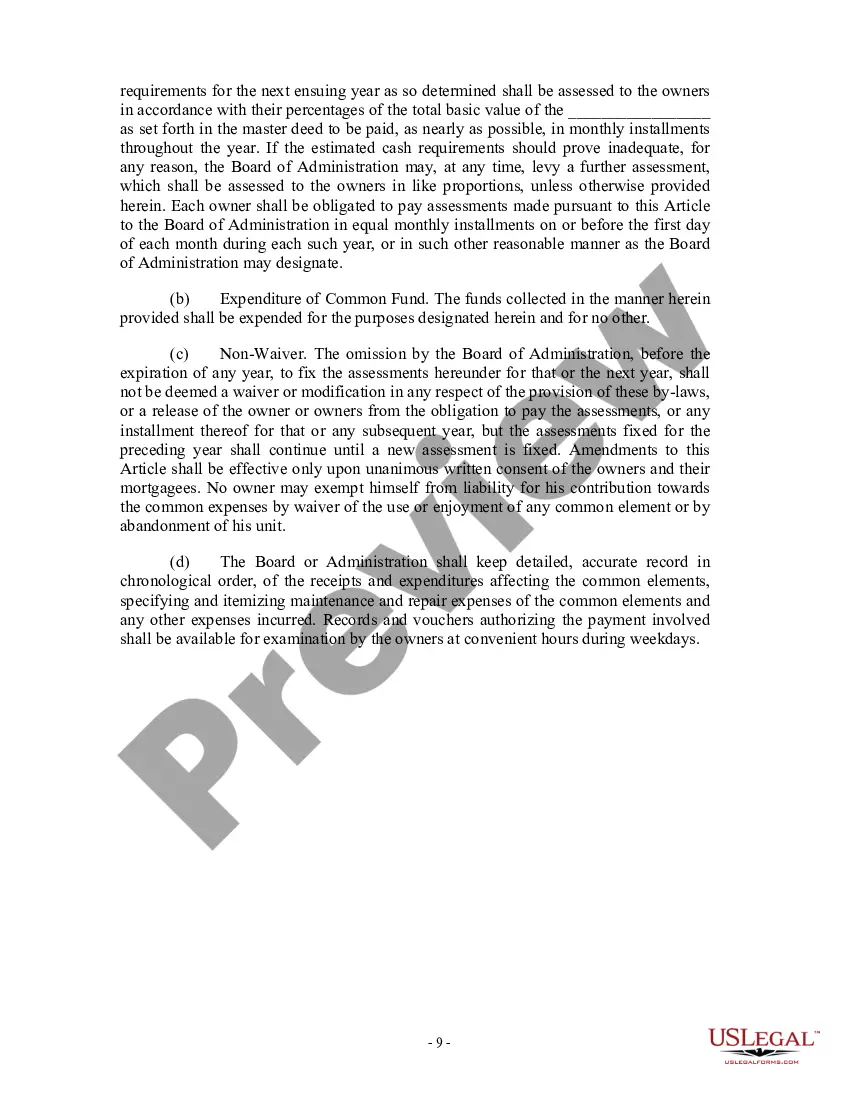
Free preview


Get your form ready online
Our built-in tools help you complete, sign, share, and store your documents in one place.
Built-in online Word editor
Make edits, fill in missing information, and update formatting in US Legal Forms—just like you would in MS Word.
Export easily
Download a copy, print it, send it by email, or mail it via USPS—whatever works best for your next step.
E-sign your document
Sign and collect signatures with our SignNow integration. Send to multiple recipients, set reminders, and more. Go Premium to unlock E-Sign.
Notarize online 24/7
If this form requires notarization, complete it online through a secure video call—no need to meet a notary in person or wait for an appointment.
Store your document securely
We protect your documents and personal data by following strict security and privacy standards.

Make edits, fill in missing information, and update formatting in US Legal Forms—just like you would in MS Word.

Download a copy, print it, send it by email, or mail it via USPS—whatever works best for your next step.

Sign and collect signatures with our SignNow integration. Send to multiple recipients, set reminders, and more. Go Premium to unlock E-Sign.

If this form requires notarization, complete it online through a secure video call—no need to meet a notary in person or wait for an appointment.

We protect your documents and personal data by following strict security and privacy standards.
Looking for another form?
How to fill out Bylaws Of Condominium?
A document procedure consistently accompanies any lawful action you undertake.
Initiating a business, applying for or accepting an employment offer, changing ownership, and numerous other life situations necessitate that you prepare formal documentation that differs from state to state.
That is the reason why having everything compiled in one location is exceptionally advantageous.
US Legal Forms is the largest online repository of current federal and state-specific legal documents. On this site, you can conveniently search for and acquire a document for any personal or business purpose relevant to your area, such as the Fairfax Bylaws of Condominium.
This represents the most straightforward and reliable method to obtain legal documents. All samples accessible in our library are expertly drafted and verified for compliance with local laws and regulations. Prepare your documentation and manage your legal matters effectively with US Legal Forms!
- Finding forms on the site is remarkably straightforward.
- If you already hold a subscription to our library, Log In to your account, search for the template using the search box, and click Download to save it to your device.
- Once downloaded, the Fairfax Bylaws of Condominium will be accessible for future use in the My documents section of your account.
- If you are using US Legal Forms for the first time, adhere to this brief guide to acquire the Fairfax Bylaws of Condominium.
- Confirm you have opened the correct page with your localized form.
- Utilize the Preview mode (if available) to examine the template.
- Review the description (if provided) to verify the template fulfills your requirements.
- Search for another document using the search option if the sample is unsuitable.
- Once you find the necessary template, click Buy Now.
Form popularity
FAQ
In Fairfax, Virginia, the governing body of condominium unit owners is typically referred to as the Condominium Association. This association is formed to manage the common areas and oversee the enforcement of the Fairfax Virginia Bylaws of Condominium. Unit owners elect a board of directors to make decisions in the best interest of the community. It is essential for owners to understand their rights and responsibilities as members of this association.
In Virginia, the regulatory body overseeing condominiums is the Virginia Real Estate Board. This board administers a range of laws and regulations, including the Fairfax Virginia Bylaws of Condominium. They ensure compliance and help resolve disputes within the community. Familiarizing yourself with this board can be beneficial for understanding your rights and obligations.
Lesson Summary. The Virginia Condominium Act consists of five articles addressing general provisions, the creation, alteration, and termination of condominiums, condominium management, administration of sales of condominiums, disclosure requirements and authorized fees.
Fortunately, you can, with the help of an attorney. You should be aware of the following: The law may be on your side. HOA members have certain rights under the Virginia Property Owners' Association Act and the Virginia Condominium Owners' Association Act.
The Virginia Condominium Act consists of five articles addressing general provisions, the creation, alteration, and termination of condominiums, condominium management, administration of sales of condominiums, disclosure requirements and authorized fees.
Republic Act No. 4726, otherwise known as The Condominium Act, governs the ownership, rights, and obligations of condominium owners. The law defines a condominium as an interest in real property consisting of separate interest in a unit in a building (whether residential, industrial or commercial).
Section 55-79.71 of the Virginia Condominium Act requires two-thirds of the votes in the unit owner's association to amend the Declaration, unless the Declaration requires a larger percentage.
Condominium bylaws govern how the condominium corporation is run. Bylaws establish matters elections and the expectations of the board of directors. These bylaws typically define how contributions are to be made, and how rules are passed.
Section 55-79.71 of the Virginia Condominium Act requires two-thirds of the votes in the unit owner's association to amend the Declaration, unless the Declaration requires a larger percentage.
The Virginia Real Estate Cooperative Act regulates cooperative ownership in the state. You can find it under Title 55.1, Chapter 21 of the Code of Virginia.