Mecklenburg North Carolina Pot Testamentary Trust
Description


Get your form ready online
Our built-in tools help you complete, sign, share, and store your documents in one place.
Make edits, fill in missing information, and update formatting in US Legal Forms—just like you would in MS Word.
Download a copy, print it, send it by email, or mail it via USPS—whatever works best for your next step.
Sign and collect signatures with our SignNow integration. Send to multiple recipients, set reminders, and more. Go Premium to unlock E-Sign.
If this form requires notarization, complete it online through a secure video call—no need to meet a notary in person or wait for an appointment.
We protect your documents and personal data by following strict security and privacy standards.

Make edits, fill in missing information, and update formatting in US Legal Forms—just like you would in MS Word.

Download a copy, print it, send it by email, or mail it via USPS—whatever works best for your next step.

Sign and collect signatures with our SignNow integration. Send to multiple recipients, set reminders, and more. Go Premium to unlock E-Sign.

If this form requires notarization, complete it online through a secure video call—no need to meet a notary in person or wait for an appointment.

We protect your documents and personal data by following strict security and privacy standards.
Looking for another form?
How to fill out Pot Testamentary Trust?
A paperwork process always accompanies any lawful action you engage in.
Establishing a company, applying for or accepting a job opportunity, transferring assets, and numerous other life circumstances necessitate that you prepare official documentation that varies from one jurisdiction to another.
That’s the reason having everything assembled in a single location is extremely advantageous.
US Legal Forms is the largest online repository of current federal and state-specific legal documents.
Select the suitable subscription plan, then Log In or create a new account. Choose the preferred payment method (credit card or PayPal) to proceed. Select the file format and download the Mecklenburg Pot Testamentary Trust onto your device. Utilize it as necessary: print it out or complete it electronically, sign it, and send it where needed. This is the simplest and most dependable method to obtain legal documents. All templates available in our library are professionally prepared and validated for compliance with local statutes and regulations. Organize your documents and handle your legal matters correctly with US Legal Forms!
- On this site, you can effortlessly locate and obtain a document for any personal or business necessity used in your area, including the Mecklenburg Pot Testamentary Trust.
- Finding templates on the site is remarkably straightforward.
- If you already possess a subscription to our service, Log In to your account, locate the template via the search bar, and click Download to save it to your device.
- Subsequently, the Mecklenburg Pot Testamentary Trust will be accessible for subsequent use in the My documents section of your profile.
- If you are interacting with US Legal Forms for the first time, follow this brief guide to acquire the Mecklenburg Pot Testamentary Trust.
- Ensure you have navigated to the correct page with your localized document.
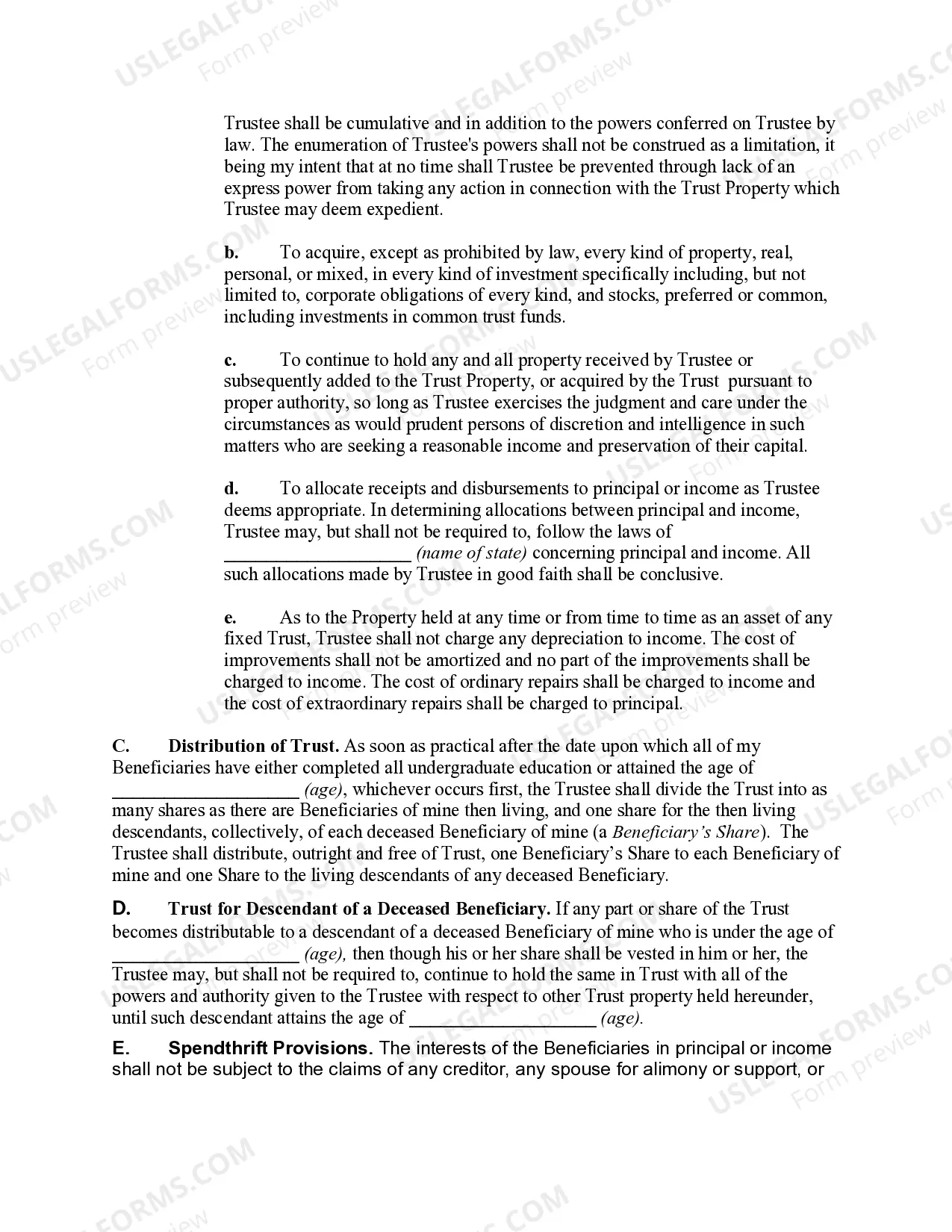
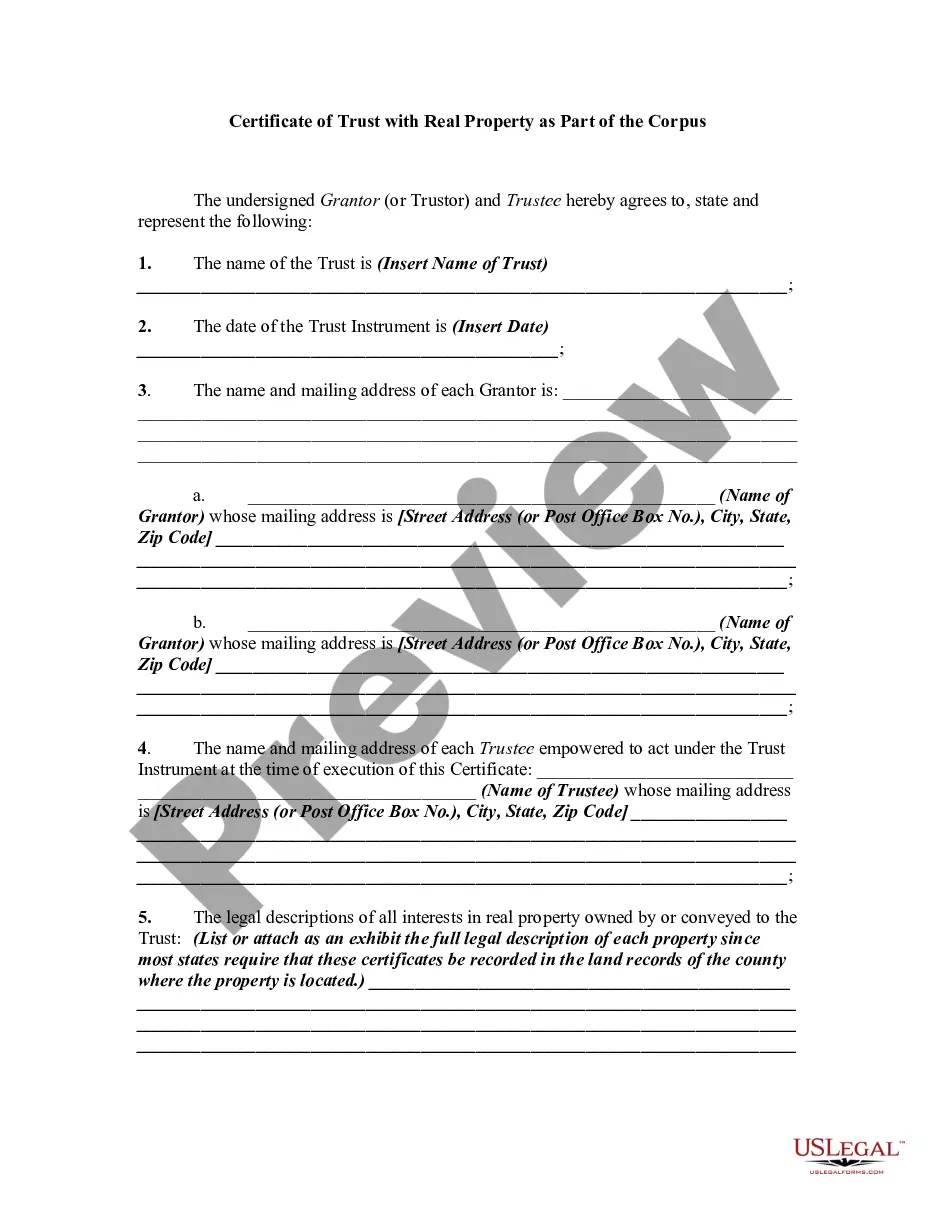
- Use the Preview mode (if available) and review the sample.
- Examine the description (if provided) to confirm that the document meets your requirements.
- Search for another form using the search feature if the sample does not suit you.
- Click Buy Now once you discover the required template.
Form popularity
FAQ
Family pot trusts (also called discretionary or sprinkling trusts) are a type of trust where the trustee is allowed to disperse funds according to the needs of the beneficiaries. Family pot trusts are created by parents for their children, usually in case something were to happen to them.
Living trusts and testamentary trusts A living trust (sometimes called an inter vivos trust) is one created by the grantor during his or her lifetime, while a testamentary trust is a trust created by the grantor's will. Only a funded living trust avoids probate court.
Testamentary Trusts are taxed as a whole, though beneficiaries will not be forced to pay taxes on distributions from the Trust. Note that you could be responsible for the capital gains tax, depending on your state.
A pot trust is a type of trust that lists children as beneficiaries, with the trustee using his or her discretion as to how trust assets should be spent. If you have minor children, you might consider setting up a pot trust to meet their financial needs, if something should happen to you.
Taxation of Testamentary Trusts Once a testamentary trust has been created, it becomes a taxable entity in its own right and is thus subject to income taxes. If it has $600 or more in annual income, it must file a U.S. Income Tax Return for Estates and Trusts (Form 1041) for that year.
If we're dealing with a testamentary trust to be established under a person's Will, then that trust doesn't come into existence until that person has passed away. Their executor and trustees are responsible for pooling all assets, paying all debts and then transferring the assets according to the terms of the Will.
A testamentary trust is created to manage the assets of the deceased on behalf of the beneficiaries. It is also used to reduce estate tax liabilities and ensure professional management of the assets of the deceased.
Trusts are a crucial element to Estate Planning as they help provide more control over asset distribution after death. Among the various types available, a Testamentary Trust can be one of the best options for those thinking of their young children or grandchildren.
A Testamentary Trust is often a simple trust for taxes purposes. Generally speaking this means the trust cannot generate income, be designated for charity, or distribute out of corpus.