Riverside California Performance Bond
Description


How to fill out Performance Bond?
Creating documentation for a business or individual obligations is always a significant duty.
While formulating a contract, a request for public service, or a power of attorney, it is crucial to consider all federal and state regulations of the specific area. Nonetheless, smaller counties and even municipalities also have legislative processes that you need to account for.
All these factors render it challenging and time-intensive to draft a Riverside Performance Bond without professional assistance.
The wonderful aspect of the US Legal Forms library is that all the documents you have ever obtained are never misplaced - you can access them in your profile under the My documents tab at any time. Join the platform and swiftly acquire verified legal forms for any situation with just a few clicks!
- It's simple to prevent unnecessary expenditure on attorneys drafting your paperwork and produce a legally binding Riverside Performance Bond independently, utilizing the US Legal Forms online repository.
- It represents the best online collection of state-specific legal templates that are professionally verified, ensuring their legitimacy when you select a template for your county.
- Previously subscribed users just need to sign in to their profiles to retrieve the required document.
- If you do not yet have a subscription, follow the step-by-step instructions below to obtain the Riverside Performance Bond.
- Review the page you've opened and determine if it includes the document you require.
- To accomplish this, employ the form description and preview if those options are accessible.
Form popularity
FAQ
To release a performance bond, you typically need to provide evidence that the obligations of the bond have been fulfilled. This may involve submitting completion documents and any necessary inspections to the obligee. Once approved, the obligee will formally release the Riverside California Performance Bond, returning any collateral or funds held. For clarity in these transactions, consider using platforms like US Legal Forms to navigate the requirements.
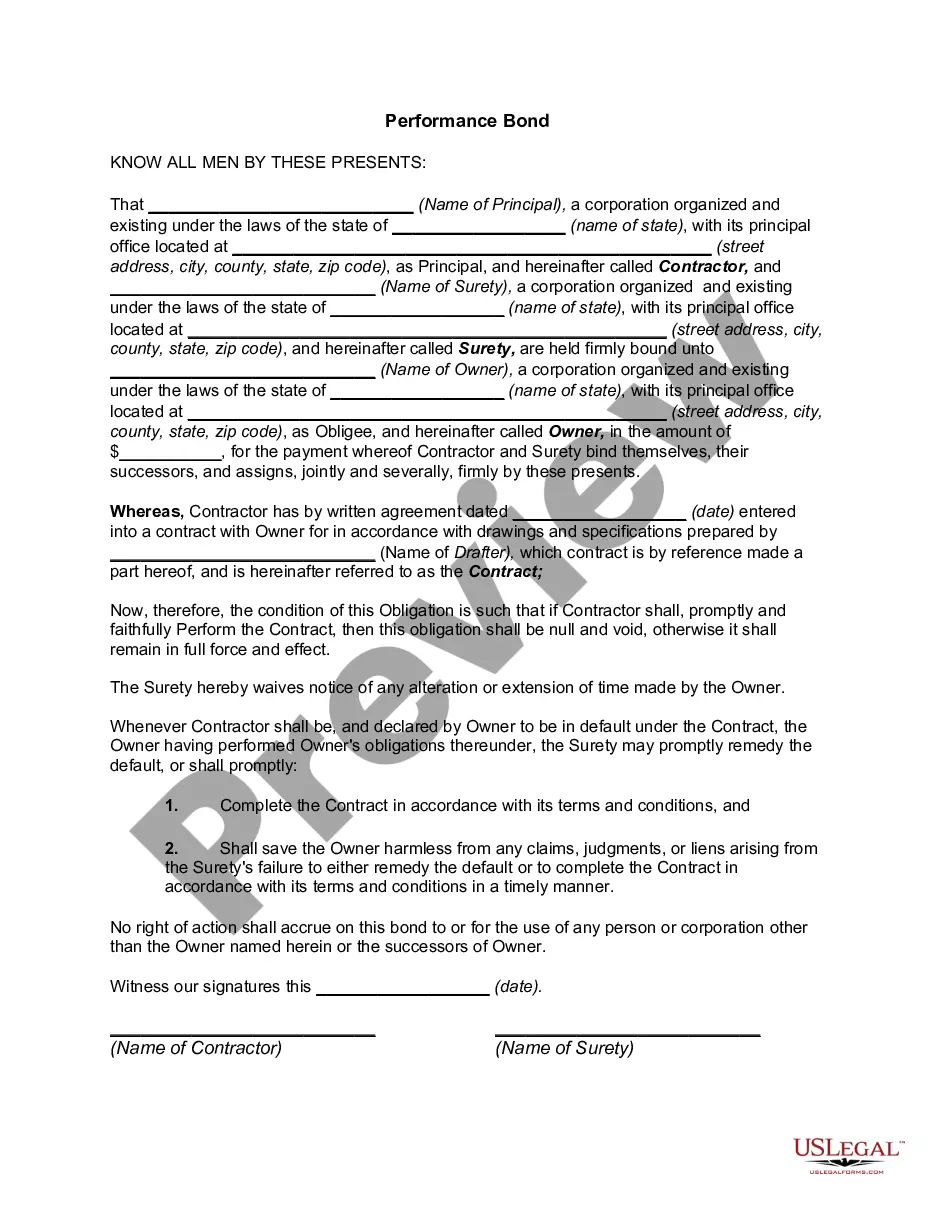
A performance bond is issued by one party to contract to the other party as a guarantee against the issuing party's failure to meet their obligations under the contract, or to delivery on the level of performance specified in the agreement.
A construction performance bond is required on federal government construction projects exceeding $100,000 as a result of the Miller Act of 1934.
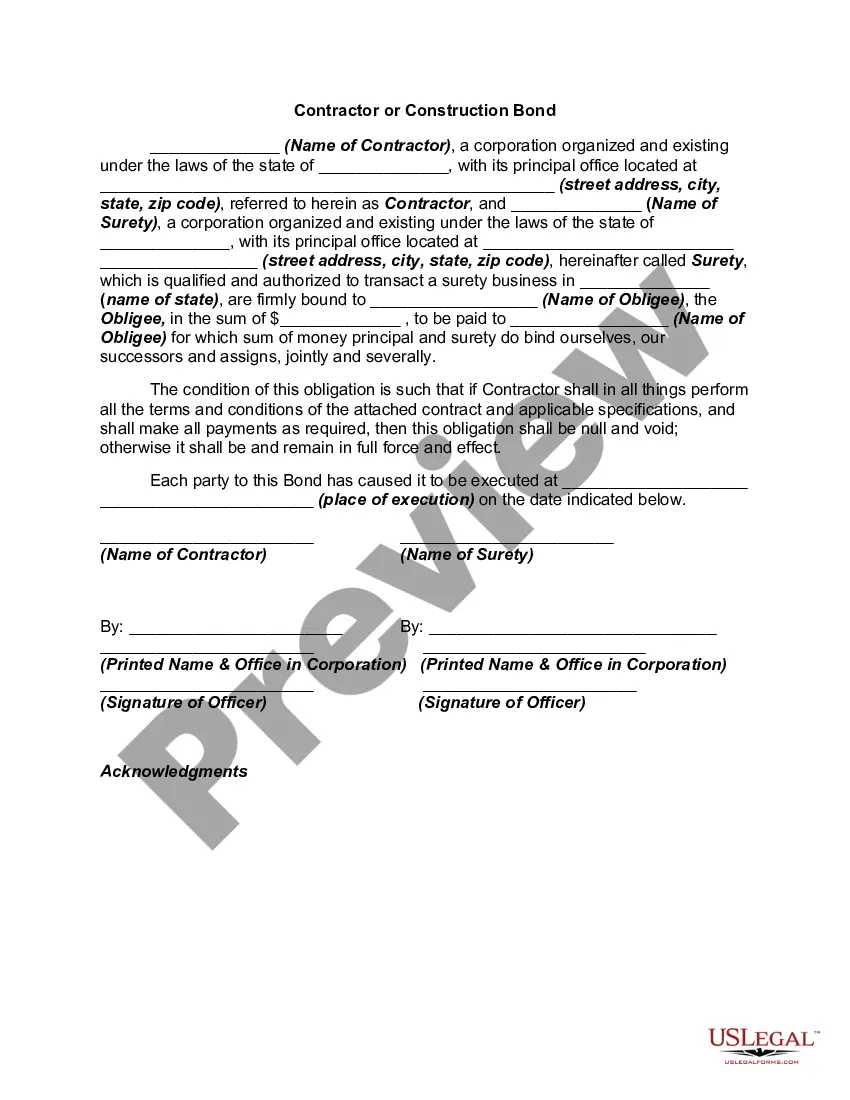
A performance bond is a type of contract construction bond that guarantees a contractor will complete a project according to the terms outlined in a contract by the project owner, also called the obligee. The obligee can be a city, state, or local government, as well as the federal government or a private developer.
Performance bonds often go hand in hand with payment bonds and bid bonds, as many project owners will require these as a contractual condition of being hired. Typically, contractors often have to post a bid bond as part of their initial bid package prior to being awarded a project.
A performance bond is a common type of surety bond used in construction projects. Performance bonds are issued by either a bank or surety company and provide a guarantee that a contractor will finish a project on time while meeting the agreed-upon specifications.
Payment bonds ensure that contractors pay their material suppliers and subcontractors according to their contracts. Performance bonds provide a financial guarantee to project owners that their contractor will perform according to contract terms.
When applying for a performance bond, the surety will require information from the contractor such as: At least two years' worth of financial statements prepared or reviewed by a CPA. A copy of the contract that the performance bond is tied to. An application with the surety company.
A performance bond is usually issued by a bank or an insurance company. Most often, a seller is asked to provide a performance bond to reassure the buyer if the commodity being sold is not delivered.
When can you release a performance bond? Generally, as a rule, the performance bond (or bid bond) remains in force until either after practical completion of the works or making good any defects.