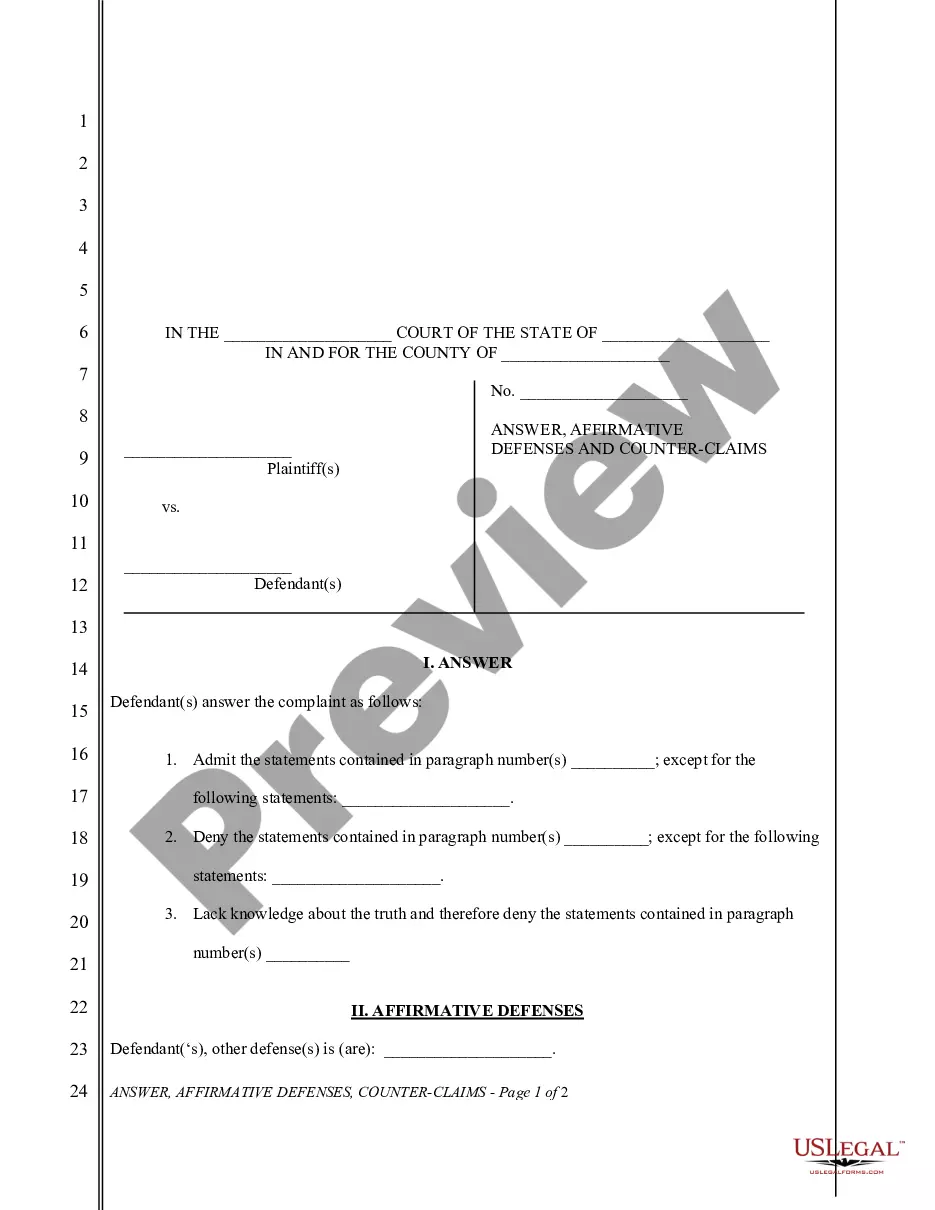
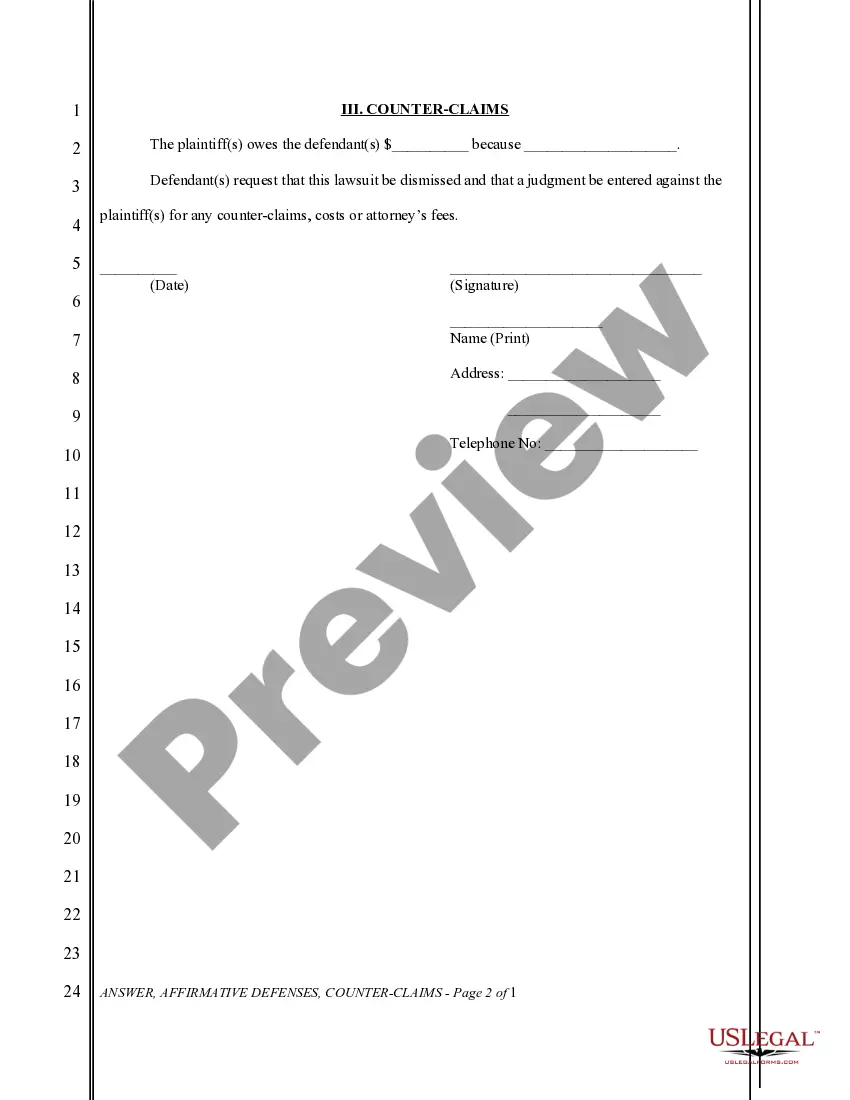
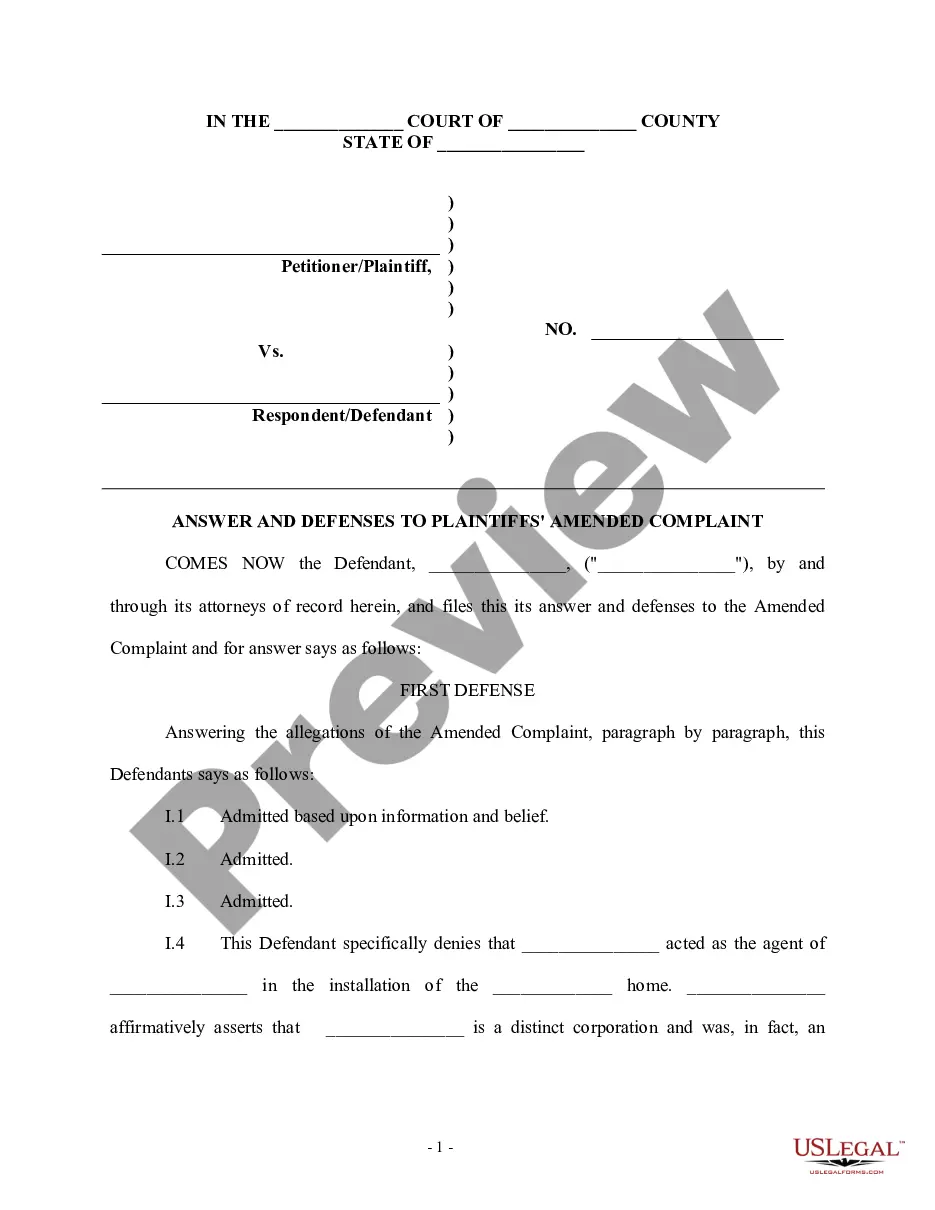
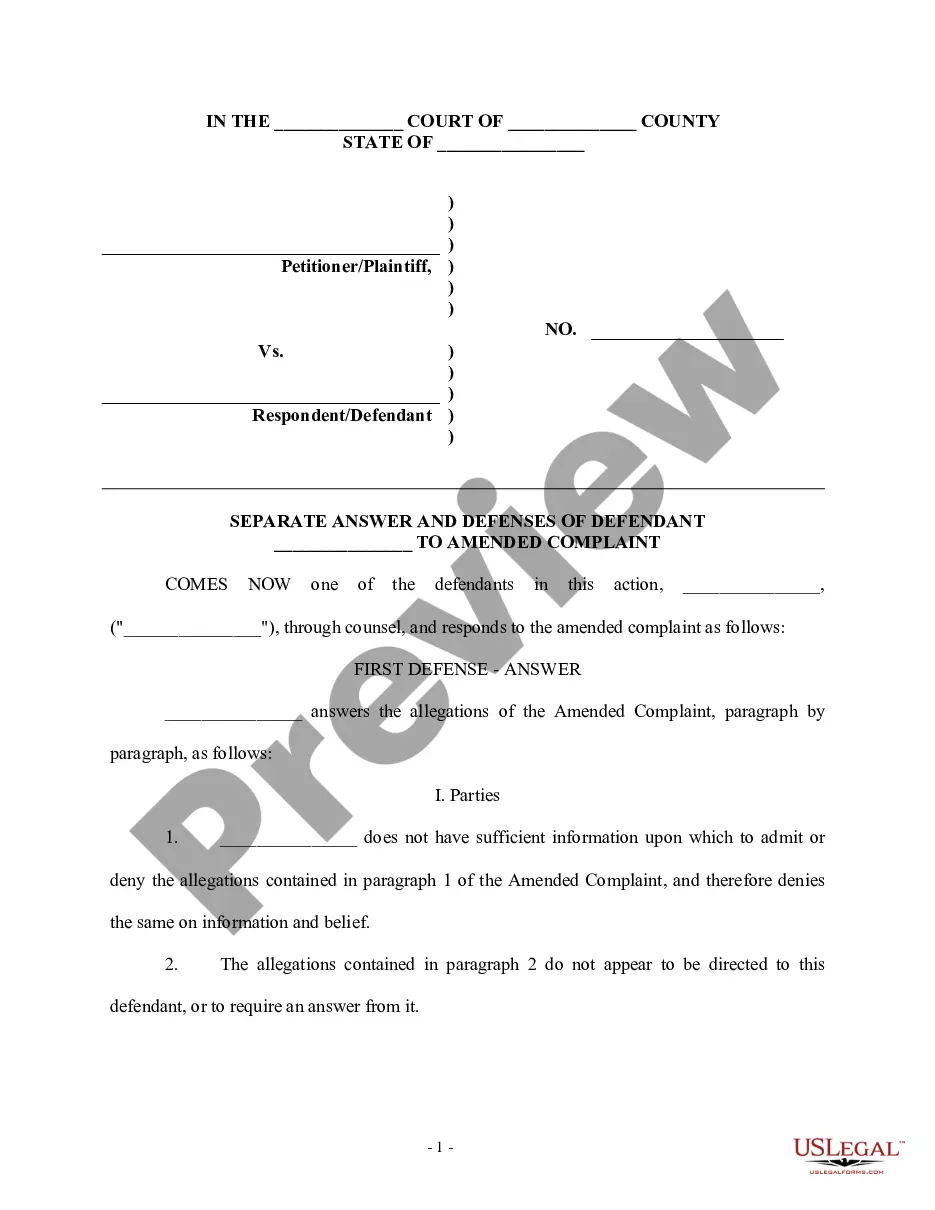
This form may be used to answer a civil complaint. Affirmative defenses may be asserted, along with a counterclaim. An affirmative defense is a type of defense in which the defendant seeks to avoid liability by introducing new evidence not addresses in the claims of the plaintiff's complaint. A counterclaim is made by the defendant to a civil proceeding, in a main action against the plaintiff or against the plaintiff and other people. This claim may be an attempt to offset or reduce the amount/implications of the plaintiff's original claim against the defendant, or it may be a different claim.
Counterclaims are either compulsory or permissive. If the counterclaim is permissive, it may be brought, but no rights are waived if it is not. If the counterclaim is mandatory, it must be brought in the current action or it is waived. Under the United States Federal Rules of Civil Procedure, a counterclaim is compulsory if it involves only the parties currently part of the suit, and is from the same transaction that the original suit is based on. Federal Rule of Civil Procedure 13(a).
King Washington General Form of Civil Answer with Affirmative Defenses and Counterclaim
State:
Multi-State
Category:
County:
King
Control #:
US-0999
Format:
Word;
Rich Text
517 downloads
Description
Free preview
Get your form ready online
Our built-in tools help you complete, sign, share, and store your documents in one place.
Built-in online Word editor
Make edits, fill in missing information, and update formatting in US Legal Forms—just like you would in MS Word.
Export easily
Download a copy, print it, send it by email, or mail it via USPS—whatever works best for your next step.
E-sign your document
Sign and collect signatures with our SignNow integration. Send to multiple recipients, set reminders, and more. Go Premium to unlock E-Sign.
Notarize online 24/7
If this form requires notarization, complete it online through a secure video call—no need to meet a notary in person or wait for an appointment.
Store your document securely
We protect your documents and personal data by following strict security and privacy standards.

Make edits, fill in missing information, and update formatting in US Legal Forms—just like you would in MS Word.

Download a copy, print it, send it by email, or mail it via USPS—whatever works best for your next step.

Sign and collect signatures with our SignNow integration. Send to multiple recipients, set reminders, and more. Go Premium to unlock E-Sign.

If this form requires notarization, complete it online through a secure video call—no need to meet a notary in person or wait for an appointment.

We protect your documents and personal data by following strict security and privacy standards.
Looking for another form?
How to fill out General Form Of Civil Answer With Affirmative Defenses And Counterclaim?
Preparing documentation for the enterprise or individual requirements is consistently a significant obligation.
When formulating a contract, a public service inquiry, or a power of attorney, it's crucial to take into account all federal and state laws of the designated region.
Nonetheless, small counties and even towns also have legislative processes that you need to take into account.
You can effortlessly access your profile to manage all documentation obtained previously in the My documents tab at any time. Become part of the platform and swiftly acquire verified legal forms for every situation with just a few clicks!
- All these factors render it arduous and time-consuming to draft the King General Form of Civil Answer with Affirmative Defenses and Counterclaim without expert help.
- It's feasible to evade unnecessary expenses on attorneys for drafting your documentation and create a legally acceptable King General Form of Civil Answer with Affirmative Defenses and Counterclaim independently, utilizing the US Legal Forms web library.
- It is the premier online repository of state-specific legal templates that are professionally validated, ensuring their legitimacy when selecting a sample for your jurisdiction.
- Previously subscribed users simply need to Log In to their accounts to retrieve the needed form.
- If you are yet to have a subscription, adhere to the step-by-step guide below to acquire the King General Form of Civil Answer with Affirmative Defenses and Counterclaim.
- Review the page you've accessed and verify if it contains the document you seek.
- To achieve this, employ the form description and preview if these choices are available.
Form popularity
FAQ
Affirmative defenses in civil procedure are legal arguments that defend against a plaintiff's claims. By utilizing the King Washington General Form of Civil Answer with Affirmative Defenses and Counterclaim, you can present these defenses officially. This form allows you to specify reasons that may justify your actions or combat liability. Knowing how to leverage these defenses can greatly influence the outcome of your case.
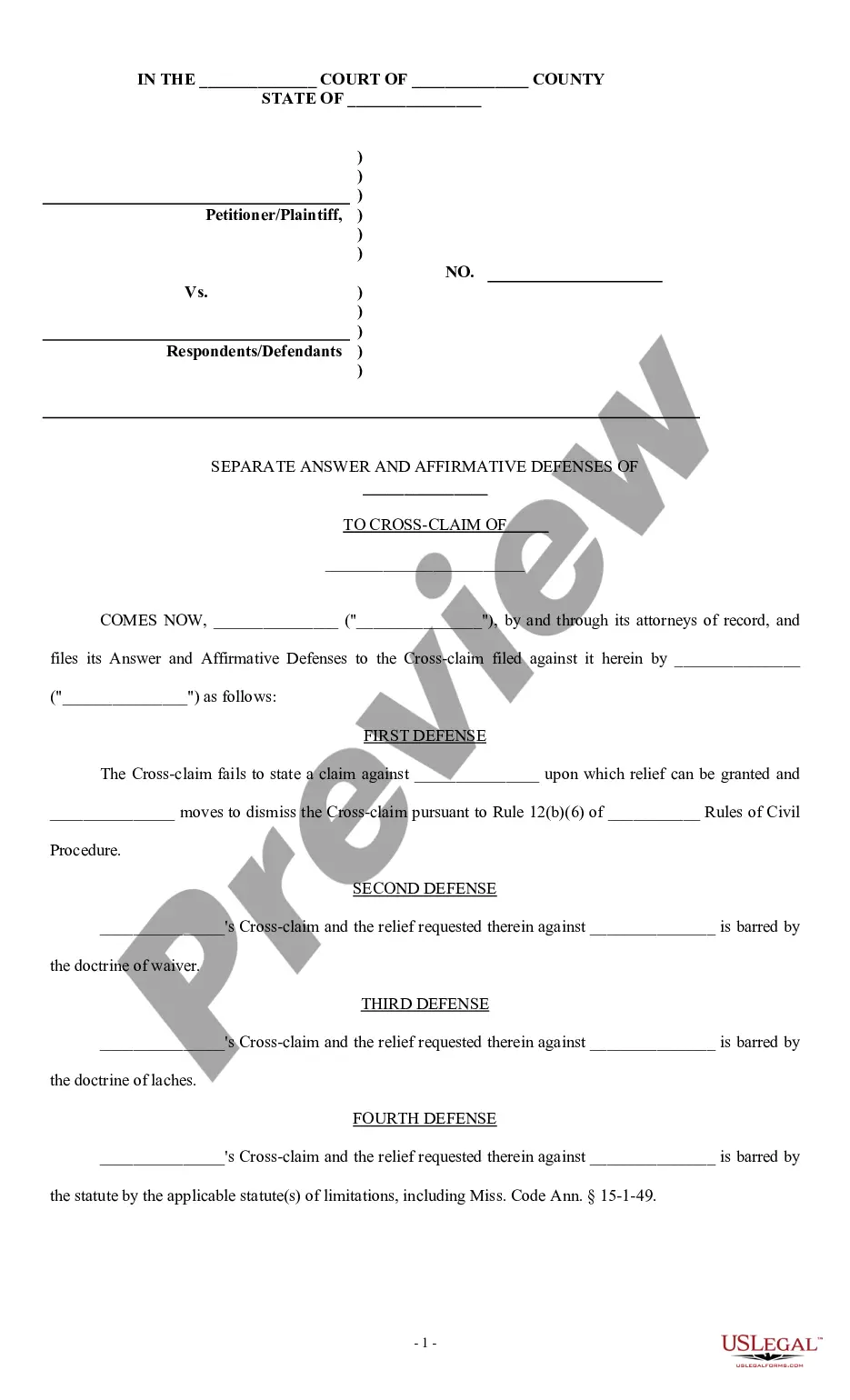
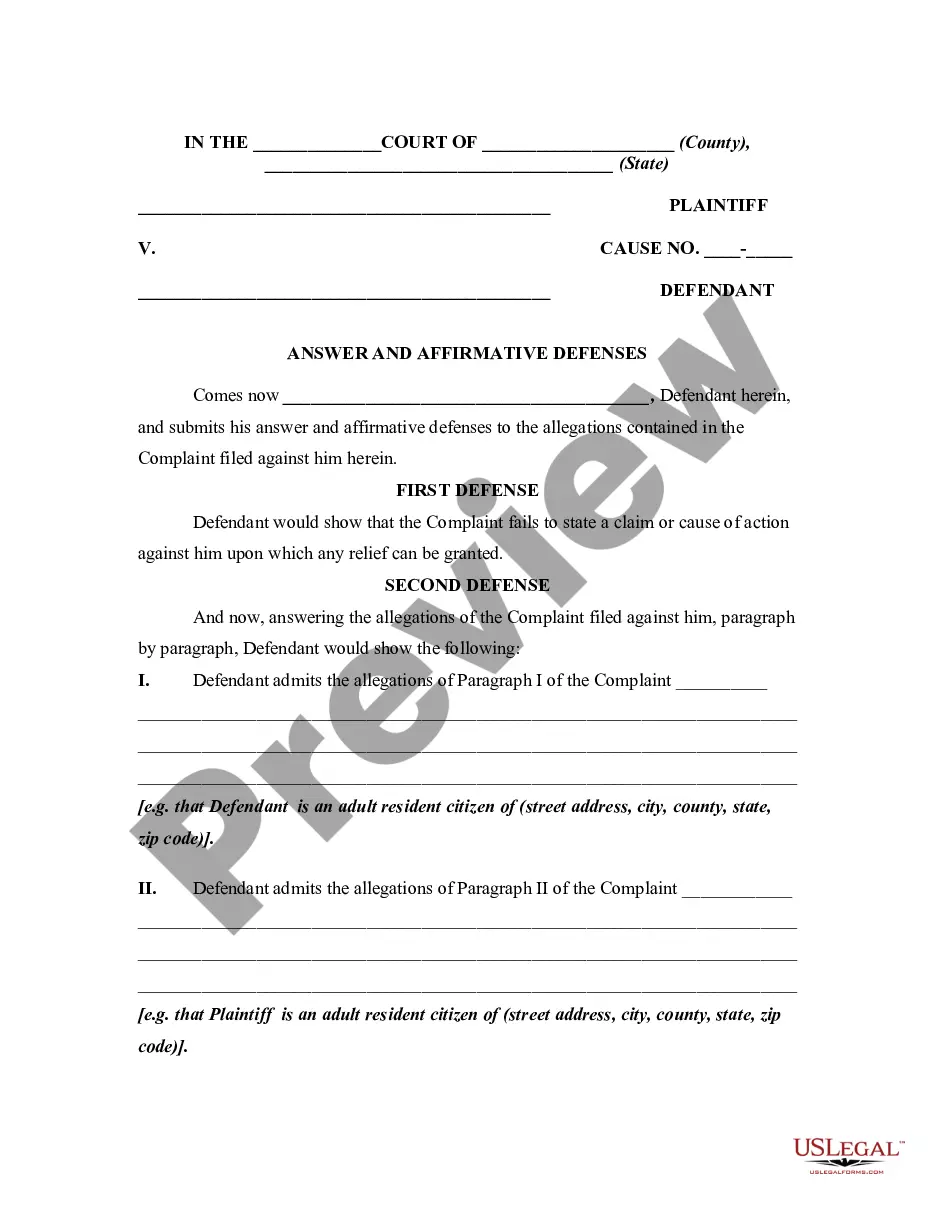
Following the admissions and denials, the answer outlines any affirmative defenses available to the defendant. Affirmative defenses, which are grounded in SUBSTANTIVE LAW, state that an allegation may or may not be true, but that even if it is true, the law provides a legal defense that defeats the plaintiff's claim.
The affirmative defense admits the act as having taken place, but acts as an excuse for the defendant's action, and negates or lessens civil liability.
Definition. This is a defense in which the defendant introduces evidence, which, if found to be credible, will negate criminal liability or civil liability, even if it is proven that the defendant committed the alleged acts.
(1930) §§1614, 1616. In other jurisdictions no reply is necessary to an affirmative defense in the answer, but a reply may be ordered by the court.
Overview. Self-defense, entrapment, insanity, necessity, and respondeat superior are some examples of affirmative defenses. Under the Federal Rules of Civil Procedure Rule 56, any party may make a motion for summary judgment on an affirmative defense.
Yes. Rule 12(b) provides a party may assert the following defenses by motion. The defendant has two options: 1) raise the defenses in a preliminary motion, or 2) raise the defenses in the answer, provided that they have not been waived by omission from a preliminary motion.
An affirmative defense is a defense which will counteract one element of a criminal or civil charge, but not the charge itself, while the standard defense or a negating defense will deign the evidence in support of the charge.
Some Common Types of Affirmative Defenses Several affirmative defenses are nationally recognized, with the more common ones being necessity, duress, self-defense, entrapment, and insanity.
While the availability of an affirmative defense will depend on the state, there are generally two categories of affirmative defenses, justifications and excuses.