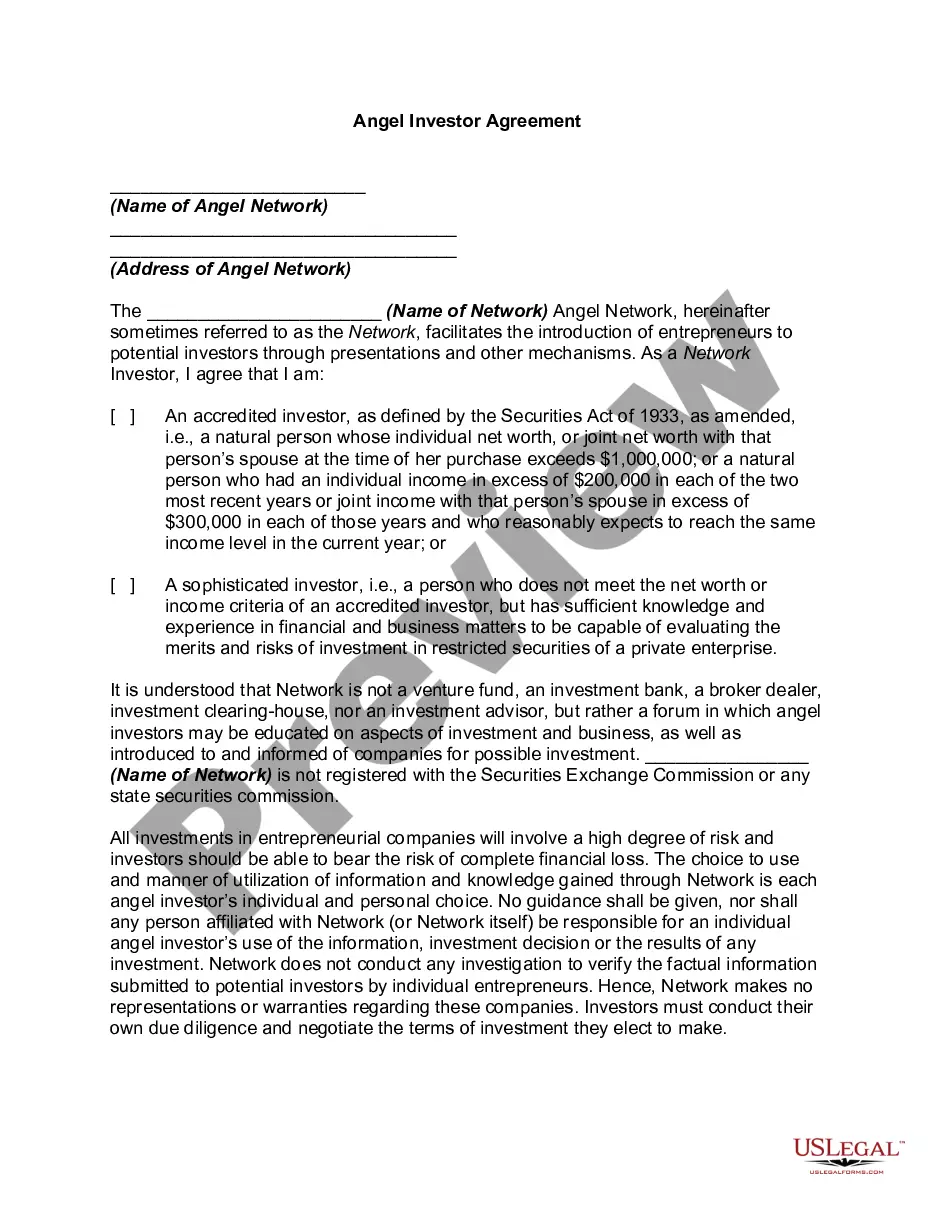
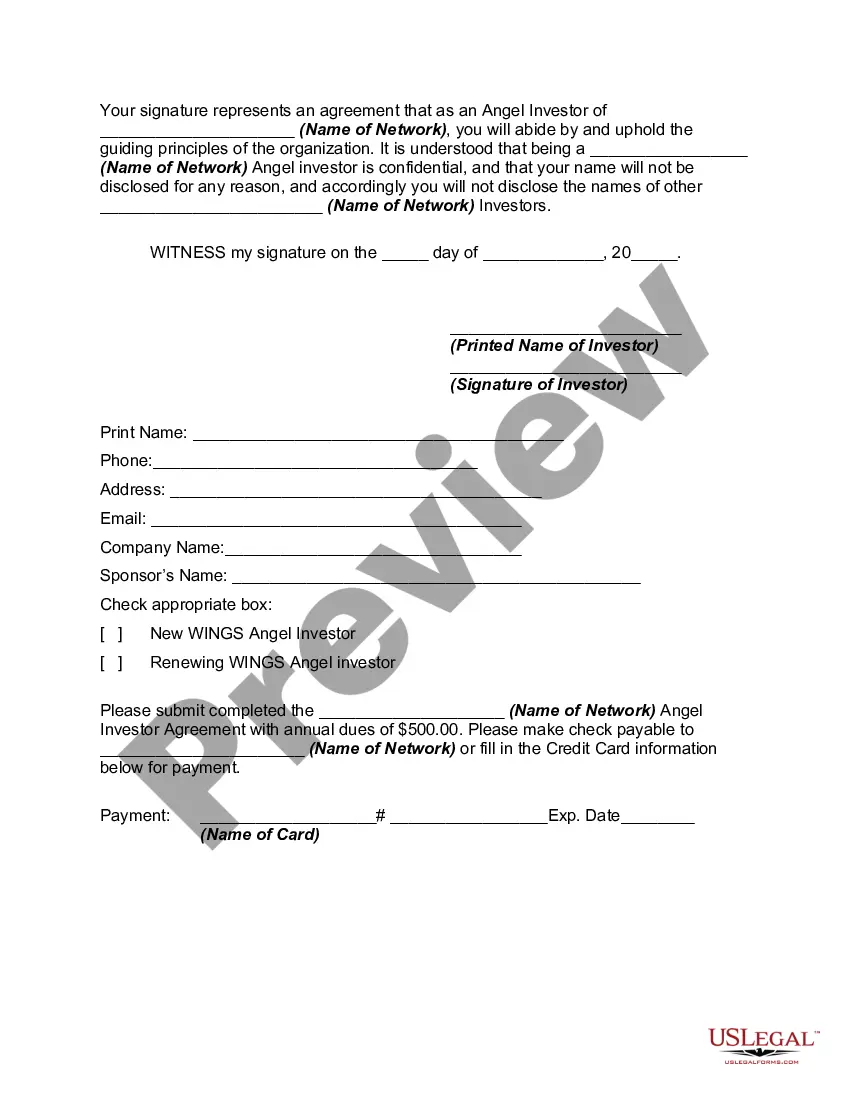
Riverside California Angel Investor Agreement
Description
Get your form ready online
Our built-in tools help you complete, sign, share, and store your documents in one place.
Make edits, fill in missing information, and update formatting in US Legal Forms—just like you would in MS Word.
Download a copy, print it, send it by email, or mail it via USPS—whatever works best for your next step.
Sign and collect signatures with our SignNow integration. Send to multiple recipients, set reminders, and more. Go Premium to unlock E-Sign.
If this form requires notarization, complete it online through a secure video call—no need to meet a notary in person or wait for an appointment.
We protect your documents and personal data by following strict security and privacy standards.

Make edits, fill in missing information, and update formatting in US Legal Forms—just like you would in MS Word.

Download a copy, print it, send it by email, or mail it via USPS—whatever works best for your next step.

Sign and collect signatures with our SignNow integration. Send to multiple recipients, set reminders, and more. Go Premium to unlock E-Sign.

If this form requires notarization, complete it online through a secure video call—no need to meet a notary in person or wait for an appointment.

We protect your documents and personal data by following strict security and privacy standards.
Looking for another form?


How to fill out Angel Investor Agreement?
Creating documents for business or personal needs is always a significant obligation.
When preparing a contract, a public service application, or a power of attorney, it's crucial to consider all federal and state regulations of the particular area.
However, smaller counties and even towns also have legislative protocols that must be acknowledged.
Join the platform and effortlessly access verified legal forms for any purpose with just a few clicks!
- All these factors contribute to the pressure and duration required to produce a Riverside Angel Investor Agreement without professional help.
- It's possible to save on legal fees for drafting your documents and create a legally acceptable Riverside Angel Investor Agreement independently by utilizing the US Legal Forms online library.
- This is the largest digital repository of state-specific legal templates that are expertly validated, allowing you to trust their legitimacy when selecting a sample for your jurisdiction.
- Previous subscribers only need to Log In to their accounts to download the necessary form.
- If you are not yet a subscriber, follow the step-by-step instructions below to acquire the Riverside Angel Investor Agreement.
- Browse the page you've opened and verify if it contains the template you need.
- To do this effectively, utilize the form description and preview if those features are available.
Form popularity
FAQ
In general, angel investors expect to get their money back within 5 to 7 years with an annualized internal rate of return (IRR) of 20% to 40%. Venture capital funds strive for the higher end of this range or more.
An angel investor (also known as a private investor, seed investor or angel funder) is a high-net-worth individual who provides financial backing for small startups or entrepreneurs, typically in exchange for ownership equity in the company. Often, angel investors are found among an entrepreneur's family and friends.
Angel investor terms are used to define the relationship between an investor and the company receiving the investment. The terms of this type of agreement are established with a non-binding document called a term sheet.
Angel investors usually take between 20 and 50 percent stake in the companies they help. Sometimes the exact amount is determined strictly by negotiation. However, frequently angel investors use a company's valuation as a measure for how much ownership they should take.
John finds Ralph Jones, an angel investor. Ralph is a wealthy friend of a friend who believes in John's idea and wants to see it succeed. Ralph is comfortable with the risk that John's product may not work or that John could turn out to be a terrible businessperson. He invests $100,000 and receives 40% of the company.
A: Angel investors typically want to receive 20% to 25% of your profit. However, how much you pay your angel investors depends on your initial contract. Hammer out these details before they give you any money, and have a lawyer draw up a contract, which will make your angel investors feel safer in their investment.
The amount of equity that angels receive in return for their investment varies widely. It's typically between around 10% and 25% but may be as much as 40% or more. Since angels invest in return for a stake in the business, you won't need to make loan repayments to a bank or other financial institution.
The Pros and Cons of Angel Investors Having an angel investor means your business doesn't have to repay the funds because you're giving ownership shares in exchange for money. Angel investing is usually reserved for established businesses beyond the startup phase.
The typical angel investment is $25,000 to $100,000 a company, but can go higher....They key terms negotiated are: Unsecured or secured on the assets of the company - this is almost always unsecured. Interest rate and payment - the interest is usually accrued and not paid currently.