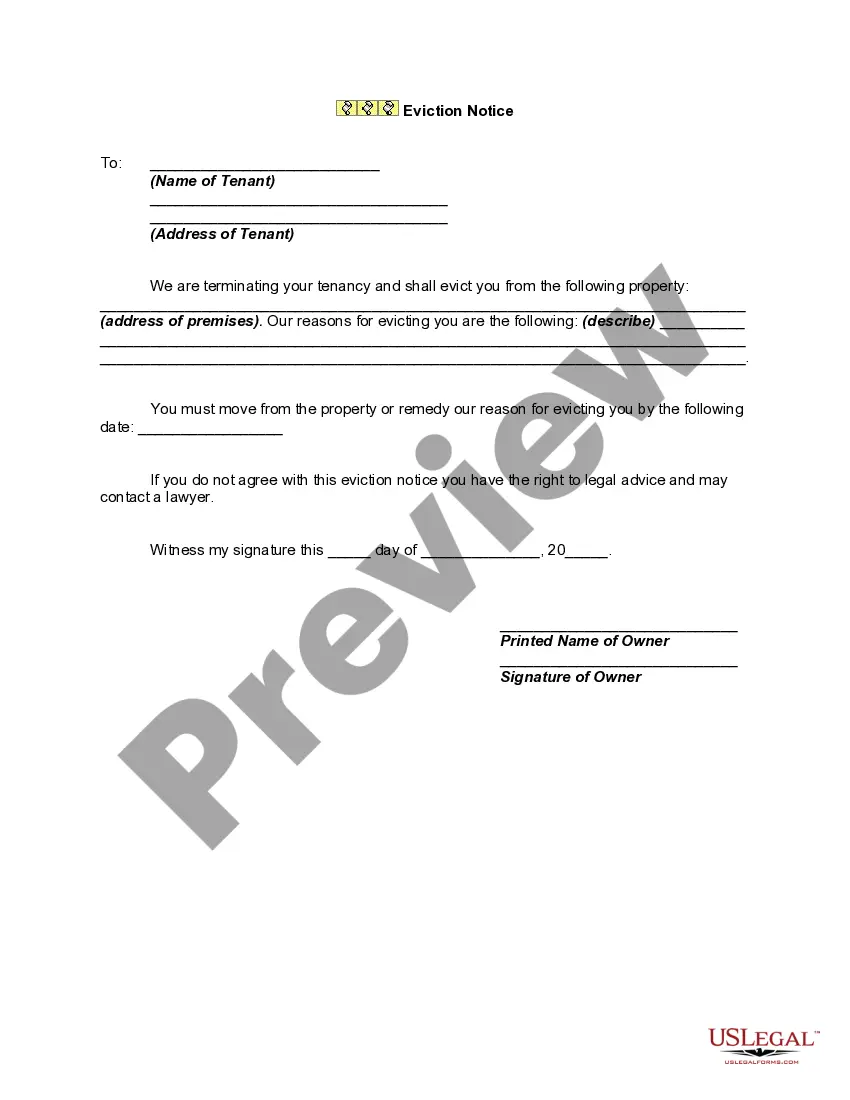
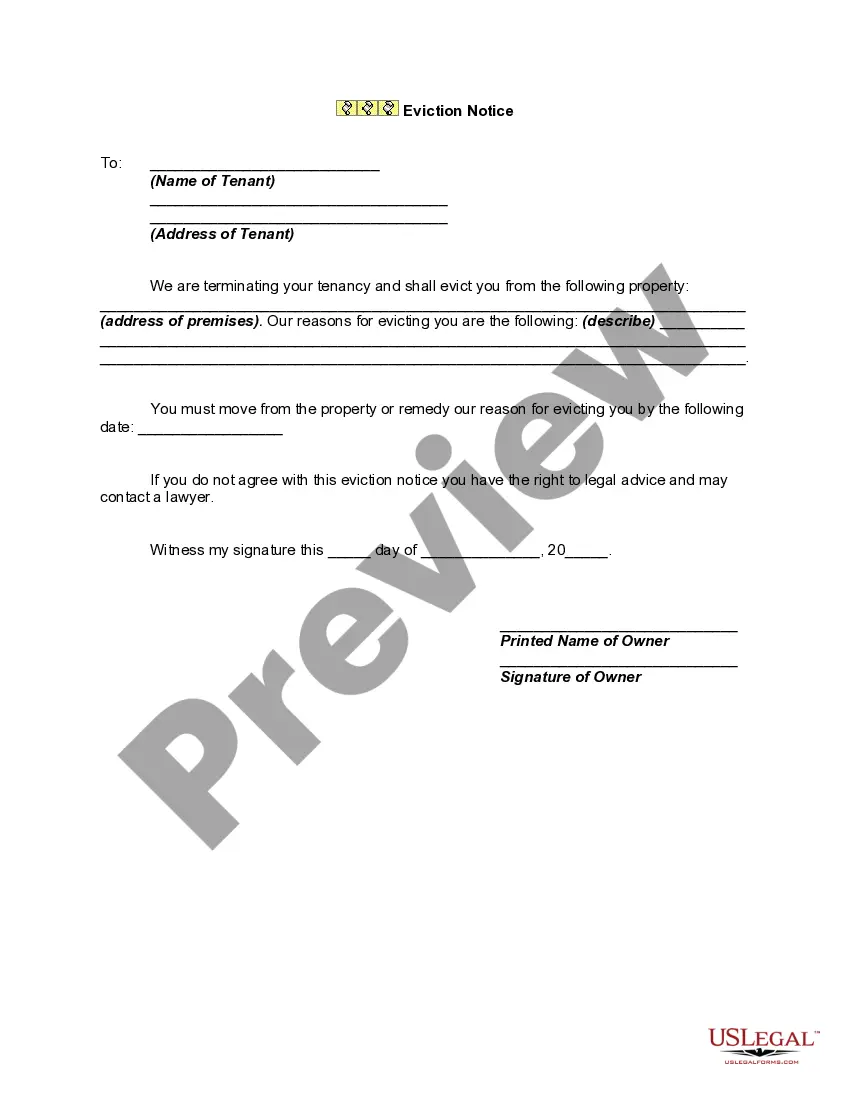
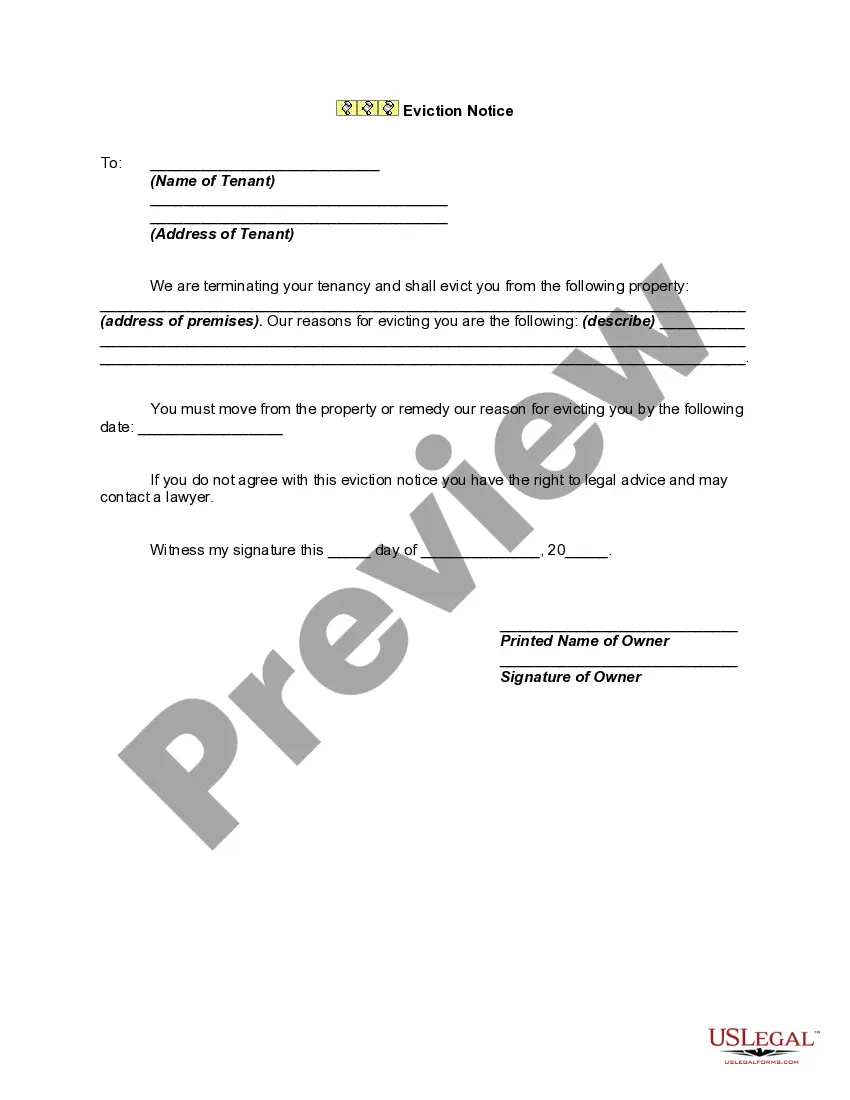
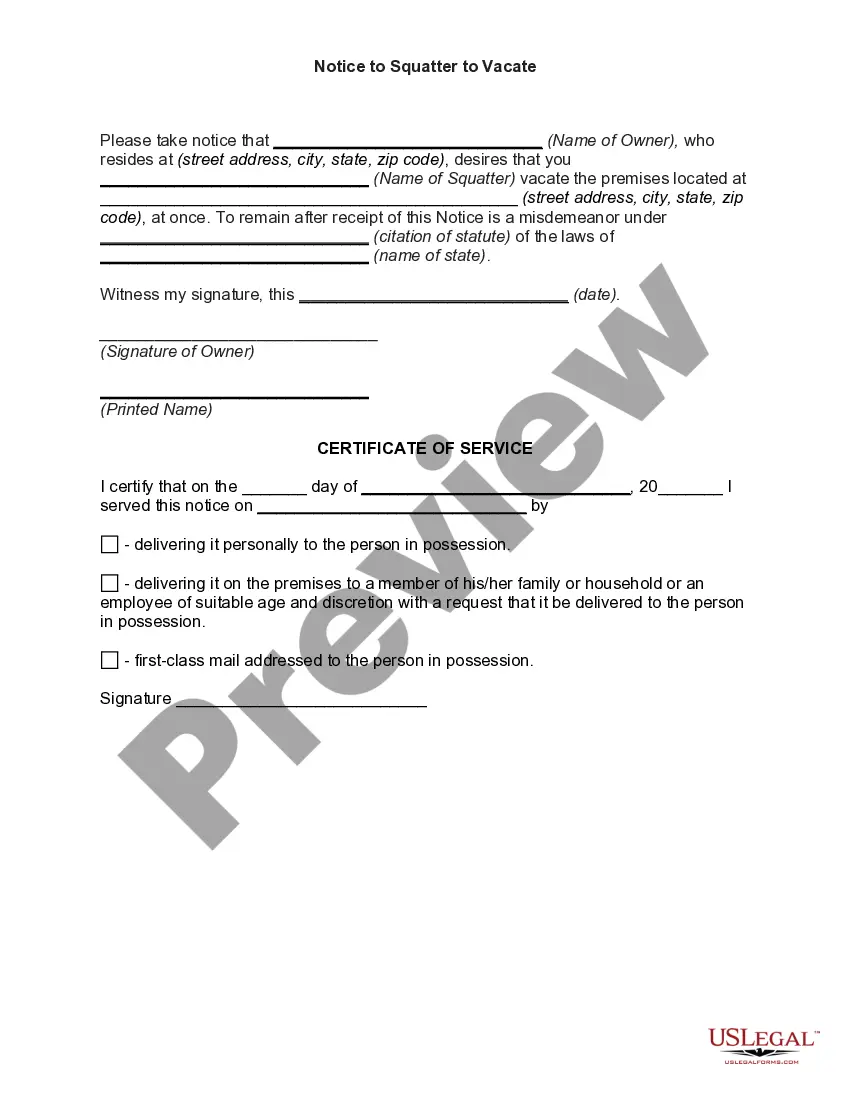
Tarrant Texas Eviction Notice for Tenant
Description
Get your form ready online
Our built-in tools help you complete, sign, share, and store your documents in one place.
Make edits, fill in missing information, and update formatting in US Legal Forms—just like you would in MS Word.
Download a copy, print it, send it by email, or mail it via USPS—whatever works best for your next step.
Sign and collect signatures with our SignNow integration. Send to multiple recipients, set reminders, and more. Go Premium to unlock E-Sign.
If this form requires notarization, complete it online through a secure video call—no need to meet a notary in person or wait for an appointment.
We protect your documents and personal data by following strict security and privacy standards.

Make edits, fill in missing information, and update formatting in US Legal Forms—just like you would in MS Word.

Download a copy, print it, send it by email, or mail it via USPS—whatever works best for your next step.

Sign and collect signatures with our SignNow integration. Send to multiple recipients, set reminders, and more. Go Premium to unlock E-Sign.

If this form requires notarization, complete it online through a secure video call—no need to meet a notary in person or wait for an appointment.

We protect your documents and personal data by following strict security and privacy standards.
Looking for another form?

How to fill out Eviction Notice For Tenant?
A document process consistently accompanies any legal action you undertake.
Launching a business, submitting or accepting a job offer, transferring ownership, and many other life circumstances necessitate you to prepare official paperwork that varies across the nation.
That’s why having everything gathered in one location is incredibly beneficial.
US Legal Forms is the largest online collection of current federal and state-specific legal documents.
Use it as necessary: print it or complete it electronically, sign it, and send it where required. This is the easiest and most reliable method to obtain legal documentation. All templates provided by our library are expertly prepared and confirmed for compliance with local laws and regulations. Prepare your documents and manage your legal matters efficiently with US Legal Forms!
- Here, you can conveniently find and download a form for any personal or business need utilized in your county, including the Tarrant Eviction Notice for Tenant.
- Finding templates on the site is exceptionally easy.
- If you already have a subscription to our service, Log In to your account, locate the sample using the search bar, and click Download to save it on your device.
- Afterward, the Tarrant Eviction Notice for Tenant will be accessible for additional use in the My documents section of your profile.
- If you are using US Legal Forms for the first time, follow this brief guide to obtain the Tarrant Eviction Notice for Tenant.
- Make sure you have accessed the right page with your local form.
- Utilize the Preview mode (if available) and look through the sample.
- Examine the description (if available) to confirm the template meets your needs.
- Search for another document using the search feature if the sample is not suitable.
- Click Buy Now when you locate the necessary template.
- Select the appropriate subscription plan, then Log In or create an account.
- Choose the preferred payment method (via credit card or PayPal) to continue.
- Select the file format and download the Tarrant Eviction Notice for Tenant onto your device.
Form popularity
FAQ
CDC's Order Halting Evictions On August 3, 2021, the Centers for Disease Control and Prevention (CDC) issued an Order preventing many residential tenants from being evicted for nonpayment of rent. Note This Order was struck down by the Supreme Court PDF on August 26, 2021.
Evictions MUST be filed in the proper Precinct (where premises is located) or the case will be dismissed. Verify the Justice Court Precinct. For information on Justice Court Rules, please visit Texas Judicial Branch Rules and Forms website. Self-Help Legal Information Packet: Filing an Eviction Case.
21 days, minimum; BUT a more complete eviction process explanation can be found below.
How long does it take to evict someone in Texas? From start to finish approximately three weeks 2022 3 days from notice to vacate to filing of suit 2022 8-10 days to serve the citation -The law requires the defendant have a least six days no more than 10 days notice before the hearing.
But under state law, there is no grace period before a landlord can give a tenant notice to vacate for failure to pay rent. (This means that a landlord can give a tenant the notice to vacate the day after rent is due.)
21 days, minimum; BUT a more complete eviction process explanation can be found below.
The CDC issued a Federal Eviction Moratorium Order effective September 4, 2020 on residential evictions for nonpayment of rent for "covered persons" from the effective date September 4 through January 31, 2021.
Texas, like many other states, has laws in place that allow a landlord to serve a 3-Day Notice to Quit. Serving this eviction notice means that your tenants need to pay the rent they owe or fix a breach in lease agreement within the period of 3 days, or else they will have to vacate the property.
Unless the lease agreement says otherwise, the landlord must give the tenant at least 3 days to move out. They cannot file an eviction suit before they give this notice in writing.
After July 24th, 2020, the CARES Act requires landlords at properties covered by the Act to give 30 days notice before beginning eviction procedures. This section of the U.S. Code contains the CARES Act provisions that temporarily suspended many evictions until July 24, 2020.