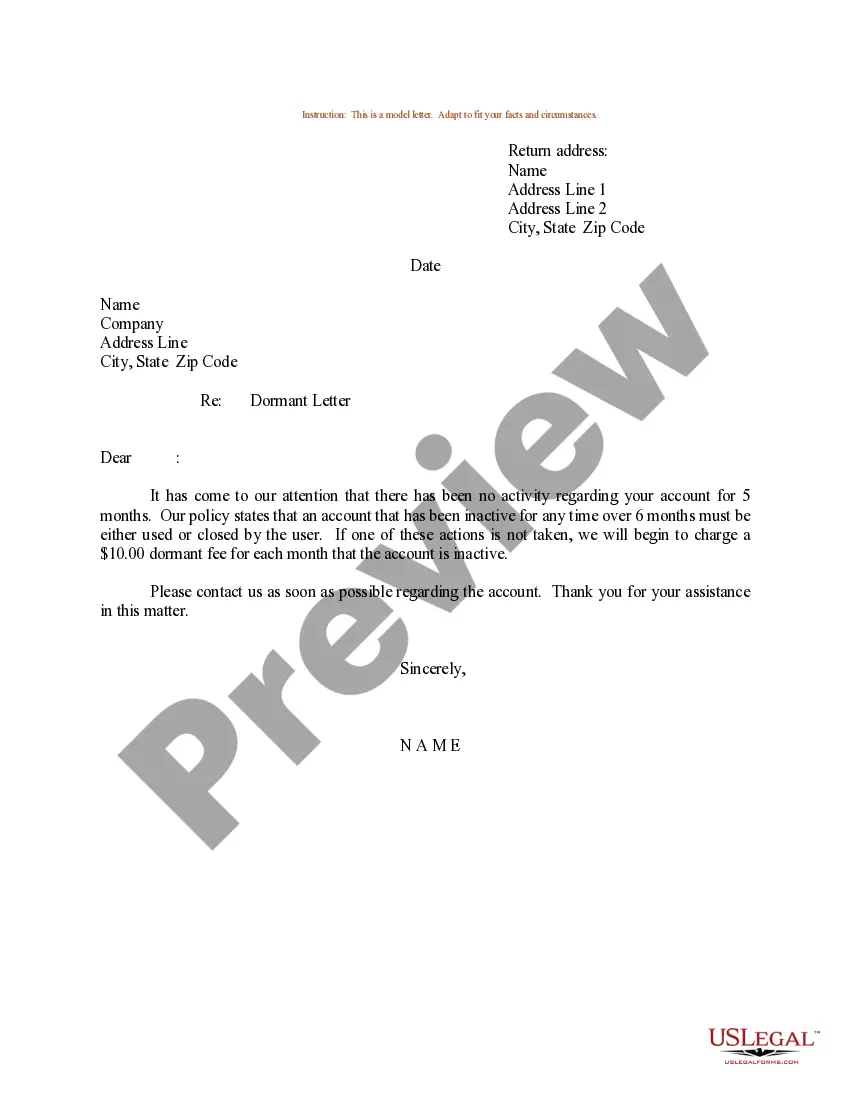
Philadelphia Pennsylvania Sample Letter for Dormant Letter
Description
Get your form ready online
Our built-in tools help you complete, sign, share, and store your documents in one place.
Make edits, fill in missing information, and update formatting in US Legal Forms—just like you would in MS Word.
Download a copy, print it, send it by email, or mail it via USPS—whatever works best for your next step.
Sign and collect signatures with our SignNow integration. Send to multiple recipients, set reminders, and more. Go Premium to unlock E-Sign.
If this form requires notarization, complete it online through a secure video call—no need to meet a notary in person or wait for an appointment.
We protect your documents and personal data by following strict security and privacy standards.

Make edits, fill in missing information, and update formatting in US Legal Forms—just like you would in MS Word.

Download a copy, print it, send it by email, or mail it via USPS—whatever works best for your next step.

Sign and collect signatures with our SignNow integration. Send to multiple recipients, set reminders, and more. Go Premium to unlock E-Sign.

If this form requires notarization, complete it online through a secure video call—no need to meet a notary in person or wait for an appointment.

We protect your documents and personal data by following strict security and privacy standards.
Looking for another form?







How to fill out Sample Letter For Dormant Letter?
Are you seeking to swiftly generate a legally-binding Philadelphia Sample Letter for Dormant Letter or perhaps any other document to handle your personal or business affairs.
You can opt for one of two choices: reach out to a legal expert to draft a legal document for you or compose it entirely by yourself. The encouraging news is that there's a third alternative - US Legal Forms.
Primarily, verify if the Philadelphia Sample Letter for Dormant Letter is customized to comply with your state's or county's laws.
If the document has a description, ensure to confirm what it pertains to.
- It will assist you in obtaining well-written legal documents without incurring hefty costs for legal assistance.
- US Legal Forms provides an extensive assortment of over 85,000 state-compliant form templates, including the Philadelphia Sample Letter for Dormant Letter and various form packages.
- We offer documents for a wide range of life situations: from divorce forms to real estate paperwork.
- With over 25 years in the industry, we have built a flawless reputation among our clients.
- Here's how you can join them and acquire the essential template without unnecessary complications.
Form popularity
FAQ
Reactivating your bank account You must submit a written application to the bank. For joint accounts, signatures of all accountholders will be needed, irrespective of a single or joint operating mode. You will have to submit your KYC (Know Your Customer) documents.You have to do at least one financial transaction.
All you have to do is send a mail to the concerned bank branch. In this mail you will request the bank that your inactive bank account be reactivated. For this, you have to send proof of your identity card, address etc. The bank will reactivate your account within a few days of sending your application.
How Unclaimed Property Works in Pennsylvania - YouTube YouTube Start of suggested clip End of suggested clip Just go to patreon.gov. And click the programs tab select unclaim property then select start yourMoreJust go to patreon.gov. And click the programs tab select unclaim property then select start your search and you're well on your way you can also search our database dedicated solely to returning
What is Escheatment? The term escheatment refers to the process of turning custody of abandoned assets or accounts over to a state authority.
Financial institutions are legally required to escheat, or transfer, funds in a dormant account to the state after a set period of time has passed. The state holds onto these funds indefinitely where you or a beneficiary can reclaim them at any time.
A statute of limitations usually does not apply to dormant accounts, meaning that funds can be claimed by the owner or beneficiary at any time. If an attempt to find the owner is unsuccessful, resources in dormant accounts become unclaimed property and must be transferred to the state's treasury department.
If the unclaimed property is valued at $11,000 or less and it has been at least five (5) years since a personal representative to the estate was appointed, the property may be paid to the surviving spouse, child, parent, or sibling of the decedent (preference given in that order), provided the owner died a resident of
Also, remember our dormancy period for the majority of unclaimed property is now three years, not five, so this may affect your need for early remittance.
Most property types in Pennsylvania have a dormancy period of three years. Accounts are considered dormant if the owner of a property has not indicated any interest in the property or if no contact has been made for the allotted dormancy period for that property.