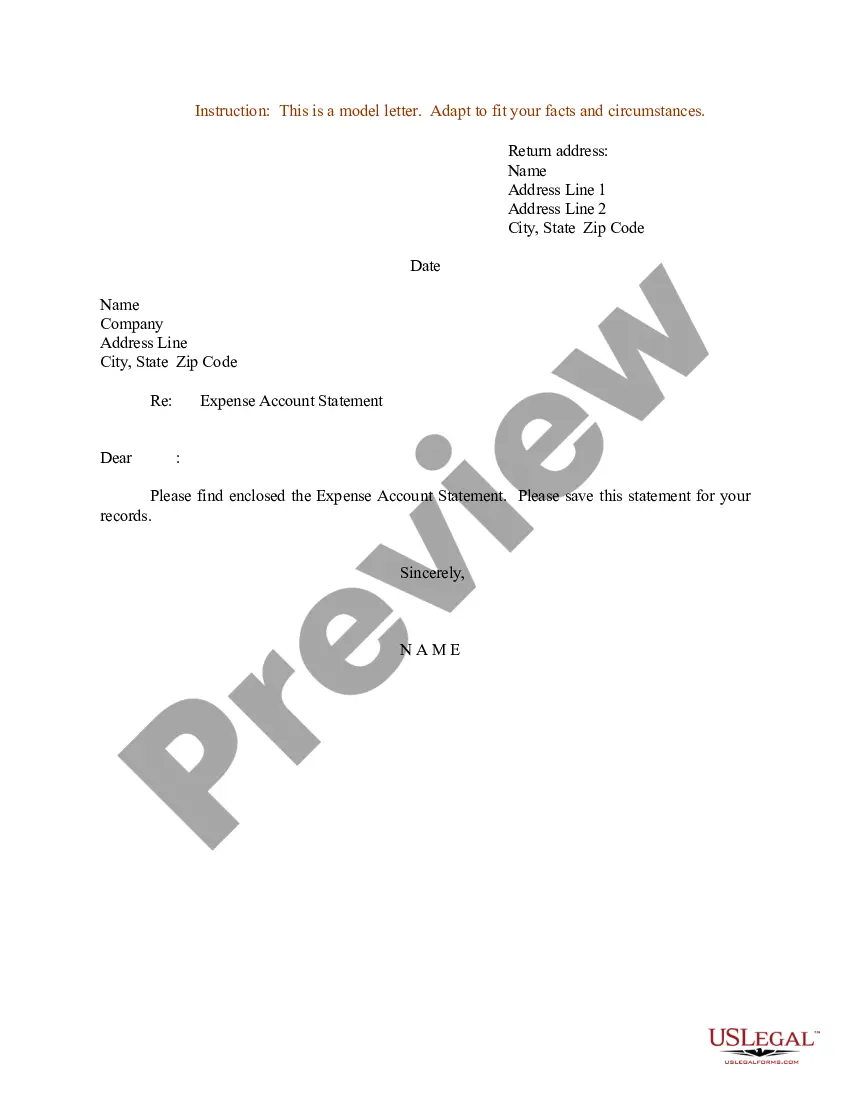
Columbus Ohio Sample Letter for Expense Account Statement
Description




Form popularity
FAQ
To write a letter requesting an account of statements, begin with a clear subject line and a polite greeting. State your request directly, specifying the period for which you need the statements, and include any relevant account details. Using a Columbus Ohio Sample Letter for Expense Account Statement can help you draft a professional and effective request.
The standard format for a SOA includes the header with your contact information, a clear title, and a date. It should present the transaction details in a table format, followed by a summary of the outstanding balance. To simplify this process, consider using a Columbus Ohio Sample Letter for Expense Account Statement as a reference.
To make a SOA letter, start by gathering all transaction records between the parties involved. Clearly list the dates, amounts, and descriptions of each transaction. For guidance, a Columbus Ohio Sample Letter for Expense Account Statement can serve as a helpful template to ensure your letter is organized and professional.
SOA and bank statements are not the same, although they both provide financial information. A bank statement reflects your bank account activity, while a SOA details transactions between two specific parties. If you need clarity on your finances, refer to a Columbus Ohio Sample Letter for Expense Account Statement to create an effective SOA.
A SOA letter, or Statement of Account letter, provides a clear outline of financial transactions over a specified period. It helps you track invoices, payments, and outstanding balances. Utilizing a Columbus Ohio Sample Letter for Expense Account Statement can ensure your SOA letter meets local standards and expectations.
Ing to Ohio Instructions for Form IT 1040, ?Every Ohio resident and part year resident is subject to the Ohio Income tax.? Every full-year resident, part year resident and full year nonresident must file an Ohio tax return if they have income from Ohio sources.
Local income tax is usually based on where a taxpayer lives, but in some cases, taxpayers also owe local income tax based on where they perform work (for example, if they commute). You may have withholding obligations based on where your company does business or based on where your employees perform work.
Columbus residents pay a total of 2.5% in taxes on all income earned, regardless of whether it was earned in Columbus or another city.
In Ohio, you have an income tax obligation to both your employment city and your resident city. Your employer is required by law to withhold your work place city tax and if you have "fully withheld", you have no filing requirement with your work place city.
Municipalities may generally impose tax on on wages, salaries, and other compensation earned by residents and by nonresidents who work in the municipality. The tax also applies to the net profits of business attributable to activities in the municipality, and to the net profits from rental activities.