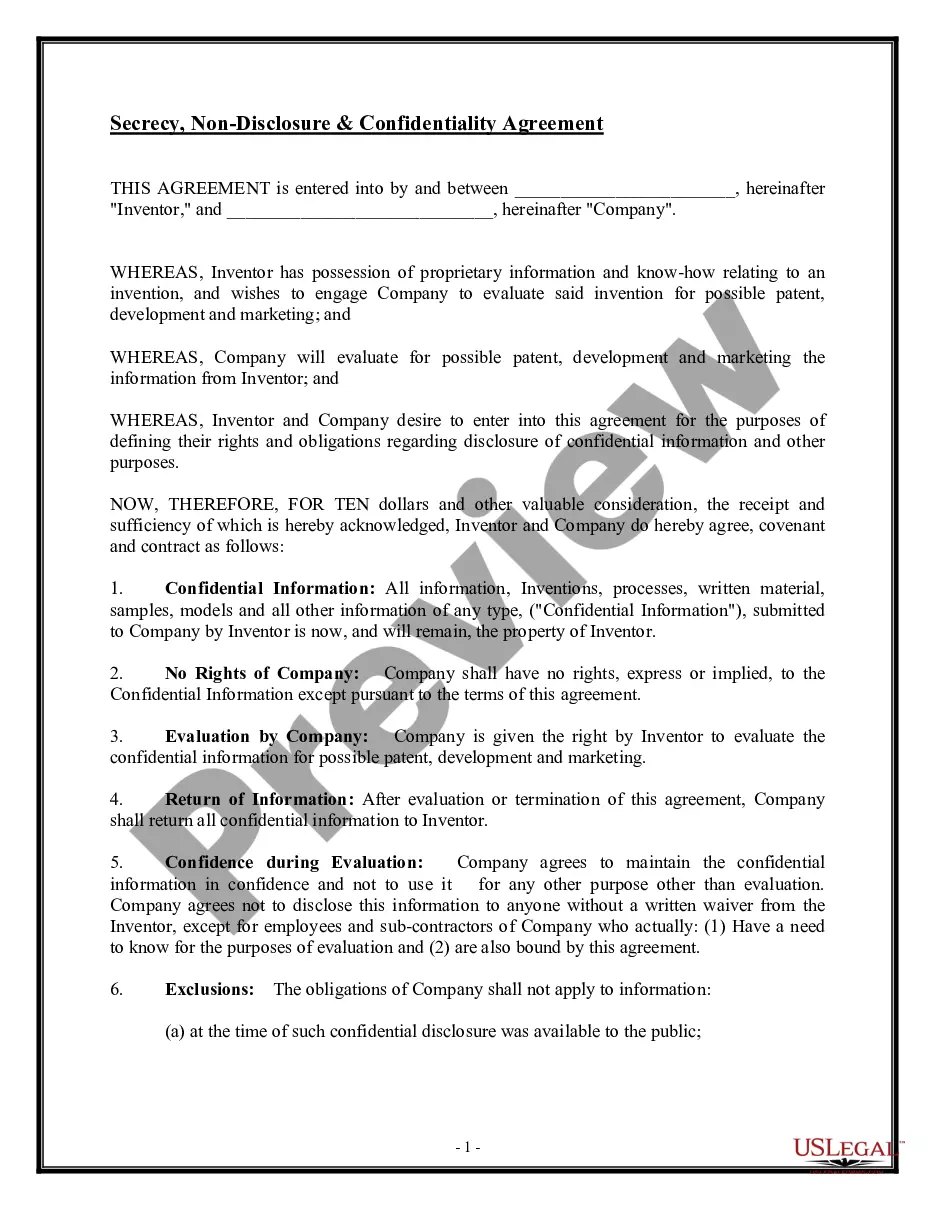
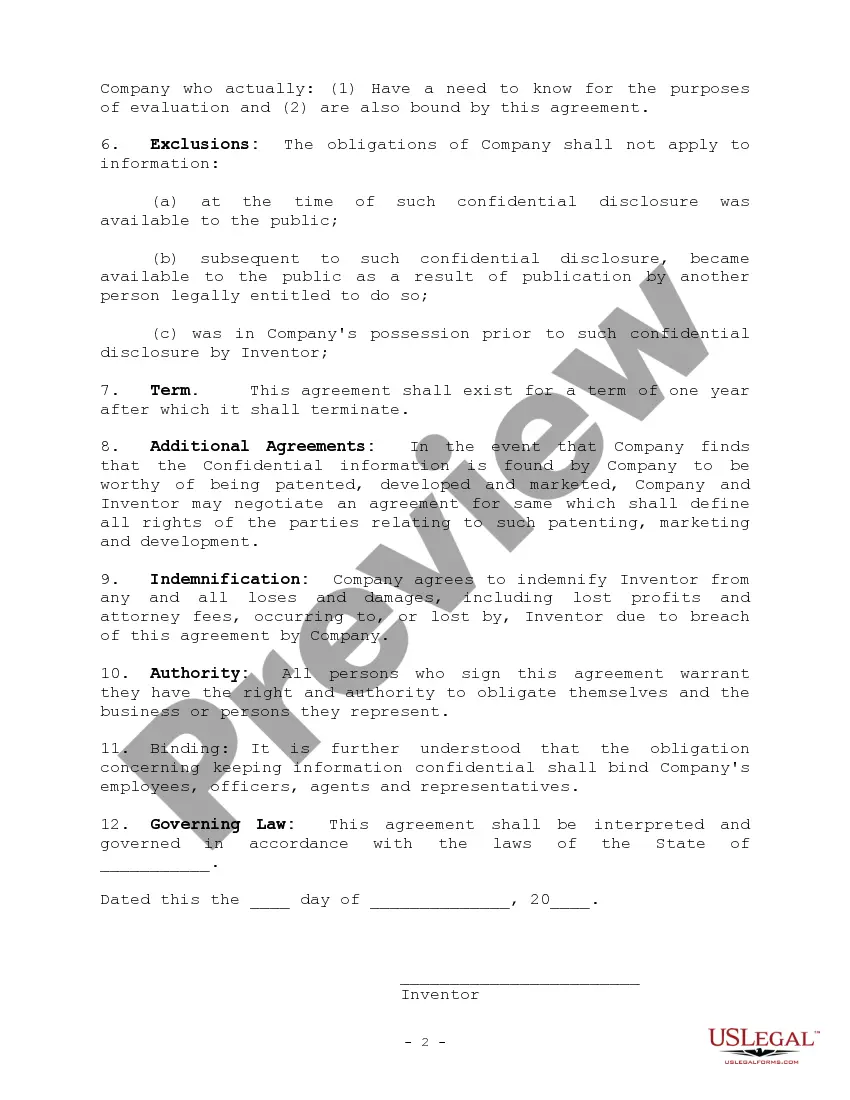
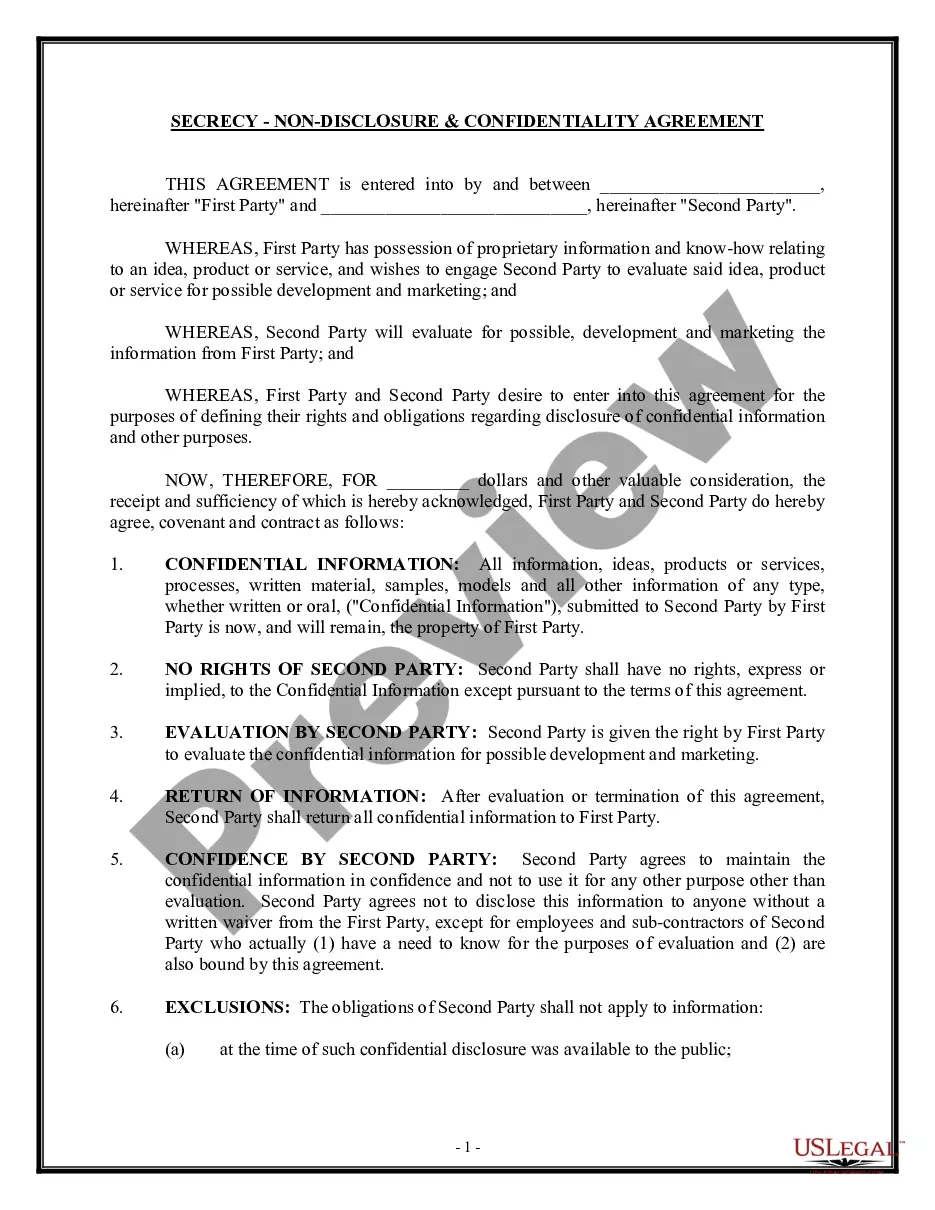
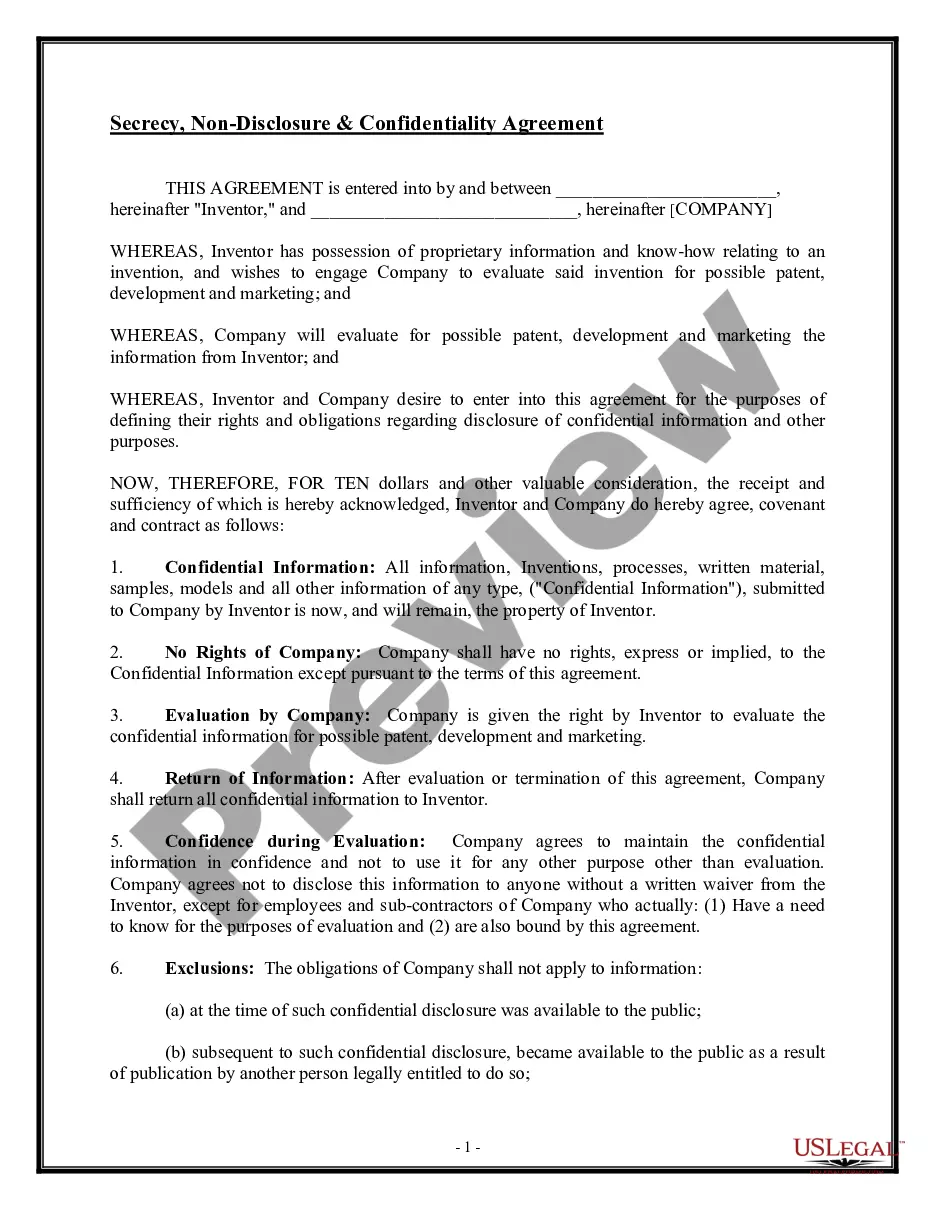
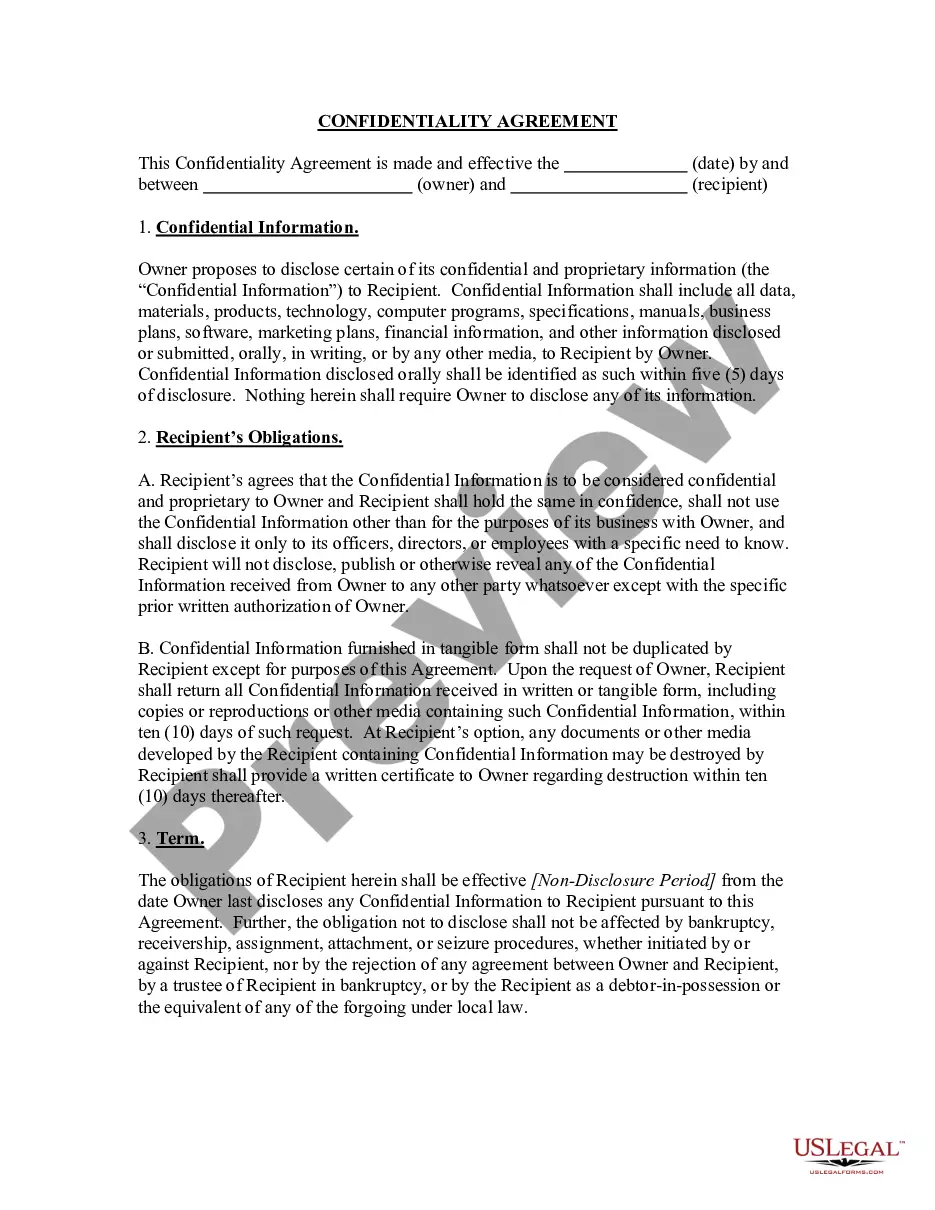
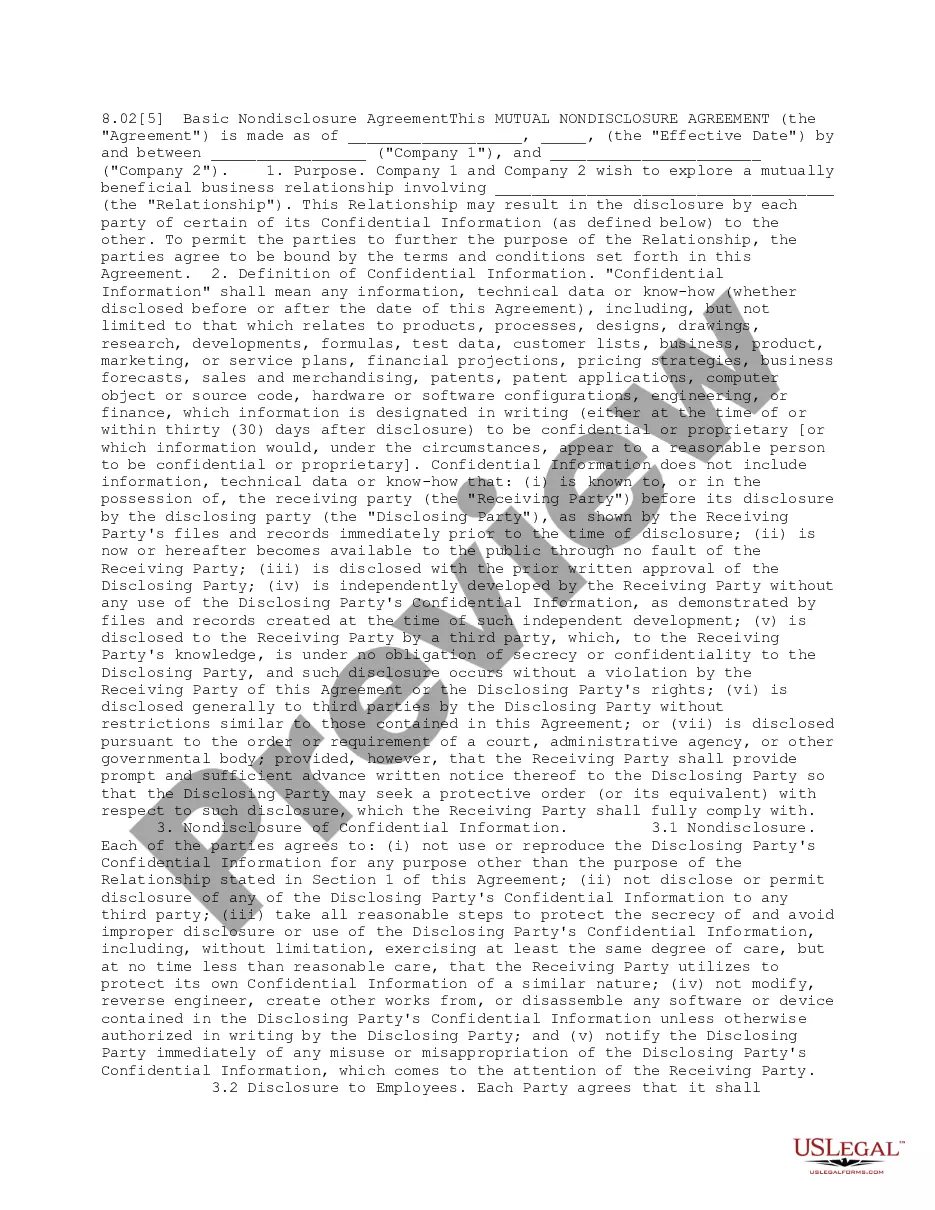
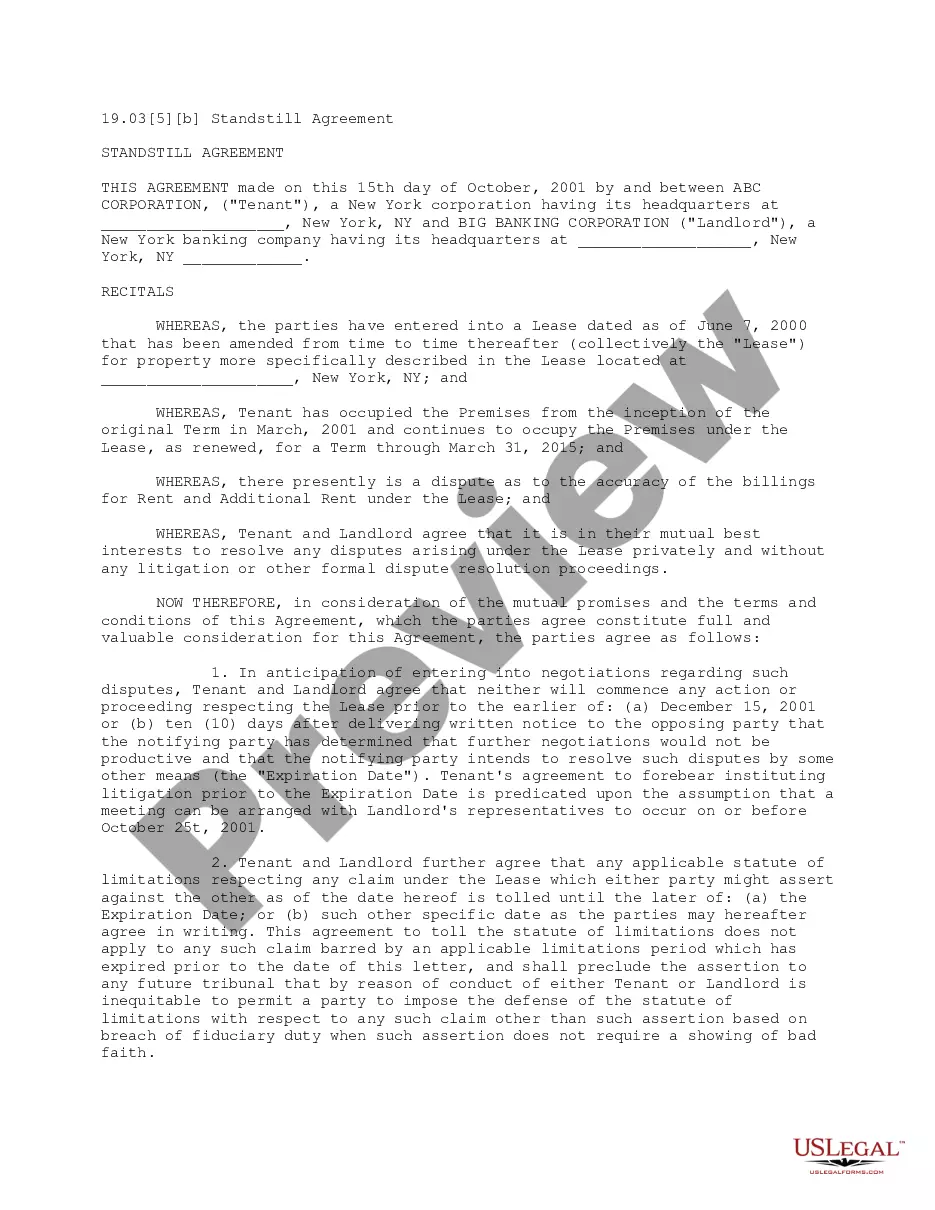
This agreement is entered into by an inventor and a company. The inventor has possession of proprietary information and know-how relating to an invention, and wishes to engage the company to evaluate the invention for possible patent, development and marketing. The company agrees that to maintain the confidential information in confidence and not to use it for any other purpose other than evaluation. The company also agrees not to disclose the information to anyone without a written waiver from the inventor, except for employees and sub-contractors of the company who actually have a need to know for the purposes of evaluation and are also bound by this agreement.
Austin Texas Secrecy, Nondisclosure and Confidentiality Agreement - Promoter to Inventor
State:
Multi-State
City:
Austin
Control #:
US-01757
Format:
Word;
Rich Text
Instant download
Description
Free preview

Form popularity
FAQ
A secrecy agreement and an NDA serve similar purposes, but there are subtle differences. Secrecy agreements often focus more on protecting sensitive information from being disclosed, while NDAs can also include elements of non-competition and non-solicitation. Both agreements are vital for protecting your ideas, and using the Austin Texas Secrecy, Nondisclosure and Confidentiality Agreement - Promoter to Inventor can clarify your rights and obligations.
An NDA can become unenforceable for a variety of reasons, including vague terms, overly broad restrictions, or if it violates public policy. If the agreement lacks mutual consent or does not outline the protected information clearly, it may not hold up in court. Utilizing the Austin Texas Secrecy, Nondisclosure and Confidentiality Agreement - Promoter to Inventor from platforms like USLegalForms can help you avoid these pitfalls.
Yes, NDAs are generally enforceable in Texas, provided they meet certain legal criteria. The Austin Texas Secrecy, Nondisclosure and Confidentiality Agreement - Promoter to Inventor must be clear in its terms and should not impose unreasonable restrictions. To ensure enforceability, it is advisable to use well-drafted templates or seek legal guidance.
Yes, you can create your own NDA tailored to your specific needs. However, it is essential to ensure that it includes all necessary elements for it to be valid and enforceable under the Austin Texas Secrecy, Nondisclosure and Confidentiality Agreement - Promoter to Inventor. Consider consulting a legal professional or using platforms like USLegalForms to help you draft a comprehensive agreement that protects your interests.
To fill out a confidentiality and non-disclosure agreement, start by identifying the parties involved and clearly defining the confidential information. Next, outline the obligations that both parties must adhere to regarding the information shared. It is also important to specify the duration of the agreement and any exclusions. You can simplify this process by using the Austin Texas Secrecy, Nondisclosure and Confidentiality Agreement - Promoter to Inventor template available on US Legal Forms.
The five key elements of a non-disclosure agreement typically include the definition of confidential information, the obligations of the parties, the term of the agreement, exclusions from confidentiality, and the consequences of breach. Each element plays a vital role in ensuring that sensitive information is adequately protected. Utilizing the Austin Texas Secrecy, Nondisclosure and Confidentiality Agreement - Promoter to Inventor can help you include all these necessary components.
An example of a confidentiality agreement is a document signed between a business and an inventor that outlines the confidential information shared during their collaboration. This agreement typically specifies what information is considered confidential and the obligations of both parties to protect that information. The Austin Texas Secrecy, Nondisclosure and Confidentiality Agreement - Promoter to Inventor serves as a comprehensive template for creating such agreements.
In Texas, a nondisclosure agreement (NDA) does not require notarization to be legally binding. However, having a notary public witness the signing can add an extra layer of authenticity and may be beneficial in disputes. It is crucial to ensure that all parties involved have clearly understood the terms laid out in the Austin Texas Secrecy, Nondisclosure and Confidentiality Agreement - Promoter to Inventor.
Filing for non-disclosure in Texas involves several steps to ensure your information remains protected. First, you must complete the appropriate forms, including the Austin Texas Secrecy, Nondisclosure and Confidentiality Agreement - Promoter to Inventor. Then, submit these forms to the court in your jurisdiction, along with any required fees. Finally, attend the hearing where a judge will review your request and, if approved, your non-disclosure will be legally binding.