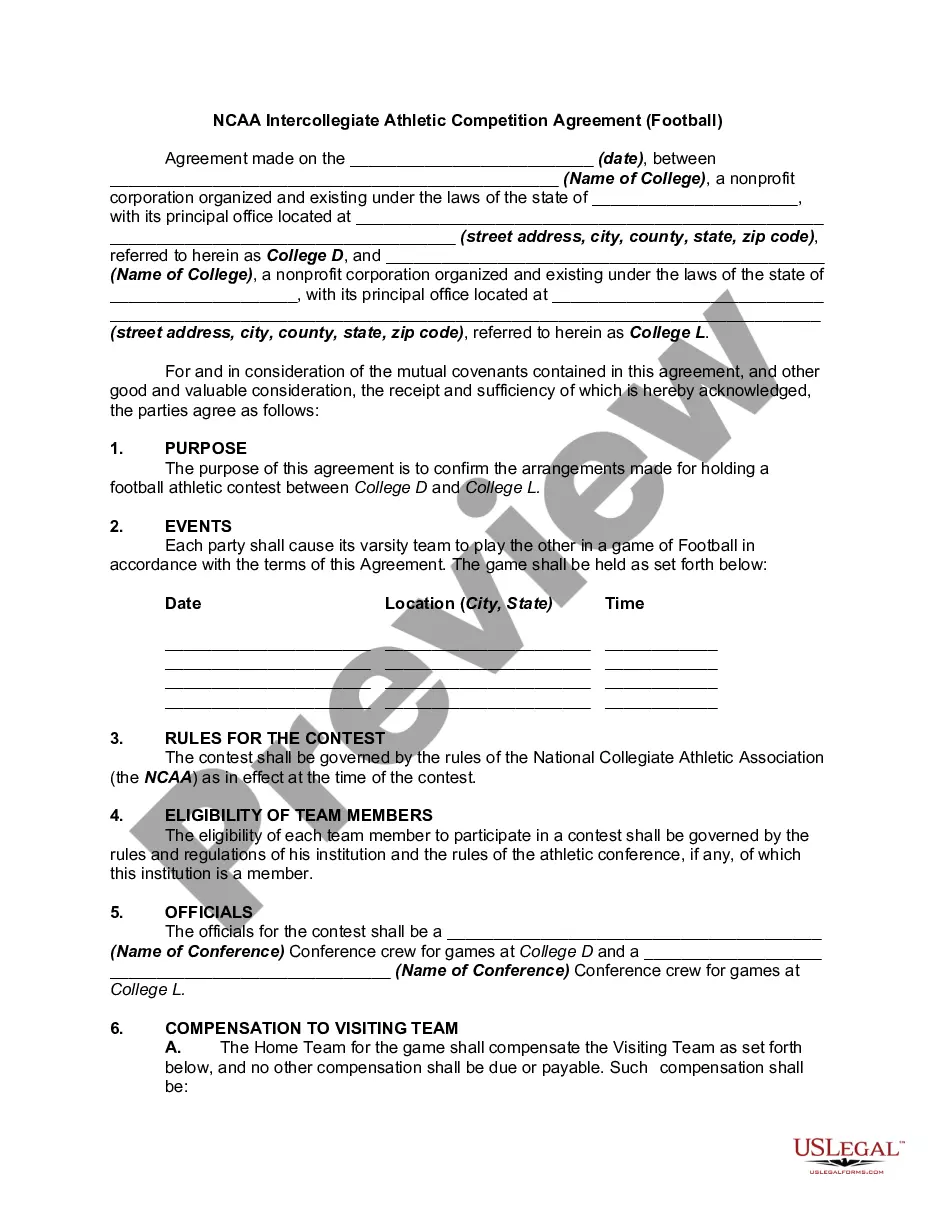
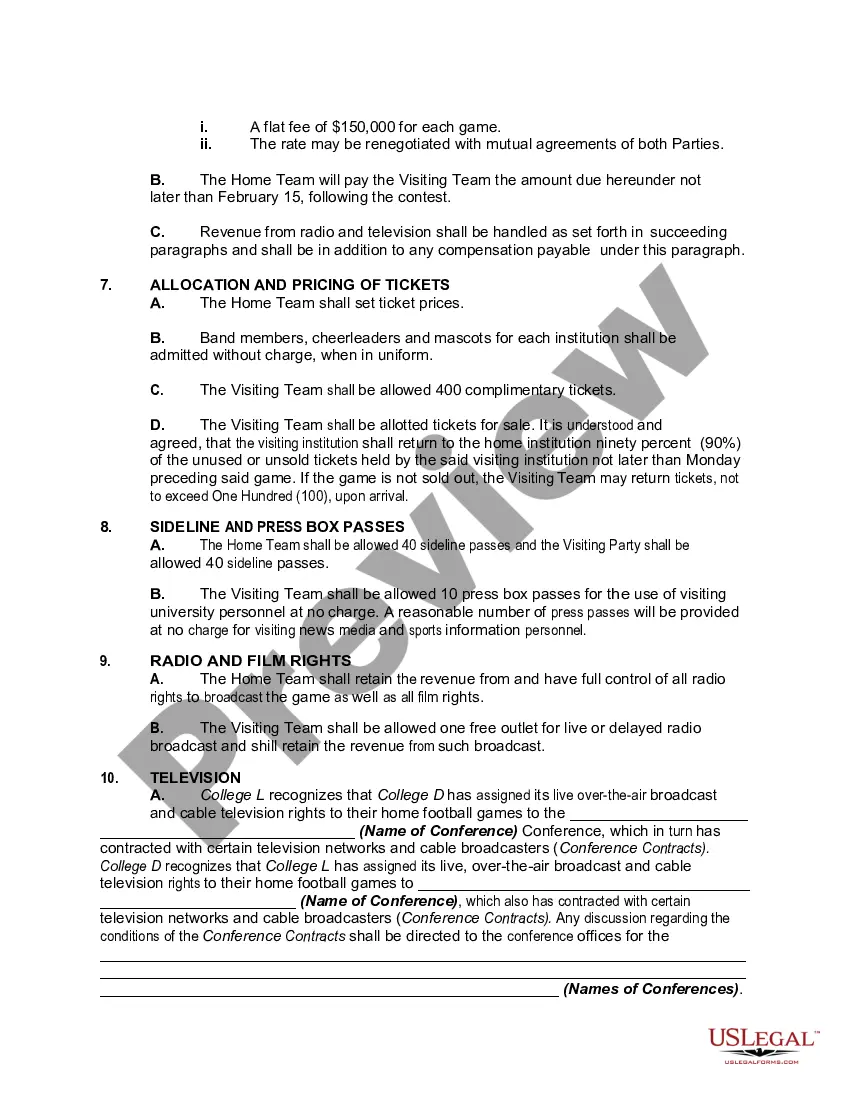
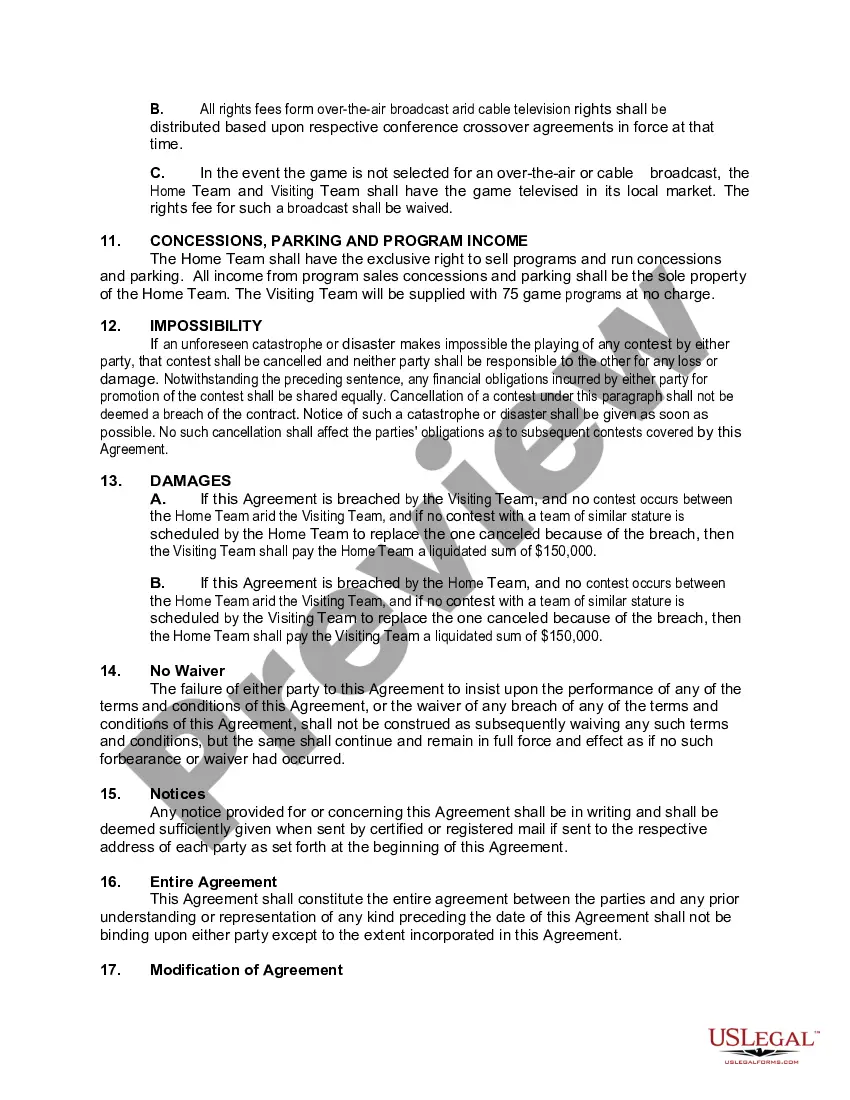
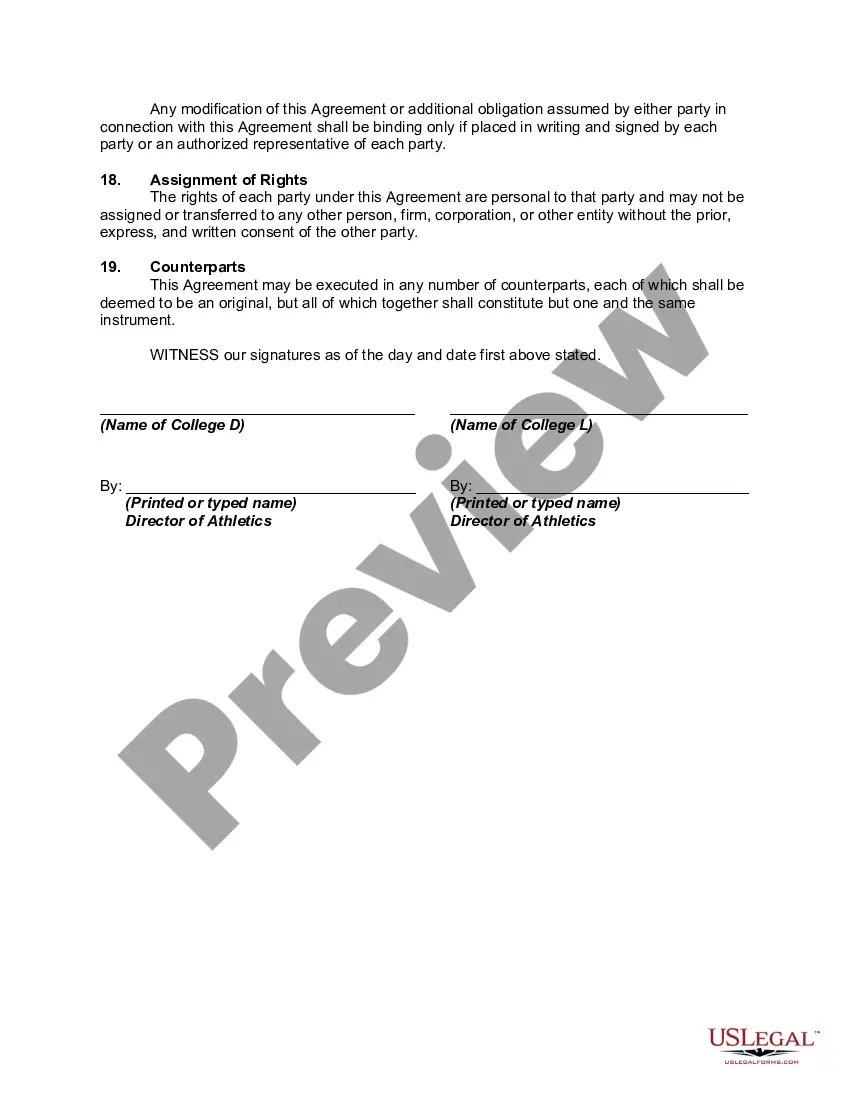
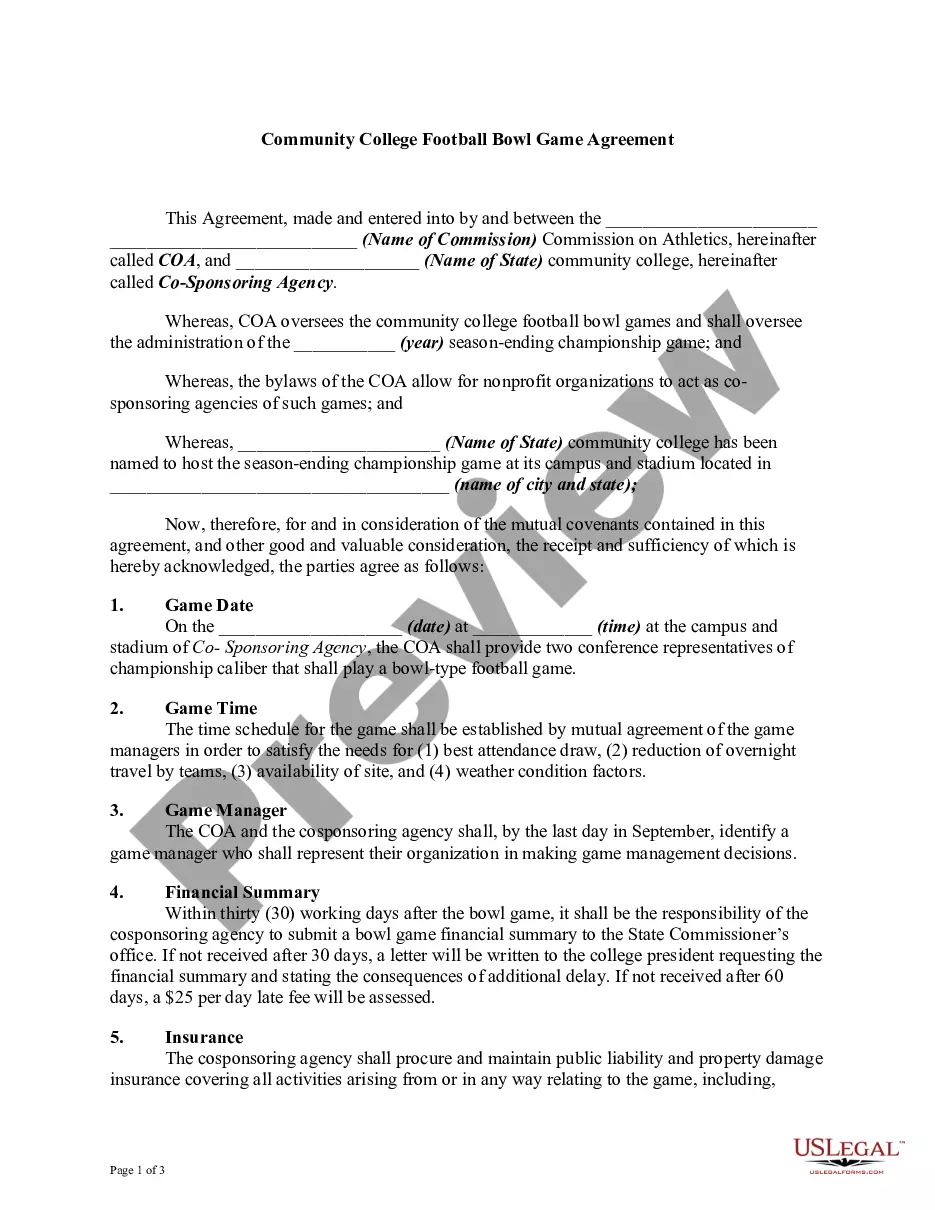
This form is a sample of an agreement between two NCAA Division I Colleges to play football games over a four year period.
Austin Texas NCAA Intercollegiate Athletic Competition Agreement - Football
Category:
State:
Multi-State
City:
Austin
Control #:
US-01634BG
Format:
Word;
Rich Text
Instant download
Description
Free preview

Form popularity
FAQ
Austin College is classified as a Division III school, and it is neither D1 nor D2. This division allows the college to maintain its focus on the academic success of its students while still providing competitive athletics. Knowledge of these classifications can aid in understanding the broader implications of agreements like the Austin Texas NCAA Intercollegiate Athletic Competition Agreement - Football. If you’re interested in college athletics, platforms like uslegalforms can help you understand the legalities involved in intercollegiate agreements.
To determine if a college is Division 1 (D1) or Division 2 (D2), you can check its NCAA membership. D1 schools typically have larger budgets and more athletic scholarships, while D2 schools usually focus on a balance between athletics and academics. Exploring the classification of schools helps contextualize their participation in events like those outlined in the Austin Texas NCAA Intercollegiate Athletic Competition Agreement - Football. Resources like NCAA websites can provide up-to-date information on college classifications.
Austin College is not a Division 1 (D1) school; it competes at the Division III level. This classification means the college emphasizes the overall student experience rather than athletic scholarships. Understanding these distinctions is important in the context of the Austin Texas NCAA Intercollegiate Athletic Competition Agreement - Football, as it illustrates the varying levels of competition among institutions. Colleges at different levels offer unique opportunities and experiences for student-athletes.
UT Austin's biggest rival is Texas A&M University. This rivalry stems from historical, cultural, and athletic competition, particularly in football. The annual football game between these two schools holds significant weight in the context of the Austin Texas NCAA Intercollegiate Athletic Competition Agreement - Football. Fans eagerly anticipate this matchup, as it embodies the spirit of collegiate sports in Texas.
The 4-2-4 rule refers to the eligibility criteria that allow student-athletes to transfer between institutions. Specifically, it allows athletes to transfer from a two-year college to a four-year college, while also providing a pathway back to a two-year institution if necessary. The Austin Texas NCAA Intercollegiate Athletic Competition Agreement - Football recognizes this rule to facilitate smoother transitions for athletes. Understanding these guidelines can empower students to make informed choices regarding their athletic and academic journeys.
Typically, student-athletes have five years to participate in NCAA sports, but they must complete their eligibility within this timeframe. Under the regulations set by the Austin Texas NCAA Intercollegiate Athletic Competition Agreement - Football, athletes may take up to one redshirt year, allowing them to extend their athletic career. This policy aims to accommodate injuries and personal circumstances while promoting the well-being of student-athletes during their college experience.
The 40-60-80 rule is a guideline that pertains to the requirements for student-athletes in NCAA sports. This rule states that 40% of the competition should take place at home, 60% away, and 80% must be conducted within the academic year. Understanding this rule is essential for teams under the Austin Texas NCAA Intercollegiate Athletic Competition Agreement - Football, as it helps maintain a balanced schedule while supporting athletes’ academic commitments.
Certainly! One prominent team in the Austin, Texas area is the University of Texas Longhorns football team. This team competes at a high level in NCAA intercollegiate athletics. The Austin Texas NCAA Intercollegiate Athletic Competition Agreement - Football provides a framework for teams like the Longhorns to engage in competitive play. Additionally, this agreement ensures that student-athletes receive the support they need to succeed both on the field and in the classroom.