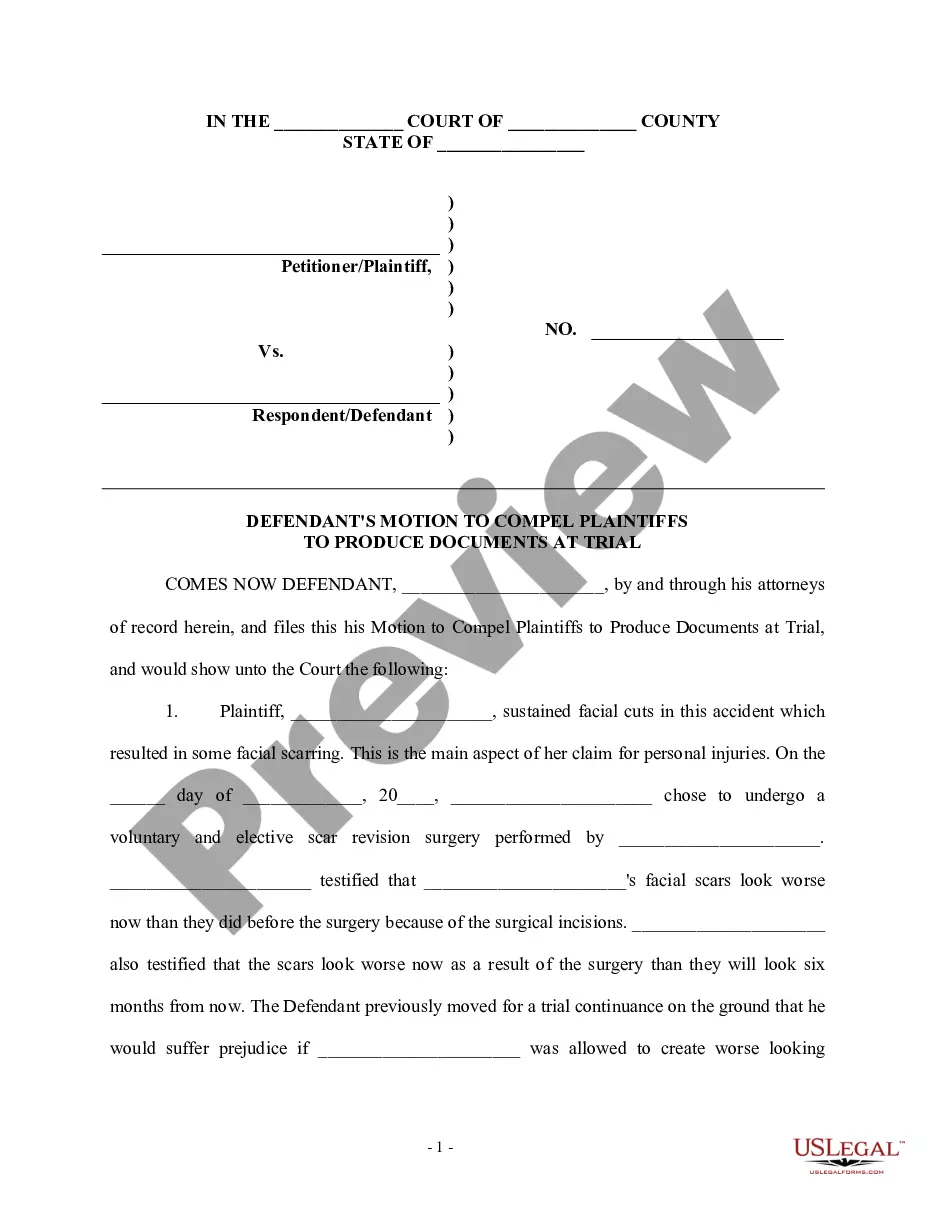
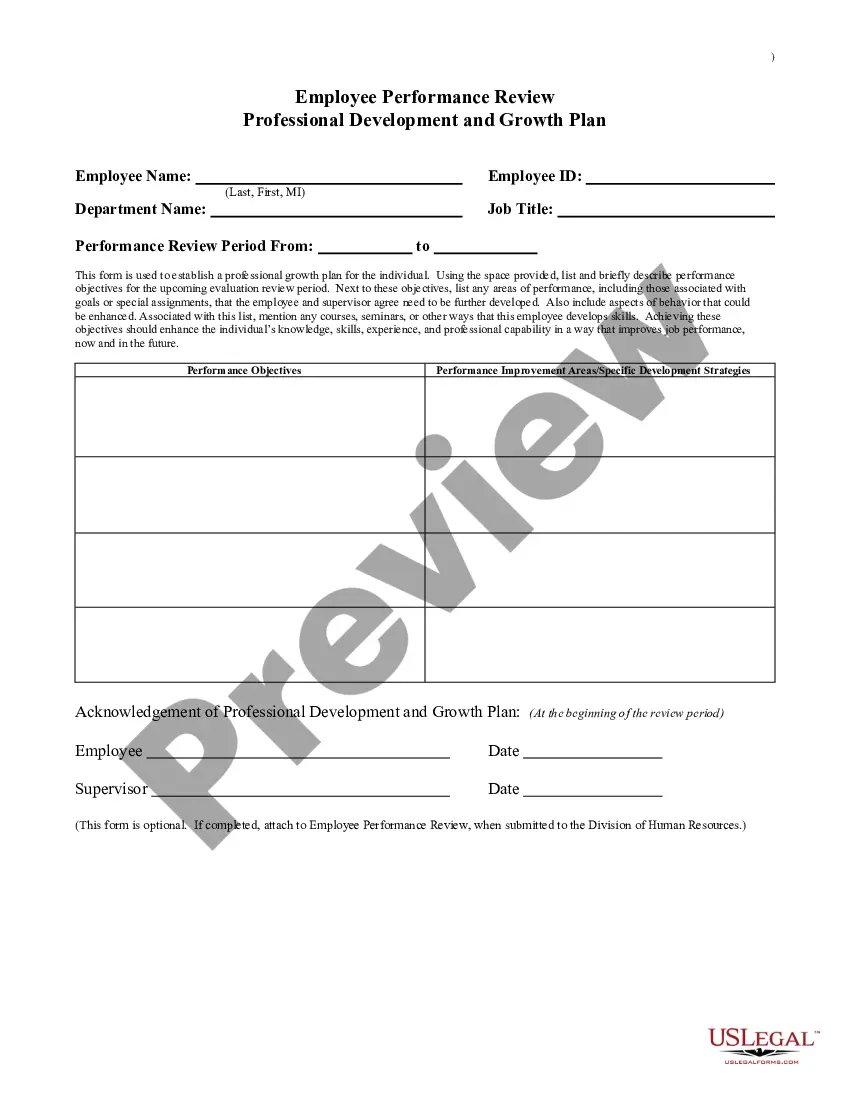
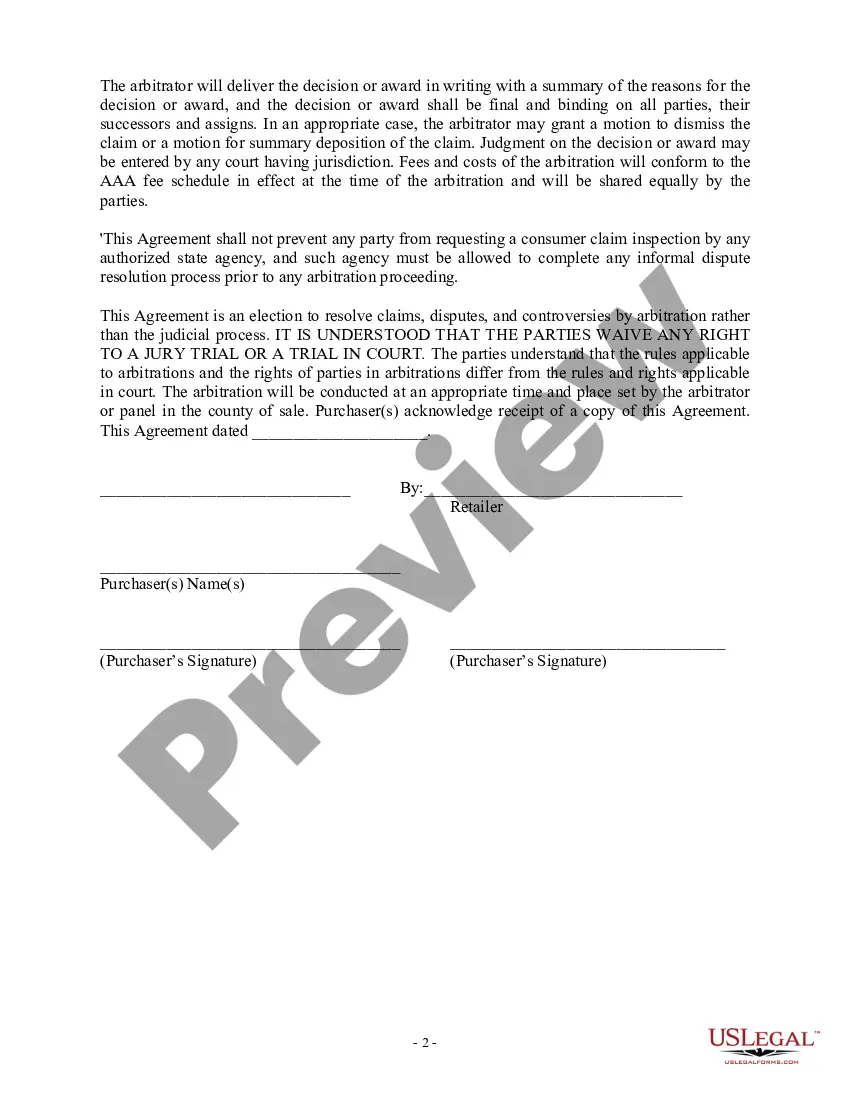
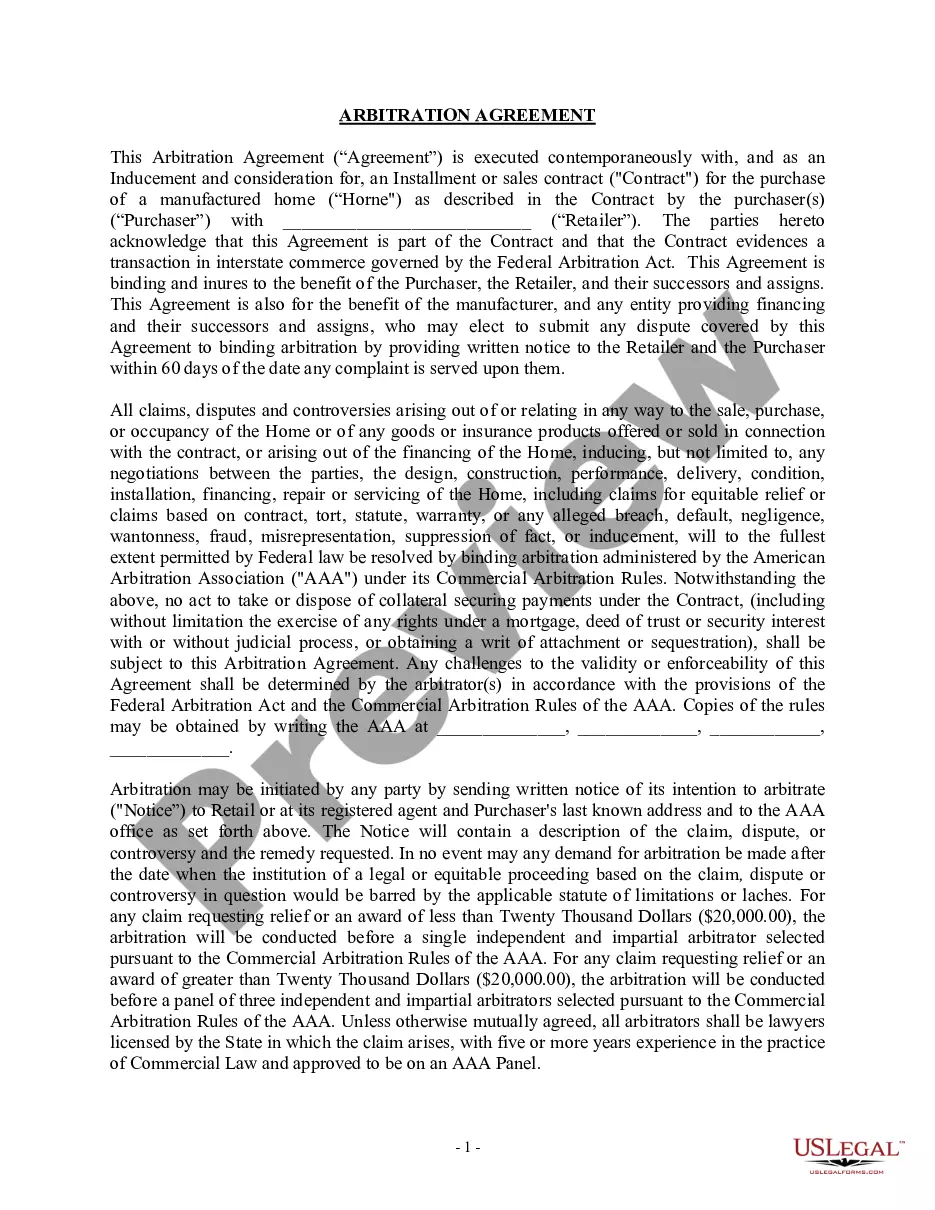
This arbitration agreement is executed contemporaneously with, and as an Inducement and consideration for, an Installment or sales contract for the purchase of a manufactured home. It provides that all claims or disputes arising out of or relating in any way to the sale, purchase, or occupancy of manufactured home resolved by binding arbitration administered by the American Arbitration Association ("AAA") under its Commercial Arbitration Rules. This Agreement is an election to resolve claims, disputes, and controversies by arbitration rather than the judicial process. The parties waive any right to a court trial.
Wayne Michigan Arbitration Agreement
Category:
State:
Multi-State
County:
Wayne
Control #:
US-00416-1
Format:
Word;
Rich Text
Instant download
Description
Free preview


How to fill out Arbitration Agreement?
Organizing documentation for business or individual requirements is always a significant obligation.
When formulating a contract, a public service application, or a power of attorney, it is crucial to take into account all federal and state regulations of the specific locality. Nonetheless, smaller counties and even cities may also have legislative stipulations that you need to be aware of.
All these factors render it challenging and labor-intensive to create a Wayne Arbitration Agreement without expert assistance.
Double-check that the template meets legal standards and click Buy Now. Select the subscription plan, then either Log In or create an account with US Legal Forms. Use your credit card or PayPal account to pay for your subscription. Download the chosen document in your preferred format, print it out, or fill it in electronically. The benefit of the US Legal Forms library is that all documents you have ever obtained remain accessible - you can retrieve them in your profile within the My documents section at any time. Join the platform and swiftly acquire certified legal forms for any situation with just a few clicks!
- It is feasible to prevent incurring costs on lawyers by drafting your documents and produce a legally binding Wayne Arbitration Agreement independently, utilizing the US Legal Forms online library.
- It is the most extensive virtual collection of state-specific legal documents that have been professionally validated, ensuring you can trust their legitimacy when selecting a template for your county.
- Previous subscribers simply need to Log In to their accounts to retrieve the required document.
- If you do not yet possess a subscription, adhere to the following step-by-step instructions to acquire the Wayne Arbitration Agreement.
- Examine the webpage you have opened and verify whether it contains the sample you need.
- To achieve this, utilize the form description and preview if these features are available.
- To locate the one that meets your needs, employ the search tab situated in the page header.
Form popularity
FAQ
What is the outcome of the arbitration process? A Decision. Under voluntary arbitration, both parties willingly submit their differences to the arbitration process. The outcome is a decision that both sides have agreed to accept, not a recommendation.
Arbitration is a procedure in which a dispute is submitted, by agreement of the parties, to one or more arbitrators who make a binding decision on the dispute. In choosing arbitration, the parties opt for a private dispute resolution procedure instead of going to court.
The Advantages and Disadvantages of ArbitrationEfficient and Flexible: Quicker Resolution, Easier to schedule.Less Complicated: Simplified rules of evidence and procedure.Privacy: Keep it out of the public eye.Impartiality: Choosing the judgeUsually less expensive.Finality: The end of the dispute.More items...
Arbitration is a way to resolve disputes outside of court. No jury or judge is present in an arbitration proceeding; rather, there is an arbitrator who is present who makes the final decision, which is called the arbitration award. The award is legally binding on all parties of the hearing.
The arbitrator's final decision on the case is called the award. This is like a judge's or jury's decision in a court case. Once the arbitrator decides that all of the parties' evidence and arguments have been presented, the arbitrator will close the hearings.
An example of an arbitration would be when two people who are divorcing cannot agree on terms and allow a third party to come in to help them negotiate. A set of rules for allocating machine resources, such as memory or peripheral devices, to more than one user or program.
Under the MUAA, an arbitration agreement is valid, enforceable, and irrevocable unless there is a legal or equitable ground for revocation of the agreement under Michigan law. Like any contract, an arbitration agreement is unenforceable unless it is a contract that binds both parties (see Heurtebise v.
Arbitration is a dispute-resolution process in which the parties select a neutral third party to resolve their claims. Parties typically agree to arbitrate in order to avoid the time, expense, and complexity of litigation.
To give you an idea of the process that arbitration typically involves, the American Arbitration Association describes artibtration as having five main steps:Filing and initiation.Arbitrator selection.Preliminary hearing.Information exchange and preparation.Hearings.Post hearing submissions.Award.
Arbitration is an out-of-court method for resolving a dispute between a worker and an employer. Arbitration takes place in front of a neutral decision-maker called an arbitrator (or in some cases, a group or panel of arbitrators) who will listen to each side and make a decision about the case.