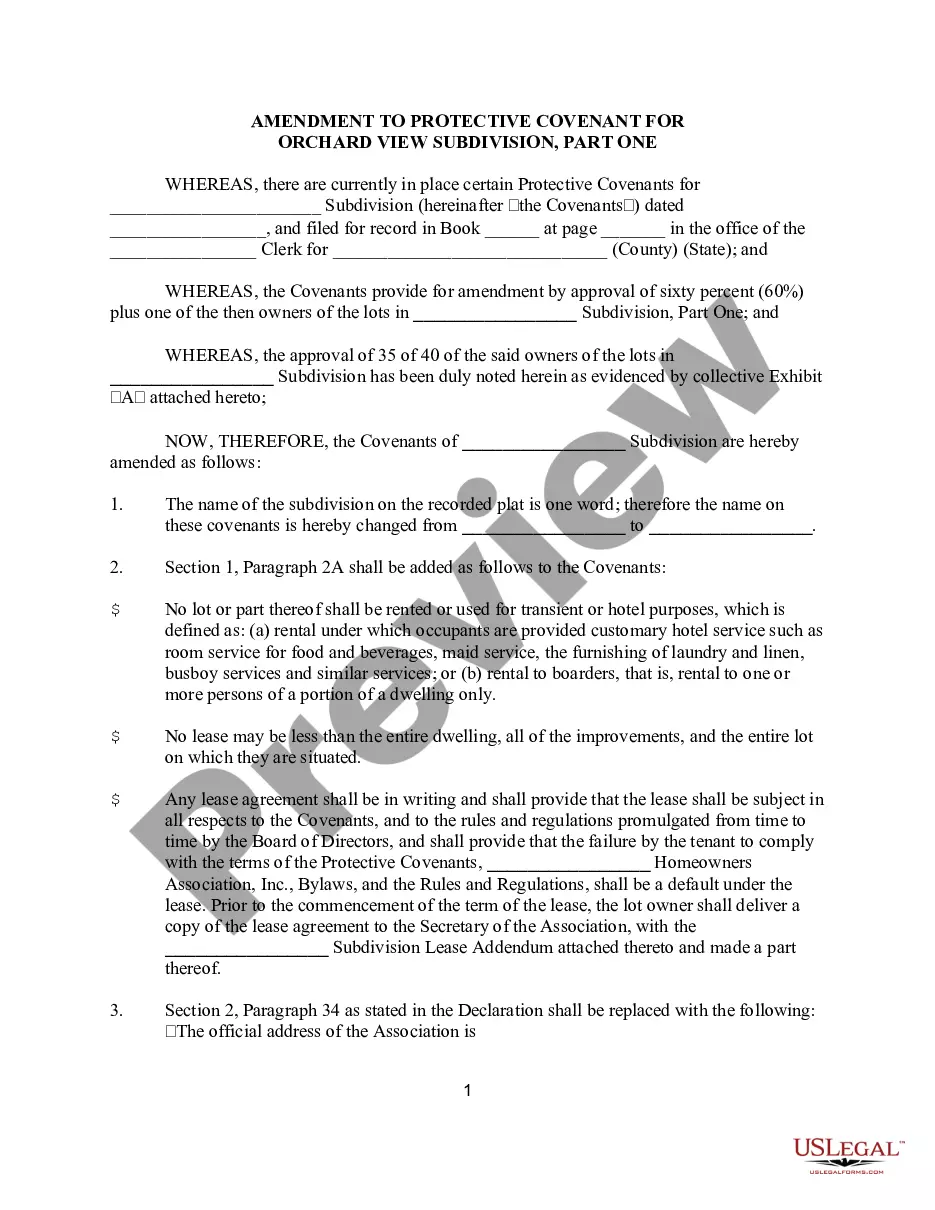
In a deed, a grantee may agree to do something or refrain from doing certain acts. This agreement will become a binding contract between the grantor and the grantee. An example would be an agreement to maintain fences on the property or that the property will only be used for residential purposes. This kind of covenant is binding, not only between the grantor and the grantee, but also runs with the land. This means that anyone acquiring the land from the grantee is also bound by the covenant of the grantee. A covenant that provides that the grantee will refrain from certain conduct is called a restrictive or protective covenant. For example, there may be a covenant that no mobile home shall be placed on the property.
A restrictive or protective covenant may limit the kind of structure that can be placed on the property and may also restrict the use that can be made of the land. For example, when a tract of land is developed for individual lots and homes to be built, it is common to use the same restrictive covenants in all of the deeds in order to cause uniform restrictions and patterns on the property. For example, the developer may provide that no home may be built under a certain number of square feet. Any person acquiring a lot within the tract will be bound by the restrictions if they are placed in the deed or a prior recorded deed. Also, these restrictive covenants may be placed in a document at the outset of the development entitled "Restrictive Covenants," and list all the restrictive covenants that will apply to the tracts of land being developed. Any subsequent deed can then refer back to the book and page number where these restrictive covenants are recorded. Any person owning one of the lots in the tract may bring suit against another lot owner to enforce the restrictive covenants. However, restrictive covenants may be abandoned or not enforceable by estoppel if the restrictive covenants are violated openly for a sufficient period of time in order for a Court to declare that the restriction has been abandoned.
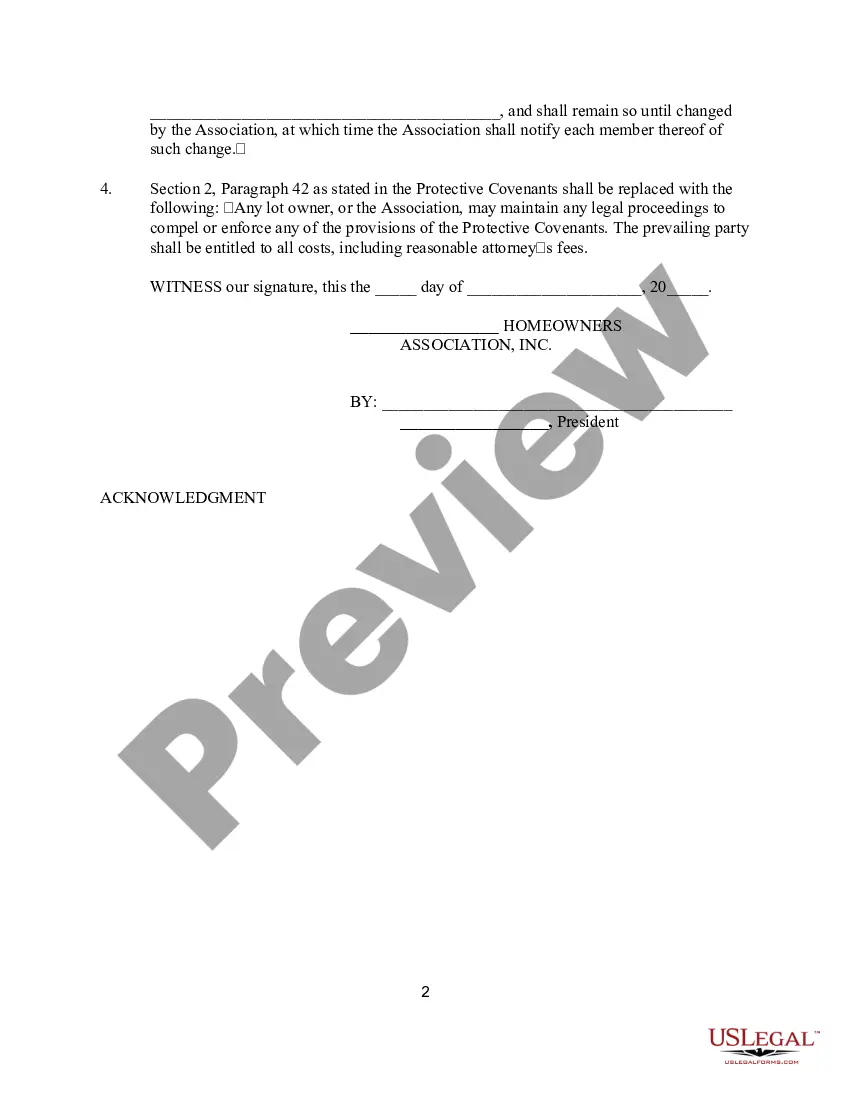
The following form shows one way in which Restrictive or Protective Covenants may be amended.
Broward Florida Amendment to Protective Covenant
State:
Multi-State
Category:
County:
Broward
Control #:
US-00405BG
Format:
Word;
Rich Text
78 downloads
Description
Free preview
Get your form ready online
Our built-in tools help you complete, sign, share, and store your documents in one place.
Built-in online Word editor
Make edits, fill in missing information, and update formatting in US Legal Forms—just like you would in MS Word.
Export easily
Download a copy, print it, send it by email, or mail it via USPS—whatever works best for your next step.
E-sign your document
Sign and collect signatures with our SignNow integration. Send to multiple recipients, set reminders, and more. Go Premium to unlock E-Sign.
Notarize online 24/7
If this form requires notarization, complete it online through a secure video call—no need to meet a notary in person or wait for an appointment.
Store your document securely
We protect your documents and personal data by following strict security and privacy standards.

Make edits, fill in missing information, and update formatting in US Legal Forms—just like you would in MS Word.

Download a copy, print it, send it by email, or mail it via USPS—whatever works best for your next step.

Sign and collect signatures with our SignNow integration. Send to multiple recipients, set reminders, and more. Go Premium to unlock E-Sign.

If this form requires notarization, complete it online through a secure video call—no need to meet a notary in person or wait for an appointment.

We protect your documents and personal data by following strict security and privacy standards.
Looking for another form?


How to fill out Amendment To Protective Covenant?
Organizing paperwork for business or personal purposes is consistently a significant obligation.
When formulating a contract, a public service application, or a power of attorney, it's crucial to take into account all federal and state statutes and regulations pertinent to the specific region.
Nevertheless, minor counties and even municipalities also possess legislative protocols that must be acknowledged.
The remarkable aspect of the US Legal Forms library is that every document you've ever acquired remains accessible - you can retrieve it in your profile within the My documents section at any time. Join the platform and effortlessly obtain verified legal forms for any situation with just a few clicks!
- All these particulars contribute to making it daunting and labor-intensive to formulate the Broward Amendment to Protective Covenant without expert assistance.
- It's feasible to prevent squandering funds on lawyers drafting your paperwork and create a legally acceptable Broward Amendment to Protective Covenant independently, utilizing the US Legal Forms online repository.
- It stands as the most comprehensive online catalogue of state-specific legal documents that are professionally authenticated, ensuring their legitimacy when selecting a sample for your county.
- Users with prior subscriptions simply need to Log In to their accounts to retrieve the needed form.
- If you haven't subscribed yet, follow the step-by-step instructions below to acquire the Broward Amendment to Protective Covenant.
- Browse the page you've accessed and confirm if it has the required document.
- To achieve this, utilize the form description and preview if these choices are available.
Form popularity
FAQ
If there is a restrictive covenant on your property you may be able to remove it. The first step would be to negotiate with the original developer or landowner to enter into a formal agreement to remove the covenants from the title.
The cost of lifting restrictive covenants involves a statutory fee of £880 upon application. If your application progresses to a hearing, there's a fee of A£1,100. If a decision is reached without a hearing, the fee is A£275. If you need more time to carry out the Tribunal's directions, you'll have to pay a fee of A£110.
To do this, you'll need to apply to remove the restrictive covenant. An application to remove or modify the restrictive covenant can take between 18 and 24 months to go through. If the party controlling the covenant can still enforce the ruling, consider negotiation, but be prepared for them to want compensation.
Restrictive Covenants may be removed and/or modified from the Register Book of Titles by:an agreement between the parties having an interest in the covenant, or,an order of a court of competent jurisdiction.
Implement HOA Rules ChangeDraft your amendment to the rules. State in clear language what the rule amendment is.Notice of Proposal. Once the board has proposed an amendment, they must send out a notice between 10 and 30 days before the next board meeting; no more, no less.Board meeting approval.After rule approval.
Can I get a restrictive covenant removed? If there is a covenant on your property which is obsolete, you can make an application to the Upper Tribunal (Lands Chamber) (which use to be known as the Lands Tribunal) asking for the covenant to be discharged or modified.
Following that general consensus throughout the country, Georgia law likewise generally provided at Code Section 44-5-60 that covenants restricting the use of land would be valid for a maximum of twenty years, and at the end of the twenty years, the restrictive covenants would automatically expire.
Amending covenants most often requires a sixty seven percent affirmative vote of the membership, while most bylaws require a majority vote of the members - what determines a majority will be detailed in the declaration.
The simple answer is NO. HOA rules cannot override state law.
An application can be made to the Lands Tribunal to have a covenant removed or varied. The Lands Tribunal will consider any changes to the property or neighbourhood since the covenant was put in place, whether the covenant is unreasonably preventing developments that would be beneficial.