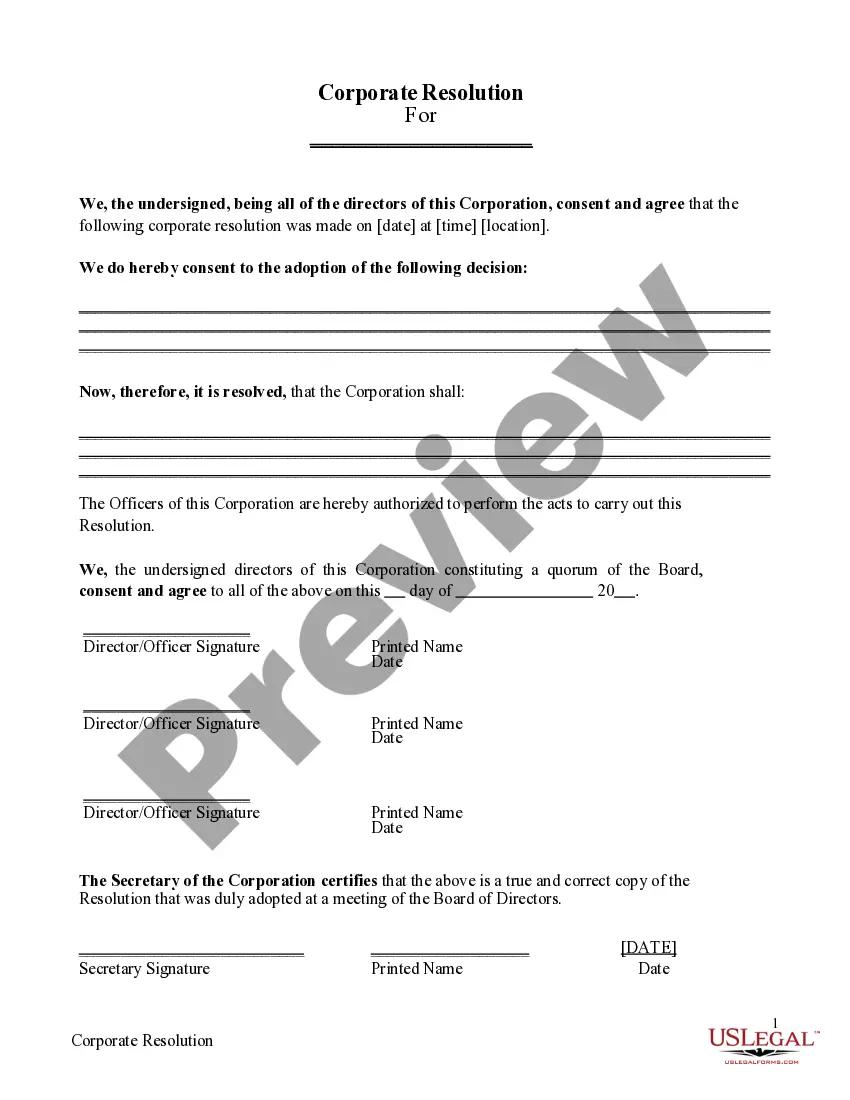
Form with which a corporation may resolve to authorize an officer or representative to file necessary official documents for a given purpose.
Fairfax Virginia File Official Papers - Resolution Form - Corporate Resolutions
State:
Multi-State
County:
Fairfax
Control #:
US-0036-CR
Format:
Word;
Rich Text
73 downloads
Description
Free preview


Get your form ready online
Our built-in tools help you complete, sign, share, and store your documents in one place.
Built-in online Word editor
Make edits, fill in missing information, and update formatting in US Legal Forms—just like you would in MS Word.
Export easily
Download a copy, print it, send it by email, or mail it via USPS—whatever works best for your next step.
E-sign your document
Sign and collect signatures with our SignNow integration. Send to multiple recipients, set reminders, and more. Go Premium to unlock E-Sign.
Notarize online 24/7
If this form requires notarization, complete it online through a secure video call—no need to meet a notary in person or wait for an appointment.
Store your document securely
We protect your documents and personal data by following strict security and privacy standards.

Make edits, fill in missing information, and update formatting in US Legal Forms—just like you would in MS Word.

Download a copy, print it, send it by email, or mail it via USPS—whatever works best for your next step.

Sign and collect signatures with our SignNow integration. Send to multiple recipients, set reminders, and more. Go Premium to unlock E-Sign.

If this form requires notarization, complete it online through a secure video call—no need to meet a notary in person or wait for an appointment.

We protect your documents and personal data by following strict security and privacy standards.
Looking for another form?
How to fill out File Official Papers - Resolution Form - Corporate Resolutions?
Laws and statutes in various domains vary across the nation.
If you are not an attorney, it's easy to become confused by a range of regulations when it comes to creating legal documents.
To evade costly legal advice when preparing the Fairfax File Official Papers - Resolution Form - Corporate Resolutions, you require an endorsed template valid for your jurisdiction.
It's that simple and cost-effective way to obtain current templates for any legal needs. Discover everything with just a few clicks and maintain your documents in order with US Legal Forms!
- That is when utilizing the US Legal Forms platform proves advantageous.
- US Legal Forms is a reliable online database utilized by millions, featuring over 85,000 state-specific legal templates.
- It's a perfect option for both professionals and individuals seeking do-it-yourself templates for various personal and business scenarios.
- All forms are reusable: once you select a sample, it stays available in your profile for future use.
- Thus, if you possess an account with a valid subscription, you can easily Log In and re-download the Fairfax File Official Papers - Resolution Form - Corporate Resolutions from the My documents section.
- For new users, there are additional steps required to acquire the Fairfax File Official Papers - Resolution Form - Corporate Resolutions.
- Review the page content to verify you have found the correct document.
- Utilize the Preview feature or read the form description if accessible.
Form popularity
FAQ
Shareholder Resolutions and Articles can now be Filed Electronically.
There are two resolutions which cannot be passed by written resolution. These are: the removal of a director before the expiration of their period of office; and. the removal of an auditor before the expiration of their term of office.
While all special resolutions must be filed with the registrar of companies, comparatively few ordinary resolutions need to be filed with them. Only the following ordinary resolutions are required: Authorising directors to allot shares. Authorising a purchase of the company's own shares.
A special resolution is a resolution of the company's shareholders which requires at least 75% of the votes cast by shareholders in favour of it in order to pass. Where no special resolution is required, an ordinary resolution may be passed by shareholders with a simple majority more than 50% of the votes cast.
A resolution shall be an ordinary resolution if the notice required under this Act has been duly given and it is required to be passed by the votes cast, whether on a show of hands, or electronically or on a poll, as the case may be, in favour of the resolution, including the casting vote, if any, of the Chairman, by
What is a written resolution? Written resolutions allow board and shareholder decisions to be made without having to hold a board or shareholder meeting. Instead, a written resolution describing the decision can be circulated to the required audience, with them able to sign and return it confirming their agreement.
Resolution TypesThe director's resolutions don't usually need filing at Companies House, unless you are talking about a substantial change being proposed that would affect the company, such as a change of PLC status following the buying back of shares.
A resolution of members (or a class of members) of a company passed by: On a show of hands at a general meeting, a majority of not less than 75% if it is passed by not less than 75% of the votes cast by those entitled to vote (section 283(4), Companies Act 2006).
Written resolutions must be accompanied by a statement informing the member:how to signify agreement to the proposed resolutions, and.of the date by which the resolution must be passed if it is not to lapse.
While all special resolutions must be filed with the registrar of companies, comparatively few ordinary resolutions need to be filed with them. Only the following ordinary resolutions are required: Authorising directors to allot shares. Authorising a purchase of the company's own shares.