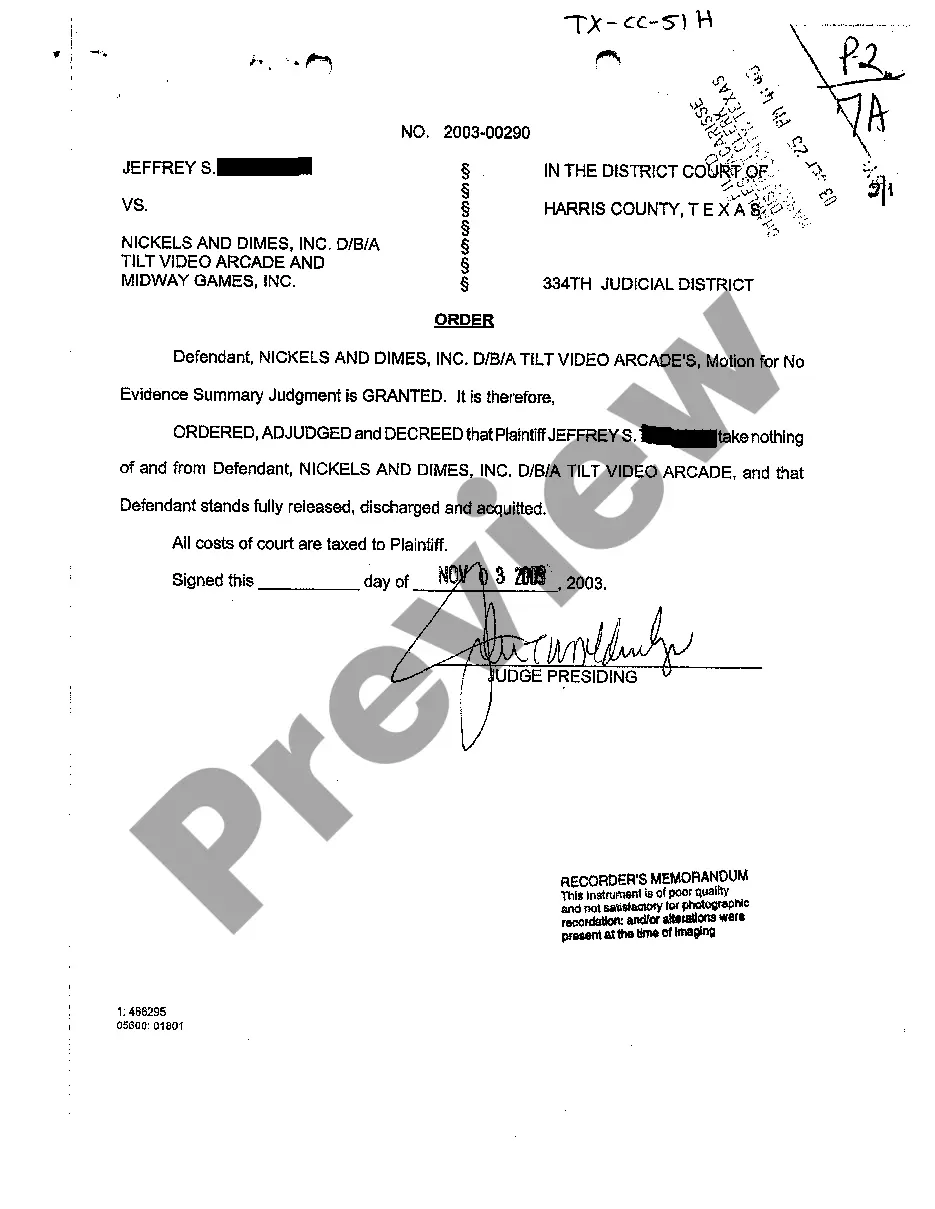
Fort Worth Texas Order for Summary Judgment as to one Defendant
Description
How to fill out Texas Order For Summary Judgment As To One Defendant?
Regardless of social or professional standing, completing legal documents is an unfortunate requirement in the modern world.
Too frequently, it's nearly impossible for someone lacking legal education to create these types of documents from scratch, primarily due to the intricate terminology and legal nuances they involve.
This is where US Legal Forms comes to offer assistance.
Ensure the form you selected is tailored to your vicinity, as the regulations of one state or region do not apply to another.
Preview the document and review a brief description (if available) of scenarios where the document may be utilized.
- Our platform provides an extensive collection with over 85,000 ready-to-use state-specific forms applicable to virtually any legal circumstance.
- US Legal Forms also acts as an excellent resource for associates or legal advisors seeking to enhance their efficiency by utilizing our DIY forms.
- Whether you need the Fort Worth Texas Order for Summary Judgment regarding one Defendant or any other document relevant to your state or locality, everything is conveniently available with US Legal Forms.
- Here’s how to obtain the Fort Worth Texas Order for Summary Judgment regarding one Defendant in minutes using our reliable platform.
- If you are already a customer, you can simply Log In to your account to download the necessary form.
- However, if you are new to our database, please make sure to take the following steps before downloading the Fort Worth Texas Order for Summary Judgment regarding one Defendant.
Form popularity
FAQ
P. 166a(a)?(b), (i). Once the hearing has occurred or, if there is no oral hearing, once submissions are made, the court may rule on the motion. No specific timeframe for the ruling exists; a judge could make a ruling on the day of the hearing or submission, or the judge may never actually make a ruling.
First, a summary judgment motion must be on file at least 21 days before it can be heard. (TRCP 166a) Second, any opposing affidavits or written response should be on file no later than 7 days before the hearing.
Summary judgment is an application that can be brought during proceedings if one party believes that it has an overwhelmingly strong case. Essentially, a party can obtain summary judgment if it is able to clearly demonstrate that its opponent has no real prospect of succeeding in the litigation.
A Motion for Summary Judgment can be filed by any party in a lawsuit (defendant or plaintiff) who wants the Court to enter a final judgment on all or some of the parties' claims or defenses before trial.
A party seeking any affirmative relief may, at any time after the expiration of 35 days from the service of the pleading claiming such relief, move for a summary judgment or order on all or any part thereof or as to any defense.
An application for summary judgment can be made by a claimant, defendant, counterclaimant or other party to an additional claim.
Under TRCP 166a, there are two basic types of summary judgment motions, each invoking a different standard of review: Traditional motion for summary judgment. No-evidence motion for summary judgment.
Summary judgment is an application that can be brought during proceedings if one party believes that it has an overwhelmingly strong case. Essentially, a party can obtain summary judgment if it is able to clearly demonstrate that its opponent has no real prospect of succeeding in the litigation.
A motion for summary judgment is when a litigant in a case, either the plaintiff or the defendant, asks the court to end the case without holding a trial.