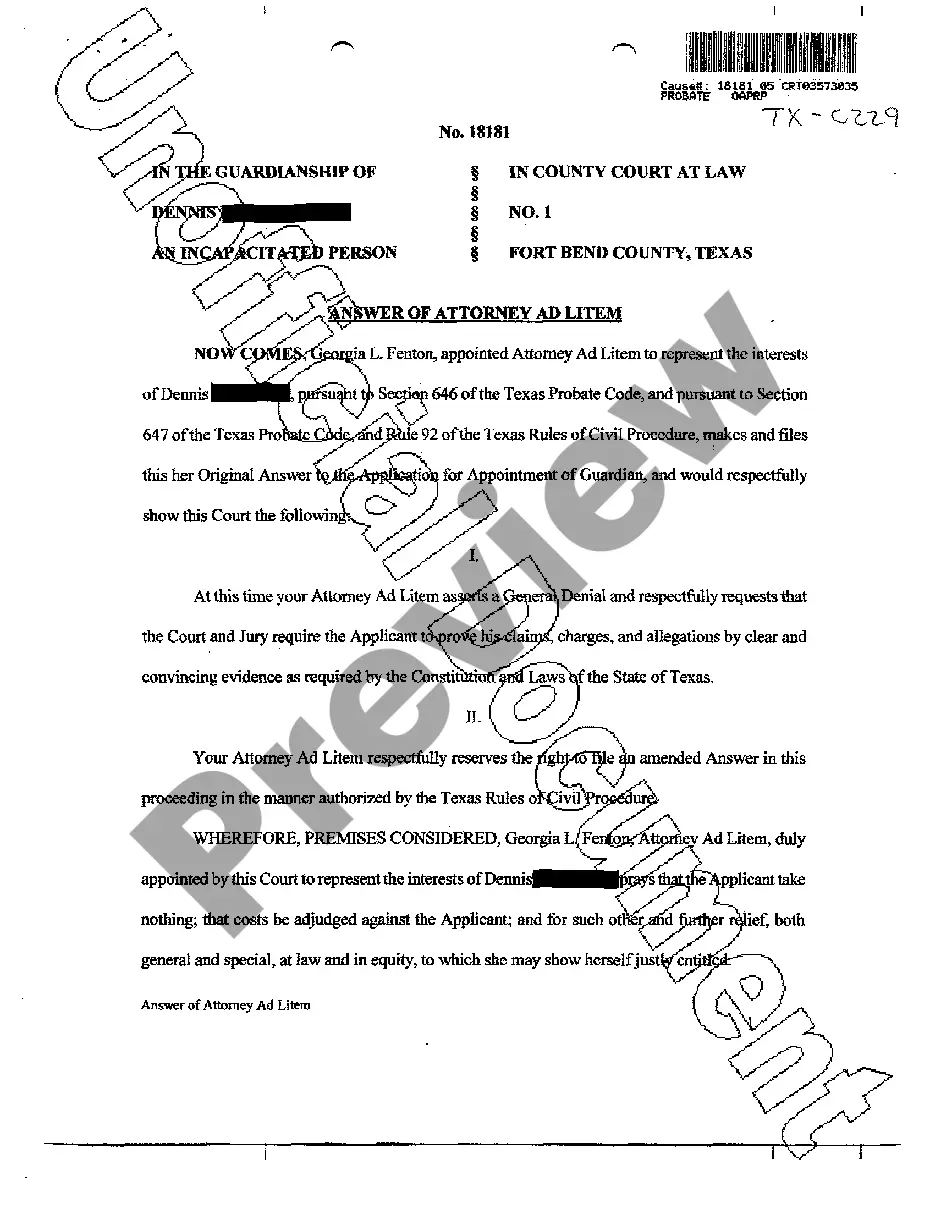
Harris Texas Answer of Attorney Ad Litem
Description
How to fill out Texas Answer Of Attorney Ad Litem?
If you have previously used our service, Log In to your account and download the Harris Texas Answer of Attorney Ad Litem to your device by clicking the Download button. Ensure your subscription is active. If it is not, renew it as per your payment plan.
If this is your first time using our service, follow these straightforward steps to obtain your document.
You have indefinite access to all the documents you have purchased: you can locate them in your profile under the My documents section whenever you wish to reuse them. Utilize the US Legal Forms service to quickly find and save any template for your personal or business requirements!
- Ensure you have located the suitable document. Browse through the description and utilize the Preview option, if available, to verify if it satisfies your requirements. If it does not suit you, utilize the Search feature above to find the right one.
- Purchase the template. Click the Buy Now button and select a monthly or yearly subscription plan.
- Create an account and process your payment. Provide your credit card information or use the PayPal option to finalize the purchase.
- Obtain your Harris Texas Answer of Attorney Ad Litem. Select the format for your document and store it on your device.
- Complete your form. Print it or take advantage of professional online editors to fill it out and sign it electronically.
Form popularity
FAQ
It is crucial to maintain clear communication with the guardian ad litem without overstepping boundaries. Avoid providing them with unsolicited information, or attempting to sway their opinions. Instead, stay respectful and factual in your interactions to ensure a smooth process. For more tips on effective communication in legal matters, check out the Harris Texas Answer of Attorney Ad Litem.
Guardians ad litem have specific limitations in their authority. They do not have the power to make final decisions on custody or visitation; their role centers on representing the child's best interests during legal proceedings. Additionally, they cannot offer counseling or therapy to the child. If you need to understand their role better, the Harris Texas Answer of Attorney Ad Litem provides beneficial insights.
A motion to disqualify a guardian ad litem is a legal request asking the court to remove the guardian from the case. This might occur if there is a conflict of interest or if the guardian fails to perform their duties properly. The court will review the motion, consider its merits, and decide whether to grant it. For detailed guidance on this process, refer to the Harris Texas Answer of Attorney Ad Litem.
The judge does not always agree with the recommendations of the guardian ad litem. While they consider the guardian’s insights, the judge ultimately makes decisions based on the law and the best interests of the child involved. It's important to understand that the guardian's role is to provide information, but the court has the final say. If you seek more clarity on this, consider the Harris Texas Answer of Attorney Ad Litem.
The key difference lies in their focus and roles within legal proceedings. An attorney ad litem advocates for the rights of an estate or individual in specific legal circumstances, while a guardian ad litem focuses on representing the best interests of a minor or incapacitated adult during legal processes. Understanding this distinction in the context of Harris Texas Answer of Attorney Ad Litem is essential for navigating legal responsibilities effectively.
Guardianship typically holds more weight than a power of attorney, as it is a court-appointed role that grants the guardian significant authority over an individual's personal and financial decisions. Unlike a power of attorney, which can be revoked by the granter, guardianship is established through legal proceedings. This means that the court closely scrutinizes guardianship decisions, ensuring that they are made in the best interest of the person under guardianship.
An attorney ad litem estate represents a legal professional appointed to protect the interests of an estate, particularly when someone is unable to represent themselves. In this role, the attorney ad litem ensures that the rights of the estate are safeguarded during legal proceedings. This is crucial in cases of incapacity or when heirs are unknown, highlighting the importance of legal advocacy.
A guardian ad litem has the power to conduct investigations, speak with relevant parties, and present findings to the court. However, their authority does not extend to making binding decisions on behalf of the person they represent. Instead, their role is advisory, providing the court with insights that help inform its decisions in cases related to welfare and protection.
Judges often give great weight to the recommendations of guardians ad litem due to their impartial assessment of the situation. While judges have the ultimate decision-making authority, they typically collaborate closely with the guardian to ensure the best interests of the involved party. Therefore, it is common for judges in Harris, Texas, to align with the findings presented by a guardian ad litem.
A guardian ad litem represents the best interests of a minor or an incapacitated adult in legal matters, while a power of attorney designates someone to make decisions on behalf of another individual. It is critical to understand that a guardian ad litem operates under court supervision, ensuring the protected party's rights are respected. In contrast, a power of attorney can function without court involvement, which establishes a clear distinction between these roles.