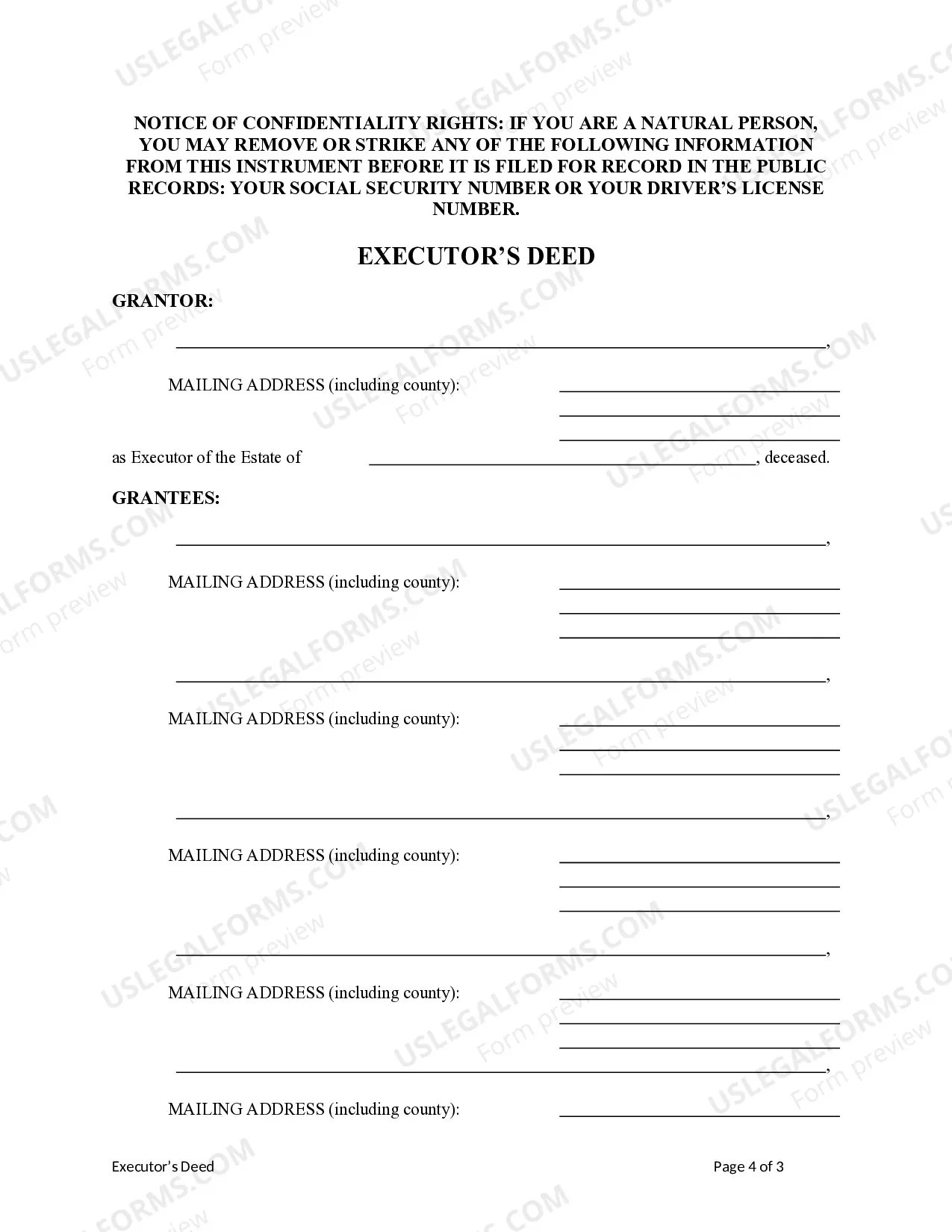
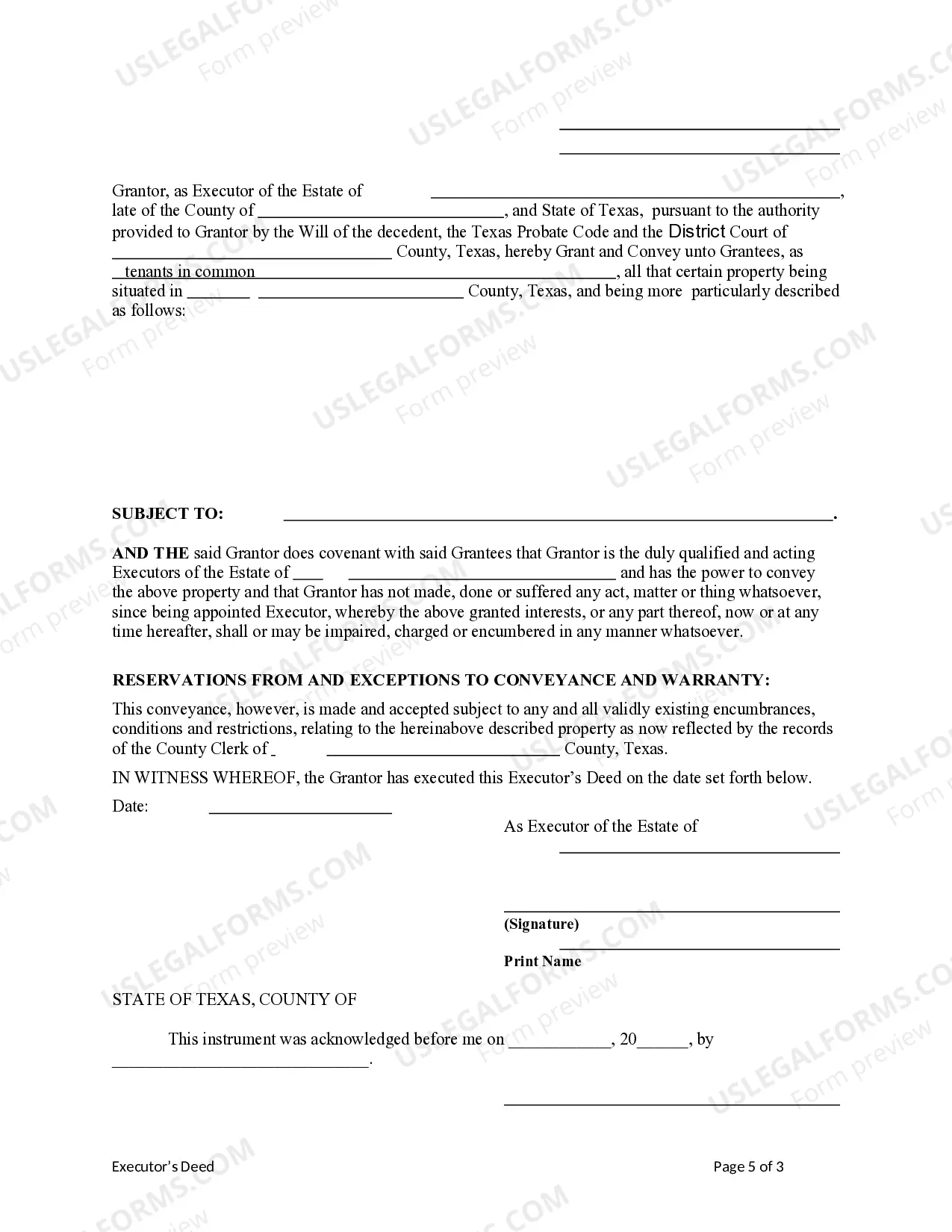
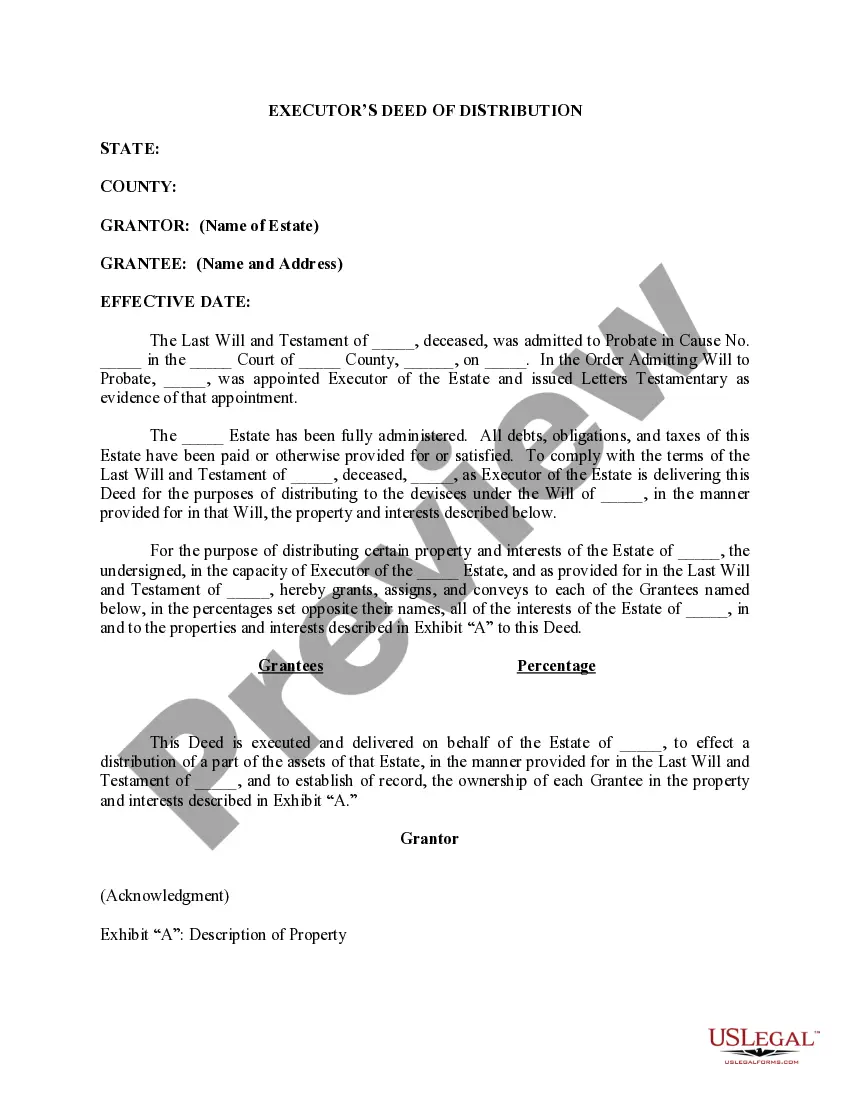
This form is an Executor's Deed where the Grantor is the executor of an estate and the Grantees are the beneficiaries or heirs of the estate. Grantor conveys the described property to the Grantees. This deed complies with all state statutory laws.
Houston Texas Executor's Deed - Estate to Five Beneficiaries
State:
Texas
Category:
City:
Houston
Control #:
TX-096-78
Format:
Word;
Rich Text
60 downloads
Description
Free preview


Get your form ready online
Our built-in tools help you complete, sign, share, and store your documents in one place.
Built-in online Word editor
Make edits, fill in missing information, and update formatting in US Legal Forms—just like you would in MS Word.
Export easily
Download a copy, print it, send it by email, or mail it via USPS—whatever works best for your next step.
E-sign your document
Sign and collect signatures with our SignNow integration. Send to multiple recipients, set reminders, and more. Go Premium to unlock E-Sign.
Notarize online 24/7
If this form requires notarization, complete it online through a secure video call—no need to meet a notary in person or wait for an appointment.
Store your document securely
We protect your documents and personal data by following strict security and privacy standards.

Make edits, fill in missing information, and update formatting in US Legal Forms—just like you would in MS Word.

Download a copy, print it, send it by email, or mail it via USPS—whatever works best for your next step.

Sign and collect signatures with our SignNow integration. Send to multiple recipients, set reminders, and more. Go Premium to unlock E-Sign.

If this form requires notarization, complete it online through a secure video call—no need to meet a notary in person or wait for an appointment.

We protect your documents and personal data by following strict security and privacy standards.
Looking for another form?



How to fill out Texas Executor's Deed - Estate To Five Beneficiaries?
If you are in search of a legitimate form template, it’s incredibly challenging to find a superior service than the US Legal Forms site – one of the largest collections online.
Here you can discover thousands of document samples for business and personal needs categorized by type and state, or by keywords.
Utilizing our enhanced search tool, obtaining the latest Houston Texas Executor's Deed - Estate to Five Beneficiaries is as simple as 1-2-3.
Complete the payment. Use your credit card or PayPal to finalize the registration process.
Access the template. Specify the format and download it to your device. Edit as needed. Fill out, modify, print, and sign the downloaded Houston Texas Executor's Deed - Estate to Five Beneficiaries.
Every template you save to your account never expires and is yours indefinitely. You can easily retrieve them using the My documents section, so if you require an additional copy for editing or creating a printed version, you can return and save it again at any time.
Leverage the US Legal Forms extensive collection to access the Houston Texas Executor's Deed - Estate to Five Beneficiaries you’ve been searching for and thousands of other specialized and state-specific samples all in one place!
- Additionally, the applicability of each record is confirmed by a team of qualified attorneys who routinely assess the templates on our platform and update them according to the latest state and county guidelines.
- If you are already familiar with our service and have an account, all you need to do to acquire the Houston Texas Executor's Deed - Estate to Five Beneficiaries is to sign in to your account and select the Download option.
- If you are using US Legal Forms for the first time, simply follow the steps below.
- Ensure you have located the form you need. Review its details and utilize the Preview function (if available) to view its content. If it doesn’t meet your requirements, use the Search feature at the top of the page to find the correct document.
- Validate your selection. Click the Buy now option. Next, choose your preferred subscription plan and provide the necessary information to register an account.
Form popularity
FAQ
When a Will appoints a dependent administration that means court approval is required for every step in settling the estate, including the sale of real property. The Will may not give the executor (independent or dependent) the power of sale. This means a court order to sell may be required.
When the Will is filed for probate, the person named as the Executor will need to sign the Executor's Deed to transfer the property from the deceased owners to the heirs named in the Will. If there is no Will, a probate judge may appoint an Administrator for the estate.
The Transfer on Death Deed must: Be in writing, signed by the owner, and notarized, Have a legal description of the property (The description is found on the deed to the property or in the deed records.Have the name and address of one or more beneficiaries, State that the transfer will happen at the owner's death,
The executor can sell property without getting all of the beneficiaries to approve. However, notice will be sent to all the beneficiaries so that they know of the sale but they don't have to approve of the sale.
The executor can sell property without getting all of the beneficiaries to approve. However, notice will be sent to all the beneficiaries so that they know of the sale but they don't have to approve of the sale.
In Texas, state and local court rules govern the various time periods that the executor must follow in probating a will. The general rule in Texas is that the executor has four years from the date of death of the testator (person who drafted the will) to file for probate.
Since the heirs own the real estate when the decedent dies, all the heirs must join in selling the property, including signing the real estate contract, deed of sale and other documents incidental to a sales transaction.
(a) An executor, administrator, or temporary administrator a court finds to have taken care of and managed an estate in compliance with the standards of this title is entitled to receive a five percent commission on all amounts that the executor or administrator actually receives or pays out in cash in the
However, if there is no stipulation, the PR, working with their attorney, submits paperwork to the court to get their okay to finalize the sale. All heirs must agree with the terms of the deal.
As an executor, you will have a duty to ensure that you are selling the property for the best possible price, for the benefit of the estate. For example, you must not sell the property at an undervalue to yourself, a member of your family, or indeed to one of the beneficiaries in the will.