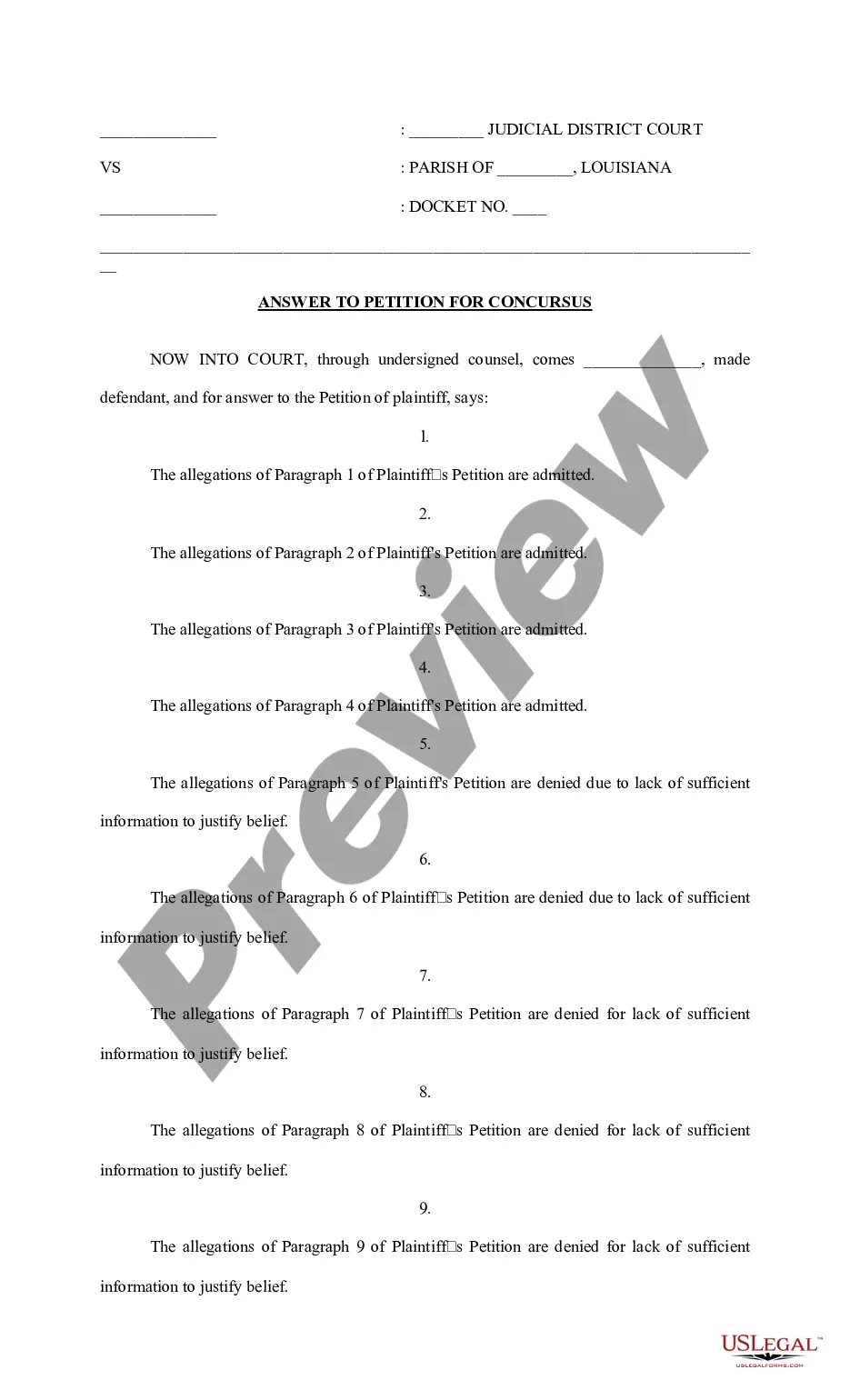
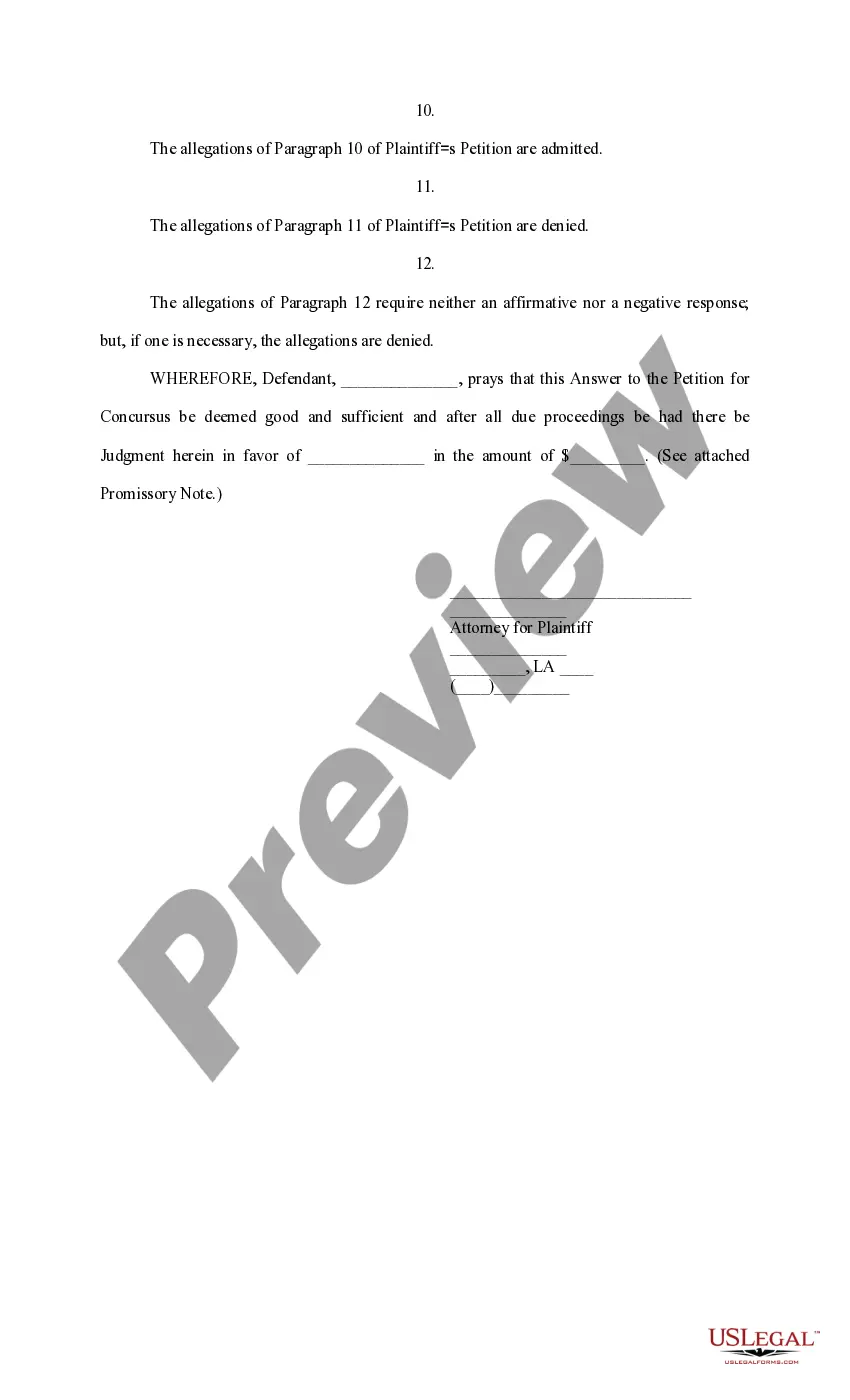
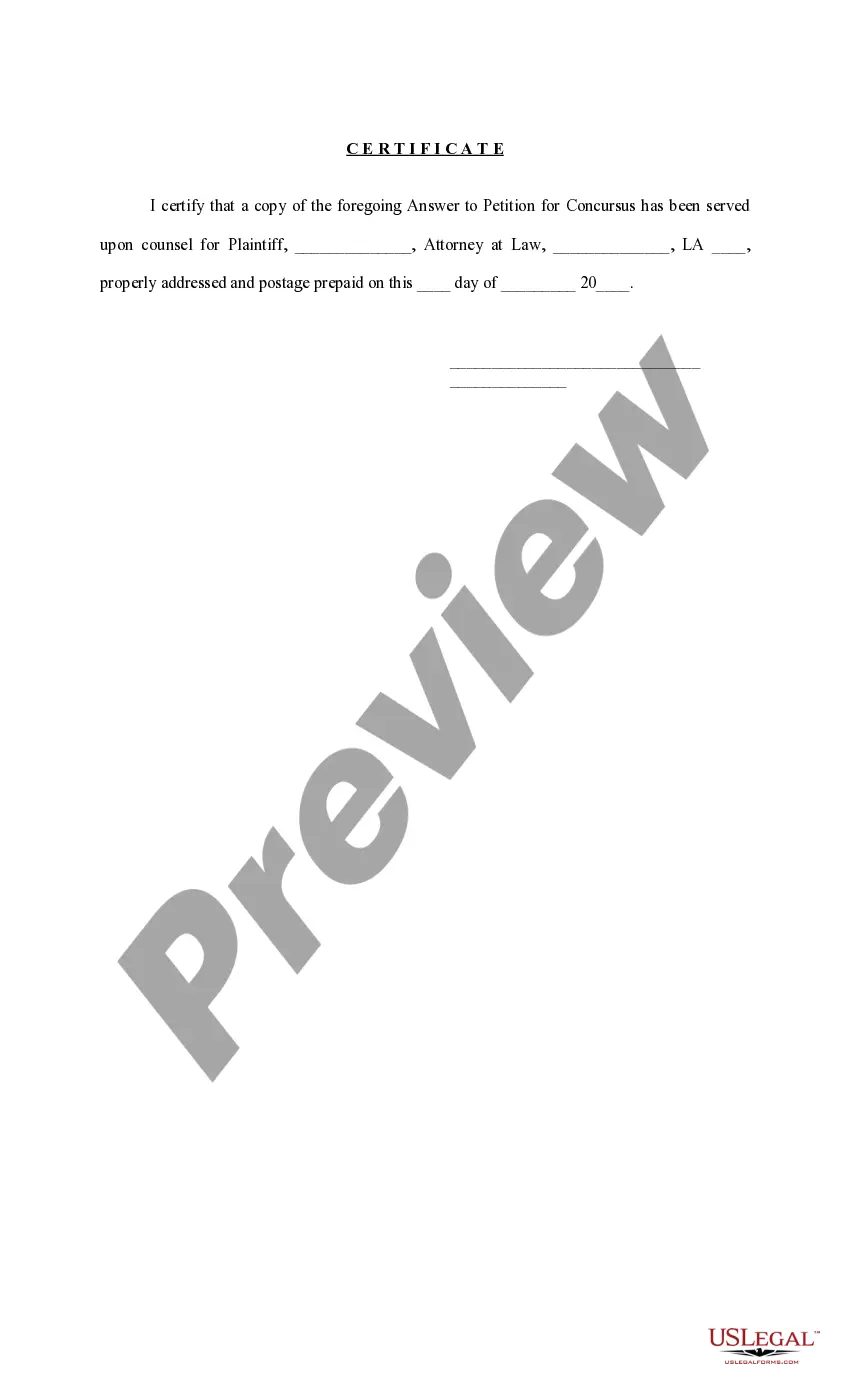
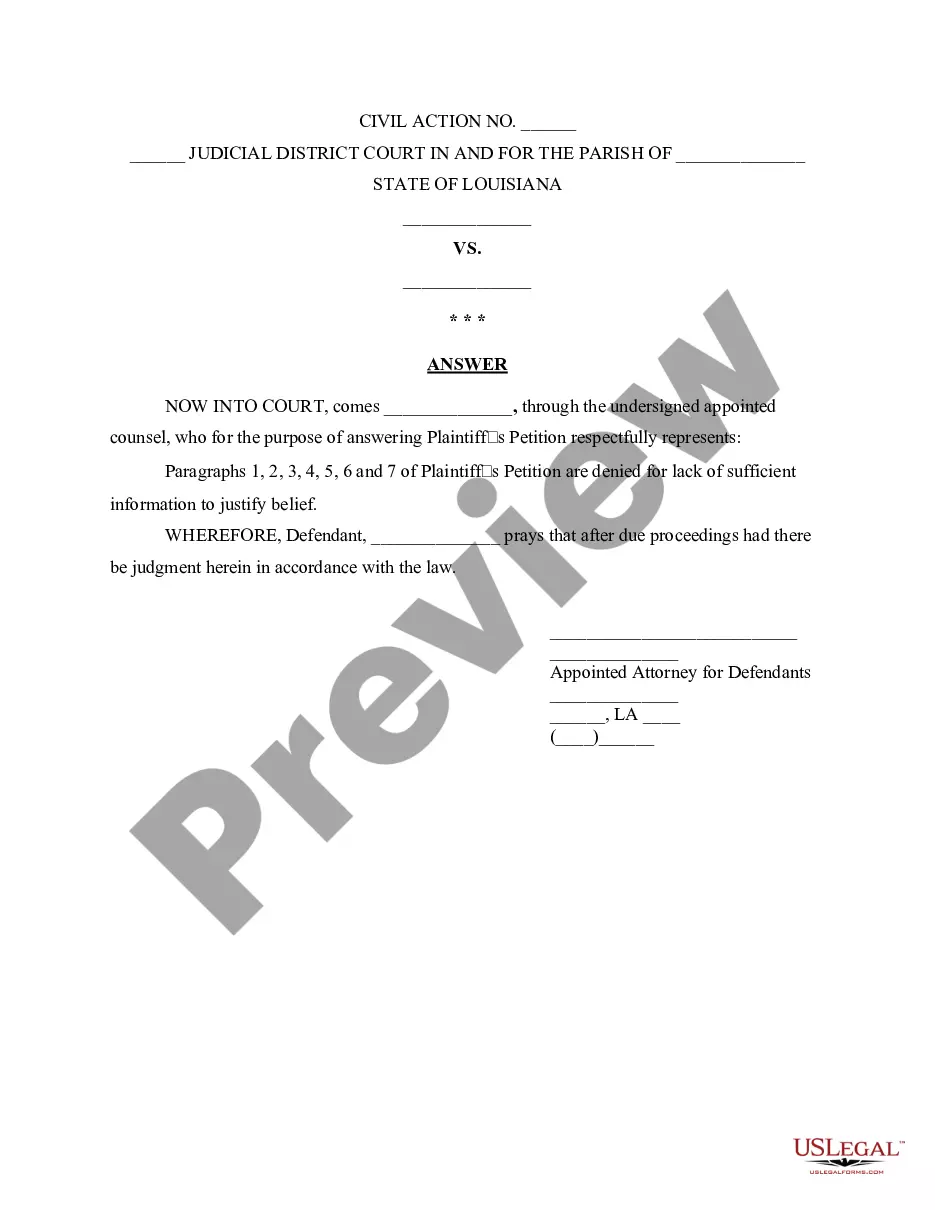
New Orleans Louisiana Answer to Petition for Concursus, Suit on Promissory Note
Description
Get your form ready online
Our built-in tools help you complete, sign, share, and store your documents in one place.
Make edits, fill in missing information, and update formatting in US Legal Forms—just like you would in MS Word.
Download a copy, print it, send it by email, or mail it via USPS—whatever works best for your next step.
Sign and collect signatures with our SignNow integration. Send to multiple recipients, set reminders, and more. Go Premium to unlock E-Sign.
If this form requires notarization, complete it online through a secure video call—no need to meet a notary in person or wait for an appointment.
We protect your documents and personal data by following strict security and privacy standards.

Make edits, fill in missing information, and update formatting in US Legal Forms—just like you would in MS Word.

Download a copy, print it, send it by email, or mail it via USPS—whatever works best for your next step.

Sign and collect signatures with our SignNow integration. Send to multiple recipients, set reminders, and more. Go Premium to unlock E-Sign.

If this form requires notarization, complete it online through a secure video call—no need to meet a notary in person or wait for an appointment.

We protect your documents and personal data by following strict security and privacy standards.
Looking for another form?
How to fill out Louisiana Answer To Petition For Concursus, Suit On Promissory Note?
Irrespective of societal or occupational standing, fulfilling law-related paperwork is a regrettable requirement in modern society. Frequently, it’s nearly impossible for someone lacking a legal education to draft these types of documents from the ground up, primarily due to the intricate vocabulary and legal nuances they entail.
This is where US Legal Forms provides assistance. Our platform boasts an extensive collection with over 85,000 ready-to-use state-specific documents suitable for almost any legal matter. US Legal Forms also serves as a valuable asset for associates or legal advisors who wish to enhance their efficiency in terms of time using our DYI documents.
Whether you need the New Orleans Louisiana Response to Petition for Concursus, Action on Promissory Note, or any other documentation that will be acceptable in your state or county, US Legal Forms puts everything within your reach. Here’s how you can acquire the New Orleans Louisiana Response to Petition for Concursus, Action on Promissory Note in just a few minutes using our reliable platform.
Select the payment method and proceed to download the New Orleans Louisiana Response to Petition for Concursus, Action on Promissory Note once the transaction is finalized.
You’re all set! Now you can either print the document or fill it out online. If you experience any issues retrieving your purchased documents, you can easily find them in the My documents section. Whatever challenge you’re looking to resolve, US Legal Forms has you covered. Give it a try today and see for yourself.
- If you are already an existing user, you can proceed to Log In to your account to download the necessary form.
- However, if you are new to our platform, be sure to follow these steps before downloading the New Orleans Louisiana Response to Petition for Concursus, Action on Promissory Note.
- Confirm the template you have selected is suitable for your area since the regulations of one state or county do not apply to another.
- Review the document and look through a brief overview (if available) of situations the document can address.
- If the form you chose doesn’t satisfy your requirements, you can start over and search for the appropriate form.
- Click Buy now and choose the subscription option that suits you best.
- using your Log In credentials or create one from scratch.
Form popularity
FAQ
The declinatory exception in Louisiana law is a legal tool that challenges the court's jurisdiction over a case. It can lead to the dismissal of a lawsuit if the court lacks the authority to hear it due to improper venue or lack of personal jurisdiction. This exception helps prevent unnecessary litigation in the wrong forum. If you find yourself facing a declinatory exception in matters like the New Orleans Louisiana Answer to Petition for Concursus, Suit on Promissory Note, it is wise to seek expert legal assistance.
In Louisiana, servitudes are categorized into two main types: personal servitudes and predial servitudes. Personal servitudes benefit a specific individual, such as a usufruct, while predial servitudes benefit a particular piece of land. These legal rights can significantly affect property use and ownership. If you encounter related issues, understanding servitudes becomes essential, especially in matters concerning the New Orleans Louisiana Answer to Petition for Concursus, Suit on Promissory Note.
Exceptions to the statute of limitations in Louisiana can be critical for preserving one’s legal rights. For instance, factors like the defendant’s fraud or the plaintiff's minority can delay the start of the limitation period. Additionally, the continuing violation doctrine may restart the clock if new harm occurs. Hence, knowing these exceptions is vital for anyone involved in cases related to the New Orleans Louisiana Answer to Petition for Concursus, Suit on Promissory Note.
Louisiana law categorizes exceptions into three primary types: dilatory, peremptory, and declinatory. Dilatory exceptions delay proceedings on procedural grounds, while peremptory exceptions lead to the dismissal of a case based on substantive issues. Declinatory exceptions challenge the court's jurisdiction or procedural matters. When navigating complex issues like the New Orleans Louisiana Answer to Petition for Concursus, Suit on Promissory Note, recognizing these exceptions can significantly assist you.
In Louisiana law, exceptions serve as preemptive measures that can impact the outcome of legal proceedings. Generally, exceptions include dilatory exceptions, peremptory exceptions, and declinatory exceptions. Each type addresses specific issues in a lawsuit, such as challenges to the jurisdiction or the sufficiency of the plaintiff’s claims. Understanding these exceptions is crucial when dealing with cases like the New Orleans Louisiana Answer to Petition for Concursus, Suit on Promissory Note.
In Louisiana, you typically have 15 days to file an answer to a petition. However, if you are responding to a New Orleans Louisiana Answer to Petition for Concursus, Suit on Promissory Note specifically, it is crucial to adhere to established timelines to protect your rights. Timely responses not only prevent complications but also ensure that your case proceeds smoothly through the courts. For assistance with drafting an appropriate response, US Legal Forms offers tailored templates and guidance.
The 60 day rule in Louisiana mandates that a defendant must respond to certain legal documents, such as a New Orleans Louisiana Answer to Petition for Concursus, Suit on Promissory Note, within 60 days of being served. This rule ensures that legal proceedings are handled in a timely manner, allowing resolution without unnecessary delays. Failure to respond within this timeframe can result in a default judgment against the defendant. To navigate these rules effectively, consider using resources available on the US Legal Forms platform.
In Louisiana, you usually have 15 days to respond to a petition after service. This short response period underscores the importance of being proactive in legal matters. Failing to respond timely could result in a default judgment against you, severely impacting your rights. Platforms like USLegalForms can help you craft an appropriate response efficiently.
An answer to a petition is your formal response to claims made against you in civil court. This document outlines your defenses and may include counterclaims, if applicable. It is important to address each allegation carefully to present your case effectively. USLegalForms offers tailored templates that can aid in drafting this crucial document.
When faced with a request for admission in Louisiana, you have 30 days to respond. This timeline is essential for confirming or denying the truth of statements made in a lawsuit. Adhering to this response period is vital, as it affects the outcome of the case. Consider using USLegalForms for templates to structure your admissions clearly and effectively.