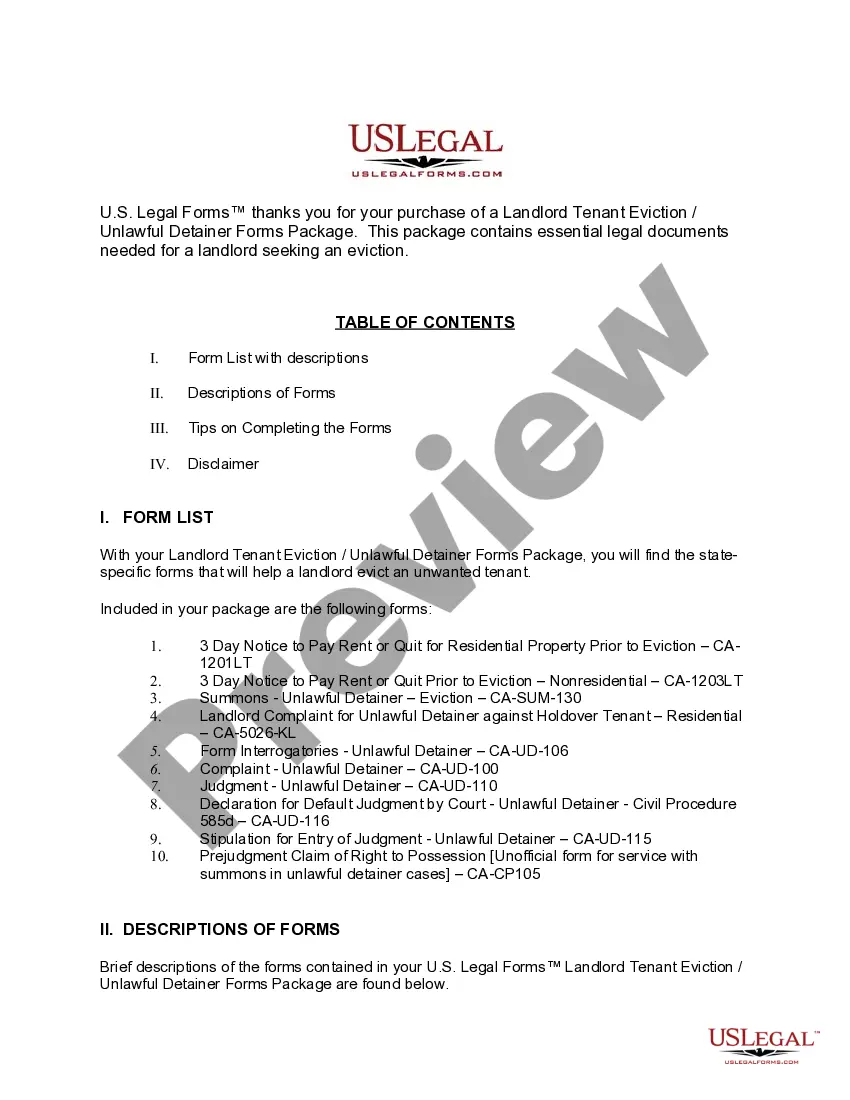
This package contains the essential state-specific forms a landlord needs to evict a tenant. If you need to get rid of an unwanted tenant, this money-saving package ensures that you follow the rules of your state. Included in this package are the following forms:
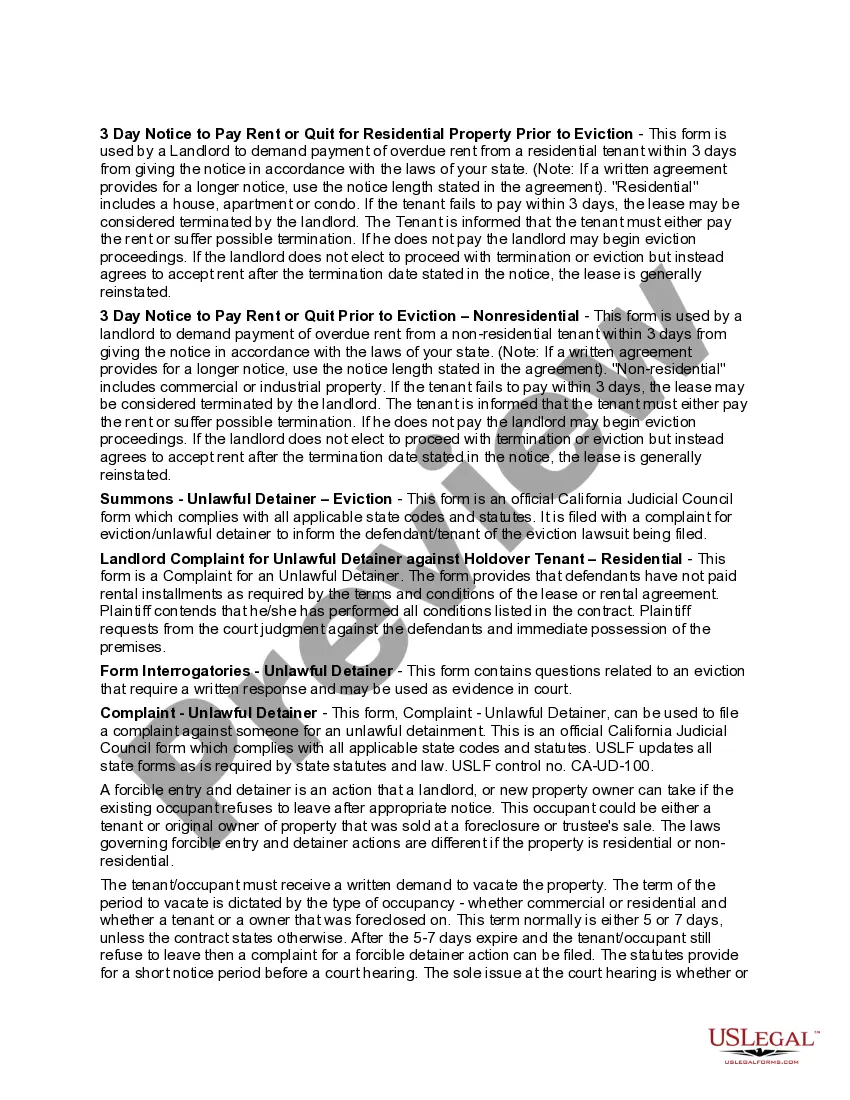
3 Day Notice to Pay Rent or Quit for Residential Property Prior to Eviction - This form is used by a Landlord to demand payment of overdue rent from a residential tenant within 3 days from giving the notice in accordance with the laws of your state. (Note: If a written agreement provides for a longer notice, use the notice length stated in the agreement). "Residential" includes a house, apartment or condo. If the tenant fails to pay within 3 days, the lease may be considered terminated by the landlord. The Tenant is informed that the tenant must either pay the rent or suffer possible termination. If he does not pay the landlord may begin eviction proceedings. If the landlord does not elect to proceed with termination or eviction but instead agrees to accept rent after the termination date stated in the notice, the lease is generally reinstated.
3 Day Notice to Pay Rent or Quit Prior to Eviction ?ˆ“ Nonresidential - This form is used by a landlord to demand payment of overdue rent from a non-residential tenant within 3 days from giving the notice in accordance with the laws of your state. (Note: If a written agreement provides for a longer notice, use the notice length stated in the agreement). "Non-residential" includes commercial or industrial property. If the tenant fails to pay within 3 days, the lease may be considered terminated by the landlord. The tenant is informed that the tenant must either pay the rent or suffer possible termination. If he does not pay the landlord may begin eviction proceedings. If the landlord does not elect to proceed with termination or eviction but instead agrees to accept rent after the termination date stated in the notice, the lease is generally reinstated.
Summons - Unlawful Detainer ?ˆ“ Eviction - This form is an official California Judicial Council form which complies with all applicable state codes and statutes.It is filed with a complaint for eviction/unlawful detainer to inform the defendant/tenant of the eviction lawsuit being filed.
Landlord Complaint for Unlawful Detainer against Holdover Tenant ?ˆ“ Residential - This form is a Complaint for an Unlawful Detainer. The form provides that defendants have not paid rental installments as required by the terms and conditions of the lease or rental agreement. Plaintiff contends that he/she has performed all conditions listed in the contract. Plaintiff requests from the court judgment against the defendants and immediate possession of the premises.
Form Interrogatories - Unlawful Detainer - This form contains questions related to an eviction that require a written response and may be used as evidence in court.
Complaint - Unlawful Detainer - This form, Complaint - Unlawful Detainer, can be used to file a complaint against someone for an unlawful detainment. This is an official California Judicial Council form which complies with all applicable state codes and statutes. USLF updates all state forms as is required by state statutes and law. USLF control no. CA-UD-100.
A forcible entry and detainer is an action that a landlord, or new property owner can take if the existing occupant refuses to leave after appropriate notice. This occupant could be either a tenant or original owner of property that was sold at a foreclosure or trustee's sale. The laws governing forcible entry and detainer actions are different if the property is residential or non-residential.
The tenant/occupant must receive a written demand to vacate the property. The term of the period to vacate is dictated by the type of occupancy - whether commercial or residential and whether a tenant or a owner that was foreclosed on. This term normally is either 5 or 7 days, unless the contract states otherwise. After the 5-7 days expire and the tenant/occupant still refuse to leave then a complaint for a forcible detainer action can be filed. The statutes provide for a short notice period before a court hearing. The sole issue at the court hearing is whether or not the tenant/occupant has the right to possession. If they do not then they will be found guilty of a forcible entry and detainer.
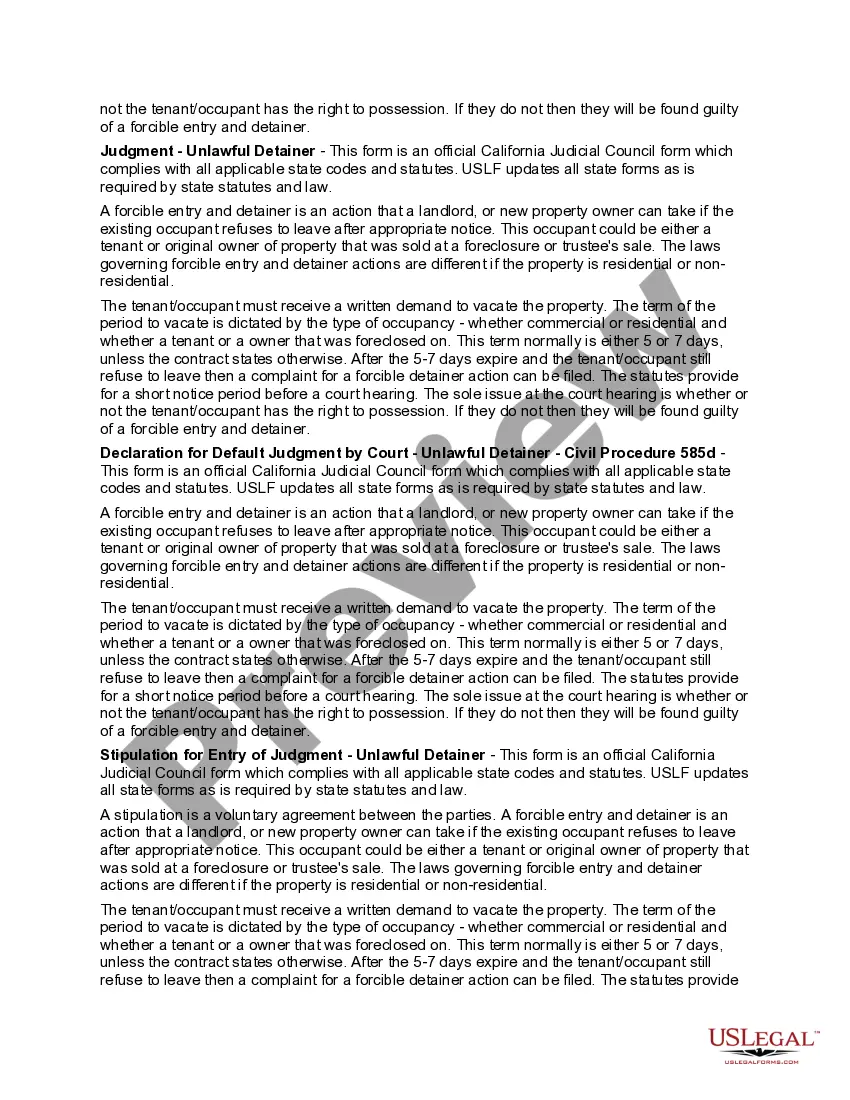
Judgment - Unlawful Detainer - This form is an official California Judicial Council form which complies with all applicable state codes and statutes. USLF updates all state forms as is required by state statutes and law.
A forcible entry and detainer is an action that a landlord or new property owner can take if the existing occupant refuses to leave after appropriate notice. The laws governing forcible entry and detainer actions are different if the property is residential or non-residential.
The tenant/occupant must receive a written demand to vacate the property. The term of the period to vacate is dictated by the type of occupancy - whether commercial or residential and whether a tenant or a owner that was foreclosed on. This term normally is either 5 or 7 days, unless the contract states otherwise. After the 5-7 days expire and the tenant/occupant still refuse to leave then a complaint for a forcible detainer action can be filed. The statutes provide for a short notice period before a court hearing. The sole issue at the court hearing is whether or not the tenant/occupant has the right to possession. If they do not then they will be found guilty of a forcible entry and detainer.
Declaration for Default Judgment by Court - Unlawful Detainer - Civil Procedure 585d - This form is an official California Judicial Council form which complies with all applicable state codes and statutes. USLF updates all state forms as is required by state statutes and law.
A forcible entry and detainer is an action that a landlord, or new property owner can take if the existing occupant refuses to leave after appropriate notice. The laws governing forcible entry and detainer actions are different if the property is residential or non-residential.
The tenant/occupant must receive a written demand to vacate the property. The term of the period to vacate is dictated by the type of occupancy - whether commercial or residential and whether a tenant or a owner that was foreclosed on. This term normally is either 5 or 7 days, unless the contract states otherwise. After the 5-7 days expire and the tenant/occupant still refuse to leave then a complaint for a forcible detainer action can be filed. The statutes provide for a short notice period before a court hearing. The sole issue at the court hearing is whether or not the tenant/occupant has the right to possession. If they do not then they will be found guilty of a forcible entry and detainer.
Stipulation for Entry of Judgment - Unlawful Detainer - This form is an official California Judicial Council form which complies with all applicable state codes and statutes. USLF updates all state forms as is required by state statutes and law.
A stipulation is a voluntary agreement between the parties. A forcible entry and detainer is an action that a landlord, or new property owner can take if the existing occupant refuses to leave after appropriate notice. This occupant could be either a tenant or original owner of property that was sold at a foreclosure or trustee's sale. The laws governing forcible entry and detainer actions are different if the property is residential or non-residential.
The tenant/occupant must receive a written demand to vacate the property. The term of the period to vacate is dictated by the type of occupancy - whether commercial or residential and whether a tenant or a owner that was foreclosed on. This term normally is either 5 or 7 days, unless the contract states otherwise. After the 5-7 days expire and the tenant/occupant still refuse to leave then a complaint for a forcible detainer action can be filed. The statutes provide for a short notice period before a court hearing. The sole issue at the court hearing is whether or not the tenant/occupant has the right to possession. If they do not then they will be found guilty of a forcible entry and detainer.
Prejudgment Claim of Right to Possession [Unofficial form for service with summons in unlawful detainer cases] - Prejudgment Claim of Right to Possession - Unofficial Form for Use by Levying Officers in Unlawful Detainer Cases: This form is used by the levying officer of the court. It explains to the defendant that the levying officer has the right to take possession of certain items which have been found to be unlawfully detained by the defendant.