Subpoena in a Civil Case:
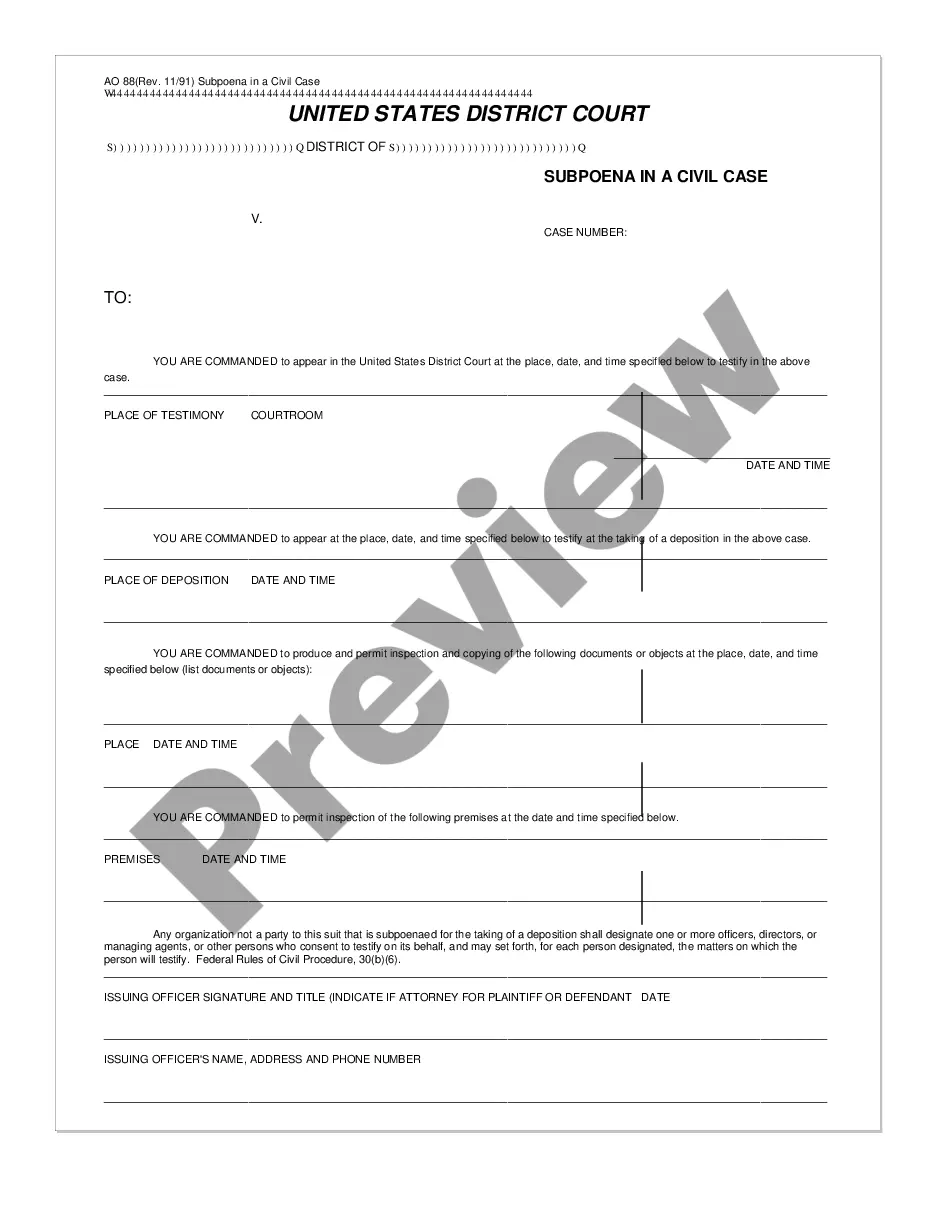
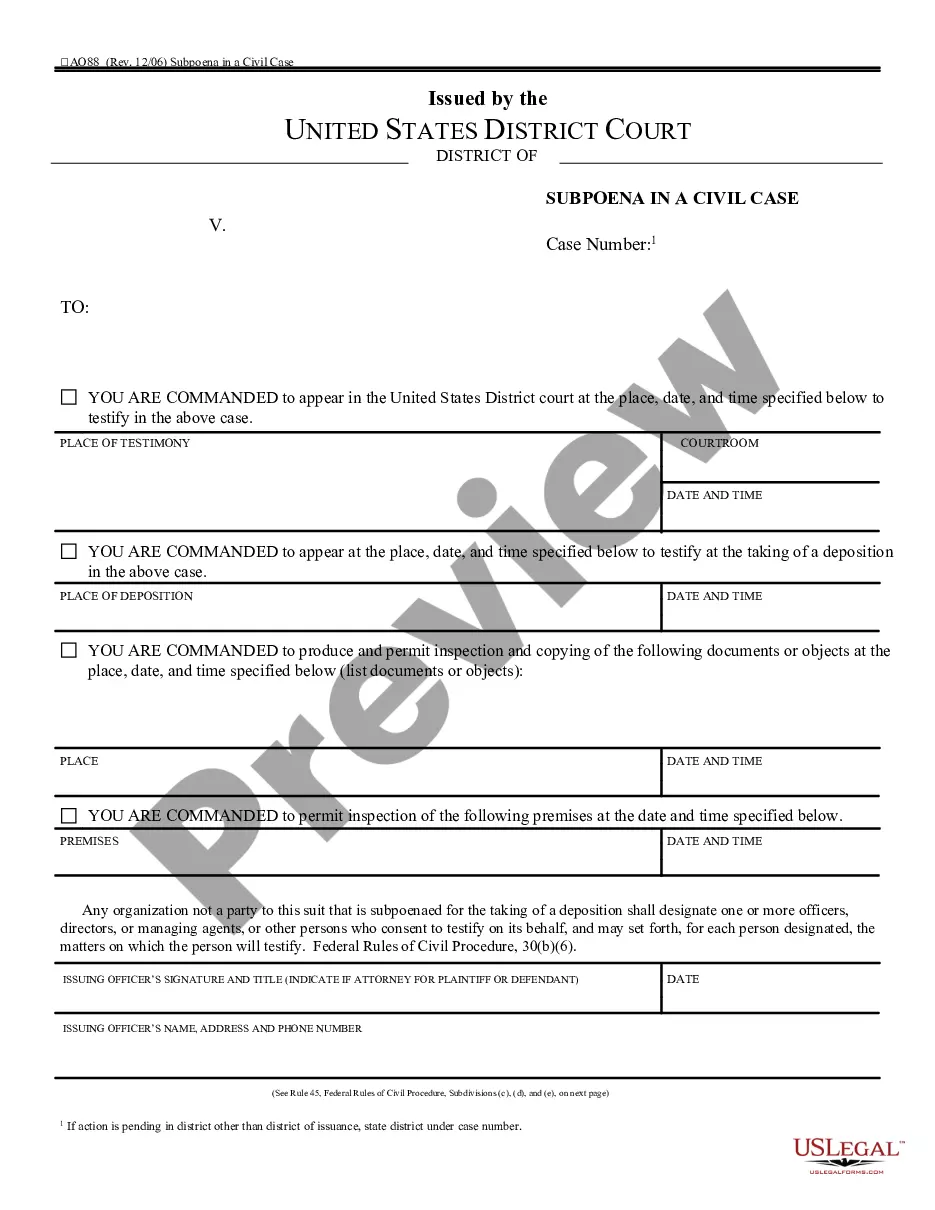
Tucson Arizona Subpoena in a Civil Case
State:
Arizona
Category:
City:
Tucson
Control #:
AZ-AO-88
Format:
PDF
40 downloads
Description
Free preview

Get your form ready online
Our built-in tools help you complete, sign, share, and store your documents in one place.
Built-in online Word editor
Make edits, fill in missing information, and update formatting in US Legal Forms—just like you would in MS Word.
Export easily
Download a copy, print it, send it by email, or mail it via USPS—whatever works best for your next step.
E-sign your document
Sign and collect signatures with our SignNow integration. Send to multiple recipients, set reminders, and more. Go Premium to unlock E-Sign.
Notarize online 24/7
If this form requires notarization, complete it online through a secure video call—no need to meet a notary in person or wait for an appointment.
Store your document securely
We protect your documents and personal data by following strict security and privacy standards.

Make edits, fill in missing information, and update formatting in US Legal Forms—just like you would in MS Word.

Download a copy, print it, send it by email, or mail it via USPS—whatever works best for your next step.

Sign and collect signatures with our SignNow integration. Send to multiple recipients, set reminders, and more. Go Premium to unlock E-Sign.

If this form requires notarization, complete it online through a secure video call—no need to meet a notary in person or wait for an appointment.

We protect your documents and personal data by following strict security and privacy standards.
Looking for another form?


How to fill out Arizona Subpoena In A Civil Case?
Irrespective of social or occupational standing, completing legal documentation is an unfortunate obligation in today's professional landscape.
More often than not, it’s nearly impossible for an individual without any legal experience to generate this type of paperwork from the ground up, largely due to the intricate language and legal subtleties that accompany them.
This is where US Legal Forms proves beneficial.
Verify that the document you have selected is applicable for your location as the laws of one state or region may not be valid in another.
Review the document and examine a brief overview (if available) of the situations for which the form can be utilized.
- Our platform offers an extensive assortment of over 85,000 ready-to-use state-specific documents suitable for nearly every legal situation.
- US Legal Forms is also a valuable resource for associates or legal advisors seeking to optimize their time by using our DIY documents.
- Whether you are in need of the Tucson Arizona Subpoena in a Civil Case or any other relevant paperwork for your state or region, with US Legal Forms, everything is readily accessible.
- Here’s how you can quickly obtain the Tucson Arizona Subpoena in a Civil Case using our reliable platform.
- If you are already a member, you can go ahead and Log In to your account to acquire the suitable form.
- However, if you are new to our library, be sure to adhere to these instructions prior to downloading the Tucson Arizona Subpoena in a Civil Case.
Form popularity
FAQ
Trial subpoenas (civil and criminal) may be issued in blank by the Clerk's Office and provided to parties/attorneys for completion and service. Go to subpoena form. Criminal subpoenas for anything other than trial, must be issued by the Clerk's Office.
Trial subpoenas (civil and criminal) may be issued in blank by the Clerk's Office and provided to parties/attorneys for completion and service. Go to subpoena form. Criminal subpoenas for anything other than trial, must be issued by the Clerk's Office.
It can be issued by any attorney, a self-represented individual, or a service hired by an attorney, using court-supplied forms.
Persons subject to subpoenas to appear as witnesses in a civil law suit (anything other than a criminal law suit) must be paid $12 for each day's attendance as well as mileage at 20 cents per mile from the witness's residence to the place of trial, hearing, or deposition.
Understanding Subpoena A subpoena is typically requested by an attorney on behalf of the court and issued by a court clerk, notary public or justice of the peace. A subpoena may be served on an individual either through personal delivery, email, certified mail or even by reading it out aloud.
If it is delivered in person, it must be served at least 10 days before the court date; For a Notice to Attend AND Bring Documents: You must have it served by mail at least 25 days before the court date. If it is delivered in person, it must be served at least 20 days before the court date.
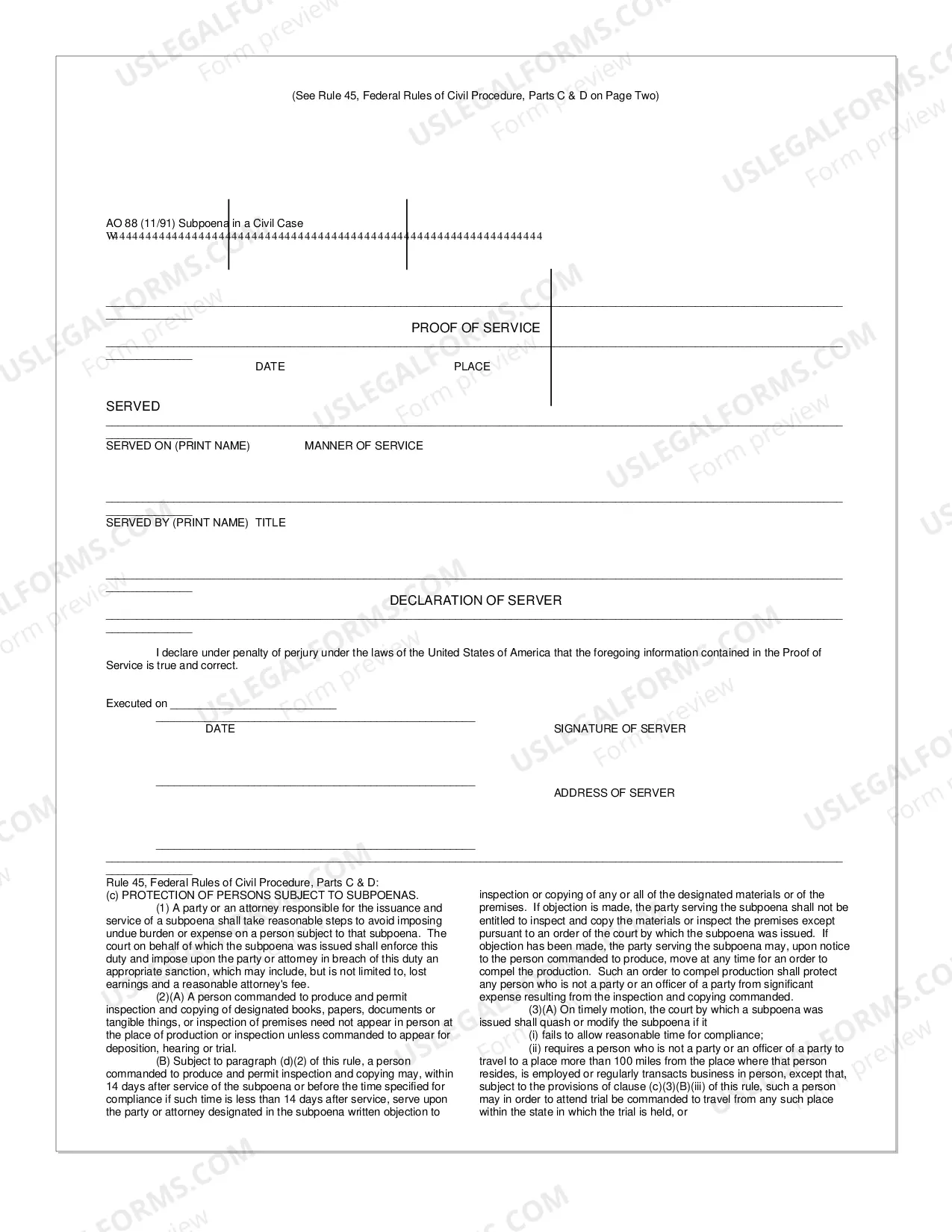
D. Subpoenas may be served by certified mail for delivery to addressee only. The subpoena shall be registered and mailed, postage and registry fee prepaid, to the addressee with a request endorsed on the envelope in the usual form for the return of the letter to the sender if not delivered within five days.
If the subpoena commands the production of documents, electronically stored information, or tangible things, or the inspection of premises before trial, a notice and a copy of the subpoena must be served on each party at least 2 days before it is served on the person to whom it is directed.
D. Subpoenas may be served by certified mail for delivery to addressee only. The subpoena shall be registered and mailed, postage and registry fee prepaid, to the addressee with a request endorsed on the envelope in the usual form for the return of the letter to the sender if not delivered within five days.