Indiana Quitclaim Deed from Individual to Two Individuals in Joint Tenancy
About this form
This Quitclaim Deed is a legal document that allows an unmarried individual to transfer property ownership to two individuals who will hold the property in joint tenancy. Unlike other deeds, a quitclaim deed does not guarantee that the grantor has clear title to the property; it simply conveys whatever interest the grantor may have. This makes it useful for situations such as transferring property between family members or in divorces.
What’s included in this form
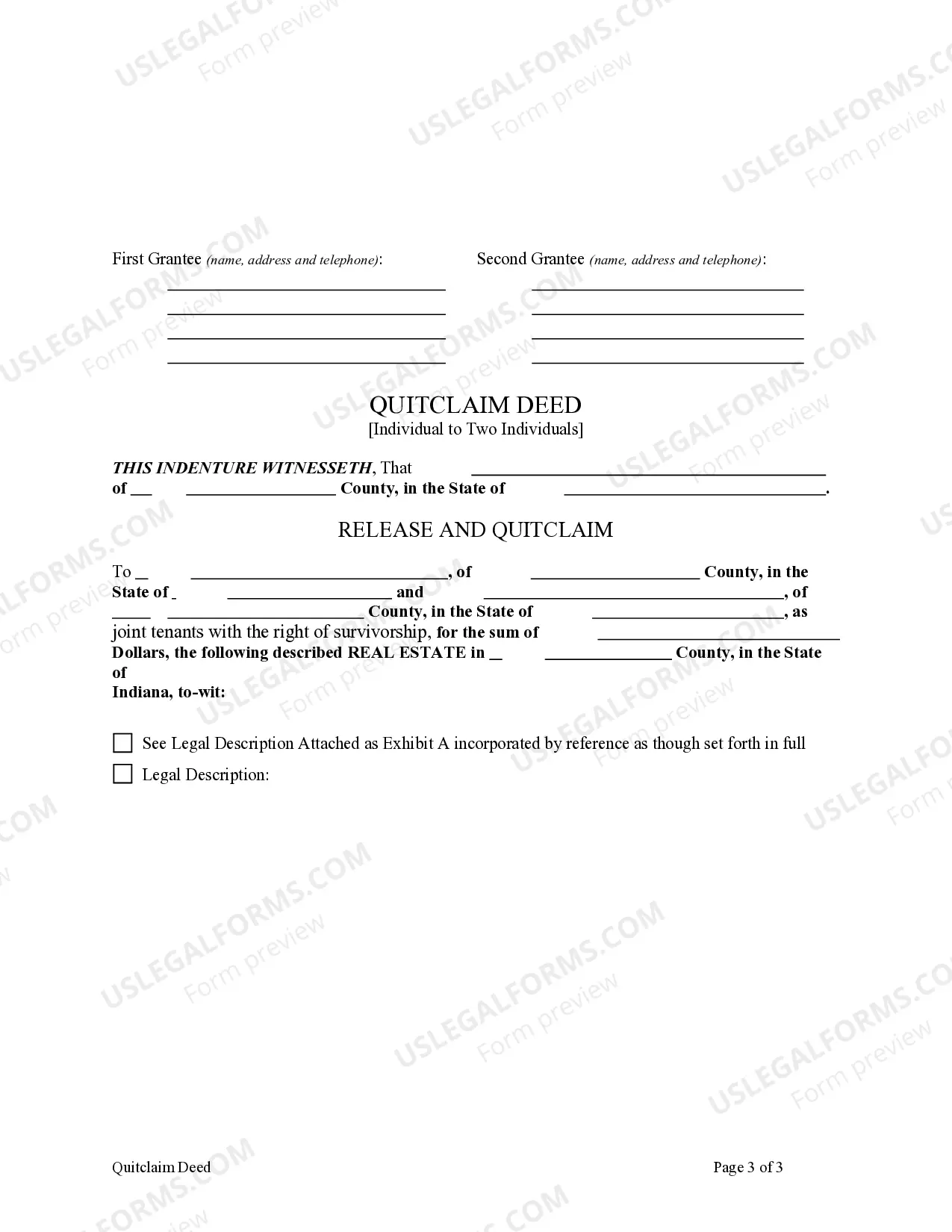
- Grantor details: Information about the unmarried individual transferring the property.
- Grantee identification: Names of the two individuals receiving the property.
- Property description: A clear description of the property being transferred.
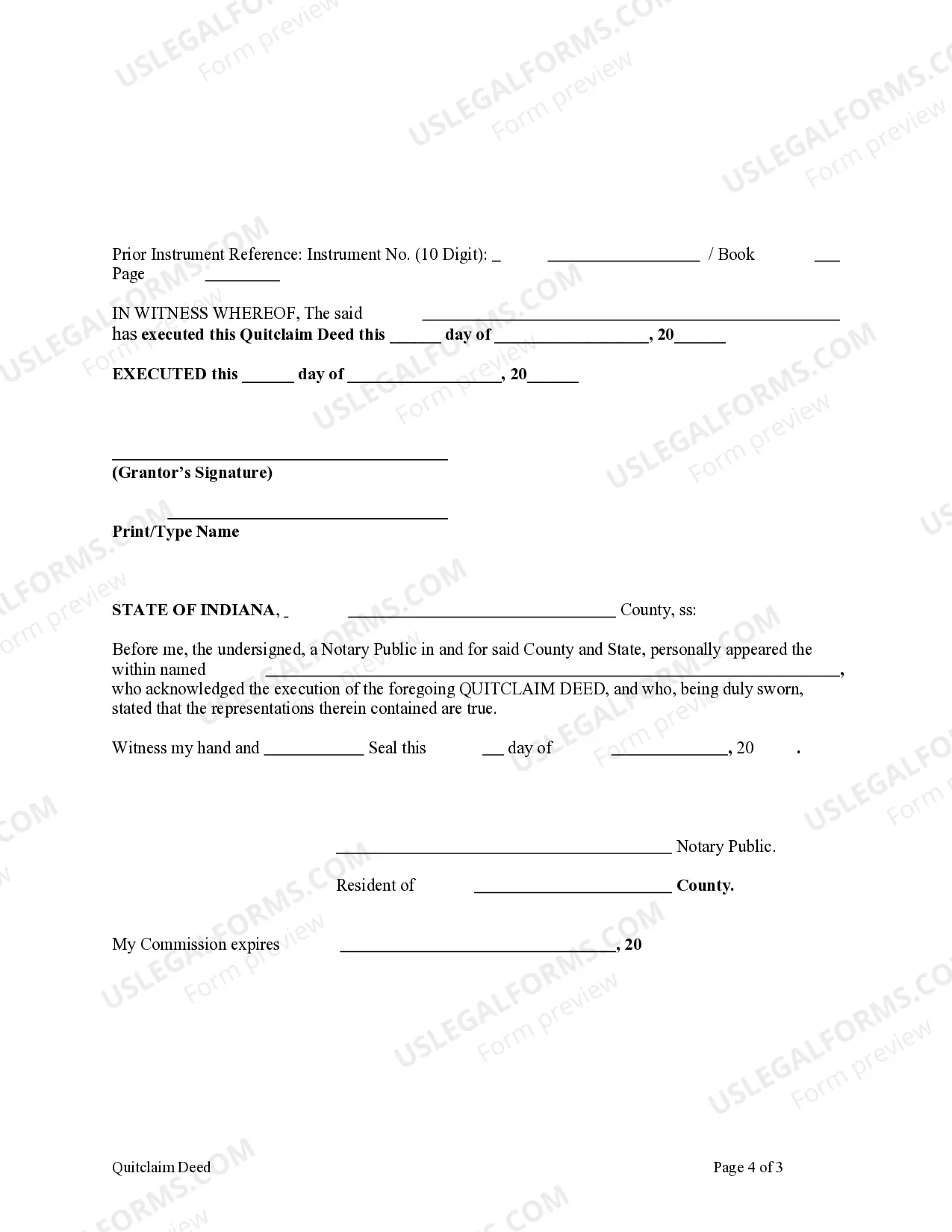
- Execution date: The date when the deed is signed and executed.
- Notary acknowledgment: Certification by a notary public to ensure legal validity.





Common use cases
You should use this Quitclaim Deed when you need to transfer property from an individual to two individuals in joint tenancy. Common scenarios include when a property owner wishes to add a spouse or partner to the title, or when an unmarried individual wants to gift or transfer property to friends or relatives. It is crucial when clear title is not a concern, and the parties involved are generally in agreement about the property.
Who this form is for
- Property owners wanting to transfer ownership to two individuals.
- Individuals involved in family arrangement or informal property transfers.
- Unmarried individuals looking to establish joint ownership with others.
How to prepare this document
- Identify the grantor: Enter the full name of the individual transferring the property.
- Enter grantee information: Include the names of the two individuals receiving the property.
- Describe the property: Provide a detailed description including address and legal description.
- Add the execution date: Fill in the date the deed is signed.
- Obtain notarization: Have the document signed before a notary public.
Does this form need to be notarized?
Yes, this form must be notarized to be legally valid. Using US Legal Formsâ integrated online notarization service offers a secure and convenient way to complete this step. You can notarize your document via a video call without the need to travel, ensuring a smooth process while maintaining legal standards.
Get your form ready online
Our built-in tools help you complete, sign, share, and store your documents in one place.
Make edits, fill in missing information, and update formatting in US Legal Forms—just like you would in MS Word.
Download a copy, print it, send it by email, or mail it via USPS—whatever works best for your next step.
Sign and collect signatures with our SignNow integration. Send to multiple recipients, set reminders, and more. Go Premium to unlock E-Sign.
If this form requires notarization, complete it online through a secure video call—no need to meet a notary in person or wait for an appointment.
We protect your documents and personal data by following strict security and privacy standards.

Make edits, fill in missing information, and update formatting in US Legal Forms—just like you would in MS Word.

Download a copy, print it, send it by email, or mail it via USPS—whatever works best for your next step.

Sign and collect signatures with our SignNow integration. Send to multiple recipients, set reminders, and more. Go Premium to unlock E-Sign.

If this form requires notarization, complete it online through a secure video call—no need to meet a notary in person or wait for an appointment.

We protect your documents and personal data by following strict security and privacy standards.
Typical mistakes to avoid
- Not fully identifying the property being transferred.
- Failing to sign and date the document.
- Not having the deed notarized, which may lead to invalidation.
- Leaving out the granteesâ names or providing incorrect spellings.
Benefits of completing this form online
- Convenience of instant access to legal forms from anywhere.
- Editability allows you to complete the form accurately before printing.
- Reliability as forms are drafted by licensed attorneys ensuring compliance with state laws.
What to keep in mind
- A Quitclaim Deed allows an unmarried individual to transfer property to two individuals in joint tenancy.
- Ensure accurate identification of all parties and the property details.
- This document requires notarization for validity.
Looking for another form?




Form popularity
FAQ
Filling out a quitclaim deed in Indiana involves several key steps. Start by including the names of the grantor and grantees, and clearly identify the property being transferred. Additionally, ensure you include a legal description of the property. For an Indiana Quitclaim Deed from Individual to Two Individuals in Joint Tenancy, specify how the grantees will hold the property together, which is essential for proper joint tenancy.
Yes, you can prepare your own quitclaim deed in Indiana. While it is possible to complete this process independently, using a resource like US Legal Forms can provide guidance and ensure that all legal requirements are met. This is particularly helpful when creating an Indiana Quitclaim Deed from Individual to Two Individuals in Joint Tenancy. Always verify that your deed adheres to state laws to avoid future issues.
In Indiana, the individual transferring ownership, known as the grantor, must sign the quitclaim deed. If you are transferring property to two individuals in joint tenancy, both names should be included as grantees on the deed. It's essential that the grantor's signature is notarized to ensure the validity of the deed. This process is crucial when you are handling an Indiana Quitclaim Deed from Individual to Two Individuals in Joint Tenancy.
Step 1: Find your IN quitclaim deed form. Step 2: Gather the information you need. Step 3: Enter the information about the parties. Step 4: Enter the legal description of the property. Step 5: Have the grantor sign the document in the presence of a Notary Public.
Write the Deed Fill out the quit claim deed form, which can be obtained online, or write your own using the form as a guide. The person giving up the interest in the property is the grantor, and the person receiving the interest is the grantee.
But you might be wondering if an owner can transfer a deed to another person without a real estate lawyer. The answer is yes. Parties to a transaction are always free to prepare their own deeds.A quitclaim deed, for example, is far simpler than a warranty deed.
The Quit Claim Deed form uses the terms of Grantor (Seller or Owner of said property) and Grantee (Buyer of said property) for the two parties involved. First, the parties must fill in the date. Then, write in the name of the county and state in which the property is located.
It is also crucial that a spouse know about the loan, even if he or she is not on the mortgage. In general, the spouse must sign a deed of trust, the Truth in Lending and Right to Cancel documents. By signing these documents, they are simply acknowledging the existence of the mortgage.
In order to transfer ownership of the marital home pursuant to a divorce, one spouse is going to need to sign a quitclaim deed, interspousal transfer deed, or a grant deed, in order to convey the title to the property.
Adding someone to your house deed requires the filing of a legal form known as a quitclaim deed. When executed and notarized, the quitclaim deed legally overrides the current deed to your home. By filing the quitclaim deed, you can add someone to the title of your home, in effect transferring a share of ownership.