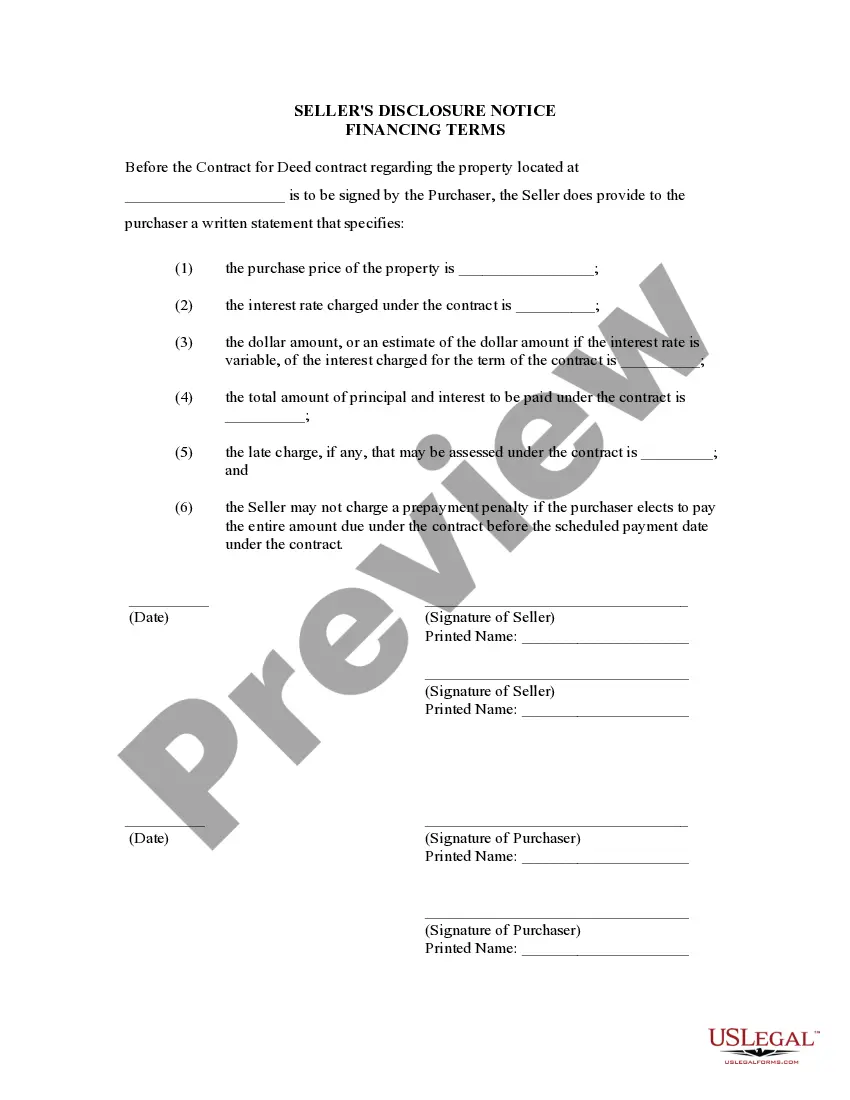
Indiana Seller's Disclosure of Financing Terms for Residential Property in connection with Contract or Agreement for Deed a/k/a Land Contract
What is this form?
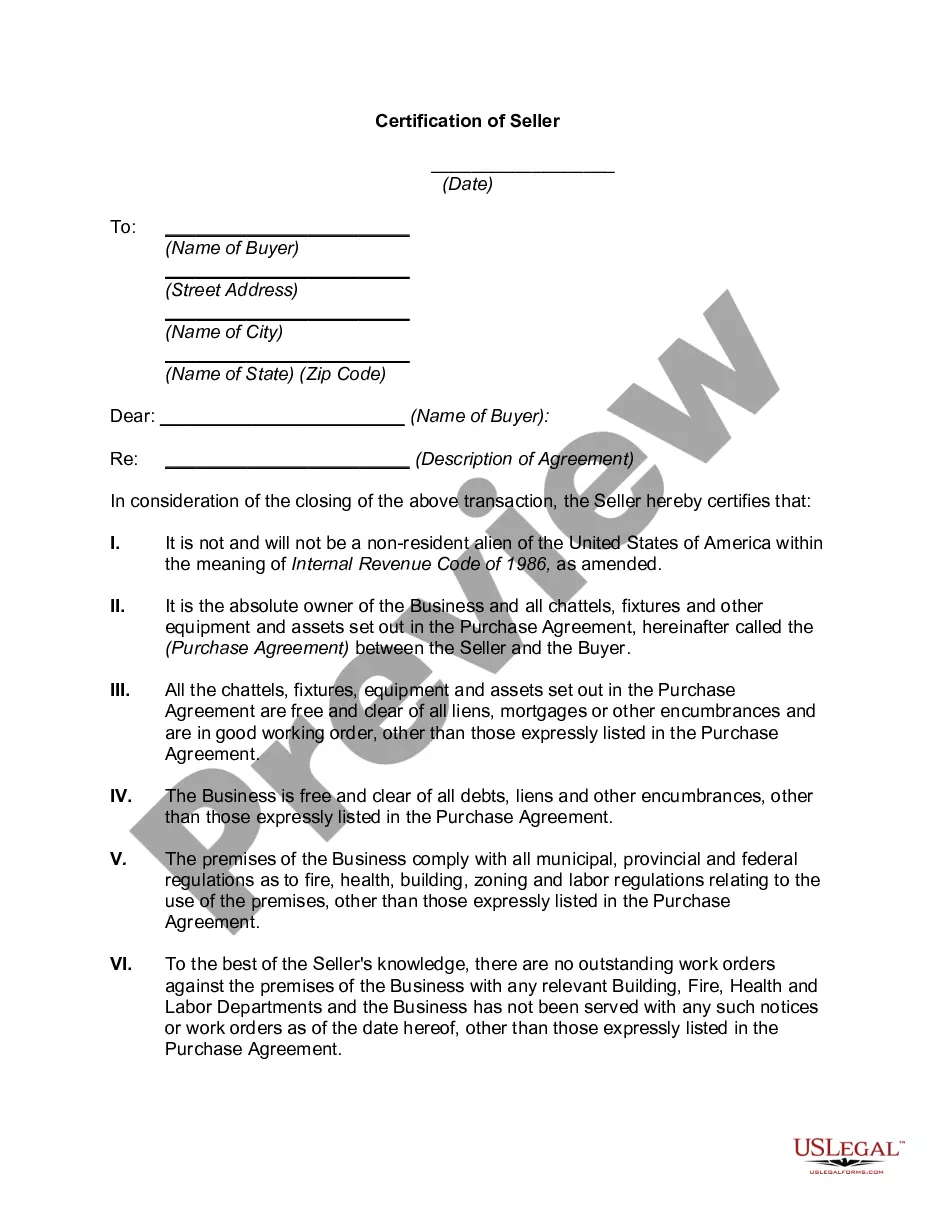
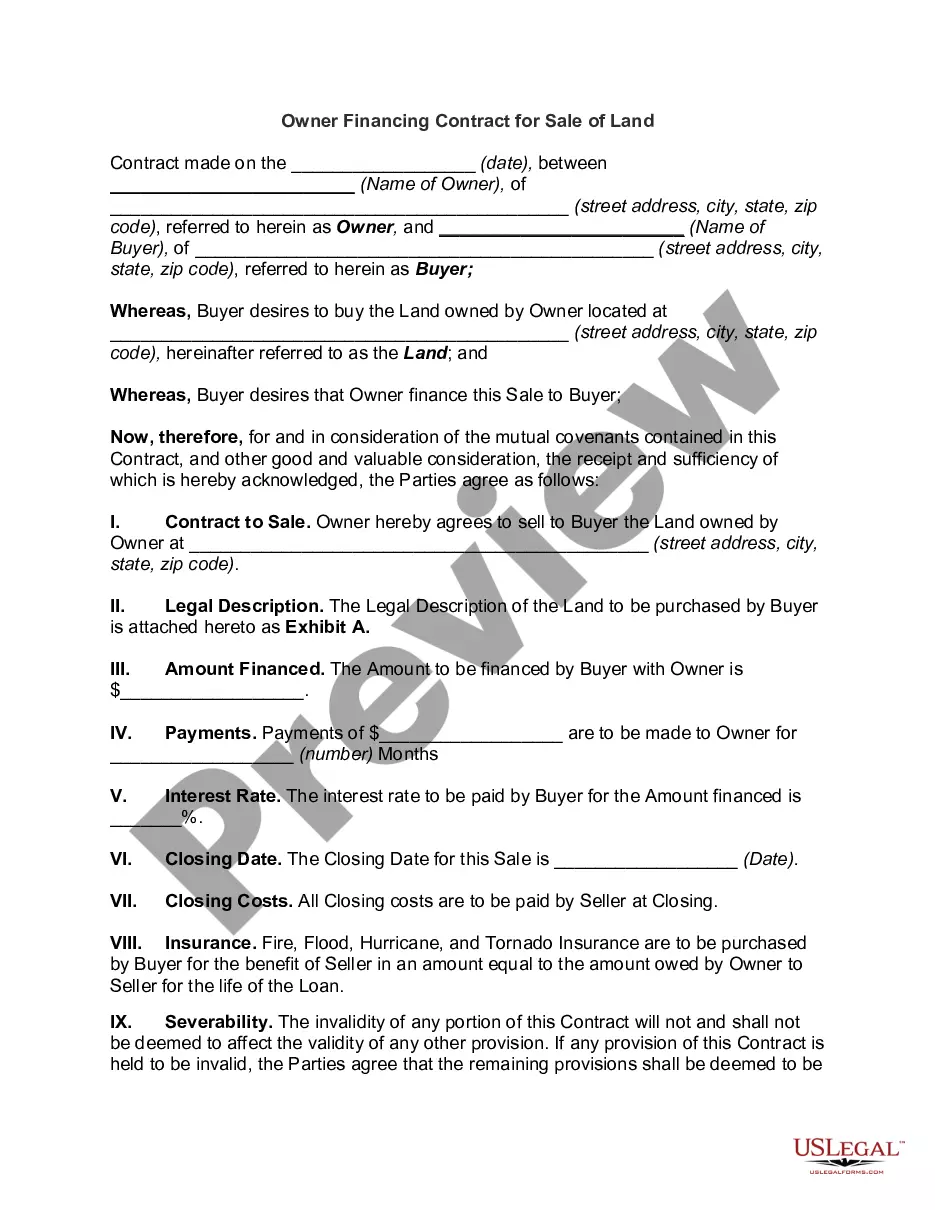
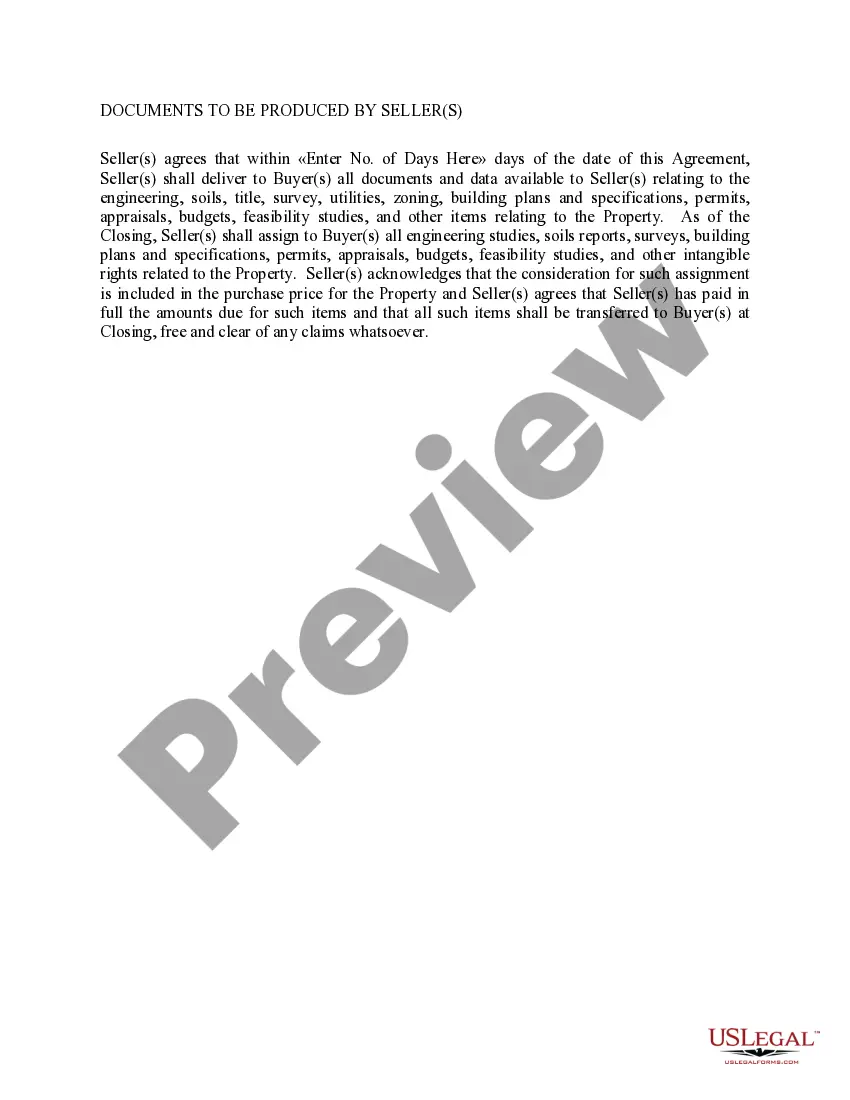
The Seller's Disclosure of Financing Terms for Residential Property is a crucial document that outlines the financial terms agreed upon in connection with a contract for deed, also known as a land contract. This form serves to inform the purchaser of essential details such as the purchase price, interest rate, payment schedules, and any late charges that may apply. Unlike other real estate documents, this form specifically focuses on financing aspects, ensuring transparency and clarity for both parties before finalizing the sale.
What’s included in this form
- Purchase price of the property
- Interest rate charged under the contract
- Estimated dollar amount of interest for the term of the contract
- Total amount of principal and interest to be paid
- Late charge details, if applicable
- Information about prepayment penalties
When this form is needed
This form should be used when a seller is offering financing for a residential property through a contract for deed. It is especially important in scenarios where traditional mortgage financing is not used. The seller provides this disclosure to the buyer before or at the time the contract is signed, ensuring that the buyer is fully aware of the financial obligations that come with the property transaction.
Who can use this document
This form is intended for:
- Property sellers who wish to offer financing through a contract for deed.
- Buyers looking to understand the financial terms associated with purchasing residential property under a land contract.
- Real estate professionals facilitating transactions involving seller financing.
How to prepare this document
- Identify the property being sold by entering the complete address.
- Specify the purchase price of the property.
- Enter the interest rate applicable to the financing arrangement.
- Provide an estimate of the total interest to be charged over the term of the contract.
- List any late charges that might be incurred for late payments.
- Include the necessary signatures of both the seller and the purchaser, along with the date.
Does this form need to be notarized?
This form does not typically require notarization unless specified by local law. It is always advisable to check local requirements or consult with a legal professional to ensure the validity of the document.
Get your form ready online
Our built-in tools help you complete, sign, share, and store your documents in one place.
Make edits, fill in missing information, and update formatting in US Legal Forms—just like you would in MS Word.
Download a copy, print it, send it by email, or mail it via USPS—whatever works best for your next step.
Sign and collect signatures with our SignNow integration. Send to multiple recipients, set reminders, and more. Go Premium to unlock E-Sign.
If this form requires notarization, complete it online through a secure video call—no need to meet a notary in person or wait for an appointment.
We protect your documents and personal data by following strict security and privacy standards.

Make edits, fill in missing information, and update formatting in US Legal Forms—just like you would in MS Word.

Download a copy, print it, send it by email, or mail it via USPS—whatever works best for your next step.

Sign and collect signatures with our SignNow integration. Send to multiple recipients, set reminders, and more. Go Premium to unlock E-Sign.

If this form requires notarization, complete it online through a secure video call—no need to meet a notary in person or wait for an appointment.

We protect your documents and personal data by following strict security and privacy standards.
Common mistakes
- Failing to provide accurate property details.
- Not including all required signatures.
- Leaving financial terms vague or unquantified.
- Overlooking local legal requirements that may affect the contract.
Why complete this form online
- Convenient access to professionally drafted legal forms.
- Editable templates allow for customization to fit specific needs.
- Instant downloads simplify the process of obtaining legal documentation.
- Reliability of forms drafted by licensed attorneys, ensuring legal compliance.
Quick recap
- The Seller's Disclosure of Financing Terms provides crucial details about the purchase price and payment structure.
- It's important for sellers using a contract for deed to ensure the form is accurately completed.
- This form helps prevent misunderstandings between the seller and purchaser regarding payment expectations.
Looking for another form?
Form popularity
FAQ
With seller-financing, often the insurance and tax payments are paid directly to the owner, who is expected to make the annual payment personally. If, for some reason these payments aren't made, both parties can be put at risk of either a tax foreclosure, or a cancellation of the home owner's insurance.
_________/- (Rupees ____________________________), will be received by the FIRST PARTY from the SECOND PARTY, at the time of registration of the Sale Deed, the FIRST PARTY doth hereby agree to grant, convey, sell, transfer and assign all his rights, titles and interests in the said portion of the said property, fully
In seller financing, the seller takes on the role of the lender. Instead of giving cash to the buyer, the seller extends enough credit to the buyer for the purchase price of the home, minus any down payment.Then the buyer pays back the loan over time, typically with interest.
Owner Financing Example Over the course of the loan, the buyer makes monthly payments of $426 and is responsible for property tax and insurance payments. At closing, the buyer receives title to the home that is subject to a mortgage held by the seller.
Complete the addendum, including your name, the purchaser's name and a description of the property. Include the type of financing that you are providing, such as first mortgage, second mortgage or deed of trust. List the terms of the loan.
The seller financing addendum outlines the terms at which the seller of the property agrees to loan the money to the buyer in order to purchase their property.Once complete, this addendum should be signed and attached to the purchase agreement made between the parties.
Taxes need not be paid on the portion of the payments representing return of basis--the amount the seller originally paid for the property. Tax must be paid on the portion representing the gain from the sale; this is paid at capital gains rates, which are usually lower than ordinary income tax rates.
In a contract for deed, often done with seller finance deals, the answer is a little complicated. The buyer holds "equitable" title, while the seller holds legal title.