Iowa Quitclaim Deed from Individual to Husband and Wife
Overview of this form
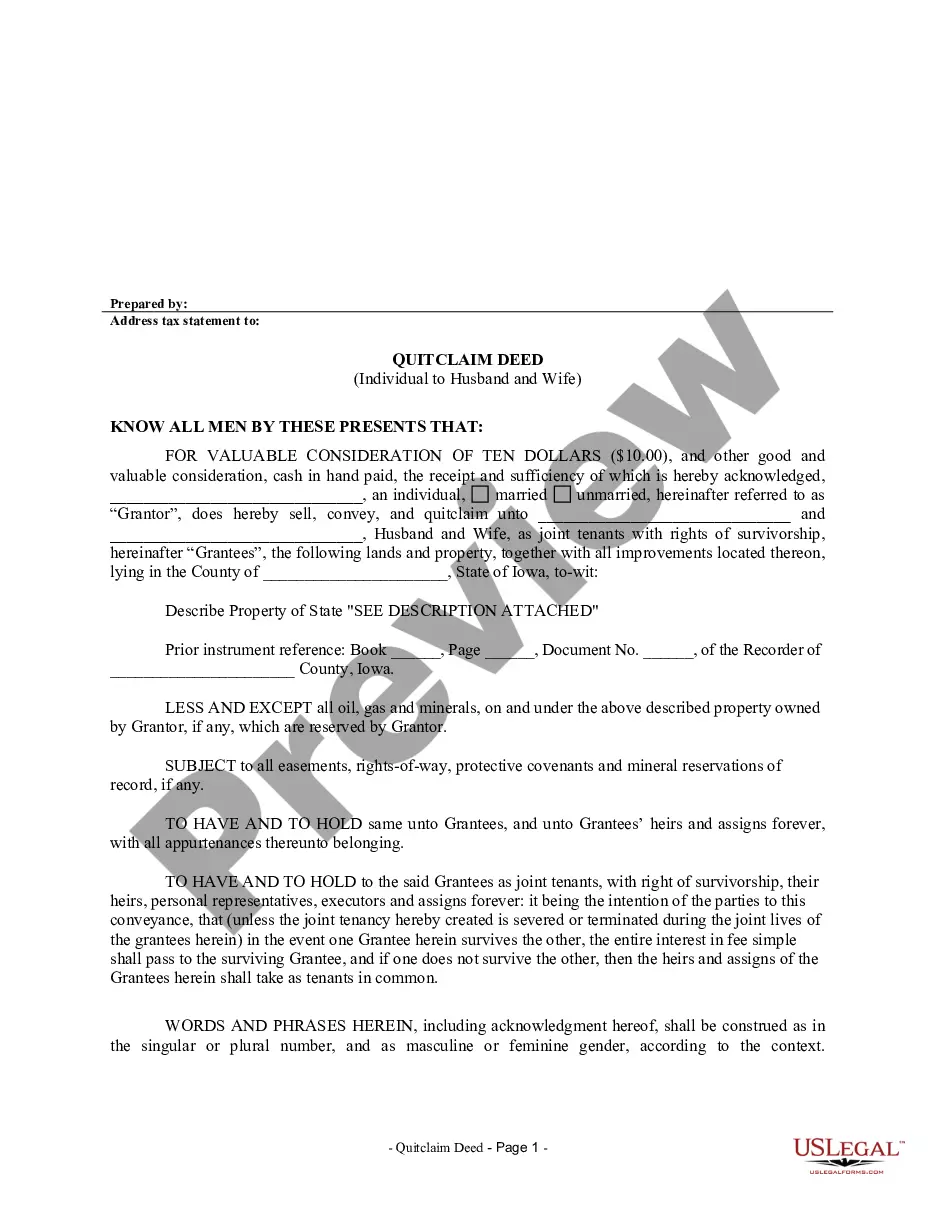
The Quitclaim Deed from Individual to Husband and Wife is a legal document that allows an individual (the Grantor) to transfer ownership of real estate to a married couple (the Grantees) as joint tenants with rights of survivorship. This form is specifically designed for personal property transactions and does not include the transfer of mineral rights. It differs from warranty deeds as it provides no guarantees regarding the property title.
Main sections of this form
- Grantor Information: The individual who is transferring the property.
- Grantees Information: Both spouses who are receiving the property.
- Property Description: A detailed description of the property being transferred.
- Consideration: The stated value of the property transfer, often nominal, like ten dollars.
- Survivorship Rights: Language indicating that if one spouse passes away, the other will retain full ownership of the property.
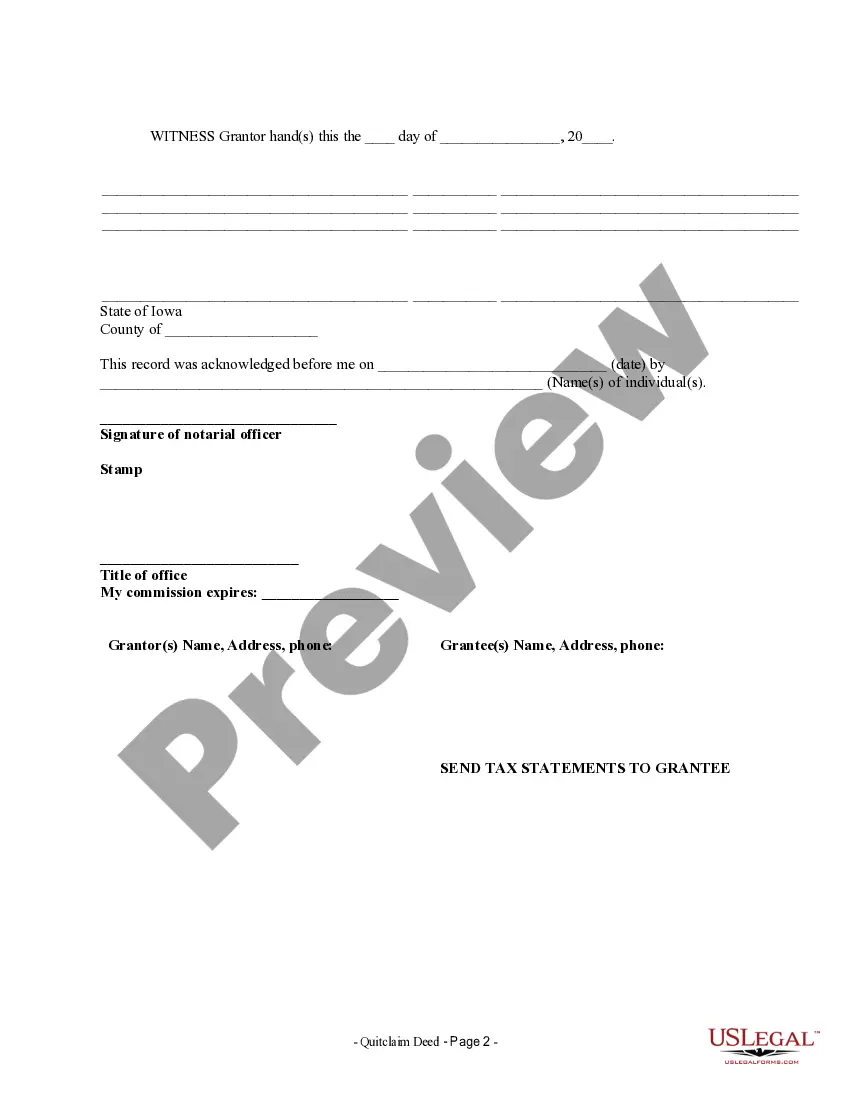
- Notarization:** A requirement for validating the deed's execution.





Common use cases
This form is essential when an individual wishes to transfer ownership of property to their spouse, especially to establish joint ownership with survivorship rights. Typical scenarios include transferring the family home to both spouses or moving property into a marital ownership structure. This deed is often used in estate planning and asset management.
Who can use this document
- Individuals looking to transfer property solely to their spouse.
- Married couples wanting to clarify joint ownership of property.
- Homeowners looking to streamline their estate plan.
Instructions for completing this form
- Identify the parties involved: Fill in the names and addresses of the Grantor and both Grantees.
- Describe the property: Provide a detailed legal description of the property being transferred.
- Indicate the consideration: Write the agreed value for the property transfer, typically ten dollars.
- Sign and date the form: The Grantor must sign the deed in front of a Notary Public and date it.
- File the deed: Submit the signed and notarized deed to the local county recorder's office for official recording.
Is notarization required?
To make this form legally binding, it must be notarized. Our online notarization service, powered by Notarize, lets you verify and sign documents remotely through an encrypted video session.
Get your form ready online
Our built-in tools help you complete, sign, share, and store your documents in one place.
Make edits, fill in missing information, and update formatting in US Legal Forms—just like you would in MS Word.
Download a copy, print it, send it by email, or mail it via USPS—whatever works best for your next step.
Sign and collect signatures with our SignNow integration. Send to multiple recipients, set reminders, and more. Go Premium to unlock E-Sign.
If this form requires notarization, complete it online through a secure video call—no need to meet a notary in person or wait for an appointment.
We protect your documents and personal data by following strict security and privacy standards.

Make edits, fill in missing information, and update formatting in US Legal Forms—just like you would in MS Word.

Download a copy, print it, send it by email, or mail it via USPS—whatever works best for your next step.

Sign and collect signatures with our SignNow integration. Send to multiple recipients, set reminders, and more. Go Premium to unlock E-Sign.

If this form requires notarization, complete it online through a secure video call—no need to meet a notary in person or wait for an appointment.

We protect your documents and personal data by following strict security and privacy standards.
Common mistakes to avoid
- Failing to provide a complete property description.
- Not having the deed properly notarized.
- Improperly filling out the names of the Grantor or Grantees.
- Neglecting to file the completed deed with the local recorder's office.
Advantages of online completion
- Convenience of immediate access to the form without needing to visit a legal office.
- Editability allows users to customize the form according to their specific needs.
- Reliability of forms prepared by licensed attorneys ensures legal compliance.
Looking for another form?

Form popularity
FAQ
Yes, adding a spouse to your deed can be considered a gift under certain circumstances. When you file an Iowa Quitclaim Deed from Individual to Husband and Wife, you transfer an interest in the property without expecting anything in return, which may qualify as a gift for tax purposes. It's wise to consult a tax professional to understand any potential gift tax implications involved in this process.
Yes, you can add a spouse to a deed without refinancing, as long as you complete an Iowa Quitclaim Deed from Individual to Husband and Wife. This process does not require any changes to your mortgage, but it's advisable to consult your lender about how this might affect your mortgage terms. The deed transfer simply updates the ownership records, making your spouse a co-owner of the property.
Adding someone to your deed can have several disadvantages, such as loss of control over the property and potential tax implications. Once you file an Iowa Quitclaim Deed from Individual to Husband and Wife, you share ownership, which might complicate future decisions regarding the property. Moreover, the new owner could be exposed to creditors or legal claims, affecting your overall financial standing.
To remove your husband's name from the deed in Iowa, you can use an Iowa Quitclaim Deed from Individual to Husband and Wife. This document allows the owner to transfer rights, which can include removing a name from a deed. It is advisable to consult an attorney to ensure that all legal requirements are met and that the transfer is done correctly.
To add a spouse to your deed in Iowa, you will typically need to complete an Iowa Quitclaim Deed from Individual to Husband and Wife. This document allows you to transfer a portion of your property ownership to your spouse. After filling out the form, you must have it notarized and then file it with your local county recorder's office. This process ensures that both names appear on the property title.
It is not advisable or legal to add someone to a deed without their knowledge. When using an Iowa Quitclaim Deed from Individual to Husband and Wife, both parties must agree and sign the document. This ensures transparency and legality in property transactions. For assistance with the process, consider using uslegalforms to guide you through obtaining and completing the necessary documentation.
To transfer a property title to a family member in Iowa, you can use an Iowa Quitclaim Deed. This deed allows for the transfer of ownership without the need for complex legal procedures. First, complete the deed with the property details and the names of both parties. Submit the signed document to the county recorder for it to take effect officially.
The best way to add your wife to your deed is by using an Iowa Quitclaim Deed from Individual to Husband and Wife. This document allows for a straightforward transfer of property rights. You should gather the property details and fill in the required information, ensuring both of you sign it in front of a notary. Filing the completed deed with the county recorder will finalize the process.
To fill out a quitclaim deed to add your spouse, start by obtaining the appropriate form for the Iowa Quitclaim Deed from Individual to Husband and Wife. Ensure you include your name as the grantor and your spouse's name as the grantee. Clearly describe the property you are transferring, including the legal description. Finally, both parties need to sign the deed in front of a notary to make it legally binding.
A quitclaim deed in Iowa transfers ownership interest in property from one party to another without guaranteeing the title. For instance, if an individual uses an Iowa Quitclaim Deed from Individual to Husband and Wife, they simply relinquish any claim to the property, making it important to trust the grantor. This deed does not protect against claims from other parties, so it’s essential to do due diligence before proceeding. To streamline this process, consider using platforms like US Legal Forms to ensure you have the correct documentation for a smooth transaction.