Hawaii Quitclaim Deed from Corporation to Two Individuals
Overview of this form
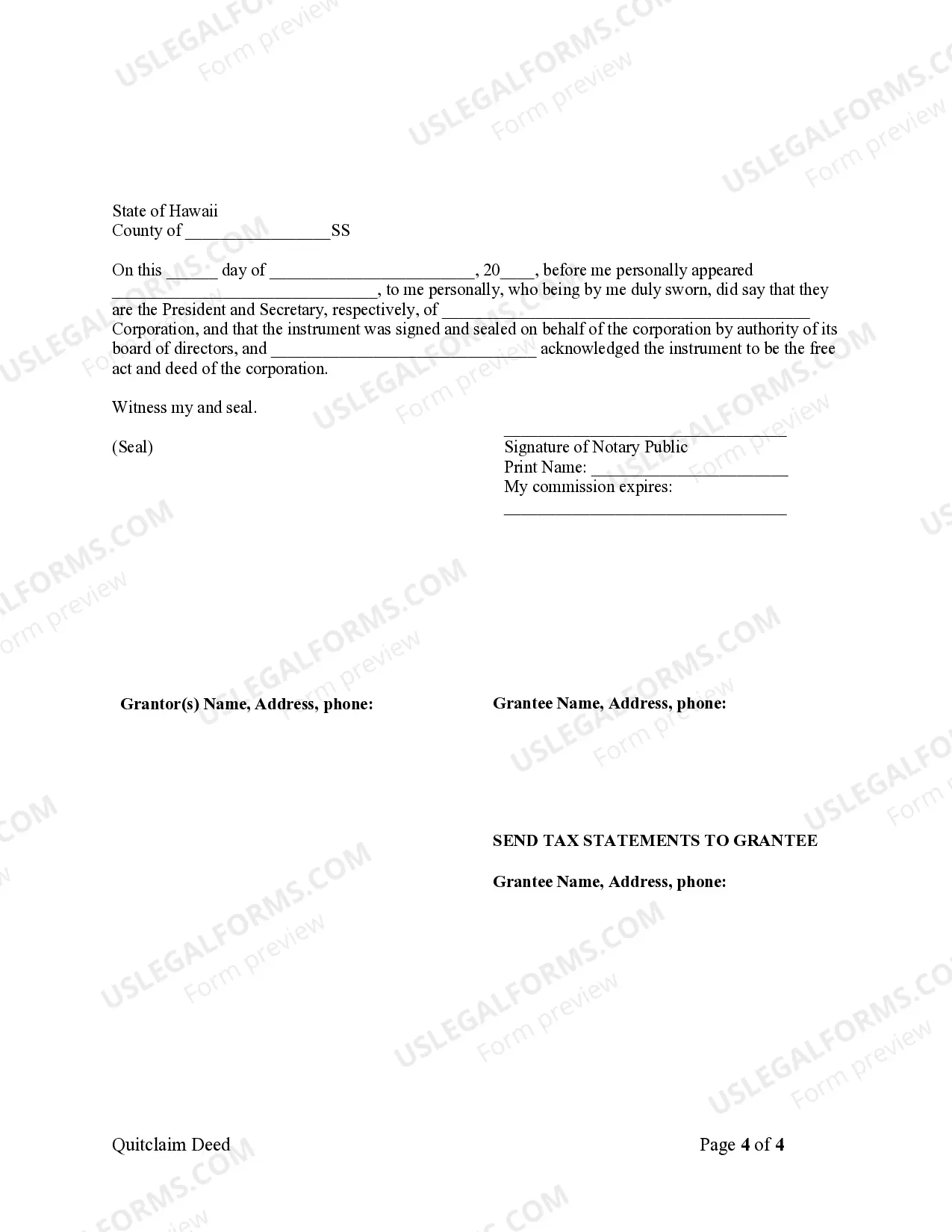
This Quitclaim Deed from Corporation to Two Individuals is a legal document used to transfer property ownership from a corporation to two individuals. The form allows the grantor (the corporation) to convey its interests in real estate to the grantees (the two individuals) without guaranteeing the title. Unlike other types of deeds, a quitclaim deed does not warrant that the property is free of encumbrances, making it a simpler and quicker way to transfer property rights.
Key parts of this document
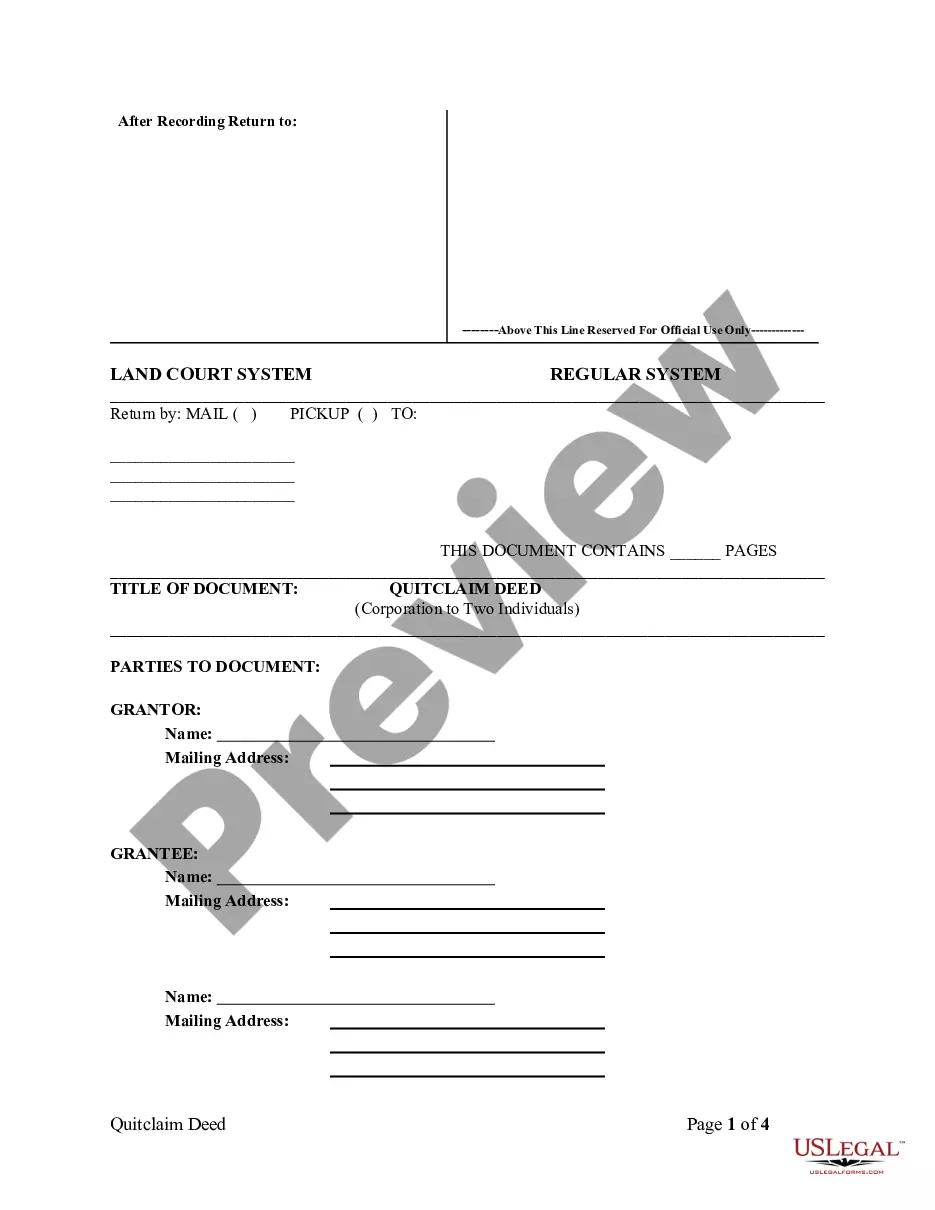
- Identification of the grantor (the corporation) and grantees (the two individuals).
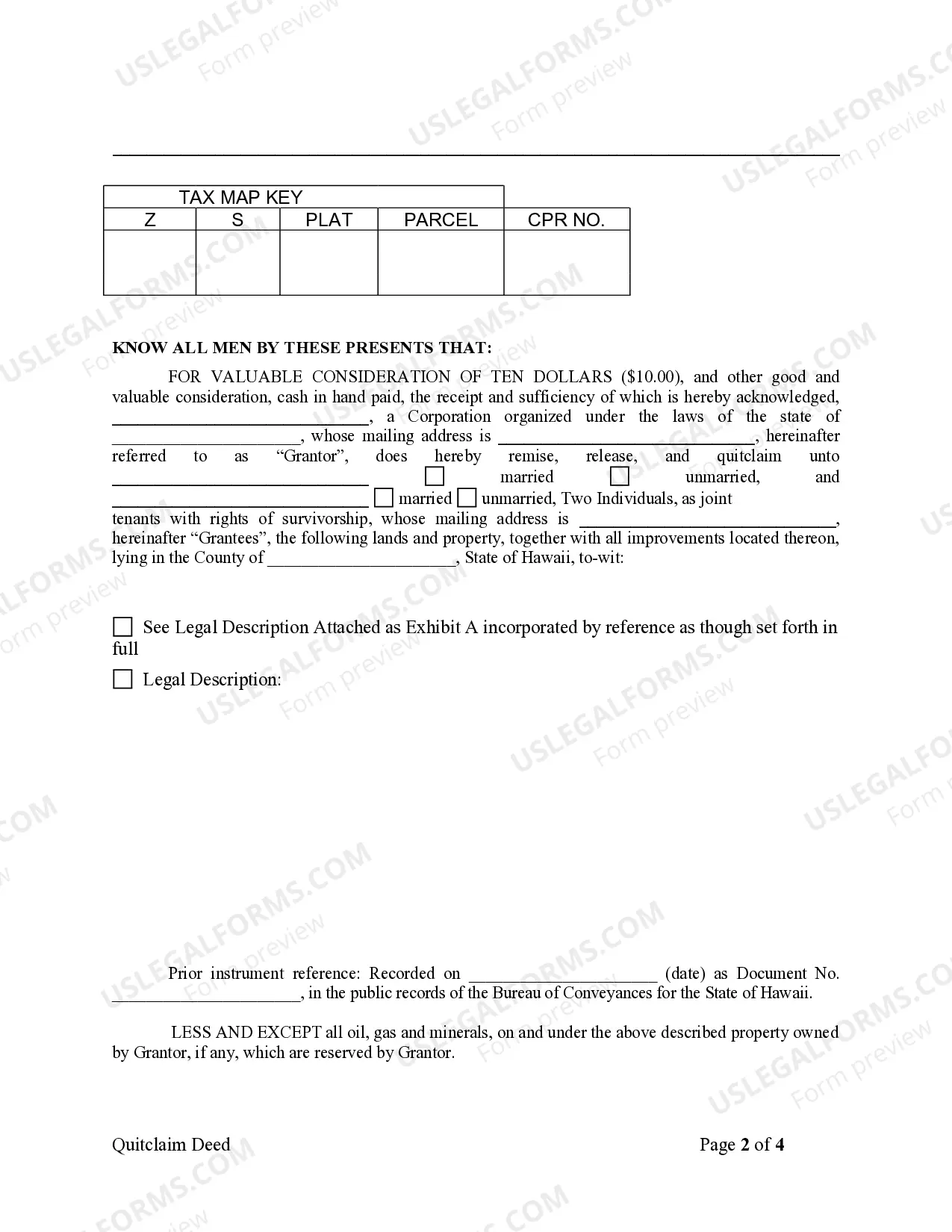
- Description of the property being transferred, including its location.
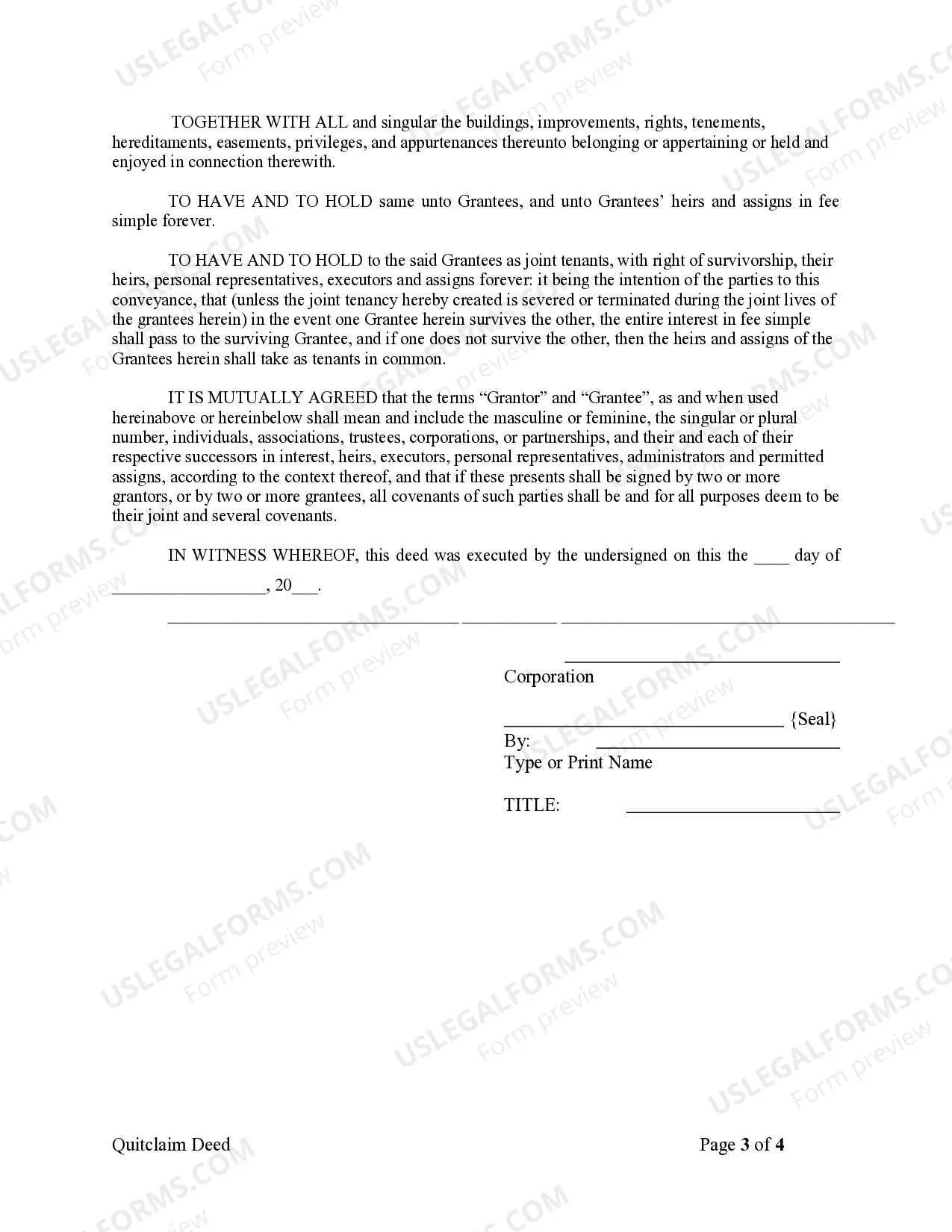
- Language outlining the rights of survivorship for the grantees.
- Clauses regarding the reservation of rights, such as minerals and easements.
- Execution date and signatures of the authorized representatives.




When this form is needed
This form is typically used when a corporation wishes to transfer ownership of real property to two individuals, such as during a business dissolution, reorganization, or as part of an estate planning strategy. It is particularly relevant when the individuals intend to hold the property as joint tenants with rights of survivorship, meaning if one grantee passes away, the other automatically inherits their share.
Who this form is for
- Corporations that are transferring property holdings.
- Two individuals who are receiving the property and wish to hold it jointly.
- Real estate professionals assisting in property transfers involving corporate entities.
Instructions for completing this form
- Identify all parties involved: fill in the name of the corporation as the grantor and the names of the two individuals as grantees.
- Provide the mailing addresses for the grantor and grantees.
- Describe the property being transferred, including the county and state.
- Include the appropriate consideration amount (e.g., ten dollars) and any reservations related to rights.
- Have the authorized representative of the corporation sign and date the deed.
Does this form need to be notarized?
This form does not typically require notarization unless specified by local law. However, having it notarized can provide an additional layer of authenticity and may be required depending on jurisdictional practices.
Get your form ready online
Our built-in tools help you complete, sign, share, and store your documents in one place.
Make edits, fill in missing information, and update formatting in US Legal Forms—just like you would in MS Word.
Download a copy, print it, send it by email, or mail it via USPS—whatever works best for your next step.
Sign and collect signatures with our SignNow integration. Send to multiple recipients, set reminders, and more. Go Premium to unlock E-Sign.
If this form requires notarization, complete it online through a secure video call—no need to meet a notary in person or wait for an appointment.
We protect your documents and personal data by following strict security and privacy standards.

Make edits, fill in missing information, and update formatting in US Legal Forms—just like you would in MS Word.

Download a copy, print it, send it by email, or mail it via USPS—whatever works best for your next step.

Sign and collect signatures with our SignNow integration. Send to multiple recipients, set reminders, and more. Go Premium to unlock E-Sign.

If this form requires notarization, complete it online through a secure video call—no need to meet a notary in person or wait for an appointment.

We protect your documents and personal data by following strict security and privacy standards.
Typical mistakes to avoid
- Failing to include complete and accurate information for the grantor and grantees.
- Not properly describing the property, which can lead to confusion over ownership.
- Omitting necessary signatures or dates, rendering the deed invalid.
Why use this form online
- Convenient access to a legal form that can be downloaded directly after purchase.
- Editable templates that allow customization to fit specific needs.
- Affordability and reliability of having forms drafted by licensed attorneys.
Looking for another form?


Form popularity
FAQ
A Hawaii Quitclaim Deed from Corporation to Two Individuals allows the corporation to transfer its interest in the property to two individuals without making any warranties. The process is generally straightforward; the corporation fills out the deed, which must then be signed and notarized. Afterward, the deed is filed with the county clerk to ensure public record. Understanding this process can help you make informed decisions when managing property transfers.
To add someone to a deed in Hawaii, you will need to execute a new quitclaim deed that names the new owner alongside the existing owner. Complete the deed, sign it in the presence of a notary, and file it with the county recorder's office. Using a Hawaii Quitclaim Deed from Corporation to Two Individuals is an effective method to ensure the addition is legally recognized and properly documented.
Adding someone to a deed can create complications, such as shared liability for any mortgage or taxes tied to the property. Furthermore, both parties must agree on decisions that affect the property, which can lead to conflicts. Therefore, when you consider a Hawaii Quitclaim Deed from Corporation to Two Individuals, weigh the benefits against these potential challenges.
Similar to other deeds, a quitclaim deed can include multiple names without a set limit. However, notify all parties involved about their rights and obligations to avoid future misunderstandings. This is especially important when executing a Hawaii Quitclaim Deed from Corporation to Two Individuals, as it involves shared ownership.
There is generally no limit to the number of individuals who can be included on a quitclaim deed in Hawaii. However, it's crucial to ensure that all parties agree on ownership terms and responsibilities. When using a Hawaii Quitclaim Deed from Corporation to Two Individuals, defining each individual's share can help streamline future decisions.
Usually, both parties do not need to be present at the signing of a quitclaim deed in Hawaii. However, it is advisable for both parties to review the deed and confirm their agreement. This helps ensure clarity and consensus, especially when executing a Hawaii Quitclaim Deed from Corporation to Two Individuals.
One disadvantage of a quitclaim deed is that it does not provide any warranties against potential claims on the property, which can be risky. If the corporation holds any liens or other issues, the new owners may face unexpected liabilities. It's essential to conduct thorough research before finalizing a Hawaii Quitclaim Deed from Corporation to Two Individuals to minimize any potential risks.
Typically, a quitclaim deed can have multiple names listed as grantees, with no strict limit on the number of individuals. However, it’s essential to ensure that all parties understand the implications of co-ownership. Using a Hawaii Quitclaim Deed from Corporation to Two Individuals allows for clarity among shared ownership, which can help avoid disputes in the future.
A quitclaim deed in Hawaii allows a corporation to transfer its ownership interest in a property to two individuals. This process involves completing the deed, signing it in front of a notary, and then recording it with the local county recorder's office. By using a Hawaii Quitclaim Deed from Corporation to Two Individuals, the transaction becomes straightforward, ensuring that the new owners receive the title without any guarantees about its quality.
Several factors can void a Hawaii Quitclaim Deed from Corporation to Two Individuals. If the deed was signed under duress, fraud, or misrepresentation, it may be considered invalid. Also, failure to meet legal requirements, such as improper notarization or lack of signatures, can void the deed. Therefore, it is essential to follow all necessary steps to avoid challenges in the future.