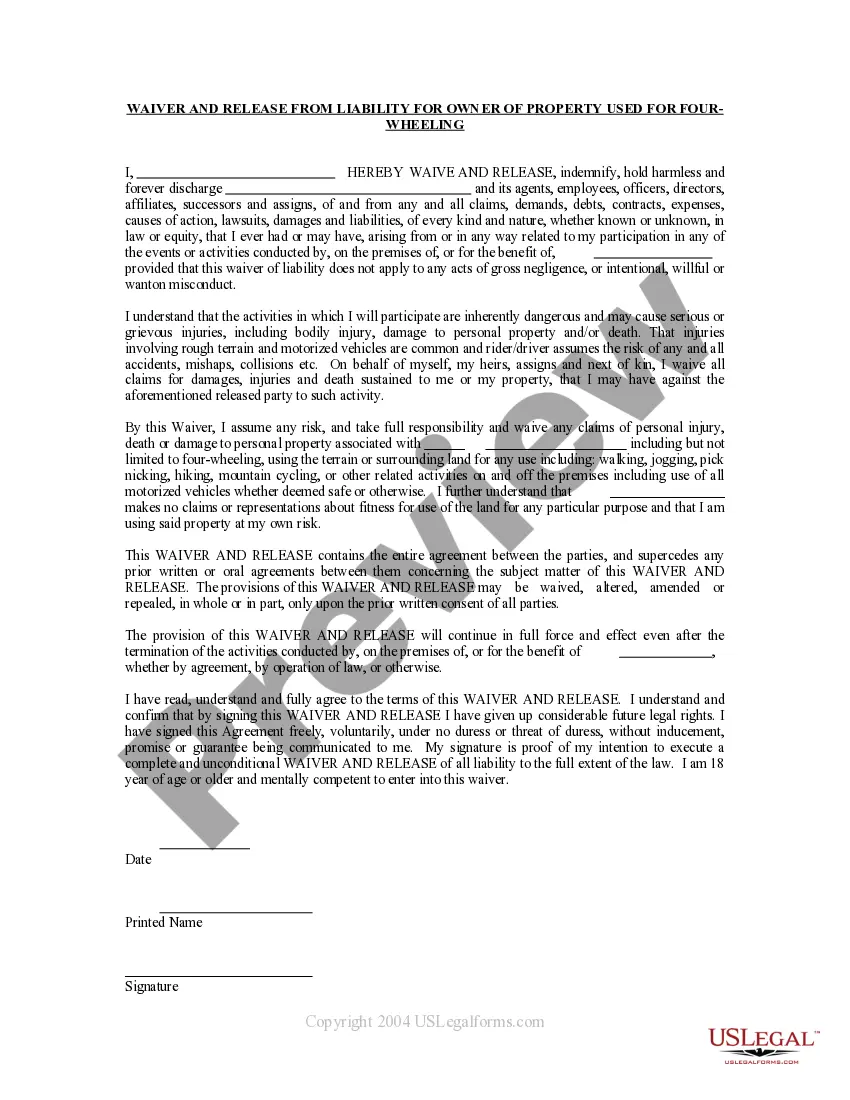
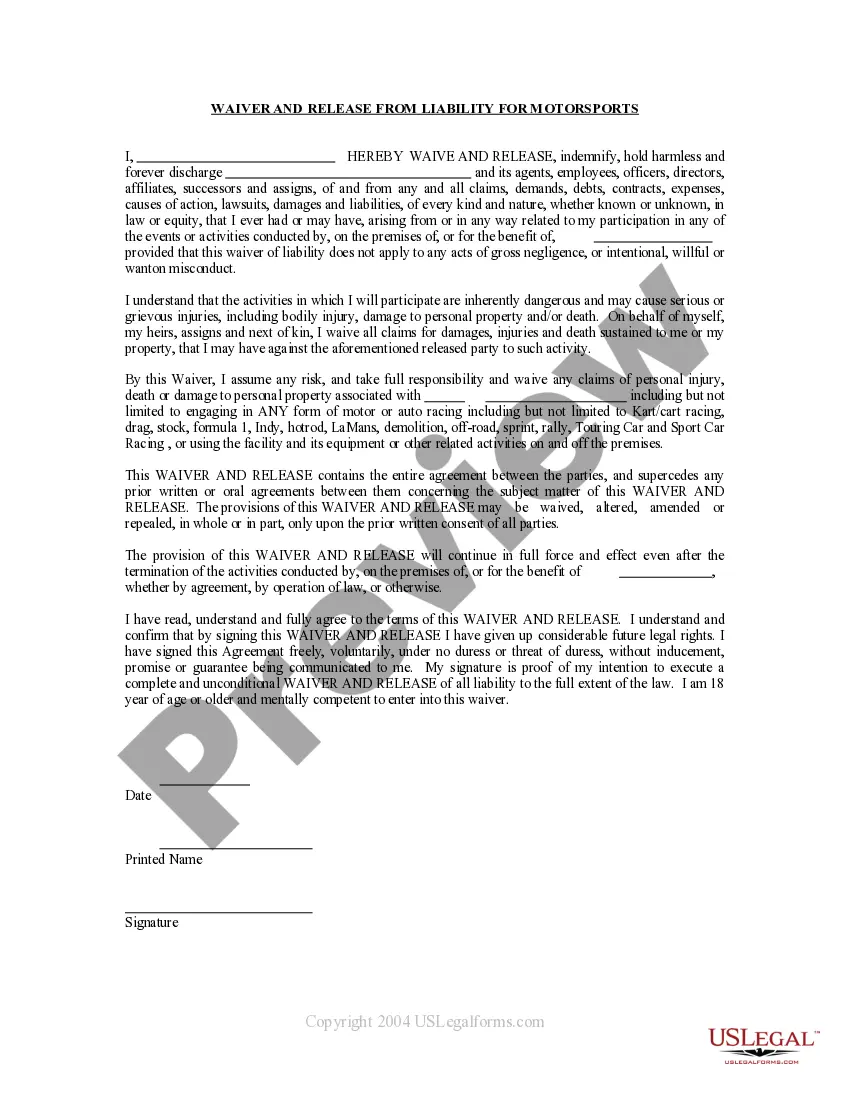
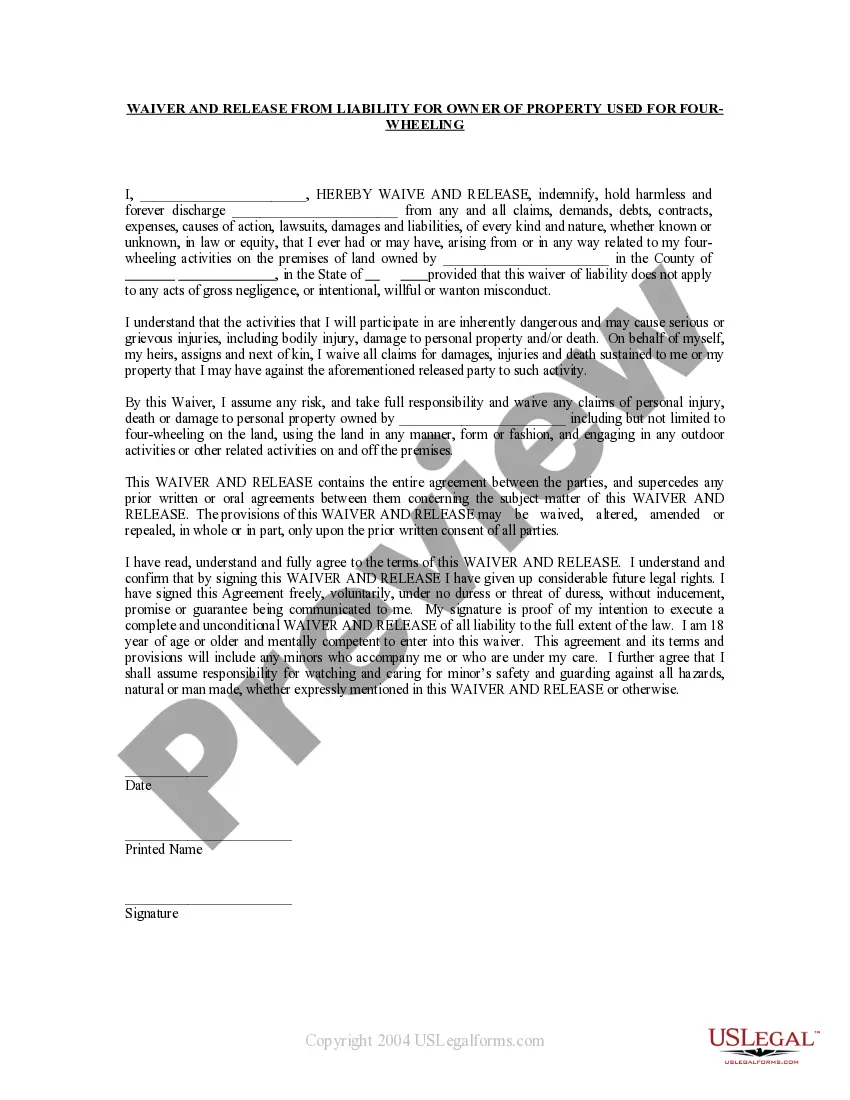
This form allows an adult to release a four-wheeling facility from liability for injuries which may be incurred while on the premises, taking part in activities, etc.
Wyoming Waiver and Release From Liability For Adult for Four-Wheeling
Category:
State:
Multi-State
Control #:
US-WAV-34A
Format:
Word;
Rich Text
Instant download
Description

How to fill out Waiver And Release From Liability For Adult For Four-Wheeling?
Finding the correct legal document template can be a challenge. Clearly, there is a multitude of templates accessible online, but how will you acquire the legal form you need? Utilize the US Legal Forms website. The service offers numerous templates, including the Wyoming Waiver and Release From Liability For Adult for Four-Wheeling, which you can use for business and personal purposes. All the forms are reviewed by experts and comply with federal and state regulations.
If you are already registered, Log In to your account and click the Acquire button to obtain the Wyoming Waiver and Release From Liability For Adult for Four-Wheeling. Use your account to browse through the legal forms you have previously purchased. Navigate to the My documents section of your account and download another copy of the document you need.
If you are a new user of US Legal Forms, here are simple steps for you to follow: First, ensure you have selected the correct form for your specific city/county. You can preview the form using the Review option and read the form description to confirm it is suitable for you. If the form does not meet your requirements, use the Search field to find the appropriate form. Once you are confident that the form is adequate, click the Purchase now button to obtain the form. Choose the pricing plan you prefer and enter the necessary information. Create your account and pay for your order using your PayPal account or credit card. Select the file format and download the legal document template to your device. Complete, modify, print, and sign the received Wyoming Waiver and Release From Liability For Adult for Four-Wheeling.
The variety of templates offered makes US Legal Forms a valuable resource for anyone seeking legal documentation.
- US Legal Forms is the largest collection of legal templates where you can find numerous document forms.
- Utilize the service to download professionally crafted documents that adhere to state requirements.
- The templates are designed to assist both business and personal needs.
- All forms are vetted by qualified professionals.
- You can view your previous purchases easily through your account.
- Ensure you are selecting the right form for your local area.
Form popularity
FAQ
In Wyoming, ATV registration is mandatory for all off-highway vehicles. This requirement applies to four-wheelers used in recreational activities, including four-wheeling. Proper registration ensures that you can legally enjoy your adventures while also complying with state regulations. Make sure to keep your registration current to avoid any legal issues while using your Wyoming Waiver and Release From Liability For Adult for Four-Wheeling.
Yes, you can write your own liability waiver, but it is important to follow certain guidelines. Ensure that you include all necessary elements, such as the risks involved and a clear release of liability. However, using a professionally crafted document, like the Wyoming Waiver and Release From Liability For Adult for Four-Wheeling templates offered by US Legal Forms, can provide added peace of mind and legal protection.
Writing a release of liability waiver involves several steps. Start by outlining the activity's risks and ensuring that the participant acknowledges them. Next, include a clear statement that the participant releases the organization from liability. Finally, consider using a template, such as those available on US Legal Forms, to ensure your Wyoming Waiver and Release From Liability For Adult for Four-Wheeling meets legal standards.
To create a valid Wyoming Waiver and Release From Liability For Adult for Four-Wheeling, three key requirements must be met. First, the waiver should clearly state the risks involved in four-wheeling activities. Second, it must be signed voluntarily by the participant, indicating their understanding of these risks. Third, the language should be clear and unambiguous to avoid potential legal disputes.
Generally, a liability waiver document is a legally binding agreement that relinquishes the right of one party to pursue legal remedy for injuries accrued on the property, regardless of fault involved.
The main difference between releases and waivers is the transferring of ownership. When rights are released, they are transferred to another party. When rights are waived, they are gone altogether.
Examples of waivers include the waiving of parental rights, waiving liability, tangible goods waivers, and waivers for grounds of inadmissibility. Waivers are common when finalizing lawsuits, as one party does not want the other pursuing them after a settlement is transferred.
Liability waivers are enforceable in California solely to the extent they shift to the customer the risk of ordinary negligence. Under California law, a liability waiver cannot excuse an injury caused by a defendant's gross negligence, recklessness or intentionally wrongful act.
A waiver is a document that obtains written confirmation from an individual that they are relinquishing a right or privilege. Businesses often use a waiver toward customers to minimize the risk of legal implications if a customer or client gets injured, however, waivers can be used in a variety of situations.
Ambiguous language or missing information can invalidate a waiver. The waiver contains errors that make it invalid. The language of the waiver must obey relevant state laws. An improperly worded or drafted waiver, as well as one that violates the law or public policy, may not hold up in court.