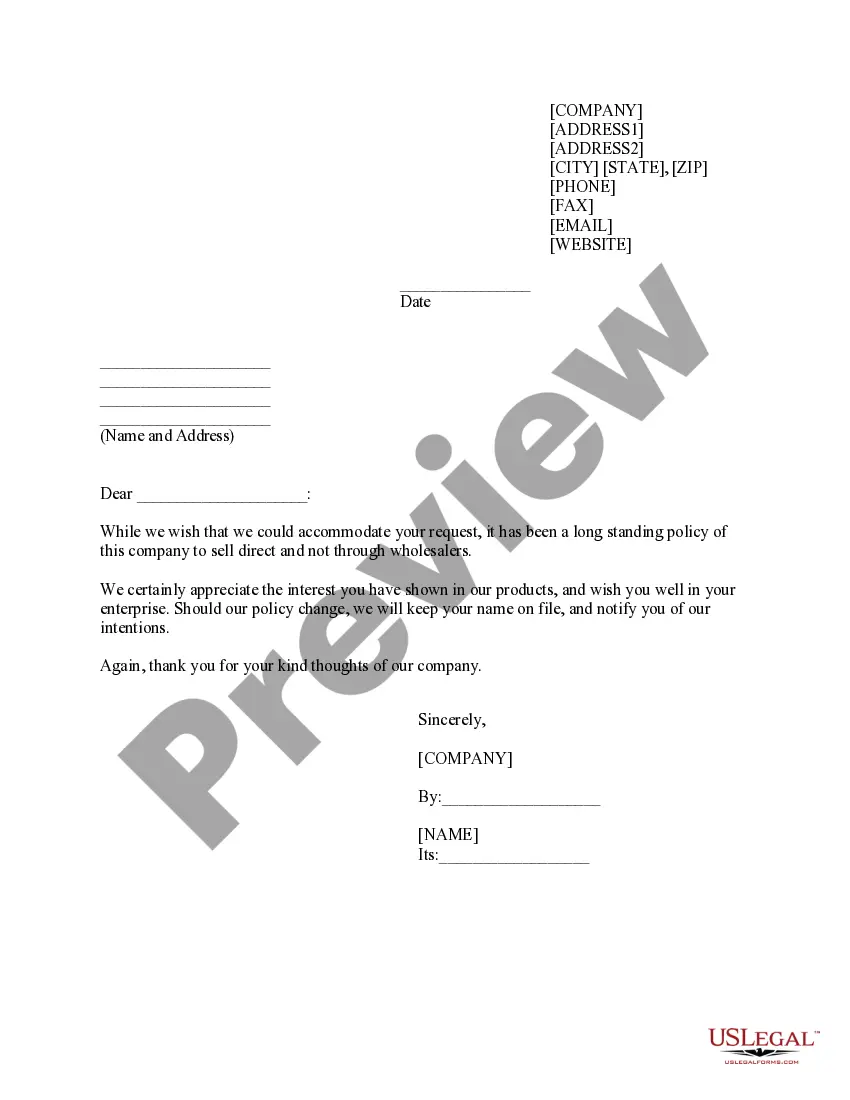
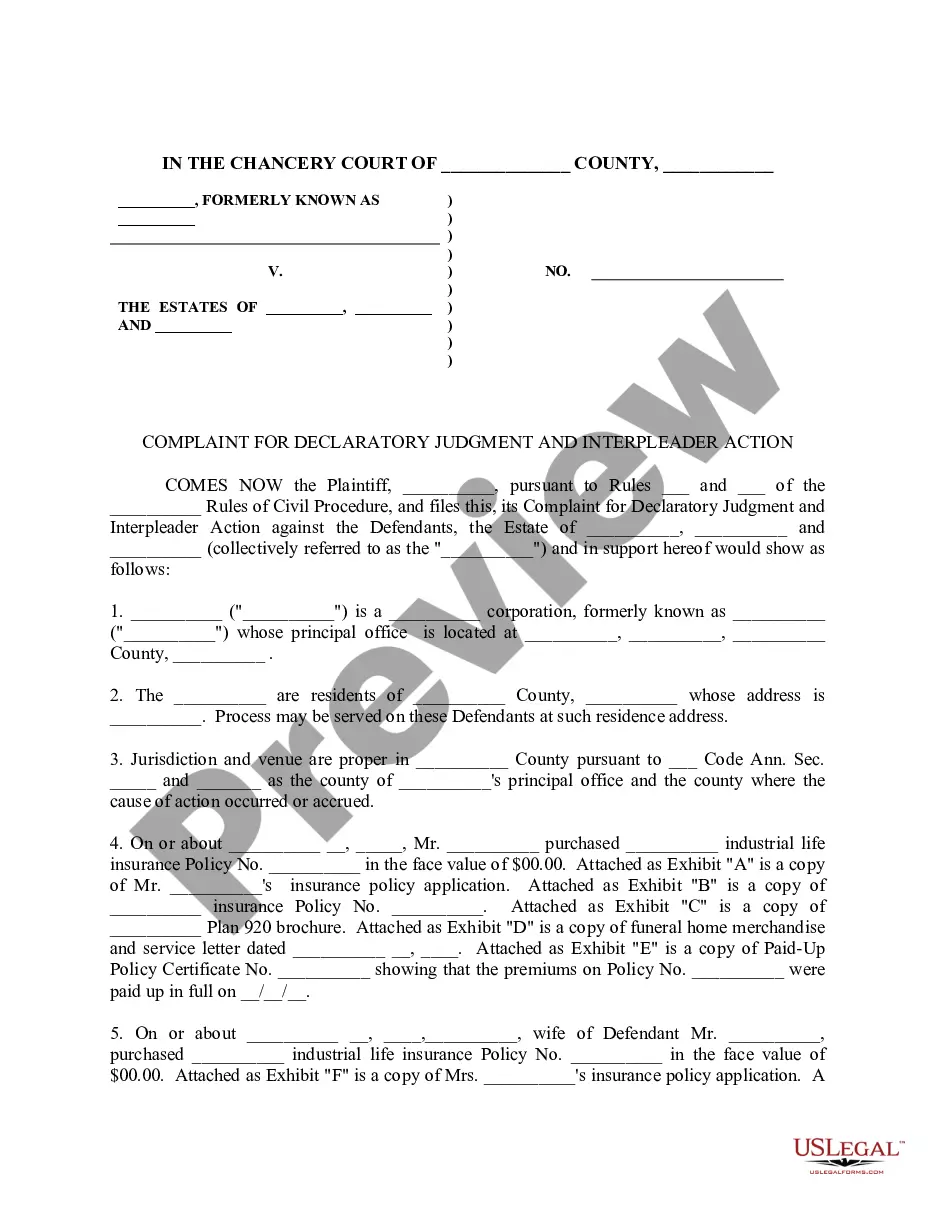
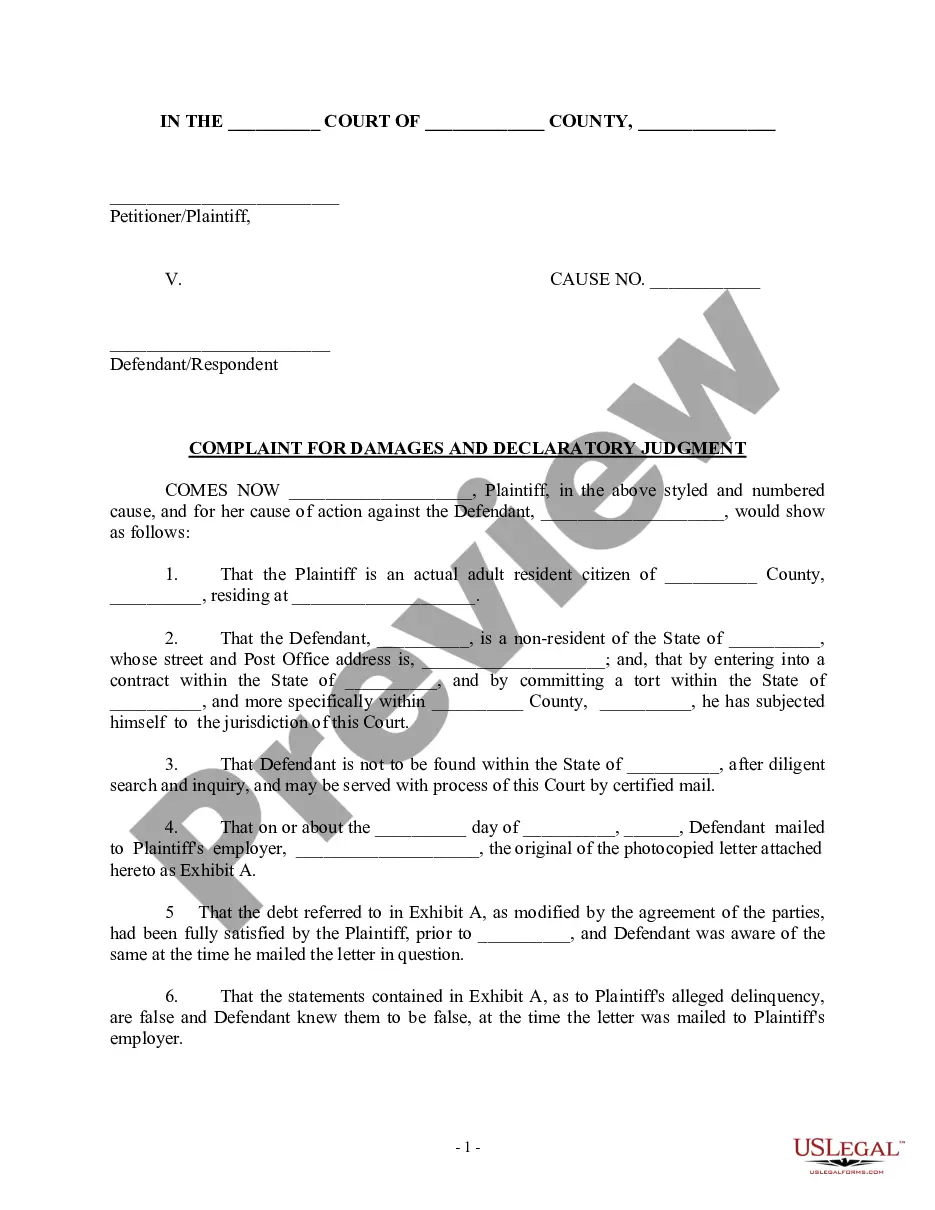
This form is a Complaint For Declaratory Judgment To Determine ERISA Coverage. Adapt to your specific circumstances. Don't reinvent the wheel, save time and money.
Wyoming Complaint For Declaratory Judgment To Determine ERISA Coverage
Instant download
Description
Free preview

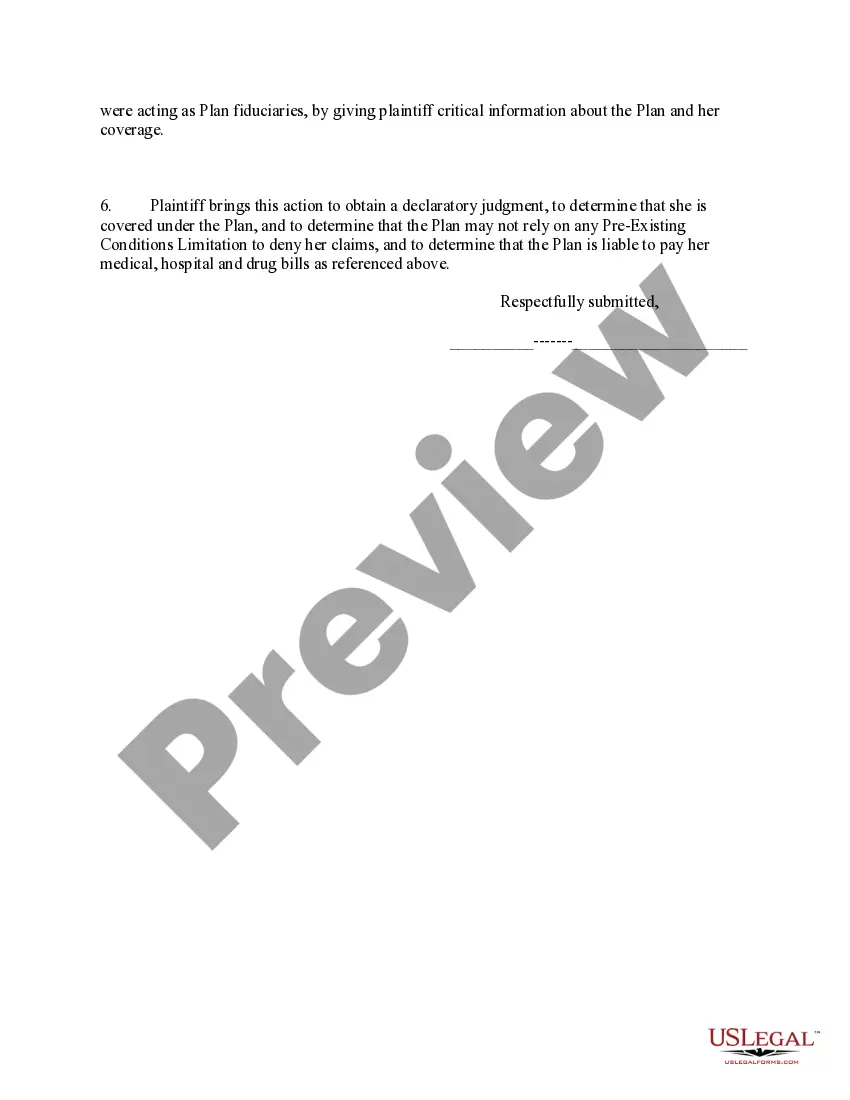
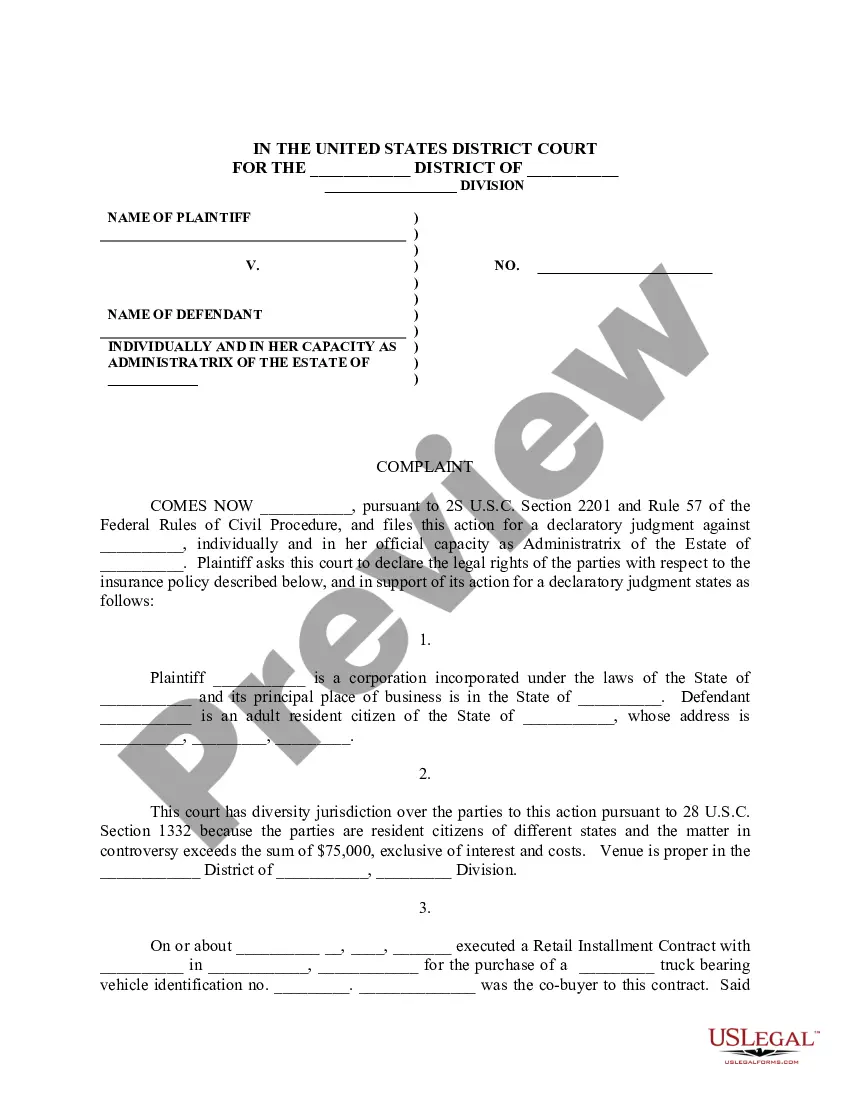
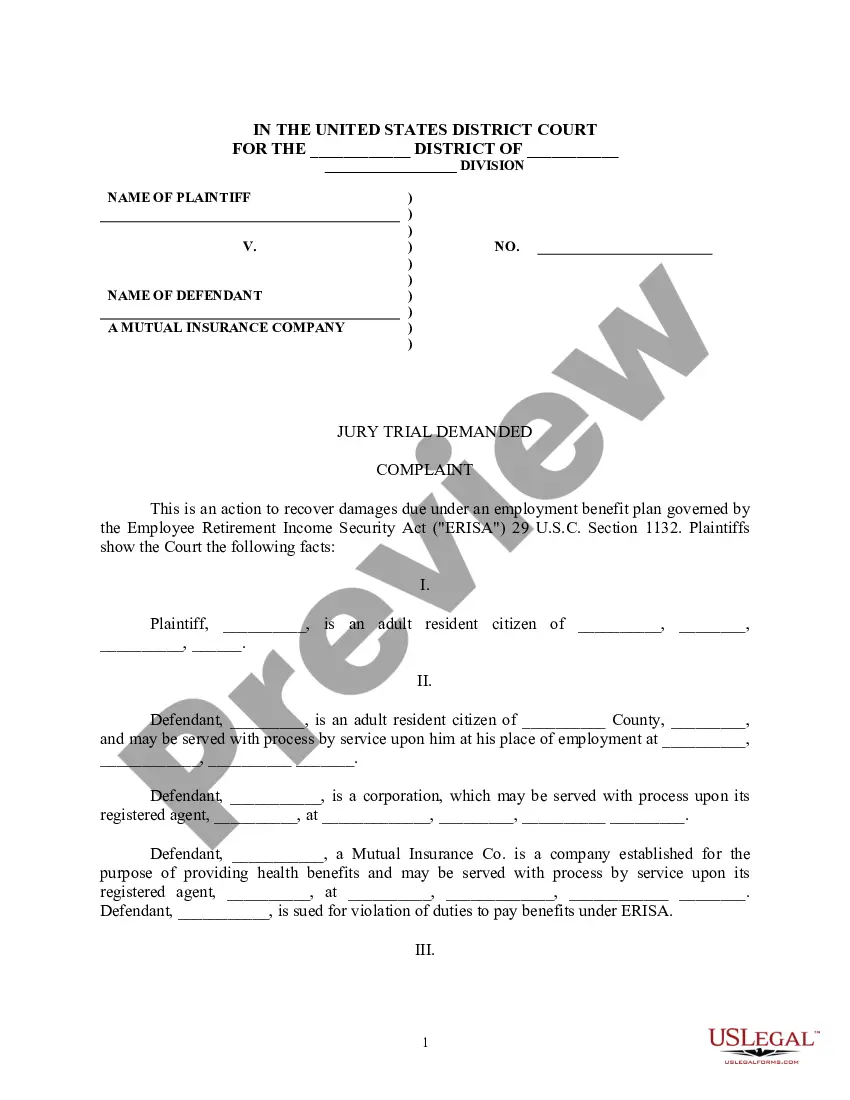
Get your form ready online
Our built-in tools help you complete, sign, share, and store your documents in one place.
Built-in online Word editor
Make edits, fill in missing information, and update formatting in US Legal Forms—just like you would in MS Word.
Export easily
Download a copy, print it, send it by email, or mail it via USPS—whatever works best for your next step.
E-sign your document
Sign and collect signatures with our SignNow integration. Send to multiple recipients, set reminders, and more. Go Premium to unlock E-Sign.
Notarize online 24/7
If this form requires notarization, complete it online through a secure video call—no need to meet a notary in person or wait for an appointment.
Store your document securely
We protect your documents and personal data by following strict security and privacy standards.

Make edits, fill in missing information, and update formatting in US Legal Forms—just like you would in MS Word.

Download a copy, print it, send it by email, or mail it via USPS—whatever works best for your next step.

Sign and collect signatures with our SignNow integration. Send to multiple recipients, set reminders, and more. Go Premium to unlock E-Sign.

If this form requires notarization, complete it online through a secure video call—no need to meet a notary in person or wait for an appointment.

We protect your documents and personal data by following strict security and privacy standards.
Looking for another form?







How to fill out Complaint For Declaratory Judgment To Determine ERISA Coverage?
If you intend to finalize, obtain, or print legal document templates, utilize US Legal Forms, the largest collection of legal forms available online.
Leverage the site’s straightforward and user-friendly search functionality to find the documents you need. Various templates for business and personal purposes are categorized by classes and states, or keywords.
Use US Legal Forms to locate the Wyoming Complaint For Declaratory Judgment To Determine ERISA Coverage in just a few clicks.
Every legal document template you purchase is yours indefinitely. You have access to every form you saved in your account. Visit the My documents section and select a form to print or download again.
Compete and obtain, and print the Wyoming Complaint For Declaratory Judgment To Determine ERISA Coverage through US Legal Forms. There are numerous professional and state-specific forms available for your business or personal requirements.
- When you are already a US Legal Forms customer, Log In to your account and click on the Download button to find the Wyoming Complaint For Declaratory Judgment To Determine ERISA Coverage.
- You can also access forms you previously saved from the My documents tab of your account.
- If you are using US Legal Forms for the first time, follow the instructions below.
- Step 1. Confirm you have selected the form for the correct city/state.
- Step 2. Utilize the Review option to inspect the form’s content. Do not forget to read the description.
- Step 3. If you are not satisfied with the form, use the Search field at the top of the screen to find other types in the legal document format.
- Step 4. After you have located the form you need, click the Get now button. Choose the payment plan you prefer and enter your details to register for an account.
- Step 5. Complete the transaction. You can use your Visa or Mastercard or PayPal account to finalize the purchase.
- Step 6. Select the format of the legal document and download it to your device.
- Step 7. Fill out, modify, and print or sign the Wyoming Complaint For Declaratory Judgment To Determine ERISA Coverage.
Form popularity
FAQ
An insurance company may request a declaratory judgment when there is uncertainty about its obligations under an ERISA policy. This often occurs when a claim is made that the insurer believes falls outside the coverage terms. By filing a Wyoming Complaint For Declaratory Judgment To Determine ERISA Coverage, the insurer seeks a court's interpretation to clarify its responsibilities. This proactive step helps prevent future disputes and ensures compliance with applicable laws.
Under ERISA, punitive damages are generally not permitted in most cases, including those initiated by a Wyoming Complaint For Declaratory Judgment To Determine ERISA Coverage. Instead, ERISA primarily allows for the recovery of actual damages and attorney's fees. Understanding this limitation helps you manage your expectations and strategize your approach to claims effectively. For more information, consider consulting resources available on platforms like uslegalforms.
To initiate a Wyoming Complaint For Declaratory Judgment To Determine ERISA Coverage, you need to meet several requirements. First, there must be an actual controversy regarding the ERISA coverage. Additionally, you must demonstrate that the declaration will resolve the uncertainty surrounding your rights or obligations. Meeting these criteria enables you to seek clarity through the court effectively.
In a Wyoming Complaint For Declaratory Judgment To Determine ERISA Coverage, the burden of proof typically rests on the party seeking the declaration. This means you must present sufficient evidence to convince the court of your position. The standard can vary, but generally, the evidence must show that your interpretation of the ERISA coverage is more likely than not correct. Understanding this burden is crucial for effectively navigating your case.
A claim of third-party bad faith may lie where the insured voluntarily stipulates to a judgment in excess of policy limits without the insurer's consent.
These are the states that currently handle financial aid on a first-come, first-served basis: Alaska. Illinois. Kentucky. North Carolina. South Carolina. Vermont. Washington.
An answer to a counterclaim is a written response by a Plaintiff to a Defendant's counterclaim. The answer to counterclaim must also state defenses to each of the Defendant's counterclaims in short, plain statements. ?
The Future of Common Law Bad Faith in Texas While the same factual circumstances can be grounds for making either type of claim, common law bad faith has limitations. For instance, you can only bring a bad faith claim against your insurance company, not a third party. The Texas Supreme Court held in State Farm v.
Bad faith refers to dishonesty or fraud in a transaction. Depending on the exact setting, bad faith may mean a dishonest belief or purpose, untrustworthy performance of duties, neglect of fair dealing standards, or a fraudulent intent.
Negligent or Bad Faith Failure to Settle If the insurer fails to exercise such reasonable or ordinary care, then it has breached its duty and is guilty of negligence. A decision not to settle must be a thoroughly honest, intelligent, and objective decision.