Wyoming Lease Subordination Agreement
What this document covers
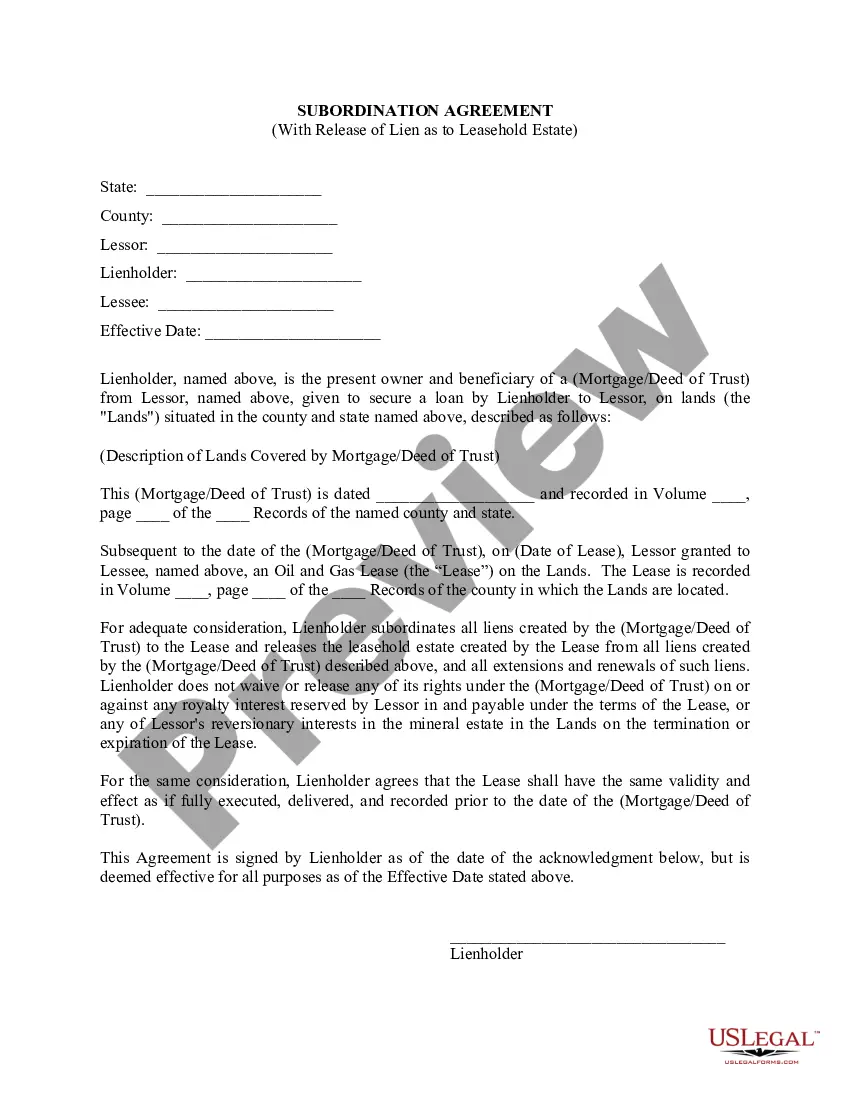
The Lease Subordination Agreement is a legal document that allows a lienholder to subordinate their existing mortgage to a mineral, oil, or gas lease. This means that the lease takes priority over the mortgage lien, giving the lessee access to the property rights stipulated in the lease. This form is essential when a property owner seeks to obtain a new loan, ensuring that the new debt has priority over previous obligations.
Key parts of this document
- Identification of the parties involved: Lessor, Lienholder, and Lessee.
- Details of the property included in the mortgage and lease agreements.
- Effective date of the subordination agreement.
- Specific terms of lienholder's release from all liens related to the leasehold estate.
- Conditions regarding the rights reserved by the lienholder under the original mortgage.
When to use this form
This form is necessary when a property owner with an existing mortgage wishes to enter a lease for mineral, oil, or gas extraction. It is often used in scenarios where a property owner seeks additional financing or when the lease needs to be prioritized to allow for the extraction of natural resources. This subordination can enhance the property's marketability and provide assurance to potential lessees.
Who needs this form
- Property owners seeking to lease mineral or gas rights while holding an existing mortgage.
- Lienholders looking to officially record their agreement to subordinate their interest to a new lease.
- Lessee parties involved in the oil, gas, or mineral lease agreements.
Completing this form step by step
- Identify and enter the names of the lessor, lienholder, and lessee.
- Specify the county and state where the property is located.
- Provide a complete description of the lands covered by the mortgage.
- Fill in the effective date and other relevant dates for the lease.
- Ensure all parties sign and date the agreement to finalize it.
Notarization guidance
This form does not typically require notarization unless specified by local law. Always verify local requirements to ensure this form complies with state regulations.
Get your form ready online
Our built-in tools help you complete, sign, share, and store your documents in one place.
Make edits, fill in missing information, and update formatting in US Legal Forms—just like you would in MS Word.
Download a copy, print it, send it by email, or mail it via USPS—whatever works best for your next step.
Sign and collect signatures with our SignNow integration. Send to multiple recipients, set reminders, and more. Go Premium to unlock E-Sign.
If this form requires notarization, complete it online through a secure video call—no need to meet a notary in person or wait for an appointment.
We protect your documents and personal data by following strict security and privacy standards.

Make edits, fill in missing information, and update formatting in US Legal Forms—just like you would in MS Word.

Download a copy, print it, send it by email, or mail it via USPS—whatever works best for your next step.

Sign and collect signatures with our SignNow integration. Send to multiple recipients, set reminders, and more. Go Premium to unlock E-Sign.

If this form requires notarization, complete it online through a secure video call—no need to meet a notary in person or wait for an appointment.

We protect your documents and personal data by following strict security and privacy standards.
Avoid these common issues
- Failing to correctly identify all parties involved.
- Not providing an accurate description of the property.
- Omitting relevant dates or signatures, which may invalidate the agreement.
- Incorrectly understanding the implications of subordination in a lease agreement.
Benefits of using this form online
- Convenience of immediate access to legal documents.
- Editable templates tailored to your specific needs.
- Secure storage and organization of your legal documents.
Summary of main points
- A Lease Subordination Agreement is essential for prioritizing a lease over existing mortgages.
- Clear identification of all parties and property details is crucial for enforceability.
- Using this form can prevent legal disputes involving conflicting claims on leased property.
Looking for another form?

Form popularity
FAQ
A ground lease is an agreement in which a tenant is permitted to develop a piece of property during the lease period, after which the land and all improvements are turned over to the property owner.
The subordination, non-disturbance and attornment agreement (commonly abbreviated as an SNDA agreement) is the document that the landlord, tenant and lender often employ to resolve how their rights do and will intersect.
Subordination clauses in mortgages refer to the portion of your agreement with the mortgage company that says their lien takes precedence over any other liens you may have on your property.However, it's also possible to have other liens. You might have some placed by contractors until work is paid off.
A rental agreement will be void and unenforceable if it allows the landlord to terminate the tenancy of a tenant for a crime committed in relation to the rental property if it does not also include the new domestic abuse protection language set forth in sec. 704.
Despite its technical-sounding name, the subordination agreement has one simple purpose. It assigns your new mortgage to first lien position, making it possible to refinance with a home equity loan or line of credit. Signing your agreement is a positive step forward in your refinancing journey.
Subordination is the tenant's agreement that its interest under the lease will be subordinate to that of the lender.Attornment is the tenant's agreement to become the tenant of someone other than the original landlord and who has now taken title to the property.
In the case of commercial property changing hands, an attornment clause in a subordination, non-disturbance, and attornment (SNDA) agreement requires the tenant to acknowledge a new owner as their landlord and to continue paying rent regardless of whether the property changes hands through a normal sale or a
An SNDA is an agreement among a commercial mortgage lender, its borrower (in its capacity as landlord), and the borrower's tenant, establishing the parties' legal rights should the landlord (borrower) default on the loan and the lender forecloses and becomes landlord to the tenant.
A Subordination and Non-Disturbance Agreement (SNDA) commonly called a non-disturb is an agreement that your landlord asks its lender to provide. The agreement basically says that if the building goes bankrupt and the lender takes control of the building from the landlord, the lender will honor your lease.